
DVD-quality lessons (including tabs/sheet music) available for immediate viewing on any device.
Take your playing to the next level with the help of a local or online banjo teacher.
Weekly newsletter includes free lessons, favorite member content, banjo news and more.
Premier Sponsors


|
Please note this is an archived topic, so it is locked and unable to be replied to. You may, however, start a new topic and refer to this topic with a link: http://www.banjohangout.org/archive/221884
rudy - Posted - 12/01/2011: 05:15:37
Good December to all!
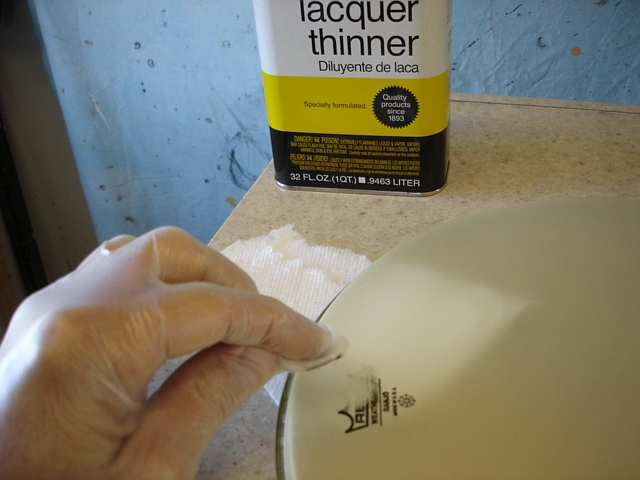
I'm beginning the process of photographically documenting a new Boucher style build and thought this early picture of materials preparation might be of some interest to new builders. That big 'ol logo on the Renaissance just isn't going to cut it if I want to keep a clean look on a banjo that's supposed to resemble an instrument coming out of the mid-1800's, so it's got to go.
Logo removal has been covered many times in the past and there are a few different ways of doing it, but a single picture says it all for me.
dickinnorwich - Posted - 12/01/2011: 05:31:20
...And a happy December to you, Randy.
I just wanted to add that lacquer thinner will also remove the frosting from a head if one chooses to do that. This is what I've been doing to frosted 5 Star heads to modify them for archtop use. Glad to see you're wearing rubber gloves!!
On a different note, yesterday, you mentioned the use of salt with glue to reduce the slippage while clamping. I had also heard of using baking soda. I know this isn't the right thread for this discussion but I'm wondering if these additives alter the bonding characteristics of the respective adhesives?
Fathand - Posted - 12/01/2011: 05:42:12
I usually hide my logo under the tailpiece. Not perfect but it helps.
banjodr - Posted - 12/01/2011: 05:54:09
air brush works well too. you can match the color if the head isn't real white or older
Hawgfiddle65 - Posted - 12/01/2011: 06:31:47
Hi Rudy
Thanks for directing me to this .The logo on my 10 inch renaissance stands out a bit like a sore thumb . What's the main ingredient of the thinner you use . May have something suitable in my workshop.
Jim (Hawgfiddle65)
rudy - Posted - 12/01/2011: 06:40:18
quote:
Originally posted by dickinnorwich
...And a happy December to you, Randy.
I just wanted to add that lacquer thinner will also remove the frosting from a head if one chooses to do that. This is what I've been doing to frosted 5 Star heads to modify them for archtop use. Glad to see you're wearing rubber gloves!!
On a different note, yesterday, you mentioned the use of salt with glue to reduce the slippage while clamping. I had also heard of using baking soda. I know this isn't the right thread for this discussion but I'm wondering if these additives alter the bonding characteristics of the respective adhesives?
As always, Safety First!
A few grains of salt are all that is required to solve the slippage issue, no problems with altering the bonding characteristics. I use salt the same way I do for food...almost none. That's the great thing about getting older, my taste buds have become extremely sensitive to the stuff. That's a good thing!
rudy - Posted - 12/01/2011: 06:50:56
quote:
Originally posted by Hawgfiddle65
Hi Rudy
Thanks for directing me to this .The logo on my 10 inch renaissance stands out a bit like a sore thumb . What's the main ingredient of the thinner you use . May have something suitable in my workshop.
Jim (Hawgfiddle65)
Jim, "Lacquer Thinner" (as noted on the can) is the only thing I know this by, and is the common generic name for it. The ingredients listed are Methyl alcohol, toluene, acetone, ethyl acetate, ethylene glycol, and other petroleum distillates. Some formulations may vary the amounts, but the main ingredients are most likely very similar.
Products that work well have been cited in the past by others, Acetone being the first that comes to mind. I always have the lacquer thinner on hand as I use very little of it, so a can lasts me a long time.
dickinnorwich - Posted - 12/01/2011: 06:53:54
quote:
Originally posted by rudy
quote:
Originally posted by dickinnorwich
...And a happy December to you, Randy.
I just wanted to add that lacquer thinner will also remove the frosting from a head if one chooses to do that. This is what I've been doing to frosted 5 Star heads to modify them for archtop use. Glad to see you're wearing rubber gloves!!
On a different note, yesterday, you mentioned the use of salt with glue to reduce the slippage while clamping. I had also heard of using baking soda. I know this isn't the right thread for this discussion but I'm wondering if these additives alter the bonding characteristics of the respective adhesives?
As always, Safety First!
A few grains of salt are all that is required to solve the slippage issue, no problems with altering the bonding characteristics. I use salt the same way I do for food...almost none. That's the great thing about getting older, my taste buds have become extremely sensitive to the stuff. That's a good thing!
O.K., great, since I'm on a restricted salt diet, too. I'll try it tonight when I glue the fingerboard.
I'm really hoping Andy Fults (Old Pappy) shares his recent experience with fingerboard creep and what a disaster that turned out to be.
DeanT - Posted - 12/01/2011: 07:02:46
Fingernail polish remover works as well, so if there is a common ingredient, that's what's doing it.
Shawn Hoover - Posted - 12/01/2011: 07:04:59
quote:
Originally posted by rudy
A few grains of salt are all that is required to solve the slippage issue, no problems with altering the bonding characteristics. I use salt the same way I do for food...almost none. That's the great thing about getting older, my taste buds have become extremely sensitive to the stuff. That's a good thing!
Also, try to keep the salt to the interior of the joint. Maybe this only applies if you use more than "almost none", but when I got carried away I had a few grains show up as bubbles or voids at the edge of a glue line. Fortunately the joint was destined for veneering anyway and I learned my lesson pain-free.
Shawn Hoover - Posted - 12/01/2011: 07:06:21
quote:
Originally posted by 1four5
Fingernail polish remover works as well, so if there is a common ingredient, that's what's doing it.
That stuff reeks of acetone to my nose!
rudy - Posted - 12/01/2011: 07:07:41
quote:
Originally posted by 1four5
Fingernail polish remover works as well, so if there is a common ingredient, that's what's doing it.
Nail polish remover contains acetone as the main ingredient. I've used it in the past, but I couldn't find a fragrance-free variety. All the heads I used it on resulted in producing a banjo that made me think of the nail salon that you walk by on the way out of Wal-mart. Yuck.
rudy - Posted - 12/01/2011: 07:14:12
quote:
Originally posted by shoover
quote:
Originally posted by rudy
A few grains of salt are all that is required to solve the slippage issue, no problems with altering the bonding characteristics. I use salt the same way I do for food...almost none. That's the great thing about getting older, my taste buds have become extremely sensitive to the stuff. That's a good thing!
Also, try to keep the salt to the interior of the joint. Maybe this only applies if you use more than "almost none", but when I got carried away I had a few grains show up as bubbles or voids at the edge of a glue line. Fortunately the joint was destined for veneering anyway and I learned my lesson pain-free.
Good point, Shawn. I usually assume that salient points like that should go without saying, but maybe I put too much trust in the general use of common sense. A few grains sprinkled on the glue surface (while avoiding the edge joint) is what I strive for. I've never had any problem with voids at a glue line, as if it's a few grains they are harmlessly embedded within the wood under clamping pressure.
Shawn Hoover - Posted - 12/01/2011: 07:16:38
I'm still working on the common sense thing  It seems I have to make every mistake once unless the common sense is spelled out, and sometimes even that's not enough.
rudy - Posted - 12/01/2011: 07:19:27
quote:
Originally posted by shoover
I'm still working on the common sense thing
Mistakes? I've made a few, too. Just ask my first wife.
Corwyn - Posted - 12/01/2011: 19:10:15
quote:
Originally posted by rudy
Nail polish remover contains acetone as the main ingredient. I've used it in the past, but I couldn't find a fragrance-free variety. All the heads I used it on resulted in producing a banjo that made me think of the nail salon that you walk by on the way out of Wal-mart. Yuck.
I suspect 'fragrance-free acetone' means regular acetone with another chemical to dull you sense of smell.
FYI: msds.chem.ox.ac.uk/PR/propanone.html
Edited by - Corwyn on 12/01/2011 19:11:43
blindsniper - Posted - 12/01/2011: 22:04:28
Here in South Africa fragrance-free acetone is sold by pharmacists. Perhaps the same there in the USA?
RG - Posted - 12/01/2011: 22:23:01
Have used lacquer thinner for years to remove logos from all types of plastic heads, but got a couple of new Remo Ren heads the other day from Elderly and the printing is there to stay, lacquer thinner didn't even make a smudge, so it looks like after all these years Remo got tired of folks removing the logos from their heads...have no idea what they are using for ink, or if the logo's are now somehow embedded in the plastic itself..
Edited by - RG on 12/01/2011 22:25:00
banjotom2 - Posted - 12/02/2011: 03:02:28
A super light steel wool works wonders... Did this recently to the lady friend's banjo... Fast and easy results...
You might also try loosening the head and just turn it so the logo is under the tail piece...
I've been doing that for 30+ years...
Tom
rudy - Posted - 12/02/2011: 05:46:19
quote:
Originally posted by banjotom2
A super light steel wool works wonders... Did this recently to the lady friend's banjo... Fast and easy results...
You might also try loosening the head and just turn it so the logo is under the tail piece...
I've been doing that for 30+ years...
Tom
I've done the 0000 steel wool thing in the past, but I could always see a slight patch on the spot where the steel wool changed the texture of the surface.
Some of my mountain banjo designs have no exposed tailpiece, so turning isn't always an option for me.
The head in the photo is a 12" Ren that just arrived from Elderly. I'm hoping that RG's experience isn't going to be the new normal from Remo. There are a lot of us that don't care for the logo on our heads. Nothing personal against Remo, we just don't want a logo that detracts from an otherwise clean and simple look. It would be a shame to have to switch to another type of head because of a simple ink or manufacturing change. It might be worth a e-mail to Remo voicing concern if that type of thing is important to you.
I just can't envision picking up a beautiful new Chuck Lee or other equally tasty banjo and having a logo staring back at me...
rudy - Posted - 12/02/2011: 05:52:25
quote:
Originally posted by Corwyn
quote:
Originally posted by rudy
Nail polish remover contains acetone as the main ingredient. I've used it in the past, but I couldn't find a fragrance-free variety. All the heads I used it on resulted in producing a banjo that made me think of the nail salon that you walk by on the way out of Wal-mart. Yuck.
I suspect 'fragrance-free acetone' means regular acetone with another chemical to dull you sense of smell.
FYI: msds.chem.ox.ac.uk/PR/propanone.html
From the cited MSDS: "Appearance: colourless liquid with a fragrant, sweet odour"' .
I did not notice any citing in the MSDS regarding any effects on the olfactory senses. Defatting of tissues, yes, but that sounds useful in my case!
Doesn't sound like that particular smell would be objectionable, all the bottles I have been able to find in the past listed "fragrance" specifically on the label. I like my banjos in the unscented variety.
Edited by - rudy on 12/02/2011 05:57:14
RB-1 - Posted - 12/02/2011: 06:52:53
quote:
Originally posted by RG
it looks like after all these years Remo got tired of folks removing the logos from their heads...
Their heads? I think they have no say over anything once a customer has bought it.
RG - Posted - 12/02/2011: 11:09:52
Originally posted by RB-1
"Their heads? I think they have no say over anything once a customer has bought it."
Semantics, I'll re-phrase it, you can't remove the logo off of your head...adds up to the same result...
I am in complete agreement with Rudy, I have been taking those logo's off for over 30+ years...these newer heads had computer printed parts numbers on the outside of the hoop, hadn't seen that before either...
Edited by - RG on 12/02/2011 11:11:15
rudy - Posted - 12/02/2011: 11:57:26
quote:
Originally posted by RG
Originally posted by RB-1
"Their heads? I think they have no say over anything once a customer has bought it."
Semantics, I'll re-phrase it, you can't remove the logo off of your head...adds up to the same result...
I am in complete agreement with Rudy, I have been taking those logo's off for over 30+ years...these newer heads had computer printed parts numbers on the outside of the hoop, hadn't seen that before either...
Thanks RG.
Anyone following this may be interested in this question submitted by me at Remo's customer support area:
support.remo.com/remoinc/topic...o_removal
charlied - Posted - 12/02/2011: 12:52:11
I used acetone to remove my label on a Renaissance head and a Fiberskyn. Wiping didn't work quickly. I laid a rag down on the spot and poured a small amount on the spot. The rag kept it from running. A couple of seconds contact time helps.
Don't let any solvents run over the edge of the plastic head and accumulate in the recesses of the aluminum band of the head. The solvents might not evaporate quickly enough and might corrupt the bond (glue) between the aluminum band and the plastic head.
.No smoking. No inhaling, please.
charlie
rudy - Posted - 12/02/2011: 17:26:46
quote:
Originally posted by charlied
I used acetone to remove my label on a Renaissance head and a Fiberskyn. Wiping didn't work quickly. I laid a rag down on the spot and poured a small amount on the spot. The rag kept it from running. A couple of seconds contact time helps.
Don't let any solvents run over the edge of the plastic head and accumulate in the recesses of the aluminum band of the head. The solvents might not evaporate quickly enough and might corrupt the bond (glue) between the aluminum band and the plastic head.
.No smoking. No inhaling, please.
charlie
Charlie, Acetone will work, but it's much slower IMHO. That's why I switched to lacquer thinner, which is almost instantaneous and has no ill effects as far as I can tell after using it many times.
Please note that Christian from Remo has assured me that there has been no change in the ink formulation or process of application, and also stated that "Goo Gone" has been used successfully by many in the past with no remaining residue. Pretty fast response from Remo, so I'm giving them an A+ on that.
Edited by - rudy on 12/02/2011 17:28:17
Corwyn - Posted - 12/03/2011: 08:42:33
quote:
Originally posted by rudy
quote:
Originally posted by Corwyn
I suspect 'fragrance-free acetone' means regular acetone with another chemical to dull you sense of smell.
FYI: msds.chem.ox.ac.uk/PR/propanone.html
From the cited MSDS: "Appearance: colourless liquid with a fragrant, sweet odour"' .
I did not notice any citing in the MSDS regarding any effects on the olfactory senses. Defatting of tissues, yes, but that sounds useful in my case!
Doesn't sound like that particular smell would be objectionable, all the bottles I have been able to find in the past listed "fragrance" specifically on the label. I like my banjos in the unscented variety.
Sorry if I was unclear. Acetone by itself has an odor (objectionable or not depending on personal preferrence), therefore 'fragrance-free' acetone can't be acheived by removing something, but only by adding something; which either means masking fragrances, or nose nerve deadeners.
faulknej - Posted - 12/03/2011: 17:06:58
Nail polish remover acetone comes in two varieties, scented and not. It doesn't really contain that much acetone. Industrial acetone is just acetone.
Edited by - faulknej on 12/03/2011 17:08:02
SFI - Posted - 12/04/2011: 13:37:58
The easiest way to have a head with no logo is to buy one from me. most of the heads I buy from Remo have no logos. Occasionally they get accidentally stamped, but most are logo free.
rudy - Posted - 12/04/2011: 13:52:02
quote:
Originally posted by SFI
The easiest way to have a head with no logo is to buy one from me. most of the heads I buy from Remo have no logos. Occasionally they get accidentally stamped, but most are logo free.
That's indeed good to know, Bob. In my case I needed the extra $18 to get my entire order up to the free shipping level. I've heard nothing but great things about your products and service!
RG - Posted - 12/04/2011: 18:37:09
Originally Posted by Rudy
"Please note that Christian from Remo has assured me that there has been no change in the ink formulation or process of application, and also stated that "Goo Gone" has been used successfully by many in the past with no remaining residue. Pretty fast response from Remo, so I'm giving them an A+ on that."
Good to hear, the 2 heads I got from Elderly have resisted EVERY effort to remove the logos with lacquer thinner...really don't know why that is now...maybe I'll try the "goo gone", but lacquer thinner should do the trick...weird...
Chuck Lee - Posted - 12/11/2011: 07:33:18
I use Acetone to remove the logos from the Amber/Renaissance type heads.
TX2AK - Posted - 12/29/2011: 23:23:12
Worse than when I started. I was impatient and used my wife's nail polish remover, which had a bluish color. I'm not done rubbing the smudge away, but now have a faint blue/green color on the head. Any suggestions - other than starting over with a new head.
rudy - Posted - 12/30/2011: 05:52:56
If you haven't done so already, you might try dabbing a bit with a lacquer thinner soaked pad. If you scrubbed on the logo it may have slightly abraded the surface and forced the logo ink into the top surface. Your tinted polish remover would be similar to adding dark stain to a solvent and then applying it to the semipermeable head surface material. Not advisable.
The logo removal process is best done with a solvent that quickly dissolves the logo ink, but doesn't affect the head material adversely. The problem with less aggressive solvents is that there is often rubbing involved, which I have found to actually scrub the logo ink into the head surface. Done correctly, it's quick and easy.
TX2AK - Posted - 01/04/2012: 01:56:48
I guess I had already messed it up too badly with the tinted nail polish remover. Went to the 0000 steel wool mentioned below and that worked really well - considering. There is a barely noticeable spot that is a little more polished looking than the rest of the head (ren.), but given the bluish alternative, I like it. My wife says she can't tell without me pointing it out, so it's OK anyway - though I know.
Terms of Use | Privacy Policy | Privacy Consent (EU/GDPR Only)
Copyright 2026 Banjo Hangout. All Rights Reserved.


