
DVD-quality lessons (including tabs/sheet music) available for immediate viewing on any device.
Take your playing to the next level with the help of a local or online banjo teacher.
Weekly newsletter includes free lessons, favorite member content, banjo news and more.
Premier Sponsors


|
Please note this is an archived topic, so it is locked and unable to be replied to. You may, however, start a new topic and refer to this topic with a link: http://www.banjohangout.org/archive/219381
Kaiuk - Posted - 11/01/2011: 09:00:50
I was watching a youtube video on African Kora harps (kinda sound like a banjo) and they are tuned (high to low) dCAGED. How can i best imitate this tuning on a banjo? Thanks!
cbcarlisle - Posted - 11/01/2011: 09:10:15
The kora usually has 21 strings which are not always tuned to our tempered scale. Selections are made from these notes depending on which song is played. The scale is not always five notes and would be difficult to replicate on a banjo. Why not go for the more similar, lute traditions: ekonting, xalam, etc.?
joshjones - Posted - 11/01/2011: 09:12:08
Jayme Stone, a BHO member did an incredible album with Mansa Sissoko called Africa to Appalachia, he'd surely be able to help you. Look him up and inquire. Also check out the album I mentioned, it may be something you'd enjoy.
Greg Adams - Posted - 11/01/2011: 09:21:17
quote:
Originally posted by cbcarlisle
The kora usually has 21 strings which are not always tuned to our tempered scale. Selections are made from these notes depending on which song is played. The scale is not always five notes and would be difficult to replicate on a banjo. Why not go for the more similar, lute traditions: ekonting, xalam, etc.?
Regarding Kora tuning, one point of reference is Eric Charry's Mande Music published in 2000:books.google.com/books?id=_gA9...p;f=false">http:// books.google.com/books?id=_gA9...p;f=false
Greg Adams - Posted - 11/01/2011: 09:27:52
quote:
Originally posted by Greg Adams
quote:
Originally posted by cbcarlisle
The kora usually has 21 strings which are not always tuned to our tempered scale. Selections are made from these notes depending on which song is played. The scale is not always five notes and would be difficult to replicate on a banjo. Why not go for the more similar, lute traditions: ekonting, xalam, etc.?
Regarding Kora tuning, one point of reference is Eric Charry's Mande Music published in 2000:books.google.com/books?id=_gA9...p;f=false">http:// books.google.com/books?id=_gA9...p;f=false
See pages starting on 157 in Mande Music. I'm not sure my previously posted link worked!
Kaiuk - Posted - 11/01/2011: 09:27:53
Technically speaking the video I was watching was not a strict kora. It was more of a xalam. I will try to find the video again. But the video was intended for a western audience. Nevertheless the tuning I am looking for is dCAGED and I was wondering what I could do to get close to that on a banjo.
Marc Nerenberg - Posted - 11/01/2011: 09:34:12
I would say dCAGE, since there are 2 Ds in the original, and I have dropped one of them. Are the strings CAGE in ascending order, or do the notes go up and down between the strings? I'm assuming ascending order here, but on the other hand, was the D lower than the E or way up higher?
Edit: Now that I'm looking at it again, it appears as though the strings are in descending order ... could you clarify what those notes really are?
Edited by - Marc Nerenberg on 11/01/2011 09:36:02
RPM - Posted - 11/01/2011: 10:10:26
The original post says high to low, but the small d makes it seem like the other way around, at least that's the convention: gDGBD is open G, for example.
Anyway, to get around tuning the drone string so low and the second string so high, you might try swapping them: gCADE.
Marc Nerenberg - Posted - 11/01/2011: 10:16:33
quote:
Originally posted by RPM
The original post says high to low
Right - didn't notice that.
I would then reverse the 4 long strings in my original suggestion to get: dEGAC, thus maintaining all the notes in the original tuning, but arranged like on a 5 string banjo. Here the d string is high, the E string is low, and the strings ascend through G,A, and C.
Edited by - Marc Nerenberg on 11/01/2011 10:24:02
Kaiuk - Posted - 11/01/2011: 10:43:51
Admittedly, I think my capitalization is incorrect. The proper order is (highest to lowest) dcaged meaning the first d is the highest note. c is second highest ect.
Question for Marc:
is dEGAC a tuning that I can easily achieve on a 5 string banjo without new strings or the like?
BobTheGambler - Posted - 11/01/2011: 12:49:51
The kora and xalam are very different instruments with completely different playing styles. I don't think there would be much crossover in terms of technique. I'm not sure what you mean by "not a strict kora." The xalam is a lute-type instrument and has a lot more in common with the banjo than the harp-like kora.
quote:
Originally posted by Kaiuk
Technically speaking the video I was watching was not a strict kora. It was more of a xalam. I will try to find the video again. But the video was intended for a western audience. Nevertheless the tuning I am looking for is dCAGED and I was wondering what I could do to get close to that on a banjo.
Marc Nerenberg - Posted - 11/01/2011: 12:53:25
If you have a 5th string capo or spikes up the neck, you can capo the fifth string up to D and I think you can accomplish the other intervals in dEGAC with a normal string set.
If you don't have a way of getting the 5th string up there - you would break it if you tried to just tune it that high, you might try an equivalent tuning in another key.
Let's say you want to leave your 5th string at G (it's usual note), then the tuning with the same intervals as dEGAC comes out as gACDF, which you should be able to accomplish with using an ordinary set of banjo strings, but the strings will be pretty slack.
Or you might try raising your fifth string to A, then the tuning comes out as aBDEG, so the four long strings will be a little less slack.
Kaiuk - Posted - 11/01/2011: 15:17:50
Here was the video I was using to clear up any confusion
thanks for the help
youtube.com/watch?v=aUxF0FbLIuU
Mirek Patek - Posted - 11/01/2011: 15:57:18
I would go to D on the fourth string (rather than E), so gDGbd becomes dDGac - if you really want to stick with these open strings of that kamale ngoni.
(Marc, the 5th string d is not above the usual g, but below it, so it will be dropped, not capoed up.)
But I would suggest to try just the common sawmill tuning gDGcd. Or drop down the 5th string of sawmill tuning to the 1st one: dDGcd if you want to keep the one octave range of D-d.
Mirek
Edited by - Mirek Patek on 11/01/2011 16:08:34
Marc Nerenberg - Posted - 11/01/2011: 17:18:59
quote:
Originally posted by Mirek Patek
I would go to D on the fourth string (rather than E), so gDGbd becomes dDGac - if you really want to stick with these open strings of that kamale ngoni.
(Marc, the 5th string d is not above the usual g, but below it, so it will be dropped, not capoed up.)
But I would suggest to try just the common sawmill tuning gDGcd. Or drop down the 5th string of sawmill tuning to the 1st one: dDGcd if you want to keep the one octave range of D-d.
Mirek
Well, there are 2 D's one up and one down. I chose for the 5th string the higher one and then reversed the order of the four long strings to give a 5 string banjo like tuning.
I don't see at all how the tunings that you are suggesting accomplish the objective of the OP to find a banjo tuning that mimics the one in the video. I would say that the E note is an essential note in the tuning, which has 5 different notes space either a tone or a tone and a half apart.
In other words, the open tuning itself is a pentatonic scale. The various tunings you have given each have only 3 or 4 different notes - not the whole pentatonic scale.
Marc Nerenberg - Posted - 11/01/2011: 19:27:00
Well, I just tried this, and Mirek is absolutely right - you tune the fifth string DOWN to D (the same note as the 1st string in G tuning).
If starting from G tuning, you then tune the first string down one tone to C, the second string up one tone to A, the 3rd string stays at G, and te 4th string comes up one tone to E. All within the normal tuning range of the strings.
It's a lovely tuning: dEGAC
Marc Nerenberg - Posted - 11/01/2011: 19:42:03
Also nice is to leave the 4th string at D, so dDGAC, and then fret that 4th string at the second fret for the E note. This way you get all 6 notes in the original tuning.
Having experimented with these tunings, I would say this one is the superior tuning, giving you a nice solid low tonic on the low D note. The useful fretting positions are 1st, 3rd and 4th strings at the second fret, and 2nd string at the 3rd fret. also all the strings at the 5th fret.
Edited by - Marc Nerenberg on 11/01/2011 19:46:54
Marc Nerenberg - Posted - 11/03/2011: 16:11:23
So I've been playing some improvised fake Malian music in this tuning (dDGAC) whenever I've had a spare moment these last few days. (It sounds like music from Mali to me, but probably wouldn't to someone actually from Mali).
Some of the suggested fingering I gave in my last post is not quite right. If I have a chance this weekend, I'll try to shoot a little video and post it up here, with perhaps some brief notes on the most useful fingering.
Mirek Patek - Posted - 11/04/2011: 04:35:08
Good! I am looking forward to hear it.
The search in Anita's list returns this info: zeppmusic.com/banjo/aktuning.htm#eEABD
Mirek
Marc Nerenberg - Posted - 11/04/2011: 05:22:05
quote:
Originally posted by Mirek Patek
Good! I am looking forward to hear it.
The search in Anita's list returns this info: zeppmusic.com/banjo/aktuning.htm#eEABD
Mirek
That's interesting - it says the related tuning dDGAC is used for a few tunes in G:
Two steps down, this becomes dDGAC , a tuning which Howie Bursen said he got from Reed Martin, claiming that it's used "for just a few tunes in the key of G". Bursen has used it for Indian Nation. For the G-chord, fret the 1st & 2nd strings at the 2nd fret. (BNL interview, Nov 1980.) .
But the Ngoni video linked higher in this thread says it's in D, so consequently, I have been using it to play in D. I suspect the tuning has a very different character if used to play in G
Marc Nerenberg - Posted - 11/06/2011: 08:41:00
So here's a little video of me playing clawhammer banjo in Ngoni Harp tuning: dDGAC, playing in D. An essential note not on the open strings is the E note found at the 2nd fret of the 4th string and 4th fret of the first string.
The other fretting positions I use are 2nd fret on 3rd and 1st strings.
I also use, as passing tones, the 2nd fret of the 2nd string, and the 5th fret of the 1st string. If this tuning is meant for a pentatonic scale, those notes would not be part of the scale, so I don't linger on them.
I sometimes barre at the 5th fret, and get some higher notes with my pinky, fretting up 2 on the 1st, 3rd and 4th strings, and up 3 on the second string. I didn't happen to play that figure in this short improvisation.
To me, this resembles music from Mali. Someone from Mali would likely disagree.
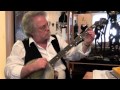 VIDEO: Clawhammer Banjo, Ngoni Harp tuning - Marc Nerenberg (click to view) |
bFunk - Posted - 11/29/2011: 00:18:14
Very enjoyable. I liked the different strumming patterns and your upward sweep. I have trouble doing any kind of up picking because I like my downpicking nail to be somewhat long (I know some people have long nails and up pick, but I can't figure out how to).
Bryce
metascrawl - Posted - 11/29/2011: 05:27:04
I had a jam with a kora player a while ago. I played out of open F (standard open G down a tone) as the kora is generally an F major/D minor instrument. It wasn't very satifying. I was thinking that next time I'd try the 'Last Chance' tuning of fDFCD, but I'll definitely try this dDGAC tuning and see what happens. Might work, might not!
oldwolf - Posted - 12/16/2011: 19:34:34
I sure was surprised, and pleased to find this thread. I have one foot planted in old-timey american music, and the other in Africa, where the variety of amazing stringed music seems to be endless. I have a real Kora sitting in my music room, but had not as yet snapped to the idea, that I might be able to play my open back in similar ways.
Sometimes near the end of a long free form jam on the couch, I find African patterns emerging in some of my spontaneous guitar stuff, so why not my new open back banjo?
Needless to say I will be experimenting soon with some of these ideas.
Gene Warner
repairman
Terms of Use | Privacy Policy | Privacy Consent (EU/GDPR Only)
Copyright 2026 Banjo Hangout. All Rights Reserved.


