
DVD-quality lessons (including tabs/sheet music) available for immediate viewing on any device.
Take your playing to the next level with the help of a local or online banjo teacher.
Weekly newsletter includes free lessons, favorite member content, banjo news and more.
Premier Sponsors


|
Please note this is an archived topic, so it is locked and unable to be replied to. You may, however, start a new topic and refer to this topic with a link: http://www.banjohangout.org/archive/215281
Page: 1 2
jimh269b - Posted - 09/08/2011: 16:16:14
well there is one thing i am going to say,paul takes time out to interview banjo pickers on here,that has to be a lot of work and time doing that,after i thought about about it and read his interviews,its most interesting about the interviews of the folks he interviews.paul that has to take time out of from your playing,and i sure you enjoy it,i know i really do.my hat off to you friend,what you have done is outstanding
The KIDD - Posted - 09/08/2011: 16:21:36
I HOPE like heck Paul got my PM about Laurence's interview. Needs to be "Here"........
jimh269b - Posted - 09/08/2011: 16:24:26
come think about it man you need to be interviewed to john,that would be interesting
JanetB - Posted - 09/08/2011: 17:03:50
To my knowledge, JIm, you were supposed to be interviewed next, and Paul had gathered some questions to ask you, like tell us about getting job offers from Bill Monroe and Country Gentlemen, and do you only play Gibsons, and how did you come to have such smooth, fluid playing (you might be the David Grier of banjo), and what tunes have you written, and who have you played with, and have you ever been in a band, and what are your favorite traditional tunes and how are you feeling and and and and.....
I agree, Paul should be interviewed. He's so full of talent and goodwill and has had a mighty interesting musical life, and let's not forget how he's benefited and helped many people with music therapy and teaching.
John the KIDD's story would be good, too.
You gentlemen of the Hangout are so brotherly. It's very touching.
jimh269b - Posted - 09/08/2011: 17:13:02
janet i really think you would be the right person for this,would you do that,i know that you have a heart for it
JanetB - Posted - 09/08/2011: 18:14:51
I'm willing, Jim. If there are already some questions out there people would like to ask Paul, start writing them here, or email me.
The KIDD - Posted - 09/08/2011: 18:18:29
Thanks for the gesture Jim but theres already enough about me 77-95 floatin around the net. . I gotta answer to enough road storys on FB and MS... I just like being a collab bro on here now.. Yeah, Id like to see one on Jim as well!!!...We're (most I know on here) all to crazy to actually interview a person for real... Who would interview Paul?
The KIDD - Posted - 09/08/2011: 18:49:53
I didnt see that last post before mine.. Yeah, Janet seems reasonably sane.(been here too long..) Not used to thinkin there could be normal people here...Yeah , me digs!
erikforgod - Posted - 09/08/2011: 19:01:25
I would like to hear a good Jim Reed interview......hopefully he will have some questions for you also about your life as a miner and what it is like, how you got started on the banjo?
Paul Roberts - Posted - 09/08/2011: 20:11:51
Thanks, folks, I'd use any excuse to talk to Janet, a wonderful musician with a great mind and a big heart.
Right now I'm promoting my new interview with Laurence Diehl. Hope you enjoy it.
Cheers,
PauL
RB-1 - Posted - 09/09/2011: 01:57:35
Paul that Laurence Diehl interview was great!
Played with Laurence and his brother Bob when he was over here in the early eighties.
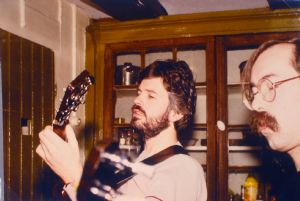
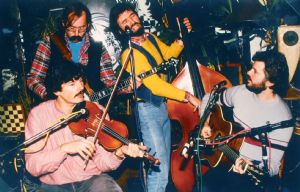
He's a gentleman player. Hope to meet him again.
Edited by - RB-1 on 09/09/2011 02:04:43
Don Borchelt - Posted - 09/09/2011: 04:35:21
Paul is a fine man, a great imaginative and creative picker, and a real asset to the banjo community.
Frebazak - Posted - 09/09/2011: 05:20:48
You can't help but be attracted to that smile that appears on each video! Paul is also a Goldtone dealer (I bought my OT6 from him). Love his music and the arrangements he plays. nnnn he has a hat collection that out does mine,...and that takes some doing!!!!
I would be very interested is hearing Paul interviewed...
Edited by - Frebazak on 09/09/2011 05:21:49
Paul Roberts - Posted - 09/09/2011: 08:30:19
quote:
Originally posted by RB-1
Paul that Laurence Diehl interview was great!
Played with Laurence and his brother Bob when he was over here in the early eighties.
He's a gentleman player. Hope to meet him again.
Thanks, RB-1, I'm sure Laurence will enjoy seeing these photos.
BHO is really quite a family. It's never been done before in human history - people coming together, from around the world, through instant communication. It's a new form of intelligence and inter-relating, and I feel very honored and privileged to be a part of it.
What's happening on the hangout is highly significant, in terms of bringing people together and in terms of expanding our vision of what banjos are capable of. We come from many different musical backgrounds but we're joining here in a kind of musical consciousness accelerator. We may have already reached the point where the Internet - even more than live performances - has become the key to musical evolution.
Couchie - Posted - 09/09/2011: 15:12:48
quote:
Originally posted by Mark Johnson
paul rocks.
oh yeah........
JanetB - Posted - 09/09/2011: 15:33:31
Let the interview begin!  We'll start from the beginning. Paul, tell us about your musical experience as a youngster. If you want to send me an email first and allow me to accumulate lots of information, we can do that. Or, easier yet, we can use this forum to ask our questions and receive answers communally. Afterwards, we can synthesize it into one easy-to-read format, perhaps with photos and musical inserts.
Thanks, Paul. We'll enjoy this.
Janet
Edited by - JanetB on 09/09/2011 15:34:52
Paul Roberts - Posted - 09/09/2011: 16:35:37
I must have been about three. I was playing with blocks and my dad was playing his mandolin. When he would hit a tremolo, I felt a strong sensation of energy going up my spine. Maybe I was hardwired to play plucked string instruments. The piano is a kind of plucked string instrument. I formal training on that for 8 years and another 5 on trumpet before I found my true inspiration with guitar and banjo when I was 16. After all the classical music education it was fairly easy for me to teach myself, although I did take bluegrass banjo lessons for 6 months with a British gal named Patty Hill. That was at Russ Miller's in El Monte, CA in 1962. After the 6 months, Patty vanished - and Russ and Pearl asked me to take her place. I also began performing around that time with a fiddler named Pete Weiss.
David Lindley was a huge inspiration for me. He was a grade ahead of me in a neighboring high school and was taking off very quickly as an innovative folk multi-instrumentalist. It was in observing Lindley that I learned one could keep expanding one's palette of musical instruments. I hung out at a folk club in Arcadia, called the Cat's Pajamas, where Lindley played a lot. Lindley had an acceptionally gifted touch on the banjo. One of the things I learned by watching him, was his use of a Flamenco type brush, which is fun for frailing. He had studied Flamenco guitar before gravitating to the banjo. Although it wasn't apparent in his early folk music days, Lindley had listened extensively to his father's record collection which contained many forms of music including Middle Eastern and Classical East Indian music. Later, when we crossed paths on the other side of the country - and he was in Kaleidoscope - I thought it was interesting that we had both simultaneously slid into Eastern music; a direction that I recognize as part of my musical self, having gotten there through genetics and upbringing.
Edited by - Paul Roberts on 09/09/2011 16:51:19
jimh269b - Posted - 09/09/2011: 16:52:34
this is going to be good,did you ever try to pick 3 finger style paul
Paul Roberts - Posted - 09/09/2011: 17:07:33
quote:
Originally posted by jimh269b
this is going to be good,did you ever try to pick 3 finger style paul
Yes, Jim, for half a century ago, and I'm glad my fingers still work. I've been getting back into more finger picking lately. I just set up my old 12-string guitar to play kind of like a banjo with 8 strings (the middle three sets are doubled octaves), if that makes any sense. Probably doesn't, but I'll post a tune soon. It's nice having the big sound of the Guild box. It really rings. So now I can play it more like a banjo. I'll record an Indian tune I like using a 3-finger style and post it on Sound Off. Let's see, it's about 9 pm your time; I'm not sure it's going to be up before you go to bed, because I'm going out into the woods for a walk before I get started.
correction: it's only 8 pm your time, so maybe I can getting something up this evening with this new wooden banjo.
Edited by - Paul Roberts on 09/09/2011 17:08:50
JanetB - Posted - 09/09/2011: 18:47:28
Already very interesting, Paul. How did genetics and upbringing draw you to Eastern music? Please give us background information on the song that you're going to record for us. How did you learn it and where would the song be heard in a native context? You usually give us details about a song and it gives me a deeper appreciation.
Paul Roberts - Posted - 09/09/2011: 19:15:52
Edited by - Paul Roberts on 09/09/2011 19:17:59
 Raghupati Raghav Raja Ram | "Renewal" |
Paul Roberts - Posted - 09/09/2011: 19:55:36
quote:
Originally posted by JanetB
How did genetics and upbringing draw you to Eastern music?
Music for me has been a journey; I've always had a very strong calling towards music. One of the places this journey keeps taking me, is back to a sense of internal roots to the East. The obvious level for me to comprehend this is the fact that my genetic heritage is of the Jewish; hence my lineage goes back to the Ancient Near East, The Cradle of Civilization as it's often referred to.
When I was growing up, I was exposed to a lot of Jewish music, some of which still harkened back to ancient times. Also, as I was growing up, a vibrant music and dance culture was emerging in the state of Israel. Beautiful music was being composed that had melodic connections to some pretty exotic cultures. And I was hearing this stuff. The sounds I was most drawn to were derivative of Greek and Arabic music. A couple tunes I recently posted to YouTube are examples of this, so I'll link to them below.
Anyway, this Eastern thing has been following me around for a long time, although I've also done a lot of composing and other types of international folk music. What started happening to me, very early in my banjo days, was that I caught on to the Harry Smith anthology. I must have listened to it a lot, because whenever it was due at the library, I'd take it back for a day, then go back and check it out again. This influenced me tremendously because it was a look under the hood into the pre-commercial past. And it called way back in time, if you let it. The unique ways people used the sounds of their voices and instruments. But it was modal banjo sounds, above everything else, that really did it for me. A couple years later, I heard classical Indian music and even though it was very different, something in it seemed somehow very familiar. I studied sitar for 3 years with Shyam Yodh and then 6 months in India with Rais Khan.
During the past couple years I've been enjoying playing Eastern music on the cello banjo.
Marc Nerenberg - Posted - 09/09/2011: 20:26:00
Paul Roberts- banjo philosopher! or - should I say: Banjosopher!
Edited by - Marc Nerenberg on 09/09/2011 20:26:43
Paul Roberts - Posted - 09/09/2011: 21:04:46
"Banjosopher," definitely.
Jim: I was very much into Scruggs and Keith styles for many years. In the the '60s I performed bluegrass with my college roommate, Jon Landau, who is now Bruce Springsteen's manager. What Scruggs and Keith did was some of the most magnificent music I have ever heard. I was learning from both ends, the bluegrass and the old-timey. I remember when I first heard Bill Keith playing Devil's Dream and Sailor's Hornpipe. Angelic.
JanetB - Posted - 09/10/2011: 11:08:21
Referring to your posted Hindu song, it's beautiful, deep and calm, as anything referenced to Ghandi is bound to be. Referring to Jim's question, when you do 3-finger picking, are you using the 5th string as a high note? Is it a drone note or part of the melody? What notes are the strings tuned to?
When you originally performed with banjo was it strictly bluegrass, fiddle tunes, and old time?
When and how did you transition to clawhammer? I recall you used tab books, correct? Which ones, and do you ever refer to them now?
To Paul's friends: I suggest we now pose our questions to Paul for him to reflect upon.
Edited by - JanetB on 09/10/2011 11:10:28
jimh269b - Posted - 09/10/2011: 14:02:17
paul was you ever offered a job playing,and you should have been
Paul Roberts - Posted - 09/10/2011: 20:11:47
Janet's questions:
"Referring to Jim's question, when you do 3-finger picking, are you using the 5th string as a high note? Is it a drone note or part of the melody? What notes are the strings tuned to?"
I shot a picture of the strings (see below) so you can see how I've hot-rodded the 12-string for 8 strings. I have it tuned cGCFC. The 1st and 5th strings are single. The 2nd, 3rd and 4th are doubled octaves. The 5th string is the same as the low C of the 3rd course. So, it doesn't have that banjoey high 5th string, but there's a lot of drone and sustain.
"When you originally performed with banjo was it strictly bluegrass, fiddle tunes, and old time?"
Yes.
"When and how did you transition to clawhammer? I recall you used tab books, correct? Which ones, and do you ever refer to them now?"
I started with clawhammer (we called it "frailing" then) as soon as I got my hands on a banjo. This, I was able to teach myself. For 3-finger picking I took lessons. After several years of playing - and after having gone to India to study sitar - a sitar student of mine, who also played banjo, showed up with the John Burke and Miles Krassen clawhammer books. This was the first time I was aware that anyone had broken down the refinements of the style, and I studied these with great relish. I rarely refer to any tab now, unless it's something I've composed that I haven't yet memorized.
Jim: Yes, I've played a lot of jobs. Everything I've done has been through music. I'll cover some of that in my next installment.
Jim and Janet - what a great interviewing team to work with!
Double-click the image and it will come up bigger so you can see the stringing.
PauL
Edited by - Paul Roberts on 09/10/2011 20:14:46
 |
Paul Roberts - Posted - 09/11/2011: 10:56:04
I recorded a tune I learned from Lindley, half a century ago, and wrote about David Lindley's influence on me - "Johnson Boys."
jimh269b - Posted - 09/11/2011: 12:06:24
well paul just how much fun did you have,i know what it is, but i want you to tell it
Paul Roberts - Posted - 09/11/2011: 12:42:10
quote:
Originally posted by jimh269b
well paul just how much fun did you have,i know what it is, but i want you to tell it
"just how much fun did you have"
Funny, that is the fundamental question, but it never has occurred to me to ask it of anyone else or even myself. Puts things in their proper perspective.
A lot; especially in regards to using music with kids and mental patients. I've had the honor to perform for over a million elementary school children. I've been blessed to have free reign over the use of music in the therapy of mental patients, at one of the top psychiatric facilities in the world; without any formal education in music therapy - just at the right place, at the right time. What's that line about seizing the moment. I think that's what's happening right here in our communication over the Internet; we're seizing the moment. We're all at the right place, at the right time. This type of communication has never before taken place in human history. Where it will lead is a mystery; a very positive and exciting one, at that. I'm thrilled to be playing a part on our new stage.
jimh269b - Posted - 09/11/2011: 12:49:58
well you have made some of the best music that they are,and whats great is that it is you,that would be hard to copy,and now what made you play the style you played,we know about the middle east but what else can you tell us
Paul Roberts - Posted - 09/11/2011: 15:24:17
I guess the short answer is every kind of music I've ever heard. I got turned onto the banjo, first by hearing Pete Seeger and The Kingston Trio; then I had quite a revelation when I heard Earl Scruggs, so I studied his style intensely. Then I heard Bill Keith and that opened up a huge doorway, so I learned how to play melodically.
But after a couple years of that I started listening to a guy named Ali Akbar Khan from India who plays sarod. You can find videos of him on YouTube. Then I tried to play like what he was doing, but on the banjo. That led to the sitar. But rock and roll was there, too. I started organizing rock and roll bands - and other types of ensembles - at McLean Hospital in Belmont, Massachusetts where I worked as a music therapist from '67-'70.
To be continued...
JanetB - Posted - 09/11/2011: 18:03:25
Did we skip something chronologically, Paul? Before music therapy, didn't you attend a famous university? What were you planning to study? Did music enter into this endeavor?
Paul Roberts - Posted - 09/11/2011: 20:27:07
quote:
Originally posted by JanetB
Did we skip something chronologically, Paul? Before music therapy, didn't you attend a famous university? What were you planning to study? Did music enter into this endeavor?
Jim, you hired a great journalist, here. This gal is sharp.
I bought a brand new Gibson bow-tie inlay banjo which I played for two years before leaving home in '64 to go to Brandeis University in Waltham, Mass. I sold the mastertone and bought a gold plated tubaphone tenor that Bob Givens made a neck for and converted to a 5-string. That's the banjo I left home with. I eventually sold it to Livingston Taylor before I left for India to study sitar.
The first day of freshman orientation week at Brandeis, I was playing my banjo outside my dorm where there was a big pond. Several people gathered around to listen and a guy with approached with a guy and started jamming with me. That was Springsteen manager Jon Landau with whom I had a close musical association for several years.
Brandeis had its good points. For me it was a good place to fall in love and play music. There was a coffee house called Cholmondley's where some of the great folk entertainers would play; also some great concerts. I would perform with Jon Landau; me on banjo (picking and frailing), he on bluegrass guitar.
But Brandeis also had its bad points for me. For example, they were into all this academic stuff which was entirely irrelevant to me, because all I wanted to do was roam around in the woods, hang out with my girlfriend and play the banjo. So, after they figured out I was definitely not buying into the program they kicked me out. A couple years later I went back and created an independent study program, based on my work in music therapy, to finish my degree, under the mentorship of Morrie Schwartz, the title character of the book, "Tuesday With Morrie."
Before I leave Brandeis to go off to the mental hospital, I'd like to mention a couple banjo players I used to jam with - Gene Korman and Howie (I think his last name was Barkin). Gene had a nice picking style and Howie was by far the first person I ever heard play in an exquisite melodic clawhammer style. The two of them would show up at my dorm and we'd play the heck out of a few tunes; 3 banjos, that's a lot of sound. Korman later took up drums and joined Landau and myself in a hard rock band in which I played electric bass. Does anyone know who this guy I remember as Howie Barkin is? He had very red hair way back then. Very skilled player; good guitarist too.
One thing I'll never forget is when I noticed Reverend Gary Davis and his wife showed up way too early for a performance at Cholmondley's. I took them to my dorm room to hand out, and he played for two hours straight for Landau and me. That was quite a treat. Joe Val and the Charles River Valley Boys used to play there quite a bit, and lots of other great musicians.
Next: how I became a fulltime musician in the mental health trade.
Edited by - Paul Roberts on 09/11/2011 20:32:46
Janna - Posted - 09/13/2011: 01:21:09
Paul Roberts is one of the unique person on banjo hangout! His interview was changed my life! Paul, you're the great man!
Paul Roberts - Posted - 09/13/2011: 09:39:59
Janna, I don't have a date on these. When did we do them - 3 years ago?
banjocrazy.com/articles/janna1.shtml
banjocrazy.com/articles/janna2.shtml
JanetB - Posted - 09/15/2011: 15:04:22
Paul, could you elucidate the impact you made in an Uzbekistani musician's life? It seems that generosity and helpfulness is a thread in your life, which will bring us full circle back to how music therapy became a vocation. (Did it precede elementary school assemblies?) But one thing at a time.....and take your time, please.
Paul Roberts - Posted - 09/15/2011: 21:20:22
Janet, thanks for your kind words about "a thread of generosity and helpfulness." I'm sure my mother would appreciate that, since it reflects a value I was raised with, namely, having a sense of caring for others. In regards to Janna, what happened was this: here was a young lady who pops on BHO, playing a banjo that a guitar maker in Uzbekistan had made as a wall-hanger for his shop, in a country that knew nothing of banjos. Janna had purchased this instrument and was making it work, and she began posting sound files on BHO.
It was obvious by her sound posts that Janna had enormous talent as a vocalist and instrumentalist. The thought hit me over the head, "we've got to get this gal a real banjo." That thought didn't go away until the mission was accomplished. I felt it was important to get a really good banjo in Janna's hands, because I felt strongly she has a lot to offer the world through her music. BHO seemed the perfect place to try out the idea of raising money from people around the world because a global banjo community was evolving here.
My work in the field of music therapy stemmed from my decision to work at a state-run mental hospital for children in Massachusetts. The first time I walked into the hospital, where I had been hired as an aide, a big question I had been carrying around with me, about where was the meaning of life, was answered in my heart. I felt needed and this gave my life a sense of meaning.
This eventually led to my work in music therapy because, after working there for 6 months, I brought my banjo and guitar to the hospital. The patients were enthralled so I knew I was onto something. But, the nursing staff disallowed it. It was okay for me to hang out with the kids, go for walks, play games, etc., but playing music was, I was told, outside of my "job description."
That resulted in my knocking on the door of another mental hospital, McLean, which happened to be looking for someone to do music with young patients. I was at the right place, at the right time. I worked at McLean from '67-'70, and I'd like to share that experience in our next installment.
Paul Roberts - Posted - 09/17/2011: 20:01:14
Every time I see Don Brochelt and Ed Britt's videos, "Busking in Harvard Square," I time-travel back to when I lived just a few blocks from where Don and Ed are doing banjo duets on their cement bench stage-set (it's a cool scene, guys).
41 years ago I left that part of the country and haven't been back since. Just to rewind the tape a little, I came from California to attend Brandeis, where I had the delusion of studying psychology, but found I had very little interest in or tolerance for academics. I was a folk musician who played banjo and guitar, not a note-taking, book-reading, exam-taking, lecture-listening obsequious student. Truth be known, the whole school thing didn't go over well with me from the get-go; I always felt like I needed to get out of prison camp so I could go be free, play music, experience nature, have fun. The artificial world of human civilization tended to be a big encumbrance upon my imagination and I resented it.
So, finally I managed to liberate myself from that idiotic system; even with my (well-known scientist) father's attempt to "give me anther chance."
Okay, we already did Met State Children's Unit, which I've been told doesn't exist anymore so that's already ancient history. Now we're going to go up the street to McLean.
I didn't know anything about McLean, except for hearing about the occasional exam flip-out case, at Brandeis, who got shipped out to a nearby hospital.
So, remember the bit about me being told that doing music at the children's hospital was outside my job description? I asked a nursing supervisor about that and he said, "Well, technically doing music here would have to be under the recreational therapy department, but we don't have a music program. I suggest if you really want to try to pursue this, to go up to McLean, where they have an extensive and high-level activity therapies department, and see if you can get something going there."
That caught my attention, so I called McLean and was directed to Jim Garland, the director of activity therapies. He was very nice and invited me in for a meeting at which he hired me on the spot to work full-time in music therapy with the burgeoning adolescent population the hospital was experiencing.
Jim Garland is one of my all-time heroes and an important father figure for me. Before he worked at McLean he had used music as a street-corner social worker in Boston, and at special summer camp programs for disadvantaged kids. He was always my image of everybody's favorite camp counselor. Anyway, he really knew the value of using music in working with all people because he had done it himself; he was a good ukulele player and singer and was good at leading songs.
Garland loved the banjo so that was one of my selling points. So he gave me a job. I started working there in April of 1967 (just a few months after I began studying sitar with Shyam Yodh, a medical student and musician doing his residency in neurosurgery in Boston).
McLean had a music therapy department with three small practice rooms with pianos, and one quite large room that was multi-purpose. That was the room I took over. Jim basically gave me free reign to try to get whatever I could happening. Several years ago, Alex Beam, a writer, tracked me down in my rural mountain village, by calling all the directories in the state because Jon Landau said to him, "I think he's somewhere in Colorado." Beam's book, Gracefully Insane, is an historical perspective of McLean and its role in the history of psychiatry in America. The chapter entitled "Hippiephrenia," is framed around my work there in the '60s. I'll be back to flesh out the details, but first I want to get a video ready for uploading...
Page: 1 2
Terms of Use | Privacy Policy | Privacy Consent (EU/GDPR Only)
Copyright 2026 Banjo Hangout. All Rights Reserved.


