
DVD-quality lessons (including tabs/sheet music) available for immediate viewing on any device.
Take your playing to the next level with the help of a local or online banjo teacher.
Weekly newsletter includes free lessons, favorite member content, banjo news and more.
Premier Sponsors


|
Please note this is an archived topic, so it is locked and unable to be replied to. You may, however, start a new topic and refer to this topic with a link: http://www.banjohangout.org/archive/212398
OK-4 - Posted - 08/01/2011: 23:08:59
I bought a made-in-Pakistan calf-skin heads for about $10, and a made-in-USA calfskin head for close to $30. Goal is to fix up a couple of cheap old spun-rim no-names. Will be my first attempt at installing a skin-head, and would like to learn more before installing. The cheap one is obviously darker, thicker and tougher than the expensive one.
Can someone give me an idea of what to expect in terms of performance from these two heads. I am hoping for some information that is a bit more specific than the obvious "you get what you pay for". Ease of installation, humidity, tone, anything?
country frank - Posted - 08/02/2011: 02:49:08
I have one of Bills heads on my maple blossom and i have found it much more stable than i'd imagined and in my opinion the tone is considerably more complex and satisfying than a plastic head.
I used a pre mount so cant advise on the/a mounting proceedure though.
Good luck.
Brooklynbanjoboy - Posted - 08/02/2011: 03:14:02
I've used both. The more expensive skins are processed and cured more efficiently and effectively, with an eye toward consistency. The cheaper skins can have some holes where the skin was separated from its former owner, and some stretch marks where the processers used sticks or something to facilitate the drying process. Out of 50, I had to discard about 5 or so but the cost was so low (far lower that 10 bucks a head when I purchased my last lot some while back) that it really didn't change the wisdom of going for the cheaper lot. Some while back Bob Smakula pointed out the wisdom of using Scotch Guard in the process of drying a skin. I used it liberally during the process, and had good results with both the cheaper calf and goat skins I purchased from the company (in New York) that was importing these in 16 inch diameters. I haven't dealt with that company in a long time; I still have skins from the large lot I purchased a few years ago. I've used them on bottom feeders and decent banjos to good effect. One note of caution: Scotch Guard's formula may have changed over the years, as someone recently pointed out. I haven't looked into it because I'm still using cans of stuff purchased when I got the large lot of Pak skins. That might cut into the effectiveness of this method of using a commercial "waterproofing" agent.
Lew
jbalch - Posted - 08/02/2011: 05:27:57
Pakistani calfskin –
Semi translucent. Some are almost fully clear. I prefer the ones with mottled white and brown spots. I generally don’t like the ones that are all clear.
Uneven thickness and stiffness – will vary around the perimeter of the hide. This might make it a little harder to tension or tune the hide for a pleasing sound. It can also impede the mounting process (I’ve really struggled with a few tough ones … but never failed to get them installed).
Very sturdy – these often have a strong feel and will reliably take plenty of tension.
Good tone. Some of the cheap hides sound fantastic!
On a banjo where you want a rustic look and sound – I like these hides a lot.
Bleached calf or goat hide (from Bill Miller banjoseen.com and Jeff Menzies jeffreymenzies.com/)
Bleached - More even white or off-white appearance.
More even thickness and stiffness – some can be quite thin. I prefer a medium thickness (not too thin).
Bleached hides often have a softer overall feel and may stretch more in the mounting process.
Good tone. Consistent texture and thickness may make these easier to tension and tune. After a period of stretching and curing, these heads sound great and can last for decades.
Great value for the price charged (under $20 each from these suppliers).
Vellum Processed calfskin
These hides are available from Bill Miller (banjoseen.com). They feel a bit stiffer than the bleached type. They have relatively even thickness and seem quite strong. I like these heads for a strong bright tone. They sound great! (cost $under $20).
Stern Tanning – machine sanded calfskin
Stern tanning (sterntanning.com/percussion.htm) makes heads the way it was done in the country for decades in the past. Jeff Stern bought the equipment of the old United Tanning Co. in Chicago. United Tanning made drum and banjo heads for Slingerland, Ludwig and others back in the mid part of the last century. These hides are machine sanded for totally even thickness and a perfect top surface. They look and sound truly fantastic. These hides cost a little more ($45-60). But they are the best I’ve found and I prefer them for my best banjos.
un-bleached calfskin:

bleached calfskin:

vellum processed calfskin:

Stern Tanning Calfskin:

jbalch - Posted - 08/02/2011: 05:40:22
I'm linking this thread to the Hide Heads group: banjohangout.org/group/hideheads
RBuddy - Posted - 08/02/2011: 06:51:38
Thanks for that post John! That got pasted directly into my banjo buildin' scrapbook for sure.
When I think of less expensive imported heads I always remember this thread from a couple years ago:
banjohangout.org/archive/119558
I'm by no means a skin head experts so will defer to those that are on this aspect - anything to add about safety???
Brian
charlied - Posted - 08/02/2011: 13:49:44
I installed two skin heads this past February for the first time, and solo. The results were good. I get tickled everytime I play them both. I am not kidding. Sometimes I giggle. The skins made a world of difference.
A second pair of hands might be helpful but not necessary.
I wasn't sure how tight to pull the skin. I used very little pull trying to get hide tight. I think I should have made a better effort. I have them both very playable and they sound like they should but I haven't left much room for tightening the hooks much further. Clearance at the tailpiece on one banjo and at the neck, on the other banjo, would become issues if I wanted to tighten the heads much more.
Another issue I had concerned the diameter of the flesh hoop compared to the tension hoop. My flesh hoop was slightly larger than my tension hoop. I hadn't checked it. I had to bend my hooks on my Harmony around the flesh hoop to get to the tension hoop.
like this: ) not straight like this ]
It wasn't a lot but it made it prohibitive in getting the wet hide pulled tighter.
3rd issue: I had oil on the metal parts. I was too busy to WIPE them all off until I had a wet skin on the rim. Stained one skin visually but nothing much else.
I read what I could , watched the videos and then visualized the whole process before I did it.
good luck and have fun
charlie
ponty - Posted - 08/02/2011: 14:22:12
quote:
Originally posted by country frank
I have one of Bills heads on my maple blossom and i have found it much more stable than i'd imagined and in my opinion the tone is considerably more complex and satisfying than a plastic head.
I used a pre mount so cant advise on the/a mounting proceedure though.
Good luck.
I am about to pull the trigger on one of these. My only concern here in humid Bermuda is stability. I am going to try it anyway!
by the way are Bill's skin of US origin? Frank, I was looking at the Brown Dog banjo website (UK) and they had a high quality skin for £48. That must be from some rare cow bred only for banjos!
tdennis - Posted - 08/02/2011: 15:09:22
I've found skin heads to be sonically incomparable. They have truly musical properties, & give a voice that is complex, rich, interesting, warm & intimate. Plastic heads are an industrial product with all that implies - ease, convenience, super strength , durability (notice that non of these are sonic qualities). But they do give volume, crispness & a cutting tone. Mounting skin heads is very tricky & takes some practice & experience, regardless of the great advice & tutorials available. Heads are strong when dry, but weak when wet. They can be easily ruined, cut & broken during the process. The most common problem with beginners (& music store amateurs) is getting the skin level, & the crown just right. Even when successful, they require special care in everyday use. Low humidity(20% or less ) is more of a villain than high. I feel they are worth the headaches because of their voice, & always have a batch of replacement skins on hand.
jbalch - Posted - 08/02/2011: 16:19:21
Ponty:
If I were considering one of Bill's pre-mounts for that climate, I'd order vellum-processed calfskin. Also I recommend asking Bill to choose a medium-thick hide (not too thin).
I just mounted a new vellum-processed Miller head for my friend David Emery in St. Augustine, FL. We treated it with leather spray and set the tension plenty tight. It turned out great! I think he is well pleased.
Best Wishes!
Bart McNeil - Posted - 08/02/2011: 17:00:08
I wouldn't be afraid of goat or calf skin for your banjos.... I do the same thing as you... restore old banjos and banjo mandolins and find that the first one may be difficult (and seem to require three hands) but after that they go on fairly easily.... I ccertainly prefer them for their softer less agressive tone and for the fact that skin heads create sound in keeping with the banjo sound when the banjos were new roughly 100 years ago. The rather mottled or off-white appearance is not, in my opinion a detriment but a mark of the original type natural skin head. There are good videos on Youtube showing installation method and if you buy the heads from a music supply house they probably come with printed instructions. Google install banjo heads and you will find lots of instructions.
DEmery - Posted - 08/02/2011: 17:42:45
I couldn't agree more. In years past skin was something felt to be too delicate and trouble. John did put a vellum processed skin on my Dan Knowles ebony banjo. It did have a great goat skin head I mounted on a Flesher banjo. The goat skin finally made the Flesher banjo sound great after having a variety of heads it for years. The vellum skin not only made the ebony banjo sound wonderful - but it looks perfect. Treating it with a leather protectant has made it quickly stable. Dan Knowles told me once that skin acts as a tone filter compared to plastic. It does give a depth of tone and quality I've not achieved with Mylar. By the way, John mounts a head as good as it can be done. It is perfect when he finishes and places his stamp on the skin. David E.
 Jubilo built by Bob Flesher |  Goshen built by Dan Knowles |
jbalch - Posted - 08/02/2011: 19:10:50
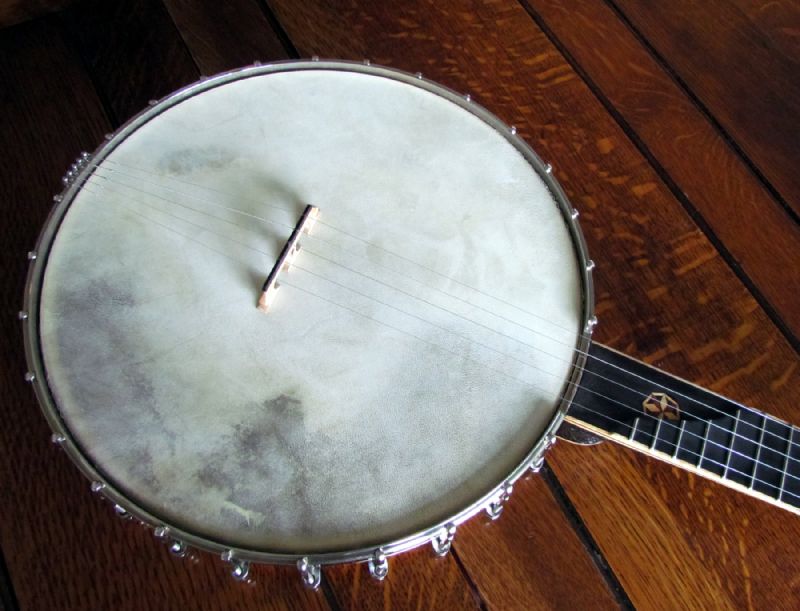
Here is the Bill Miller vellum processed hide we put on David's ebony banjo. The video of me playing it is attached below. I think it looks as fine as it sounds:
Edited by - jbalch on 08/02/2011 19:14:31
 VIDEO: JOHN BALCH ~ Muscadine (click to view) |
OK-4 - Posted - 08/03/2011: 14:10:51
A couple of folks have mentioned leather weatherproofing treatment. At what point do you apply this? After it is mounted and dried? Before it dries? Also, I have seen a recommendation to have 6 long tension hooks to start off the mounting process. Will this likely be necessary?
jbalch - Posted - 08/03/2011: 15:24:48
Here is what I do:
1. mount the hide (with the tension hoop sitting about 1/8" or a little more higher than its final position).
2. when it is stretched and properly installed, trim the skin above the tension hoop.
3. allow to dry overnight or several hours.
4. when thoroughly dry, remove the head from the rim
5. trim the excess skin around the edge with scissors.
6. spray with leather water-proofer - allow to dry - repeat
7. re-install on the banjo and apply tension
I don't have any extra-long hooks. That might make the job easier. But I find that standard hooks from the banjo are usually sufficiently long to accommodate mounting.
kevinwholmes - Posted - 08/03/2011: 16:20:30
I used the cheapest skin head I could find when I did my first one because I figured if I broke it no big deal, I was pretty much doing it for the experience and practice, and would probably replace the skin with a better one later on anyway. I had to make a flesh hoop out of 1/8" steel rod I bought at Lowe's and bent to rough shape and length on a home-made wooden jig (the tension hooks fit over this just fine).
The mounting is a bit of a slimy job, but not bad (I bought my skin from Elderly that came with a copy of S. S. Stewart's original installation instructions.) A few extra long hooks helped me quite a bit. I did that 4 years ago and the head is still on and sounds great. I originally didn't tighten it down far enough, so the strings would slap the tension hoop when playing the frets near the head. I just remoistened the skin head (top and bottom) while still on the banjo (trying not to get goo on the banjo) and tightened the head down to the proper height. I live in NC where it gets pretty hot & humid & have had no serious problems with stretching or shrinking of my skin heads, just with the one that sits at the top of my shoulders.
jbalch - Posted - 08/03/2011: 18:05:28
Here is another thread with a few photos of my mounting process. Other folks may approach it differently. But this works for me.
country frank - Posted - 08/04/2011: 07:46:31
quote:
Originally posted by ponty
quote:
Originally posted by country frank
I have one of Bills heads on my maple blossom and i have found it much more stable than i'd imagined and in my opinion the tone is considerably more complex and satisfying than a plastic head.
I used a pre mount so cant advise on the/a mounting proceedure though.
Good luck.
I am about to pull the trigger on one of these. My only concern here in humid Bermuda is stability. I am going to try it anyway!
by the way are Bill's skin of US origin? Frank, I was looking at the Brown Dog banjo website (UK) and they had a high quality skin for £48. That must be from some rare cow bred only for banjos!
Hey Ponty, i know Brown Dog Banjos and deal with him fairly frequently. I would say that he defiantly does NOT have UK cows bread for banjo hides [great idea though....anyone into genetics out there?]. I'd honestly give Bills head a try, they really are the business IMO and all the advice from John is just priceless. I've said it before and i'll say it again, a hide head gives a more complex tone and cuts out many unwanted overtone in my experience.
Let us know how you find it once you are all fixed up.
bdj - Posted - 08/05/2011: 07:35:37
Question , I have one of Millers premounted heads . Will it require any more tension on my original one piece flange prewar Gibson than the current Weatherking requires? I already know about the great tone from the skins but do not want to ruin an original flange.
Just for additional info it is an original archtop with one piece flange 97XX-XX thx
tdennis - Posted - 08/05/2011: 08:37:03
Your pre-war banjo was originally engineered for a skin head, & I would think it's more in danger from mylar . A skin head will more easily stretch & would probably break before any part of your instrument. I've seen overtensioned mylar break banjo pots & drums.
Terms of Use | Privacy Policy | Privacy Consent (EU/GDPR Only)
Copyright 2026 Banjo Hangout. All Rights Reserved.


