DVD-quality lessons (including tabs/sheet music) available for immediate viewing on any device.
Take your playing to the next level with the help of a local or online banjo teacher.
Weekly newsletter includes free lessons, favorite member content, banjo news and more.
Premier Sponsors


|
Please note this is an archived topic, so it is locked and unable to be replied to. You may, however, start a new topic and refer to this topic with a link: http://www.banjohangout.org/archive/211251
Page: 1 2
banjori - Posted - 07/18/2011: 13:18:05
is it possible that using a capo throws off the intonation so that an adjustment of the bridge is necessary? If a capo essentially moves the nut up the neck and changes the length of the strings, then wouldn't it affect the placement of the bridge?
I ask this because I've noticed that my Saratoga Star doesn't sound good with a capo, and it's not the tuning. Could it be that this banjo is unusually sensitive to small changes in intonation caused by the capo?
Should I be experimenting with different capos or with where I place the capo in relation to the fret? Right now I'm using a Paige.
steve davis - Posted - 07/18/2011: 13:33:47
Do your 12th fret harmonic and fretted notes match.
My compensated bridge does an outstanding job of keeping good intonation whether using a capo or fretting all the way to the 22nd fret.
uncle.fogey - Posted - 07/18/2011: 13:33:52
As long as the bridge is in the right place, and the nut slots are properly cut (argument for zero frets) the capo won't throw the intonation off, but you will probably have to adjust the tuning a bit because the capo puts down pressure on the strings that can sharp them if it's too much.
The fifth string usually has to be "tweaked" regardless, because of spikes.
Those of us who play with longnecks live with capos as a fact of life. I'm not sure I've ever moved the capo up or down without having to correct the tuning a little bit - it's a reflexive act.
banjognome - Posted - 07/18/2011: 14:03:44
No. Assume that the correct bridge placement is based on the distance from the nut to the 12th fret wire(or there-abouts), The distance between the fret wires gets progressively smaller. If you capo at the second fret, then measure from the 2nd fret wire to the 14th (1 octave -- essentially now the 12 fret) that distance should be the same as the distance from the 14th fret wire to the bridge. Or 3rd fret to the 15th and 15th to the bridge, or 5th to the 17th and 17th to the bridge, etc...
Edited by - banjognome on 07/18/2011 14:07:50
uncle.fogey - Posted - 07/18/2011: 14:24:53
The fret intervals are based on a mathematical formula. Read here:
Calculating the positions of the frets requires the simplest bit of math. The historical technique is called the rule of 18, and it involves successively dividing the scale length minus the offset to the previous fret by 18. These days we conventionally calculate fret positions using equal temperament, successively dividing the scale length minus the offset to the previous fret by 17.817. This series of calculations puts the 12th fret (octave) at exactly half the scale length, and we know from the physics of vibrating strings that halving the vibrating string length of a theoretically perfect string doubles the frequency.
Capoing at any fret shortens the string length, and now the octave is at a different fret. Whether you put a capo on the first , second, third, of fifth fret, the the intervals on rest of the fingerboard on down are pre determined and do not not change. Sorry to bore you with this, but this is an educational forum and a previous poster doesn't understand the principal, so I must correct in order to preclude misleading information.
banjognome - Posted - 07/18/2011: 14:26:19
excuse me?
Maybe you just didn't understand what I wrote. I didn't use your nice formula, but in simple terms said that when you use a capo you change the scale length. If you capo at two you now have an A scale banjo. Get you tape measure and check if the scale doesn't match up. 2nd to 14th and 14th to bridge.
I was essentially saying the same thing as you. Man. There is no need to come on here and be deprecating.
Edited by - banjognome on 07/18/2011 14:31:58
uncle.fogey - Posted - 07/18/2011: 14:45:36
quote:
Originally posted by banjognome
excuse me?
Maybe you just didn't understand what I wrote. I didn't use your nice formula, but in simple terms said that when you use a capo you change the scale length. If you capo at two you now have an A scale banjo. Get you tape measure and check if the scale doesn't match up. 2nd to 14th and 14th to bridge.
I was essentially saying the same thing as you. Man. There is no need to come on here and be deprecating.
I'm not trying to be deprecating, far from it - I try to be helpful, and that's why I wrote what I wrote - a new player was trying to understand what the capo does. Maybe you didn't read what I wrote - "that when you put a capo on, the octave is in a different place".
In other words, a normal length banjo, the octave is at the 12th fret, put the capo on the second fret (A banjo) and the octave is now at the 14th fret. The "intervals" never change - the capo only changes the key, not the intervals of the frets.
banjoman56 - Posted - 07/18/2011: 14:54:02
I will personally vouch for Steve's bridges. I have one on one of my banjos and it cleared up all my intonation problems. The lead guitar player in our band is amazed with the difference it has made in my banjo, and comments on it every time we play. I never capo at the 7th fret to play in D because of intonation problems, but with this bridge it's no problem. The thing I love most about it, is that I never have to re-tune when I place the capo on it.
steve davis - Posted - 07/18/2011: 15:15:09
If the harmonics and 12th fret fretted notes don't match on the tuner(as well as possible with a straight bridge) the bridge needs to be moved.
Fretted note sharp to harmonic or open note(they are one and the same no matter where the bridge is on the head),move the bridge toward the tailpiece.
Fretted note flat to open or harmonic/bridge moves toward the neck.
Thanks,Carl.
Edited by - steve davis on 07/18/2011 15:18:18
uncle.fogey - Posted - 07/18/2011: 16:47:58
I would like to publicly apologize for offending someone on this thread. Offense is not my goal, nor do I set out to be offensive - argumentative, maybe, but not offensive. We're supposed to be sharing and debating ideas here and not indulging in personal attacks. Apparently some comments I made cut too close to the bone and were interpreted as being a personal attack. They were not meant to be that, and, to the person I offended, once again, I apologize.
Richard Dress - Posted - 07/18/2011: 17:07:47
quote:
Originally posted by banjori
is it possible that using a capo throws off the intonation so that an adjustment of the bridge is necessary? If a capo essentially moves the nut up the neck and changes the length of the strings, then wouldn't it affect the placement of the bridge?
I ask this because I've noticed that my Saratoga Star doesn't sound good with a capo, and it's not the tuning. Could it be that this banjo is unusually sensitive to small changes in intonation caused by the capo?
Should I be experimenting with different capos or with where I place the capo in relation to the fret? Right now I'm using a Paige.
Put on your capo and turn the banjo so you can see it from the side. Look at the string where you have clamped the capo. Does the string bend as it goes by? Or is it straight? If it bends then it is being stretched by the capo and the note will necessarily be sharp. It's most likely the way you set your capo rather than the fault of the banjo.
banjori - Posted - 07/18/2011: 18:15:47
Steve - could you post a link to a photo of your compensated bridge?
Kenneth Logsdon - Posted - 07/18/2011: 18:51:43
Amen... IF the banjo is set up properly AND the bridge is in the correct position... There should be NO need to retune when using the capo (exclude the fifth spike sweeting)...
The majority of problems that I see in banjos, that the owners complain about.. is the bridge out of position, Then POWER clamping the capo, and then the owners themselves (We all know people that are gonna retune every string on a perfectly tuned banjo, everytime, regardless.. I've come to regard it as a nervious habit...)
banjognome - Posted - 07/18/2011: 19:39:49
For my part, I need to apologize as well. I was getting frustrated because what I was seeing in a post was what I was trying to say. I just wasn't getting it out properly because I don't know the formula or necessarily all of the correct terminology.
oldwolf - Posted - 07/18/2011: 19:56:43
I have done a little research on capos, and the tuning problems that occur. When we fret a string without the capo, most of us don't press the string all the way down to the wood of the fingerboard. We just use enough pressure to seat the string on the fret, with a slight amount of bend behind the fret. If as Richard Dress, and Kenneth Logsdon said, we use so much capo pressure that the strings are pressed to the wood of the fingerboard, then you are bound to be sharp, as compared to other non-capoed instrument players.
Intonation within the neck itself should not change much at all, except possibly for the issue of an intonated, verses a non-intonated nut. That's another complete bucket of worms!
I have found that if you use a good adjustable capo (I am a big fan of the Shubb), you can pinch the string on the back side of the fret you capo at, with the rubber part, and adjust the tension to just hold it there firmly, without ever pushing the string all the way to the fingerboard. If you get the rubber too much on top of the fret, it will mute the strings and they won't ring like they should, but the nut side of the fret will work very well, and your tuning will be right on the money. Sliding type 5th string capos can cause the same problem, if the finger that frets the string is tensioned too highly. That is why I personally like the spikes.
As with everything in life, it seems there is still a drawback to capoing correctly. If you are playing with some one else who just mashes the strings all the way to the fingerboard, you and he won't be together, after capoing.
Gene Warner
repairman
Bart Veerman - Posted - 07/18/2011: 21:48:44
Hey Ori, I'm only about an hour down the road from you - why don't you bring your jo sometime and I'd be happy to look it over for you.
Bart.
uncle.fogey - Posted - 07/19/2011: 14:54:37
I play longnecks as well as conventional banjos, so I'm VERY familiar with capos - all different kinds, and I sometimes make my own, I'm working on a design right now, but don't wait for that.
The best ones available now are the Planet Waves ones - they don't scratch the neck, they are easy to adjust the down pressure - they are lightweight and well designed. I love them.
juststrings.com/pwv-pw-cp-06.html
DantheBanjoMan - Posted - 07/21/2011: 11:27:12
I want to second what Uncle Fogey said. The Planet Waves is a great capo. I can't find the banjo version locally so I buy the guitar ones and shorten them in my shop. I sometimes "notch" the rubbber part of the capo so some string remain open.
Back in then old days capos exerted so much downward pressure that re-tuning was a necessity, and a lot of capos being sold today still have that problem.
Capos are one part of a larger equation. On most banjos, positioning the bridge so it plays accurately at the 12th fret is a commitment to inaccurate intonation, even with a compensated bridge. A good bridge that is properly located is a necessity, but as Uncle Fogey pointed out, fret positions are calculated with a mathematical formula that doesn't take nut height or fret height into account. A properly located compensated bridge mitigates the situation but it doesn't solve all intonation problems, and most banjos would benefit from a the kind of compensated nut you see on a Stelling. What Uncle Fogey said about the way fret positions are calculated is common practice, and most makers (other than Stelling) do not take real world conditions like the height of the nut or the string stretching (caused by the height of the frets) into account when determining fret location. A banjo that plays a precise octave at the 12th fret is likely to be sharp when fretted at the first fret and the common practice of setting the bridge in relation to the 12th fret is a good start, but you will almost certainly have to move it a tad to get it to play in tune at the first few frets. If you do most of your playing on the first six or seven frets, you might want to position the bridge so those are the ones that are most in tune.
That kind of long-winded, but the short version is that plenty of factors affect intonation, and it's best to go after the low-hanging fruit first and check for bridge position and watnot, but if you're really fussy you can keep going, although after a certain point the changes tend to be pretty minute.
steve davis - Posted - 07/21/2011: 12:01:32
My compensated bridges are designed from comparing the 12th fret harmonics to the 12th fret fretted notes.
This gives very accurate notes for the entire length of the neck and no need to retune the banjo when capoed.I use a Shubb capo.
uncle.fogey - Posted - 07/21/2011: 14:13:21
banjos are funny instruments because they use a movable bridge and use very light strings. On classical guitars, using gut or nylon strings, the bridge saddle is almost straight because nylon strings have very little stiffness compared to steel strings. The bridge saddle on a steel-strung guitar is cocked at an angle because of the difference in relative stiffnesses of the strings. Violinists and fretless players care nothing about this because they have no frets and do it all with their ear.
Why is this?
No doubt I will be corrected by various physicists, but I'll try to explain it as best I can.
String stiffness is the key.
The physics of vibrating strings is such that:
(1) a string stretched between two points will ALWAYS ring at the octave by chiming a harmonic at the center of its length (12th fret on a banjo) This is a physical law and cannot change.
(2) THEORETICALLY, a string should also ring at the octave if it's FRETTED at the center of its length, but the STIFFNESS of the string interferes with this for some reason I don't understand, and the stiffer the string, the sharper the fretted note will be compared to the harmonic (true) note.
(3) the stiffest string on a banjo is almost always the third string - the thickest plain steel string, hence the third string is the most problematic one. and is always sharp if you have a straight bridge going straight across the head perpendicular to the strings.
(4) stretching the string by pushing it down hard against the fret exacerbates this problem by making it even sharper.
(5) In the old days (Earl, Ralph, Sonny) everyone used straight bridges and they would cock them towards the 5th string (nobody but Bill Keith fretted the 5th string), which mitigated the problem just as it does in a guitar bridge. These guys learned to deal with this and I never got upset because I thought Earl’s 3rd string was sharp - with BK music, the notes are fast coming and every note on the 3rd string is surrounded by others on other strings.
ENTER the electronic tuner. All of a sudden, you didn’t have to listen to the instrument any more, but you turned the tuning peg and watched the digital thingy. Well, folks, it ain’t going to work on every string, and God forbid, you get it tuned and capo up.
(6) you can compensate for this by building a bridge (or a silly nut) that makes the centerpoint of each string different, to compensate for the difference in stiffness, hence the term “compensated”.
Nowadays, there are people out there building VERY NICE bridges that do that, and they will work as long as you don’t change string gauges too much. If you are nervous about different strings not matching the readouts on the digital tuner, I would recommend one of those. An excellent builder of them has made comments on this thread
Another alternative is what’s called a “moon bridge”, which doesn’t attempt to make every string exactly right so that you can tune it up and never have to correct it, but is another step beyond the age of the classic players and helps solve the problem by getting the 1st and 3rd strings into good relative intonation. The arc can be changed according to how far you want to go with it and what your string gauges are:
As for the capo, which was the original question, the minimum down pressure that will push the strings against the frets without sharping them, is what you want. Back in the day, we all used elastic Dunlop ones and folksingers with longnecks used Elton ones with a spring.
to quote Mies Vanderohe, "less is more".
bango - Posted - 07/21/2011: 15:12:15
I find that my strings go a little sharp when I capo -- no matter how carefully. So after I capo I give each string a quick stretch with my right hand before I play. I find it helps.
rexhunt - Posted - 07/22/2011: 06:16:53
If your banjo is not in tune with itself when you capo, you have a problem with your nut slots. Some capos will also tend to pull the strings off to one side or the other if you aren't careful. As has been mentioned, a lot of capos will make the banjo go sharp. This can be avoided by using an adjustable capo, placing it almost on top of the fret and applying just enough pressure to get a clean note. I prefer the Paige as it's always on the banjo and is very easily adjusted. I'd probably love the Elliott capo if I weren't so cheap.
Rex
steve davis - Posted - 07/22/2011: 06:22:32
I set my capo to mimic the pressure and location(s) of my fretting fingers.
Richard Dress - Posted - 07/22/2011: 06:55:50
Rexhunt is exactly right, except the Paige-style sucks. You can't beat Shubb.
What Steve says makes a lot of sense but I don't see it working in the real world. I wonder why?
rudy - Posted - 07/22/2011: 07:08:04
banjori, Many posters have given you a lot of useful info here, kudos to all. I would go at this from a direction that would remove your actual capo installation from the issue, as I would assume you would touch up the tuning after putting on the capo. ALL capos are going to affect tuning slightly when they are put on, so sweetening up the pitches is a given.
IF you still have intonation issues when using the capo it is often STILL the result of bridge placement relating to the fret you are capoed at. It's all inter-related, and the application of the capo will have a bit of an effect on intonation, especially if you have a really good sense of pitch. The capo/intonation issue will really manifest itself if your nut slots are even a bit higher than the equivalent "zero fret" height, even after re-tuning. It's the nature of the beast. You may also be experiencing the perception that your notes are not sweet as a direct result of equal temperament. You can read my take on the issue HERE.
Banjophobic - Posted - 07/22/2011: 07:17:17
These are banjos and in the real world, a capo will sometimes pull you slightly out of tune. It doesnt matter the tyoe banjo, bridge and or capo, although some capos are much better than others, mechanically speaking. If you own a banjo and use a capo, then 'tweeking' your tuning is a part of your required learning.
steve davis - Posted - 07/22/2011: 07:21:06
Well,Richard,my world is quite real and I only speak from experience.
Just because you haven't seen something doesn't mean it isn't real.
Banjophobic - Posted - 07/22/2011: 07:21:33
quote:
Originally posted by Richard Dress
Rexhunt is exactly right, except the Paige-style sucks. You can't beat Shubb.
What Steve says makes a lot of sense but I don't see it working in the real world. I wonder why?
Hmm, I never could get good results with the Shubb because that rubber sleeve was too mushy and if you bump it, it isnt stable enough. I switched to the Paige when it first came out and still have the same one. It only needs the vinyl sleeve replaced every so often. The Paige doesnt 'suck' for folks who use them everyday with great results. Shubb isnt the only capo that works for folks. There are many good choices these days, except for ones that are cheaply made and inferior in quality.
Edited by - Banjophobic on 07/22/2011 07:25:24
Richard Dress - Posted - 07/22/2011: 07:41:26
I can capo to the 5th fret a lot faster than you can with your Paige, I bet. But you are right; if you are used to it, stick with it. And I didn't say Shubb was the only good choice. It's really only for those of us who can play along with the Country Gentlemen's "Matterhorn". There is a lot of banjo above the fourth fret, you know. (Want to buy a barely used Paige?)
Edited by - Richard Dress on 07/22/2011 07:42:33
Banjophobic - Posted - 07/22/2011: 07:48:23
quote:
Originally posted by Richard Dress
I can capo to the 5th fret a lot faster than you can with your Paige, I bet. But you are right; if you are used to it, stick with it. And I didn't say Shubb was the only good choice. It's really only for those of us who can play along with the Country Gentlemen's "Matterhorn". There is a lot of banjo above the fourth fret, you know. (Want to buy a barely used Paige?)
I never capo past 4 so thats a non issue with me. I paid 15 dollars for my Paige and its been the best money Ive ever spent on a capo. My issue with your statement wasnt that you inferred that the Shubb was the 'only' capo choice, but that the Paige 'sucked'. If it wont go to frets 5 and above then it surely 'sucks for folks who play capoed up there. 
Edited by - Banjophobic on 07/22/2011 07:49:53
steve davis - Posted - 07/22/2011: 07:52:58
I think the worst capos might be the "one pressure only" spring-loaded ones.
goldtopia - Posted - 07/22/2011: 08:06:24
All capos affect intonation even if only slightly which does not seem to affect playing, but it does make the banjo a little sharp though not enough to worry about. The same would apply to any other string instruments playing with you that is using a capo. So its not really much of a problem and the fiddle player is used to intonation anyway and adjust without thinking about it.. If you have a high action then intonation or tuning can be noticeably affected.
rudy - Posted - 07/22/2011: 08:31:40
quote:
Originally posted by Banjophobic
quote:
Originally posted by Richard Dress
I can capo to the 5th fret a lot faster than you can with your Paige, I bet. But you are right; if you are used to it, stick with it. And I didn't say Shubb was the only good choice. It's really only for those of us who can play along with the Country Gentlemen's "Matterhorn". There is a lot of banjo above the fourth fret, you know. (Want to buy a barely used Paige?)
I never capo past 4 so thats a non issue with me. I paid 15 dollars for my Paige and its been the best money Ive ever spent on a capo. My issue with your statement wasnt that you inferred that the Shubb was the 'only' capo choice, but that the Paige 'sucked'. If it wont go to frets 5 and above then it surely 'sucks for folks who play capoed up there.
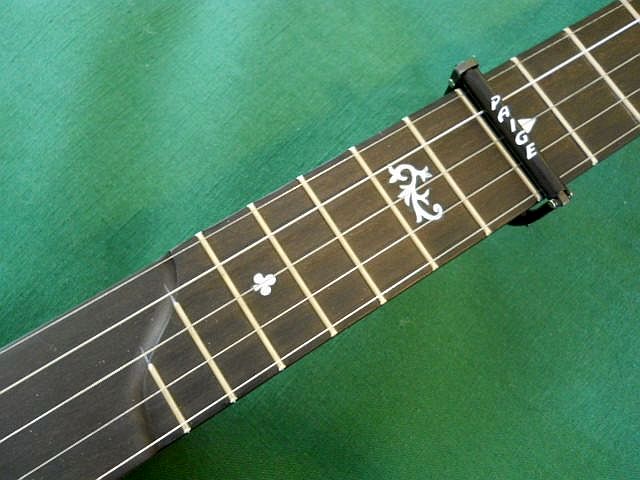
I purchased several Paige Wide capos from a hangout member that had a bunch of new ones for $5 each. I give 'em to friends that need a wide capo up the neck. My octave mando playing friend loves his, but he doesn't tell anyone that it said "banjo capo" on the package! Here's mine at the tenth fret:
steve davis - Posted - 07/22/2011: 08:36:37
There's no need for a capo to make your banjo go any sharper than when you fret it.
If you have a straight bridge,you will find all kinds of sharp notes on the neck whether you capo or simply fret the strings.
It's not the capo's fault,it's the bridge's.
Edited by - steve davis on 07/22/2011 08:46:23
rexhunt - Posted - 07/22/2011: 09:29:45
quote:
Originally posted by Richard Dress
I can capo to the 5th fret a lot faster than you can with your Paige, I bet. But you are right; if you are used to it, stick with it. And I didn't say Shubb was the only good choice. It's really only for those of us who can play along with the Country Gentlemen's "Matterhorn". There is a lot of banjo above the fourth fret, you know. (Want to buy a barely used Paige?)
I can capo just as fast as you on the 5th fret. How? I pull the Shubb out of my back pocket and leave the Paige where it is. I don't use it much but I've got it.
Rex
Richard Dress - Posted - 07/22/2011: 10:00:47
Rex, I never thought of that. Does it really work well? I still wouldn't change brands but it is interesting. I have seen it on a guitar to change tunings but never to change keys.
John, a Paige for $5? I got ripped off in more ways than I thought. It's not worth taking a $5 capo to the PO and paying the postage and mailing it to a buyer. Maybe I'll leave it at a jam. If you don't capo past the 4th fret and don't need to grab your Keith tuners, then it's smooth sailing with a Paige. I don't have tuners but I commonly capo above the 4th and many of those pickers backing female lead singers are pushed in that direction. But more than anything else it comes down to what you are used to. In the 1940s maybe they were happy using a pencil and rubber-band. All these modern accessories won't make us better musicians but they make playing music a lot easier.
rexhunt - Posted - 07/22/2011: 10:29:42
Richard, I'll usually put the Paige back behind the nut but I really don't have to. I agree that if you are going to put a Paige style capo past the 4th fret, it's going to be harder than a Shubb but - for me anyway - it's a whole lot quicker just leaving it on for the first 4 frets - and cuts down the wear and tear on my back pocket.
Rex
Banjophobic - Posted - 07/22/2011: 14:15:33
quote:
Originally posted by Richard Dress
Rex, I never thought of that. Does it really work well? I still wouldn't change brands but it is interesting. I have seen it on a guitar to change tunings but never to change keys.
John, a Paige for $5? I got ripped off in more ways than I thought. It's not worth taking a $5 capo to the PO and paying the postage and mailing it to a buyer. Maybe I'll leave it at a jam. If you don't capo past the 4th fret and don't need to grab your Keith tuners, then it's smooth sailing with a Paige. I don't have tuners but I commonly capo above the 4th and many of those pickers backing female lead singers are pushed in that direction. But more than anything else it comes down to what you are used to. In the 1940s maybe they were happy using a pencil and rubber-band. All these modern accessories won't make us better musicians but they make playing music a lot easier.
Richard
I think you got me confused with Rudy's post, in regards to how much I paid.. He's the guy who got some Paige capos for 5 bucks...lucky dog. I paid 15 for mine, if I remember correctly. Ive got Keith tuners but rarely use them and never when capoed, so thats not an issue for me either.
As you said, its about what works and there are many choices in capos these days so to e ch his own. The Paige has been a well worth the 15 bucks and will most likely be the only capo I'll ever need.
DantheBanjoMan - Posted - 07/22/2011: 23:35:37
Richard said:
What Steve says makes a lot of sense but I don't see it working in the real world. I wonder why?
Before we can answer that question, let's do a test. I just did this myself with an Epiphone MB 250.
Use a single string, let's say the G string. Since we're dealing only with one string, it doesn't matter if the bridge is compensated or not. Set it so the banjo plays exactly one octave higher at the the 12th fret. When I fret it at the first fret with normal finger pressure it plays slightly sharp. All of this is easily proved with a strobe or a good electronic tuner and you can try it yourself.
Why is this? The height of the nut raises the string off the fingerboard to the degree that, all else being the same, it will play sharp. Think of it as a right triangle. The distance from the nut to the first fret is one leg, the distance from the fingerboard is another leg, and the distance from the nut to the first fret is the hypotenuse, which is marginally longer and that alone would cause the string to play a tiny bit sharp, but the pressure of pushing down the string to the fingerboard stretches the string and causes it to go sharp. Therefore, in order to play perfectly in tune, the nut should be moved a tad closer to the first fret.
This is an important element of the Buzz Feiten system. According to the Buzz Feiten website "The strings are moved closer to the first fret a precise distance based on the scale length, fret width and string gauge of your guitar." The only banjo maker that I know of who precisely corrects the intonation at the nut is Geoff Stelling, and I believe that Geoff does this himself to every banjo before it leaves the factory, although I have run across certain banjos (like my Gibson RB 100) where it seems that someone has introduced a certain degree of compensation at the nut.
That's not to knock the compensated bridge. Compensated bridges are very good.
Of course, once a capo is in place it's all about the bridge because the nut is not a factor in equation.
steve davis - Posted - 07/23/2011: 03:44:37
Strings don't fret sharp all the time.You can move the bridge enough toward the tailpiece so that the strings fret flat.
You can use all the words you want to,but my compensated bridge design lets the fretted and capoed strings to be very accurate all over the neck.
I know this because I hear this and a tuner bears out what I say.
Edited by - steve davis on 07/23/2011 03:47:19
steve davis - Posted - 07/23/2011: 04:16:10
When you capo a banjo with a compensated nut the effects of the nut are still good because the fretted notes are dividing the string at a different ratio of the entire length of the string.
rudy - Posted - 07/23/2011: 04:44:00
quote:
Originally posted by Banjophobic
Richard
I think you got me confused with Rudy's post, in regards to how much I paid.. He's the guy who got some Paige capos for 5 bucks...lucky dog. I paid 15 for mine, if I remember correctly. Ive got Keith tuners but rarely use them and never when capoed, so thats not an issue for me either.
As you said, its about what works and there are many choices in capos these days so to e ch his own. The Paige has been a well worth the 15 bucks and will most likely be the only capo I'll ever need.
Yup, I’m the guy. When I purchased these I thought “What am I going to do with those?” I used ‘em as freebies to my playing friends, but kept one for myself.
Regarding the whole compensation issue: You can use whatever bridge design that trips your trigger. You can make it Z, X, or Y=shaped, make it wavy or make it straight, make it so it undulates. Make it soft or make it hard, throw the rest out in the yard. Repeat all that for the nut. Do it often enough and you’ll have no time to actually make music. If things still sound that bad maybe a change in hobby is in order.
If you’re blessed (or cursed, depending on how you look at it) with a critical sense of pitch then you’ll never be completely happy with ANY bridge at ANY position on the head. If you’re happy with whatever floats your boat more power to you.
IF you get a banjo (or any other fretted or fixed pitch instrument) to sound good in any particular key that you prefer playing in you can consider yourself lucky. That will change when you go to a different key, unless you lack a keen sense of pitch discernment. The reason you can set any bridge (straight, curved, intonated, squiggly, yada, yada, yada) for proper intonation and then forget about it has much less to do with mechanics and more to do with equal temperament. If a special design works for you that’s great; placebos also genuinely help many patients with illnesses, too.
What’s equal temperament? My explanation relative to banjo HERE.
There. I used all the words I wanted to use.
steve davis - Posted - 07/23/2011: 04:55:33
I'd be happy to send you one of my compensated bridges to try,Rudy.You might be surprised.
Cav - Posted - 07/23/2011: 05:54:33
I'll vouch for Steve's bridges. I have one and it really does help a LOT with intonation problems. The ONLY intonation problem I have with it is the 3rd string at 19th and higher frets is a bit flat, but everything else rings true. Course, this isn't a problem once we capo up to A or B :)
steve davis - Posted - 07/23/2011: 06:11:27
Thanks,Stephen.A bridge can only do so much in perfecting the fretted notes.To get perfect zero accuracy everywhere involves slanted frets(which are being made),but I like that those notes are on the flat side of 0.
A touch flat up there produces a sweeter tone than a touch sharp and can be sharped slightly with finger pressure.
Joe Jakonczuk - Posted - 07/23/2011: 07:01:00
I never worried about the banjo going a little sharp with a capo because the guitars go a little sharp too. We are pretty close, The uncapoed instruments aren't sharp but who cares about them?
Randall - Posted - 07/23/2011: 08:08:07
Lol Joe!!
If the bridge is right, most notes will be close. I play a compensated bridge third string only. My third string is a fraction sharp when I capo. Nothing I can't live with. On stage I let it go because the show must go on! Maybe in a jam or practice I might try to press on the string to lower it.
The way I set a bridge may be different than others. I use harmonics and overtones to insure the "ring" of the notes all the way to the 22 fret. You can't set it perfect for every note and every string. There must be a compromise on some notes.
Just my two cents!!
Page: 1 2
Terms of Use | Privacy Policy | Privacy Consent (EU/GDPR Only)
Copyright 2026 Banjo Hangout. All Rights Reserved.