
DVD-quality lessons (including tabs/sheet music) available for immediate viewing on any device.
Take your playing to the next level with the help of a local or online banjo teacher.
Weekly newsletter includes free lessons, favorite member content, banjo news and more.
Premier Sponsors


|
Please note this is an archived topic, so it is locked and unable to be replied to. You may, however, start a new topic and refer to this topic with a link: http://www.banjohangout.org/archive/207669
Page: 1 2
Wes Lassiter - Posted - 05/29/2011: 05:20:35
I have a 1926 TB 3 I have just come into ownership of and was wondering why ball bearings and the tone ring in such a strange format? What is the tonal purpose and what was trying to be achieved here with this bizarre kind of construction?
HSmith - Posted - 05/29/2011: 05:41:25
Hi Wes
I understand that the ball-bearing system was intended to ease the problem of calf-skin heads expanding and contracting in conditions of high humidity. When the skin moved, the tension in the springs beneath the bearings was intended to help maintain a constant head tension. With the invention of plastic heads, the problem disappeared and the ball-bearing system was discontinued. While their owners clearly have every right to do as they wish with them, I think it's a pity that so many bb banjos are converted to take a standard tone ring. These instruments are a part of banjo history and I've heard some that sound really good.
Best wishes
Harry
TB-4 Guy - Posted - 05/29/2011: 05:53:08
What Harry says makes sense. I don't know exactly when the plastic heads came into use but I can see where the springs and ball bearings would keep the head tight under varying conditions of temperature and humidity.
Beyond that, there's nothing bizarre about the ball bearing tone ring setup. My little 1923 TB-4 with its now plastic head is very bright and has excellent sustain in chords and notes. It's actually a very nice, well thought out system that helped to make Gibson banjos stand out in that era.
Emiel - Posted - 05/29/2011: 06:00:03
It's not an "era". Gibson only produced Mastertone ball-bearings for two years only. The head tension was not the reason, the patent and the advertisements don't mention it at all. It was said that the tone ring could float "freely" this way. Advertisement speech and gimmicks of those days. They do sound great though.
This all has been discussed before in various lengthy threads... 
ronald trotta - Posted - 05/29/2011: 06:07:41
More than likely it was too expensive and didn't work that well.If you tightened your head and compressed the springs on a humid day when a dry day came along the head could still burst.I think it worked alot better on paper than in actual playing conditions.Just my opinion
Emiel - Posted - 05/29/2011: 06:17:14
quote:
Originally posted by ronald trotta
More than likely it was too expensive and didn't work that well.If you tightened your head and compressed the springs on a humid day when a dry day came along the head could still burst.I think it worked alot better on paper than in actual playing conditions.Just my opinion
Like I said, there's no single word about it on paper...
Edited by - Emiel on 05/29/2011 06:17:41
Banjo40 - Posted - 05/29/2011: 06:35:55
I was under the impression that the latest school of thought about ball bearing tone rings had drifted away from the popular and accepted head tension theory to the theory that they were introduced to improve tone by allowing more head vibration.
Mike
Wes Lassiter - Posted - 05/29/2011: 06:56:48
I took one look at the craftsmanship involved combined with the banjos I have heard and wondered why anyone would cut on those to put a flathead rings as well. I have heard some really nice sounding banjos. Also I was lucky enough to find a 1925 ? 1926 (from that era) style three five string neck from a friend of mines pre war parts banjo. It will be like changing the barrels of a shotgun to convert it and if anyone wanted it back as a tenor all they would have to do is change it back to the old neck. How cool is that !!! The expansion and contraction theory makes sense although I could see where it might not work as planned.
rexhunt - Posted - 05/29/2011: 07:56:59
As Emil has said, the constant tension had nothing to do with it. Gibson was simply following the current banjo tone ring wisdom of "floating" the tone ring above the rim. The ring was more or less a round version of Vega's Tubaphone ring but was floated above the rim not unlike the Lange style tone rings of the same period. It sounded good but was expensive and complicated to manufacture. The cast tone ring turned out to be cheaper and sounded just as good albeit different.
Rex
Wes Lassiter - Posted - 05/29/2011: 08:03:24
quote:
Originally posted by USELESSWALI
lloyd loar for sound
Please explain !!!
tom elder - Posted - 05/29/2011: 08:06:38
Jim Reed here at the hang out gets a lot of depth from those springs
gdoc - Posted - 05/29/2011: 09:00:06
Hi Wes,
Congrants on getting a great banjo.
One of the reasons I don't believe the springs were for keeping the calf skin tight, is the action would be going up and down then too. I've heard from so many people who know about the banjos, that it was for transfer of tone into the rim.
But your right about one thing, it took a lot more work to make one of those banjos.
gdoc - Posted - 05/29/2011: 09:08:43
I posted awhile back the two main reasons for the ball bearing banjos, so here is a repeat for those of you who already read it...
The 24 ball bearings reduce friction better than the tone rings that fit like a bushing.... therefore, you are able to play much faster!
Also with that 24 independent coil spring suspension, your playing will be much smoother too!
Wes Lassiter - Posted - 05/29/2011: 09:42:22
quote:
Originally posted by gdoc
I posted awhile back the two main reasons for the ball bearing banjos, so here is a repeat for those of you who already read it...
The 24 ball bearings reduce friction better than the tone rings that fit like a bushing.... therefore, you are able to play much faster!
Also with that 24 independent coil spring suspension, your playing will be much smoother too!
Now that makes sense!!!
Banjo40 - Posted - 05/29/2011: 12:47:18
quote:
Originally posted by Wes Lassiter
quote:
Originally posted by USELESSWALI
lloyd loar for sound
Please explain !!!
Lloyd Loar was the "acoustical engineer" at Gibson from 1918 until 1924. From Roger Siminoff "Lloyd's work on banjos was equally astute. Loar developed a new banjo design with a hollow tubular tone chamber supported by spring-loaded ball bearings. This instrument was the foundation of the heralded Gibson Mastertone banjo line and the many pot-assembly hardware derivations that were to follow."
Edited by - Banjo40 on 05/29/2011 12:52:25
mikehalloran - Posted - 05/31/2011: 04:53:54
Actually, the Style 3, pre-Mastertone, did not have springs. It was thought that floating the tone ring would make it vibrate more freely. The springs were added to keep the balls from rattling and to make the tone ring vibrate even more freely.
The illustration on the left is a '23/24 Style 3; the one on the right would be a 4 or 5:

I never owned a trap-door era 4 or 5 but I have owned a number of 3s including an RB from 1924.
Plastic heads had nothing to do with it seeing how they weren't to be invented for another 30+ years.
Edited by - mikehalloran on 05/31/2011 04:56:12
Prof - Posted - 05/31/2011: 06:09:41
"The springs were added to keep the balls from rattling and to make the tone ring vibrate even more freely."
Interesting thought. My first inclination would be to think that the springs would actually have a dampening effect on vibrations.
Edited by - Prof on 05/31/2011 06:11:25
Emiel - Posted - 05/31/2011: 09:40:48
quote:
Originally posted by Prof
"The springs were added to keep the balls from rattling and to make the tone ring vibrate even more freely."
Interesting thought. My first inclination would be to think that the springs would actually have a dampening effect on vibrations.
I don't know but the sound of the at least spring-supplied ball-bearings leaves nothing to wish for... I think, El Dobro got it right though...
Edited by - Emiel on 05/31/2011 09:41:47
mikehalloran - Posted - 05/31/2011: 10:01:37
Here is the non-sprung RB-3 as played by Buell Kazee:
youtube.com/watch?v=AgBgfn9S3gw
I traded mine to David Grisman in 1995. No regrets but I kind of wish I'd kept it on occasion.
Edited by - mikehalloran on 05/31/2011 10:03:54
The Old Timer - Posted - 05/31/2011: 11:57:23
I never thought about it as "floating" the tone ring above the rim--I always thought is was for head tension variation.
But I guess having that big tube touch the rim all the way around could be conceived of as "dampening" the vibration of the tone ring tube itself... Imagine a bell with a circle of wood hanging on its "bell-mouth". It would affect the sound of the bell, right?
What Gibson didn't seem to figure was that the tone ring/maple rim combination might an even BETTER tone if they were in full contact, as the later case tone rings indeed were.
The flaw in their thinking was that only the tone ring counted in making the banjo's sound. Rims were just a piece of wood to hold the shape of a circle and fasten the hardware to, a "base" with no tonal properties.
Oldtwanger - Posted - 05/31/2011: 12:58:26
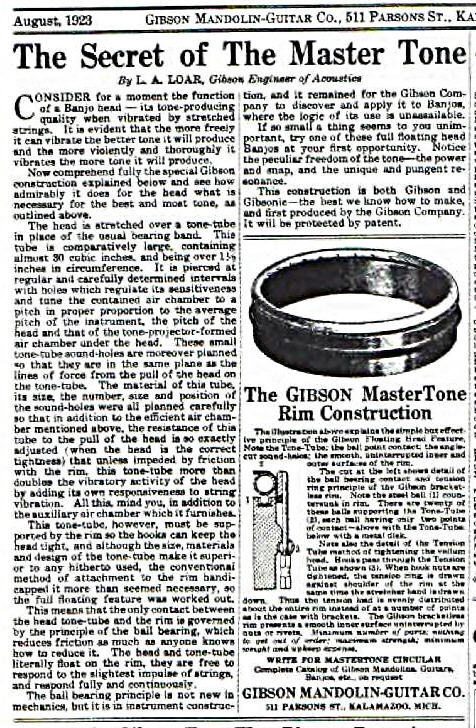
Well, time to post this again - Loar's thoughts in August of 1923 on the ball bearing tone chamber. This was the immediate predecessor of the model with springs.
Loar was a degreed acoustical engineer and his concept was based on the principle of "restoring force" wherein the acoustical energy is transmitted downward into the assembly and returned upward in a manner that reinforces the original energy source. The later addition of springs was to further increase the effects of this restoring force.
Later tonerings, although of differing construction, still function in the same manner. It is not about the tonering vibrating freely like a bell, but rather as a transmitter of acoustical energy between the head and the rim/neck assembly, and it's effect on those vibrations in absorbing some while reinforcing others in the process, not unlike the function of the bridge.
Steven M - Posted - 05/31/2011: 13:14:24
quote:
Originally posted by Oldtwanger
Later tonerings, although of differing construction, still function in the same manner. It is not about the tonering vibrating freely like a bell, but rather as a transmitter of acoustical energy between the head and the rim/neck assembly, and it's effect on those vibrations in absorbing some while reinforcing others in the process, not unlike the function of the bridge.
I never understood that. Surely if you have the head and 'tonetube' vibrating on springs then the responsive compression of the springs will DAMPEN the head vibration, NOT enhance it. There is no way that a series of springs can be engineered (at this level) to promote constructive interference whilst reducing deconstructive interference
As an obvious confirmation of this, that is surely why heavy, high mass tone rings that have a good contact with the pot are now regarded as the best tone producers.
Edited by - Steven M on 05/31/2011 13:22:50
Emiel - Posted - 05/31/2011: 14:04:48
quote:
Originally posted by Steven M
quote:
Originally posted by Oldtwanger
Later tonerings, although of differing construction, still function in the same manner. It is not about the tonering vibrating freely like a bell, but rather as a transmitter of acoustical energy between the head and the rim/neck assembly, and it's effect on those vibrations in absorbing some while reinforcing others in the process, not unlike the function of the bridge.
I never understood that. Surely if you have the head and 'tonetube' vibrating on springs then the responsive compression of the springs will DAMPEN the head vibration, NOT enhance it. There is no way that a series of springs can be engineered (at this level) to promote constructive interference whilst reducing deconstructive interference
As an obvious confirmation of this, that is surely why heavy, high mass tone rings that have a good contact with the pot are now regarded as the best tone producers.
What, if the vibrations in the tonering are such that they don't cause the spring to contract and release... that they have such frequencies that those frequencies are just transplanted through the springs into the rim?
Oldtwanger - Posted - 05/31/2011: 14:44:56
quote:
As an obvious confirmation of this, that is surely why heavy, high mass tone rings that have a good contact with the pot are now regarded as the best tone producers.
What, if the vibrations in the tonering are such that they don't cause the spring to contract and release... that they have such frequencies that those frequencies are just transplanted through the springs into the rim?
Now you're getting the idea.
Loar was working on the preliminary stages of what eventually evolved into the Mastertones we love. At the time he believed the basic tonering needed to be isolated to perform its task, but after his departure the cost reduction process brought about cast tonering that worked better clamped firmly to the rim. Oh happy day.........
Loar was on the right track. The 1925 and 1926 ball bearings sounded great; they only weakened when compared to their successors both in sound energy and production cost.
Oldtwanger - Posted - 05/31/2011: 15:10:17
Over the years I have developed another theory - that's all it is, I can't prove a thing. Years ago when I worked in Radar, we had a ground based set that generated a six microsecond pulse.
By delaying that pulse twice and adding it back to itself we transmitted an effective 18 microsecond pulse with three times the average power.
Twanger, what the hell are you talking about?
Delaying and adding back.
Well, I can't help but wonder if Loar was onto something different with those springs. Think about it - if those springs were straightened out they would be quite long. The vibrations being transmitted to the rim/neck and then back again were traveling a longer distance through the coils of the springs, delayed by some small amount and then added back to the original (restoring force). The early Hammond organ used long spring delay lines in tubes filled with oil to introduce electronic reverberation. Later, this evolved into the small spring delay lines we all used in our Fender amps early mixing boards.
It would not surprise me if Loar was using this acoustical delay principle to add something extra to the sound output. It may not seem like much, but remember that very small changes can make a big difference in banjo sound.
But its just another theory of mine to ponder.
The Old Timer - Posted - 05/31/2011: 15:38:06
And just for the record, what university granted a degree in "acoustical (or acoustic) engineering" pre-1920? Hmmmmm? Could you be licensed back then as an acoustical/acoustic engineer? Just wondering...
snakeherd - Posted - 05/31/2011: 15:40:25
We don't know what sound that they were actually trying for. Today, we're all trying to find "the Foggy Mountain Breakdown Sound" but they had their own pursuits back then.
Posters are commenting that the post-ball bearing Mastertones sound better, but for all we know, Loar may have regretted the cost cutting that eliminated the ball bearing design.
TB-4 Guy - Posted - 05/31/2011: 16:24:13
quote:
Originally posted by The Old Timer
And just for the record, what university granted a degree in "acoustical (or acoustic) engineering" pre-1920? Hmmmmm? Could you be licensed back then as an acoustical/acoustic engineer? Just wondering...
That's an interesting point.
Mr. Loar was a rather well-educated man. I found some biographical information here:
siminoff.net/pages/loar_background.html
 I want to see his birth certificate too.
Edited by - TB-4 Guy on 05/31/2011 16:34:27
Hotrodtruck - Posted - 05/31/2011: 17:49:45
Delaying and adding back to the pulse would be a very precise affair. The head tension and spring strength would have to be at a very specific relationship. It does sound good though. I speculate that when the head was tightened to the point that the springs were completely compressed, and the delaying and adding back or free-floating feature was overcome, the improvement in sound convinced them to go with the later rings where energy was transmitted directly to the rim.
Of course, I am speculating and could be all wet...
Mike
mikehalloran - Posted - 05/31/2011: 18:00:37
quote:
Originally posted by Hotrodtruck
Delaying and adding back to the pulse would be a very precise affair. The head tension and spring strength would have to be at a very specific relationship. It does sound good though. I speculate that when the head was tightened to the point that the springs were completely compressed, and the delaying and adding back or free-floating feature was overcome, the improvement in sound convinced them to go with the later rings where energy was transmitted directly to the rim.
Of course, I am speculating and could be all wet...
Mike
Except that Mr. Loar was gone 2 years by then. He left Dec. 1924.
Tightening a skin head to the point that the balls were sunk into the rim was probably not possible back then. 80-90 years later, the springs have lost some tension and, with certain plastic heads, it might be possible now.
I had always wanted to A/B my RB-3 against an RB-4 or 5 but to see if I could hear a difference between springs and none - but never got the chance. Oh well. That Buell Kazee clip shows that those banjos sounded pretty good but mine was never as loud as the Tubaphone I replaced it with.
BanjoLink - Posted - 06/01/2011: 06:17:35
quote:
Originally posted by The Old Timer
And just for the record, what university granted a degree in "acoustical (or acoustic) engineering" pre-1920? Hmmmmm? Could you be licensed back then as an acoustical/acoustic engineer? Just wondering...
Old Timer - that's an interesting point. I am not sure Lloyd Loar was actually an "acoustic engineer" and pretty certain neither was anyone else who ever signed Gibson's mandolins (and maybe other instruments). In many states it is illegal to refer to yourself as an engineer without a degree and state certification. I know it to be the case in Tennessee and it is enforced - however, that has never stopped Gibson from having someone sign their mandolin labels as an acoustic engineer.
TB-4 Guy - Posted - 06/01/2011: 06:48:32
quote:
Originally posted by BanjoLink
quote:
Originally posted by The Old Timer
And just for the record, what university granted a degree in "acoustical (or acoustic) engineering" pre-1920? Hmmmmm? Could you be licensed back then as an acoustical/acoustic engineer? Just wondering...
Old Timer - that's an interesting point. I am not sure Lloyd Loar was actually an "acoustic engineer" and pretty certain neither was anyone else who ever signed Gibson's mandolins (and maybe other instruments). In many states it is illegal to refer to yourself as an engineer without a degree and state certification. I know it to be the case in Tennessee and it is enforced - however, that has never stopped Gibson from having someone sign their mandolin labels as an acoustic engineer.
That's really interesting. So your theory is that Lloyd Loar may have broken the law when he referred to himself as an acoustical engineer. That's really something new that I had honestly never thought of.
The internet is such a wonderful invention. It permits us to explore these thoughts.....
BanjoLink - Posted - 06/01/2011: 07:43:07
TB-4 Guy - It was probably not illegal in Michigan at the time as I imagine the licensing procedures were not nearly as stringent in those days. However, after using the term "golf course architect" on my letterhead in the state of Tennessee prompted a call from the state to tell me to stop using the term architect if I was not registered there. I am a member and past president of The American Society of Golf Course Architects, graduated from college in architecture, and have practiced foralmost 40 years, but none of that carried any weight without me being registered as an architect in Tennessee. I had to change my letterhead to read "Golf Course Designer"! I am positive the same law applies to engineers. Any term affixed to the word engineer ( civil, mechanical, industrial, acoustic, etc.) implies yopu are an engineer and you must be registered.
Didn't mean to sidetrack this thread any further than it already is.
Banjo40 - Posted - 06/01/2011: 08:53:20
This is way off subject, but I've heard for years that Lloyd Loar is Jack Kevorkian's grandfather. Anybody else heard that? Sorry for the detour.
Mike
Oldtwanger - Posted - 06/01/2011: 09:16:43
quote:
Originally posted by Banjo40
This is way off subject, but I've heard for years that Lloyd Loar is Jack Kevorkian's grandfather. Anybody else heard that? Sorry for the detour.
Mike
Neither of Lloyd Loar's two marriages produced any offspring.
Emiel - Posted - 06/01/2011: 09:48:01
According to Joe Spann's book Lloyd Loar became a professor of acoustics at Northwestern University in Evanston, Illinois, in 1925.
BanjoLink - Posted - 06/01/2011: 10:21:26
quote:
Originally posted by Emiel
According to Joe Spann's book Lloyd Loar became a professor of acoustics at Northwestern University in Evanston, Illinois, in 1925.
Then maybe he was indeed an acoustic engineer! Got Joe's book - maybe I ought to finish reading it!
JoeZ - Posted - 06/01/2011: 13:19:28
Apparently another big name banjo company of that era, who had actually thought up that design, threatened suit and Gibson "moved on". So I've read from more than one source. Can't remember which company, though. Glad they moved on to that solid, flathead ring - aren't you?
Emiel - Posted - 06/01/2011: 13:22:50
quote:
Originally posted by JoeZ
Apparently another big name banjo company of that era, who had actually thought up that design, threatened suit and Gibson "moved on". So I've read from more than one source. Can't remember which company, though. Glad they moved on to that solid, flathead ring - aren't you?
If that's true, it was supposed to be Vega, because of the Tubaphone tonering, but that one didn't have ball-bearings... This story has been doubted though...
Edited by - Emiel on 06/01/2011 13:25:59
Fishrrman - Posted - 06/01/2011: 13:44:00
"I understand that the ball-bearing system was intended to ease the problem of calf-skin heads expanding and contracting in conditions of high humidity. When the skin moved, the tension in the springs beneath the bearings was intended to help maintain a constant head tension. With the invention of plastic heads, the problem disappeared and the ball-bearing system was discontinued."
Well, it weren't exactly like that...
Ball-bearings were produced in 1925 and 1926, and discontinued in 1927 (in favor of the cast 1-piece archtop ring).
The first Remo "Weatherking" plastic heads were introduced in 1959.
Your timeline is off by 32 years!
- John
TB-4 Guy - Posted - 06/01/2011: 14:03:51
quote:
Originally posted by Fishrrman
"I understand that the ball-bearing system was intended to ease the problem of calf-skin heads expanding and contracting in conditions of high humidity. When the skin moved, the tension in the springs beneath the bearings was intended to help maintain a constant head tension. With the invention of plastic heads, the problem disappeared and the ball-bearing system was discontinued."
Well, it weren't exactly like that...
Ball-bearings were produced in 1925 and 1926, and discontinued in 1927 (in favor of the cast 1-piece archtop ring).
The first Remo "Weatherking" plastic heads were introduced in 1959.
Your timeline is off by 32 years!
- John
Do you have a reference for the date the first plastic banjo head?
stanger - Posted - 06/02/2011: 04:57:17
Hi, Wes...
The springs and all were there for tonal reasons only. The idea of the springs acting as constant head tensioners was never part of the patent- if the springs were added for that purpose, Gibson would have included it in the patent description, as steady tension on skin heads was the Holy Grail of design back then.
None of Gibson's advertising ever mentioned self-tensioning as a feature. It's one of those things that sounds logical, but springs strong enough to counter a head's tension would have to be so strong the banjo couldn't have been assembled by hand. But it worked as a salesman's gimmick, and persists to this day.
The prevailing acoustic theory back then was to let the banjo's sound 'out', and Gibson took that theory to the max with the ball bearing Mastertone. The 1925 model put at least 50 holes in the tone ring skirt, just to make sure plenty of sound got out in addition to all the other parts.
The entire thrust of the banjo makers and players of the time, was volume as the banjo evolved from a rather quiet parlor instrument into a stage instrument. Volume was the reason why the tenor banjo overcame the 5-string in popularity- the higher pitch of the tenor tuning added string tension to the head, which increased the volume, as did the use of a flat pick vs. bare fingers. The tenor tuning in 5ths, which creates a greater note separation to the ears, also gave the perception of greater volume.
The first tone rings increased the volume, but the reasons why they worked weren't understood well. It came to be generally believed that tone rings somehow increased the vibrations of the banjo head. (What they actually did was increase the mass of the rim, which concentrated the head's vibrations more to just the head and less bleeding of the head's vibrations into the rim.)
The tone rings also imparted much more metallic brightness to the tone, which was equated back then to be volume. It was simply cutting power, as the high overtones were reinforced.
How the banjo makes noise was misunderstood. The theory of increasing vibration in a violin's or a guitar's top by 'floating' the top- making the edge as thin as structurally possible, works, but they are made of wood, not skin. A banjo head vibrates in an entirely different way.
The very first resonators were created in a further attempt to make the banjo louder, but the earliest fit snugly into the back of the rim, and had the opposite effect. They tended to damp the head's vibrations, much like a sealed back 'infinite baffle' speaker does. So holes were drilled all over the place in addition to the resonators, which let the banjo head pump again.
Different manufacturers used many different hole systems- some drilled holes in the rim, others in the tone rings, others in the back of the resonators. The first high volume banjos were the Rettberg-Lange Orpheums, which were the first to incorporate a plate flange to hold the resonator. The holes in the flange, combined with a multi-piece tone ring that consisted of a hollow brass tube resting on metal 'staples', which were held in place by small holes drilled into the top of the rim, was a radical departure back then.
Back then, as now, resonated banjos are thought to be louder, because the sound is directed forward by the resonator. The audience hears more volume than the player.
Other makers misunderstood why the Orpheums were so loud. They thought it was the tone ring, not the resonator design. Since the Lange tone ring was patented, the others all came up with their own 'tube on pins' designs. Vega's Whyte Laydie tone ring, which was the oldest, was widely copied, and Epiphone used a similar design in their recording models. All were archtop designs. The Vega tone rings, especially the Tubaphone, had high volume as open backs. Vega's solution to adding a resonator was adding individual small flange plates held in place by the bracket shoes, and this worked just fine. Vega was Orpheum's main competition in the modern banjo market for years before Gibson made any banjos. Bacon was the other big brand, which followed after Vega and Orpheum. All 3 were making modern banjos by 1919 or earlier.
Gibson was very late in coming to the banjo market, and after they got in it, their designs were far behind. They were a mandolin and guitar company, and had no experience with banjos.
The tube on pins system was changed by Gibson to a tube on ball bearings, but their early resonators sealed the back of the banjo. A port was cut in the reso backs, but it didn't increase the volume much, and Gibson added a hinge to the resonators, which allowed a portion of the back to swing open. This didn't increase the volume any more than the hole, but it changed the tone a lot, as the banjo became essentially open backed when the trap door was open.
Loar designed the tube on ball tone ring (without the springs), and he designed the use of a hollow tube to hold the brackets instead of using shoes, which created a smooth surface on the inside of the rim- this smooth rim was used first by Vega, and was a sales gimmick.
By 1923, Gibson finally realized they were missing the boat in comparison to it's banjo competitors, so they essentially copied the Orpheum's later version, the Paramount. They used a new peghead shape that imitated to the Paramount's, lengthened the scale, and adopted the Lange style flange and resonator. At the same time, they incorporated the few successful features they already had, including the smooth rim and the tube on ball tone ring.
The springs were essentially a sales gimmick. The tube on ball bearings tone ring worked just as well, and sounded very similar. The ball bearings were used partly because no other maker used them, and partly because the amount of surface on a bearing is much smaller for the tone ring tube to rest on than any of the other systems. The bearings didn't rattle in the rims as was suggested earlier- they were held in place with small flat washers in the bottom of the rim holes. When the head is tightened, the balls, washers, and springs are totally compressed.
The reason why the ball bearing Mastertone was so successful in comparison to Gibson's earlier banjos was mostly due to it's modern appearance. The old Gibson peghead shapes were odd, and more mandolin-like than their competitors, the scale was very short while all the others were much longer (and longer scales increase volume), and the competitor's banjos at the pro level all had fancier inlay patterns. All except Vega had archtop tone ring designs and heavy rims, and all had resonator flanges with holes.
Gibson simply got in the game. They dropped all the mandolin-like aspects of their earlier banjos, modified took what they already had, and copied elements from their competitors to create a banjo that was similar to the competition and fit the ideas of the day.
The ball bearing system was the most complicated floating tone ring on the market, and worked well as a sales gimmick, but was a nightmare to manufacture and assemble. And Gibson dressed their new models up with a choice of fancy inlays and trim, something the others didn't do much.
While the ball bearing Mastertone only lasted for 2 years, the tube on ball tone ring was around for 3 years previous, so Gibson stuck with it for some time. The cast bronze archtop tone ring was Gibson's solution to the ball bearing's severe production problems. While it cost more, the labor costs were cut drastically, and labor is the greatest cost by far over materials. The huge addition of mass under the banjo's head the cast tone ring added increased the volume enormously, and all of a sudden, Gibson banjos were the loudest that could be had.
The cast archtop was the first radical departure from prevailing acoustic theory of the time, but the old floating, let-the-sound-out theory is still around today, and the solid, high mass tone ring combined with high-mass rim is still misunderstood. That's why how many little holes drilled in cast tone rings is still argued- they were the last Gibson remnant of lot-of-holes. The greatest advance in banjo acoustic theory was accidental, and had nothing to do with Loar, who was long gone by then.
My brother has a 1923 TB4 Gibson tenor, and I own a 1925 ball bearing. Both have skin heads. His sounds very similar to mine, but the modern resonator on mine makes it louder. At lower head tension, both have real sweetness of tone. His has more sustain than mine.
regards,
stanger
Edited by - stanger on 06/02/2011 05:51:31
Ks_5-picker - Posted - 06/02/2011: 07:20:40
I must say I really enjoy the postings of you long time banjo enthusiasts who are so knowledgable about these old Gibsons and are willing to share info. Thanks!
Page: 1 2
Terms of Use | Privacy Policy | Privacy Consent (EU/GDPR Only)
Copyright 2026 Banjo Hangout. All Rights Reserved.


