
DVD-quality lessons (including tabs/sheet music) available for immediate viewing on any device.
Take your playing to the next level with the help of a local or online banjo teacher.
Weekly newsletter includes free lessons, favorite member content, banjo news and more.
Premier Sponsors


|
Please note this is an archived topic, so it is locked and unable to be replied to. You may, however, start a new topic and refer to this topic with a link: http://www.banjohangout.org/archive/207360
Cryo - Posted - 05/24/2011: 17:14:58
Just got my first long neck banjo. What tuning should I start with? Any recommendations? Looks like it is set up pretty well. Very nice Gold Tone long neck with open back.
As a clawhammer novice, is it OK to start with a long neck. I bought this because I was impressed with Pete Seeger, especially when he came down to DC to sing the Woody Guthrie version of This Land is Your Land.
Grey Dog - Posted - 05/24/2011: 17:30:19
Sounds to me like you should start in whatever tuning "This Land is Your Land" is in.....
J-Walk - Posted - 05/24/2011: 17:36:14
I think most long-neck players end up putting a capo on the 3rd fret so it's like a normal banjo. Then, just tune to standard G or Double-C. I just never understood the point, unless you need to sing in the key of E -- and then you need to stretch your left arm to an unnatural (and apparently uncomfortable) position.

There must be a good reason for long-neck banjos, but I don't know what it is. I'm sure somebody will tell me.
Cryo - Posted - 05/24/2011: 18:03:59
Found some good advice on the Long Neck Banjo Group in this forum.
There is a following for this kind of banjo. Very cool.
Galante_K4 - Posted - 05/24/2011: 18:06:19
Got my Vega Pete Seeger model in 1964 I think. Wanted to be just like Pete ... but I can't sing so the long neck has been a waste. All these years I automatically capo at its 3rd fret. You sing?
Now I just about never use this fine old banjo. I've been really happy with my Bart Reiter Regent. Its the one I play daily.
wbheilmann - Posted - 05/24/2011: 18:24:10
The reason for the long neck is simple -- it gives access to more keys without having to retune the banjo. Tuned to E, it can easily be adapted to more "singing keys" by moving the capos. Thus, the player can use the same chord shapes for more keys and thereby reduce the need to learn and use alternate tunings.
Longneck banjos are especially well-suited for folk music, where the emphasis in most songs is more on singing and less on instrumental passages. In other words, folk singers and groups typically use their instruments to back up their singing. They sometimes break for instrumental solos, but the main focus is on the song and the story it tells.
There isn't any "right way" to play a longneck banjo for folk music -- some players use picks (bluegrass-style), while others use various bare-finger styles (ala Pete Seeger, Dave Guard, etc.). I play mainly clawhammer-style (with variations) on mine, and it seems just as suitable for folk music as it is for old-time fiddle/banjo tunes.
Put the capo on the 3rd fret, and you've got a regular open-back banjo. That's pretty versatile, if you ask me.
WB
championofnorthhuron - Posted - 05/24/2011: 18:39:08
quote:
Originally posted by J-Walk
I think most long-neck players end up putting a capo on the 3rd fret so it's like a normal banjo. Then, just tune to standard G or Double-C. I just never understood the point, unless you need to sing in the key of E -- and then you need to stretch your left arm to an unnatural (and apparently uncomfortable) position.
There must be a good reason for long-neck banjos, but I don't know what it is. I'm sure somebody will tell me.
I'm really just a novice myself J-Walk, but you pretty much nailed it. I have a longneck and it does allow lower keys without retuning. Not only good for singing in lower keys, but also if you just like the throaty growl sound. Doesn't necessarily fit with the keys typically used where other instruments are involved, but obviously fine for solo. Of course you can tune a more standard scale to the lower register, but I have other banjos with more standard scale lengths in the 25"-26" range and when tuned down there the strings are like rubber bands. I think the longer vibrating string length also gives a different tonal quality than a shorter string with less tension. To me the additional neck length/reach isn't so much an issue as is the additional distance between the frets.
As to the original question on tuning... you can either transpose the more typical G, C, Double C, etc. tunings to the notes that would be 3 half-tones lower (assuming your neck has 3 additional frets); Otherwise do what I do... capo at the third fret for purposes of tuning and tune to (i.e. G) gDGBd, then take off the capo and you have yourself the equivalent relevant tonal step difference between strings albeit in the lower register.
jduke - Posted - 05/24/2011: 19:04:30
If your book, DVD or instructor wants you to start in Open G tuning, then tune the open strings of your long neck banjo to eBEG#B. If you are learinig in Double C, then tune to eAEAB. In both cases, you will need to put a capo at the third fret ( eighth fret on the 5th string) to get the keys of G and C, the most common keys and tunings used in instruction material.
In order to play in A or D, you will need to capo at the fifth fret (tenth fret on the 5th string).
I do not usually recommend learning on a long scale or short scale banjo because the keys you are playing do not match the instruction materials. That doesn't mean that it can't be done, it's just that it can be a little extra frustrating for the beginner. That being said, the devotees of long neck banjos here an the BHO are sure to help you in any way they can.
Good luck,
Jeff
xomcat - Posted - 05/24/2011: 19:05:55
"capo at the third fret for purposes of tuning and tune to (i.e. G) gDGBd, then take off the capo and you have yourself the equivalent relevant tonal step difference between strings albeit in the lower register".
Except for the fifth, which is probably tuned to "E", ala John Hartford, if you are a baritone. I am playing with a long neck also. I don't sing, but I love the tones.
oldwoodchuckb - Posted - 05/24/2011: 21:08:10
Most people tune the 5th string to "G" for a start - that is equal to the 1st string at the 8th fret. They also mostly leave the capo in the 3rd frot of the long strings so the "base" tuning is gBEG#B but with a capo in the 3rd fret it works out to gDGBD.
If you have a longneck Pete Seeger's "How To Play the 5 string Banjo" is essential learning material.
If you also want to get into clawhammer I have a free ebook
That can help with a lot of other things beside clawhammering. Along with chapters on clawing there is a chapter on tuning and one on memorizing - a chapter on the tools you need to learn any style of banjo, and... There are a lot of goodies in the book.
Bonuscup98 - Posted - 05/24/2011: 21:25:44
Not more than an aside, but what exactly would a scale length for a long neck be? I know that if I want to sing some songs I tune down a whole step, to F, if only because my lack of training and feeble range require it.
And I wonder, J-Walk, if the stretch is any more of less ergonomically sound than a regular or short scale banjo. I've been playing electric bass for 20-some years and even a 36" scale doesn't feel any more unnatural than any other bass. Or Guitar. Or Mandolin.
Cryo - Posted - 05/24/2011: 21:32:30
Thank you for the helpful replies. I have been playing around with the different tunings and frailing and picking on my new banjo this evening, both with capo and without. I have come to a few conclusions.
1) The long neck is a really nice banjo. Gold Tone makes a really nice product. The White Laydie Ring sounds nice. The fybreskin head goes perfectly with the rest of this banjo. I'll post some pictures when I get a chance. I did not get the version with the frailing scoop, which is OK with me as I would rather have the extra frets up the neck towards the head. The tonal characteristics of this banjo are a marked contrast to my resonator 5 string.
2) My favorite and the most versatile tuning is the Open E tuning so far. I am keeping the 5th string tuned to an e. It is pretty easy to tune it up to G if I capo the other strings to the common banjo G tuning. With the open E tuning I fret all of my favorite songs like I would normally, but sing in a key three half steps lower. Very nice for my voice, which leans a bit towards baritone.
3) From the standpoint of being a guitar player, the fretting is akin to playing a baritone guitar or a bass guitar. A bit more reach, but doable.
4) While it has the versatility of being a solo instrument to accompany vocal, I can distinctly appreciate how this falls nicely between a bass guitar and a mandolin in tonal range for a trio without guitar. I can't wait to try some stuff with this instrument in a group setting and to lay some tracks with it.
Overall, I am pleased with this banjo and am looking forward to explore its versatility further. Those who havent tried a long neck at least for a reasonable amount of time should give it a try.
Cryo - Posted - 05/24/2011: 21:40:19
quote:
Originally posted by Bonuscup98
Not more than an aside, but what exactly would a scale length for a long neck be? I know that if I want to sing some songs I tune down a whole step, to F, if only because my lack of training and feeble range require it.
And I wonder, J-Walk, if the stretch is any more of less ergonomically sound than a regular or short scale banjo. I've been playing electric bass for 20-some years and even a 36" scale doesn't feel any more unnatural than any other bass. Or Guitar. Or Mandolin.
oldwoodchuckb - Posted - 05/24/2011: 22:13:55
I believe the scale length of the original Seeger Model was based on the 27 inch Vega scale that most of their normal banjos had. Those last three frets were quite long and the longneck scale came out to 32 inches - that sounds like too much but it is probably right.
Goldtone scale would be based on Gibson scale of 26.25 inches and probably would be more like 31 inches overall.
Roy Smith, a local luthier and hangout member, recently made a long neck based on Seeger's original cobbed together neck that was only 2 frets longer than normal. He based the scale on the relatively common 25.7 inch scale and with only 2 added frets it came out very compact - for a long neck. I suppose one could get exact scales from one of those on-line fret programs.
Edited by - oldwoodchuckb on 05/24/2011 22:17:37
oldwoodchuckb - Posted - 05/24/2011: 22:25:01
Cryo,
I had a Beatlebass copy (from Japan) And it was pretty light. I never really had much fretting problems since I was usually "up" the neck anywhere to 4 to 7 frets for most songs. I rarely played in a lower position.
With a long neck there was a tremendous weight from the peghead and I had to do a lot more 0pen position scales and runs etc. I found that exhausting. I'm only 5' 9". However I was taller than Hedy West and Michael Cooney, who both made great use of the uncapoed long neck.
Cryo - Posted - 05/24/2011: 22:26:30
Another interesting finding with my long neck:
One of the major harmonic is at the twelfth fret like you would expect it, but the fret markings for the banjo are laid in for the long neck to be played with a capo on the 3rd fret.
As a bass player, i would naturally reach for harmonics to get upper register tones. Just takes getting used to with this banjo. The markings are a throwback to when to get a long neck, some would add a length of wood to their shorter neck banjos - see Pete Seegers instructional book on banjo.
By the way, the harmonics on the Gold Tone long neck are much, much better than any of the shorter scale banjos. Sweet sounding....like fresh made blueberry jam.
Cryo - Posted - 05/24/2011: 22:36:40
quote:
Originally posted by oldwoodchuckb
I believe the scale length of the original Seeger Model was based on the 27 inch Vega scale that most of their normal banjos had. Those last three frets were quite long and the longneck scale came out to 32 inches - that sounds like too much but it is probably right.
Goldtone scale would be based on Gibson scale of 26.25 inches and probably would be more like 31 inches overall.
Roy Smith, a local luthier and hangout member, recently made a long neck based on Seeger's original cobbed together neck that was only 2 frets longer than normal. He based the scale on the relatively common 25.7 inch scale and with only 2 added frets it came out very compact - for a long neck. I suppose one could get exact scales from one of those on-line fret programs.
Edited by - Cryo on 05/24/2011 22:45:18
John Gribble - Posted - 05/25/2011: 02:11:06
quote:
Originally posted by J-Walk
I think most long-neck players end up putting a capo on the 3rd fret so it's like a normal banjo. Then, just tune to standard G or Double-C. I just never understood the point, unless you need to sing in the key of E -- and then you need to stretch your left arm to an unnatural (and apparently uncomfortable) position.
There must be a good reason for long-neck banjos, but I don't know what it is. I'm sure somebody will tell me.
The point of the longneck was to be able to play easily in any key with a minimum of re-tuning. Seeger uses (Still! He's still playing in his 90s) gDGBD and gCGBD tunings almost exclusively. Using a capo and spikes under the fifth string he's able to play in any key using his various right hand styles almost instantly. He's a master at off-the-cuff accompaniment/back-up. And since he's such a Longfellow himself, he doesn't appear to have any troubles with the reaches.
One of my favorite memories of watching him perform in concert was with Arlo Guthrie and Guthrie's electric band in the early 1970s in LA. I believe it was at the Hollywood Bowl. I don't think anybody in the place was having more fun than Seeger that night.
vega long neck - Posted - 05/25/2011: 05:45:30
Generalities are usually a dangerous thing but I have a few general comments on this long thread.......
I bought a Seeger model in the early 60s less than a year after starting to play and had clawhammer and BG instruction. I don't think it was a problem... others might disagree.
The advantages of a long neck are primarily for singers. Seeger says so in his book from the get go. Ease of changing keys and getting the banjo more in register with your voice. It's also a nice change up if others in a group capo UP to a new key you can go DOWN and provide a nice new sound into the mix. I'm a singer so the banjo is wonderful! For a non-singer it's probably not such a big deal and becomes more of a novelty.
I'd venture to say that those who complain of the "un-natural stretch" (etc.) probably haven't played one or if so, not much. Check out the elbow angle of some one playing a standard scale and note how much extension is still available. Sure, a child or some one shorter than 5'6" (maybe?) might have a problem but I doubt most teens or adults will. I own a long neck, a few standard scale, and a pre 1900 short scale and think the short scale is a bigger hassle than the long neck.
They do have a really sweet, low growl when played in E or A !
Scott
Cryo - Posted - 05/25/2011: 08:45:30
Here are some photos of The Goat. As you can see, very nice construction.
 |  |  |
DantheBanjoMan - Posted - 05/25/2011: 09:50:18
I've read that the long neck was developed so that Pete could play along with blues guitarists who commonly play in the key of E. I love the sound of the long neck, but it takes too much of a toll on my left shoulder.
oldwoodchuckb - Posted - 05/25/2011: 13:02:11
That picture shows the position Pete uses a lot when he plays it uncapoed (1 o'clock). It goes lower when he is capoed at the 3rd (close to 2 o'clock. I've never been able to keep my arm raised like that and the weight of that neck is tremendous. But Hedy West held hers almost vertical ( just shy of 12 o'clock) back in the 60s when she sat down to play. The banjo neck was only a couple inches from her left ear - she was almost in the position of the Veena player in an Indian Raga trio. She went to Europe for quite some time and I didn't see her again until the late 70s when she stood to play and held the neck almost flat - but the head of the banjo was well to her right side. Michael Cooney usually sat but he was always switching instruments and only used the long neck for stuff that needed the extra notes. Last time I saw him he was starting to do more with a fretless.
Edited by - oldwoodchuckb on 05/25/2011 13:07:46
vega long neck - Posted - 05/25/2011: 13:36:31
At risk of scaring some folks half to death; If you attach the strap (like Seeger shows in his book) part way up the neck it's balanced all by itself ergo you're not supporting anything with your left arm. I did that about 44 years ago and it's really nice. You just have to be willing to drill a hole and insert a medium sized eyebolt. Works fine, lasts a long time.
Scott
john bange - Posted - 05/25/2011: 14:35:56
I think Vega Long Neck is right about the eye bolt. The position might differ with body size but the balance can't be beat. While I haven't got around to drilling the neck on my new banjo, my Gold Tone was drilled and I never had a problem
Cryo - Posted - 05/25/2011: 17:29:43
I would have concern that drilling into the neck is goin to interfere with access up the neck. I seem to be doing fine with the strap around my own neck and over the right shoulder. I can position the banjo head slightly to the right of center for the long neck. Its comfortable for me.
Marc Nerenberg - Posted - 05/25/2011: 19:04:25
quote:
Originally posted by DantheBanjoMan
I've read that the long neck was developed so that Pete could play along with blues guitarists who commonly play in the key of E.
I think this is highly unlikely, as demonstrated by the fact that Pete first lengthened his neck by only 2 frets and tuned it in F. Pete wanted the longer neck to suit his voice on certain tunes - it had nothing to do with being able to conveniently play with others. Though perhaps he later decided that 3 extra frets would be better than 2 because that would allow him to play blues in E. However, Pete almost never plays blues, and always seems to play pretty much that same one blues riff that he knows. He's really hardly a blues player at all, so I doubt that playing blues was a strong motivator for him to alter his banjo.
Somewhere I've read or heard him explain that he wanted to sing a song in B or B flat and thought it would be much more convenient to be able to capo down 1 or 2 frets from C than to capo up 3 or 4 frets from G, losing the bass.
Edited by - Marc Nerenberg on 05/25/2011 19:12:29
BrittDLD1 - Posted - 05/25/2011: 20:53:00
Originally posted by Marc Nerenberg
Originally posted by DantheBanjoMan
I've read that the long neck was developed so that Pete could play along
with blues guitarists who commonly play in the key of E.
I think this is highly unlikely, as demonstrated by the fact that Pete first lengthened
his neck by only 2 frets and tuned it in F. Pete wanted the longer neck to suit his voice
on certain tunes - it had nothing to do with being able to conveniently play with others.
Though perhaps he later decided that 3 extra frets would be better than 2 because that
would allow him to play blues in E. However, Pete almost never plays blues, and always
seems to play pretty much that same one blues riff that he knows. He's really hardly a
blues player at all, so I doubt that playing blues was a strong motivator for him to alter
his banjo.
Somewhere I've read or heard him explain that he wanted to sing a song in B or B flat
and thought it would be much more convenient to be able to capo down 1 or 2 frets from
C than to capo up 3 or 4 frets from G, losing the bass.
DantheBanjoMan - Posted - 05/26/2011: 05:09:17
I can't vouch for the accuracy of the information, but I've read this (or something like it) in various places:
"These banjos were typically tuned down to "E" in standard five string tuning and were the result of Pete Seeger's need for a banjo that could comfortably accommodate the typical blues guitarist's penchant for that particular key!"
musurgia.com/products.asp?Prod...085182011
I think it's quite possible that Mr. Seeger had more than one reason for wanting three extra frets and that he gave different explanations at different times.
BrittDLD1 - Posted - 05/26/2011: 08:52:22
quote:
Originally posted by DantheBanjoMan
I can't vouch for the accuracy of the information, but I've read this (or something like it) in
various places:
"These banjos were typically tuned down to "E" in standard five string tuning and were the
result of Pete Seeger's need for a banjo that could comfortably accommodate the typical
blues guitarist's penchant for that particular key!"
musurgia.com/products.asp?Prod...085182011
I think it's quite possible that Mr. Seeger had more than one reason for wanting three extra
frets and that he gave different explanations at different times.
Edited by - BrittDLD1 on 05/26/2011 08:55:55
kingfisher500 - Posted - 05/26/2011: 10:32:00
Here is what Pete Seeger say about it in his book, "How to play the 5-string Banjo."
HOW TO LENGTHEN THE NECK
If your 5 -string banjo is of the usual kind, the 5th string peg will stick out between the 4th and 5th frets (Look again at the diagram, page 34 ). This has certain disadvantages F one thing, if you want to play in the key of Gb or F# you cannot move your capo high enough for it.
Furthermore, if you want to use a C tuning to accompany some song, but the key of C is too high for your voice (you may prefer Bb ) you are also stuck. The only way you can get Bb is in the G tuning, three frets up.
Therefore, I have found it very convenient to do a little carpentry on my banjo neck, lengthening it by two frets. Thus I can play in F or Bb without having to capo so far up the neck that I lose my bass notes.
JMarshallP - Posted - 05/26/2011: 20:05:09
Greetings All: Long necked banjos - fun topic. Ed was kind enough to introduce me to Mr. Cohen at a NEFFA festival a few years ago. It was really an honor to meet a gentleman who had helped to add a new dimension to this great instrument. I own a Bart Reiter long neck that I had made back around 1990. It's a great banjo. I did not utilize the extra frets very much at first. I got into Old Time style and never had much need for the lower keys the long neck afforded me. But in more recent years I've been playing with musicians who have a number of different styles and genres that they play in. So every once in a while it's a fun thing to take the capo off the third fret and, say, play "Folsom River Blues" in the key of E! Also, I've got the strap set up in guitar style. So, the neck pretty much stretches out horizontal to the ground, and the pot stays right over my right hip, and it works out quite well. - John P.
Cryo - Posted - 05/26/2011: 23:53:54
From this thread, it sounds like long neck banjos are relatively recent in the banjo world and also the world of musical instruments. Although new, it also appears that this instrument has a following and its capabilities continue to be explored and its stage presence expanded.
I am enjoying this instrument very much and I am glad that I have a long neck as my second banjo. It provides some additional keys and dynamic range.
I am noticing that as I play up the neck, the open back has a much more muted tone than my resonator. Leaving that range to the mandolin in the band when on this instrument is good advice.
BrittDLD1 - Posted - 05/28/2011: 11:57:52
Hi Cryo --
Edited by - BrittDLD1 on 05/28/2011 11:59:17
 Longneck Minstrel c1845-50 | 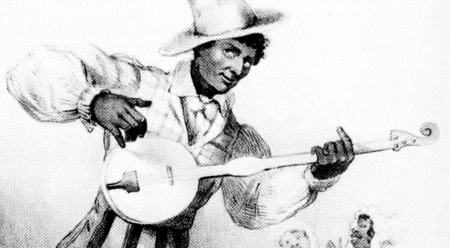 Joel Sweeney with swelled-neck banjo c1845 |
oldwoodchuckb - Posted - 05/28/2011: 12:19:30
It was actually Vega that invented the current "Pete Seeger Long Neck". They had made a few long neck banjos before - most famously the one for Eric Darling that ended up bisecting the cover of his first solo album. That banjo had 3 frets added (like the later Seeger) but the 5th string nut was one fret higher (9th) giving the impression in that picture that the neck was actually 4 frets longer than standard - I certainly believed it was.
Anyhow Vega decided to make a Seeger model and I suspect they either didn't check with Pete, or decided to use up 3 extra fret neck blanks for what they considered to be a niche market. They combined the models making a 3 extra fret neck with the 5th string nut at the 8th fret. - How were they to know the folk boom was right around the corner?
Pete was paid for the use of his name with a banjo. and the Long Neck model as used by every Important folk singer and folk group of the 50s became the instrument that saved Vega for a while. When the long neck craze went the way of all crazes, Vega went under and was eventually sold to Martin and then on to an importer of Asian made banjos. Deering owns the name now.
Edited by - oldwoodchuckb on 05/28/2011 12:24:04
DantheBanjoMan - Posted - 05/28/2011: 20:24:42
There seems to be credible info that Mr. Seeger had a long neck banjo made both for singing purposes and so he could play in the blues guitar key of E.
According to Acoustic Guitars and Other Fretted Instruments by George Gruhn and Walter Carter (I have the 1997 edition), "Folksinger Pete Seeger wanted to play his banjo in keys lower than the standard open-G tuning would allow--particularly in the popular blues guitar key of E. In the 1940's, he had famed archtop builder John D'Angelico make a neck with three extra frets. He then tuned to an open E chord."
I'm not saying that Gruhn and Carver never make mistakes, but that particular book is considered to be a very reliable source.
Marc Nerenberg - Posted - 05/28/2011: 20:52:53
Since, in the 1940s, Seeger was playing first with the Almanac Singers, and then with the Weavers, neither of which had blues guitarists or really played much blues, if any, I wonder what blues guitarists Pete would have been so anxious to be playing with in the key of E.
Josh White? Leadbelly? Brownie McGee? Maybe...though I doubt it.
John Gribble - Posted - 05/29/2011: 01:55:48
Seeger and Big Bill Broonzy performed together at least once and there is even a concert album of the event.
Seeger's used more than one longneck over the years. I believe the first one had two extra frets and that one was stolen. The others have three.
Like most people with most things, I'm sure he had more than one reason for his customized instrument choices.
Cryo - Posted - 05/29/2011: 10:14:05
Just got back from the community swimming hole. I took The Goat along and we had a blast. The neighborhood kids liked Oh Susana and Cripple Creek. I was playing these in open E tuning on the long neck, fingering as if I was in Open G. The guitarist was trying to figure out the key I was using. I think it was in E. Am I correct? I didn't think I was off.
I still am not entirely happy with La Bamba on the banjo. It is harder than I thought to balance "banjifying" and keeping it recognizable. Maybe La Bamba is still best on the guitar. I found a interesting book of Classical banjo by Kyle Datesman. These are mostly pieces of Renaissance music adapted for banjo. I picked up a few riffs from there for soloing with. Something different.
I did the whole thing without capoing once and without any picks. Frailing gives enough volume for a swimming hole, it keeps it sweeter sounding also. I also found when it came to improvising that going up the neck imposed one issue with the long neck. I had to adjust my strap a bit. It reminded me a lot of playing electric bass up the neck. Balance was key. I still am not tempted to put a hole in the neck. The strap I am using (a Neotech WickIt) is fantastic. It is comfortable and provides good support. My current setup for Goat is proving to be perfect for the 2011 summer season.
I am also glad that I have this open back. Jasmine would have been a lot heavier.
Edited by - Cryo on 05/29/2011 10:15:33
Terms of Use | Privacy Policy | Privacy Consent (EU/GDPR Only)
Copyright 2026 Banjo Hangout. All Rights Reserved.


