
DVD-quality lessons (including tabs/sheet music) available for immediate viewing on any device.
Take your playing to the next level with the help of a local or online banjo teacher.
Weekly newsletter includes free lessons, favorite member content, banjo news and more.
Premier Sponsors


|
Please note this is an archived topic, so it is locked and unable to be replied to. You may, however, start a new topic and refer to this topic with a link: http://www.banjohangout.org/archive/201024
Helix - Posted - 03/03/2011: 05:01:11
I'm intertested in peoples' thoughts about how necks are made. The first time I saw an ODE neck, that was it.
A laminated neck can be two-piece, or as many as 7.
Usually with stripe(s).
I prefer splitting a plank and book-paging with a generous stripe because it gives a solid heel and peghead.
Here's one next to a CNC product. 


Edited by - Helix on 03/03/2011 05:13:49
uncle.fogey - Posted - 03/03/2011: 05:19:03
Very nice, Larry!
I'm a big advocate of lamination, myself. It adds strength and stability by allowing you to "engineer" it, and is definitely more economical in terms of wood utilization.
The possibilities are endless.
It looks great, too.
I would only make a one-piece neck for some kind of restoration where the original one had a one piece neck.
rudy - Posted - 03/03/2011: 05:36:59
I've in agreement with you on booking the wood grain and the addition of stripes.
There are several good reasons to laminate:
1. Laminated necks are much more stable and able to reduce any tendancies for twisting.
2. They are much stronger in critical areas such as heel and particularly the neck to peg head transition area. I've seen more one piece necks broken across that area than I care to think about. I've never seen a laminated neck break there. The addition of a peg head veneer and/or back strap further strengthens this critical area.
3. Laminated necks can be made from common "flat sawn" stock which is more readily attained from most any source of lumber. The addition of a center strip (or 2 or 3) allows you to increase the width of your neck blank build up so it's wide enough at the heel, 2" plus. Flat sawn stock is easily book-matched.
I don't think laminated necks are any more resistant to bowing from string pressure than any other form of neck construction, although your choice of woods for the center sections can increase the overall strength in an otherwise less-strong neck design. I do incorporate reenforcement in my necks unless I might be making a short scale designed for nylon strings.
With a little planning reenforcement such as the commonly available graphite bars could be added directly into the center layer so there would be no need to channel the neck and add it after the blank was made.
Edited by - rudy on 03/03/2011 05:40:43
uncle.fogey - Posted - 03/03/2011: 06:20:52
If you put the graphite bars on either side of the truss rod and allow them to continue into the peghead, they strengthen that weak area greatly.
theonly1hardway - Posted - 03/03/2011: 06:24:15
I'm a firm believer in laminated necks.....in spite of what others will say I use no truss rod ( I don't knock the reenforcement)....I just don't see the need....I've built a mere 35 banjos and have never had any neck problems and most are strung with steel....I have one banjo thats been strung full time for 4 years...its straight and is very close to in tune any time I pick it up!!
On another note....where I live its next to impossible to find stock large enough to build a solid neck....I do have wood curing (figured maple) that still has 2-3 years to go before its ready....may try 1 piece necks at that time???? Or sell neck blanks!!
harrisonbanjos.com
uncle.fogey - Posted - 03/03/2011: 07:39:17
Hardway,
I must say you've had better luck than me. Over the years, I have had 2 longnecks and a regular curly maple neck twist.
The way I look at it is that I can buy a two way truss rod for less than 10 bucks and enough carbon fiber for a long neck costs about the same, so I invest $20 in a long neck and $10 in a regular length. which I consider to be a cheap insurance policy. When I sell a banjo to someone, it's guaranteed and I'd hate to have to rebuild a neck.
PLUS, nowadays, people are more sophisticated about action and relief than they were in the past and a lot of players like to adjust the neck relief to a fair-thee-well. It's very handy to have a 2-way truss rod so you can do that, and all it takes is a simple groove in the top of the neck to do it. With a laminated neck, you can even make the center stripe the same width as the truss rod and glue up the blank so to eliminate cutting a groove altogether.
Helix - Posted - 03/03/2011: 09:50:45
There, that's what people need to hear, that's a master's trick you describe, forethought.
Dave Telecaster - Posted - 03/03/2011: 13:03:28
I think splitting thr wood and then laminating is surely the strongest most stable design and i prefer the head to have no wings, but not always that easy with rippled grain. i still not sure about the need for the carbon fibre ? but each to their own
 My new old style 5 string |
uncle.fogey - Posted - 03/03/2011: 13:20:34
I'm sure that everybody knows this, but when you cut neck halves out of a board, you have to flip them, so the grain opposes itself, which is what gives it stability:
No matter how many layers you use, they should always run counter to one another, also horizontal to vertical orientation.
yumagah - Posted - 03/03/2011: 13:31:59
Interesting pictures. The lower-end Martin guitars have "Stratabond" necks made of 35 or more layers. They are reputed to be very strong and don't hurt the sound of the instrument. I wonder if some enterprising banjo maker has tried these for banjos?
McUtsi - Posted - 03/03/2011: 13:40:34
Framus springs to mind,as well...many of their vintage acoustics sported
40-45 ply necks...very strong...I happen to have a late 50´s mulit laminate
Framus kicking around my shop...a customer left it here some 15-20 years
ago...McUtsi
uncle.fogey - Posted - 03/03/2011: 14:09:18
I would venture to say that a multi-ply neck like what's been described would be VERY VERY stable and warp-proof -you might not like the look, which is esentially the same as Baltic birch plywood, but some people like that. I have a knife with a handle having that kind of lamination that's been impregnated with vinyl - "pakkawood". It's beautiful and comes in many colors and finishes.
HOWEVER - just not warping is not enough. I would STILL put in a 2-way adjustable truss rod because of today's players wanting fine adjustment of the action, not blind faith that the neck will not bend. What if it does? I can fix mine with an allen wrench in 5 minutes ( 4 1/2 minutes of that being how long it takes me to find the allen wrench).
Helix - Posted - 03/04/2011: 06:56:24
Definitive pictures, happy to see this come to the front.
I build with the nut contacting the neck, with the peghead veneer or topcap touching but not underlying the nut.
Are people gluing the nut and binding to the fretboard, then assembling over on the one-piece neck? I believe that's a production technique whether from a CNC shop or bench.
blm10jn - Posted - 03/04/2011: 07:12:07
My necks are always 2 piece with a center stripe, booked matched. Cut from 6/4 or 8/4 planks that are at a minimum 7" in width. Most of the time I can get 2 neck blanks from each glued up block. I have been doing them that way for 35 years. All have been strung with steel strings, many with medium guage strings. I try to emulate the feel of the maple necked Fairbanks/Vega banjos ca 1900-1910. I have not observed any warpage. But then that is only in the few that are local and I have been able to watch over the years. There are more out there that I have not seen in years and hope that those are in similar condition. I only make open back banjos these days.
rudy - Posted - 03/04/2011: 09:37:45
Heel ofcut showing bookmatched grain over a walnut center section:
Helix - Posted - 03/04/2011: 14:15:57
Look at that, I like how thin you can cut the hardwoods.
blm10jn: the neck in the first photo is 40 years old. What a well-written and clear response, I'm just 65, so I'm just looking to build better. I think it's real fun to inform the consumer, give them choices. Trunk and large limb.
I know there are a bunch of curious young people here who need to know this stuff.
uncle.fogey - Posted - 03/04/2011: 14:20:55
quote:
Originally posted by Helix
Look at that, I like how thin you can cut the hardwoods.
blm10jn: the neck in the first photo is 40 years old. What a well-written and clear response, I'm just 65, so I'm just looking to build better. I think it's real fun to inform the consumer, give them choices. Trunk and large limb.
I know there are a bunch of curious young people here who need to know this stuff.
Helix - Posted - 03/04/2011: 14:43:51
This music kills death itself, I actually don't plan on dying, and Ken, you sound a little hard to kill, too.
Certainty of death, small chance of success, what are we waitin' for?
uncle.fogey - Posted - 03/04/2011: 14:59:27
quote:
Originally posted by Helix
This music kills death itself, I actually don't plan on dying, and Ken, you sound a little hard to kill, too.
Certainty of death, small chance of success, what are we waitin' for?
farmer bob - Posted - 03/04/2011: 15:40:47
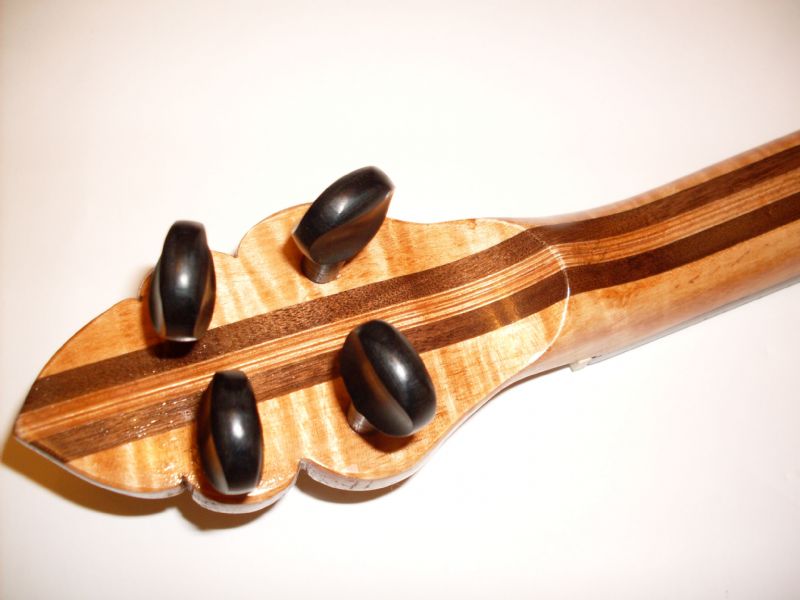
I like Baltic birch 10 plies in my center stripes. Solid woods are boring and if you are going to custom build you might as well make it look cool... Bob.
 |
stanger - Posted - 03/04/2011: 23:12:18
The Ode necks have proven to be very stable over time. I've seen a couple that were slightly bowed, but in both instances, either a minor tweak to the truss rod,
or just changing the string gauges straightened them out.
The laminated necks are indeed quite a lot stiffer than 1-pc. necks. I believe the stiffness of a neck affects the tone at least as much as the choice of wood
used, and possibly more than the wood. Since the tone of a banjo comes from a multitude of variables, I think it's very hard to say just how important a
stiff neck is to the tonal contribution.
But, as I see it, the most important function of the neck is it's ability to stay straight and playable. I have owned a
banjo or two that had shifty necks, which wanted to bow when the climate was moist, and straighten back out when the climate was dry. Neither of them
had problems with the truss rod adjusting the bowing out, but they were both unpredictable and a pain in the butt- I don't like to have to tweak a neck very
much. Both banjos are long gone, and both had single piece necks, but that doesn't prove anything much- 2 banjos is nothing in the larger scheme of things.
Personally, I've always liked the looks of a laminated neck that has narrow laminations. I think that the woods used for the strips should be very stiff and hard-
rosewood or ebony- and I tend to think that the narrower they are- 1/8" to about 3/8", are going to be much stiffer than wider ones. I like the looks of narrow
strips much better than wide ones, as they don't detract from the main wood used in the neck.
Weight is also another factor. Laminated necks can become much heavier, and the weight can shift a banjo's balance quite a lot, especially in open backs.
Even on resonated banjos, a heavy neck can be a hassle, as it's always wanting to slip downwards.
All my best banjos have lively necks. I can feel their necks vibrating, and some are one-piece and others laminated. I'm not sure what this liveliness does, but
it must be contributing something I like to hear. I think that it comes more from excellent neck-to-rim fit more than anything else, as none of my banjo's
co-rods are cranked down very tightly, and some of my banjos have old-style dowel sticks, which are most often a looser connection of neck to rim.
regards,
stanger
Helix - Posted - 03/05/2011: 04:59:24
It's great to hear from personal experience.
Mike, I like your description of 'lively.' It becomes clear that the strings are not the only transfer medium from the nut to the bridge.
I've heard birdseye Maple can be self-cancelling in a neck.
uncle.fogey - Posted - 03/05/2011: 05:20:52
The necks I make with the colored laminations are VERY lively. The colored stripes are pressure dyed sycamore .9mm thick. I think dowel sticks with a good solid neck-to-rim connection also contribute to liveliness. In a recent multiple laminated longneck I made, I could feel the vibration and hear the sound resonating all the way down the neck to the pot, and hear the pot resonating at the head note as I was attaching the tuning pegs and tightening them onto the peghead.
Quickstep192 - Posted - 03/05/2011: 06:28:50
I like the way a contrasting center stripe provides a reference point when you're shaping the neck. You always know where the center is.
Sgtp3pp3r - Posted - 03/05/2011: 08:58:26
quote:
Originally posted by Helix
It's great to hear from personal experience.
Mike, I like your description of 'lively.' It becomes clear that the strings are not the only transfer medium from the nut to the bridge.
I've heard birdseye Maple can be self-cancelling in a neck.
Polle Flaunoe - Posted - 03/05/2011: 09:02:46
A friend of mine - Johannes Bonefass - cuts his necks, inclusive of sharp angled peghead and dowel stick - out of ONE piece of walnut.
I doubt, that anyone will question the musicality of his banjos. 


Polle
Klondike Waldo - Posted - 03/05/2011: 10:24:03
quote:
Originally posted by farmer bob
I like Baltic birch 10 plies in my center stripes. Solid woods are boring and if you are going to custom build you might as well make it look cool... Bob.
Grumpy1 - Posted - 03/05/2011: 15:00:10
 What type of glue do you folks use. I've done some spar repair on boats using Resorcenal but it leaves a pinkish stain at the interface. Might as well try my hand at this as well.
Grumpy1 - Posted - 03/05/2011: 15:52:37
quote:
Originally posted by rudy
Original Titebond (type 1).
Thanks Rudy: Gonna give this neck building a try. 
farmer bob - Posted - 03/06/2011: 06:59:34
quote:
quote:
--------------------------------------------------------------------------------
Originally posted by farmer bob
I like Baltic birch 10 plies in my center stripes. Solid woods are boring and if you are going to custom build you might as well make it look cool... Bob.
--------------------------------------------------------------------------------
I like that peghead shape!
JTC111 - Posted - 03/06/2011: 15:30:48
One of my guitars has a beautiful 5-piece laminate neck... Mahogany on the outside, next to Indian Rosewood, and center of Quilited Sapele. I definitely prefer a lam neck if given the choice. They're better looking, imo, and as others have pointed out, much more stable.
stanger - Posted - 03/06/2011: 17:12:14
Yup. Lots of top-end guitars have a single strip of rosewood or ebony in their necks.
As far as the lively thing...
I've always thought that a dowel stick, with it's wood dowel glued into a hole in the heel, was a weaker method of attachment than a co-ordinator rod. The wood dowel can stretch and deform over time, as can the hole in the heel, or both. A steel lag bolt can certainly do the same, but steel typically takes a lot more strain to deform than wood does.
But even so, I've found what Uncle Fogey said- a dowel-sticked banjo can be just as lively as one with co-rods.
I've seen dowels that were turned from laminated stick wood stock and fit laminated necks- the early Odes were made like this, and none I've seen have ever developed any deformation or stretching. Maybe what's good for the neck is good for the stick as well?
regards,
stanger
Helix - Posted - 03/07/2011: 06:00:51
When you see your first curly quilted plank, you realize the grain is like taffy, spread and folded. The trees grow this way for strength.
Birdseyes are little cylinders grown down into the wood, all the way through. Thus by 'self-cancelling' I mean vibrations are not going straight through the neck, from the tailpiece to the nut.
Like playing pinball, another builder told me he had a customer claim that his banjo never got going.
I'm not talking about the stripe, but the stick itself. Sounds like libelous hearsay for the birdseye crowd.
Helix - Posted - 03/12/2011: 18:18:24
So thanks to each and every opinion and experience, I hope others learned that you can make something yourself pretty easily, and with some advice and help ( a paltry amount available here), you can make better music, or at least amuse yourself.
I appreciate the solid heel and peghead every time I build one.
Glue up some sticks.
( ))===='=== ::}
Terms of Use | Privacy Policy | Privacy Consent (EU/GDPR Only)
Copyright 2026 Banjo Hangout. All Rights Reserved.


