
DVD-quality lessons (including tabs/sheet music) available for immediate viewing on any device.
Take your playing to the next level with the help of a local or online banjo teacher.
Weekly newsletter includes free lessons, favorite member content, banjo news and more.
Premier Sponsors


|
Please note this is an archived topic, so it is locked and unable to be replied to. You may, however, start a new topic and refer to this topic with a link: http://www.banjohangout.org/archive/195963
rudy - Posted - 01/07/2011: 10:41:04
Here’s a Boucher Minstrel Double Ogee technical question for ya…
As some of you may know, I maintain a website that offers free downloadable pdf plans of various banjo designs. One of the projects I have in the works is a full size plan for a Boucher Minstrel Double Ogee design, but I’m having a bit of a problem resolving an issue with the points of the Ogee versus the scale length. I’ve gathered as much information on scales, pot sizes and depths, etc. as I can, but there seems to be a discrepancy between the Ogee points and the bridge position for any given scale length.
I was under the impression that the upper Ogee point is an indicator of the string’s octave point, but that doesn't transfer out as a hard and fast rule when you examine existing instrument information and photos of extant and reproduction instruments.
To complicate the issue further, various copies of old photos and copies of original artwork show the bridge position as being anywhere from close to the tailpiece to quite a bit closer to the neck from the commonly used center of head position. See Figure 1-37 drawing on page 62 of Gura and Bollman’s “America’s Instrument” as an example of this. I’ve found references to scale lengths of anything from 25” all the way up to a whopping 32” as relayed in Chuck Ogsbury’s offering of a 32” scale Minstrel banjo in his 1994 OME catalog. I know there wasn’t a particular standard for Bouchers, but I’d like to provide a drawing that had some basis in historical accuracy for others to use as they see fit.
At the present time I’m thinking of a “Hybrid” Boucher design that has elements from several instruments, but will be geared toward a more user-friendly design. Specs would be 12” by 3” deep pot, Patina finished raw brass tension band with 8 shop made solid brass long point bracket shoes and matching brass tapered square flange nuts, shop made polished brass tapered square head tensioning wrench, 26” scale length, bridge at center of head location, Ebony violin tuners, Nylgut Minstrel strings, Ebony or birdseye maple finger board and scroll peg head with ebony overlay and beehive, Period correct tailpiece
I’d particularly appreciate anyone’s thoughts on the Ogee points so I can locate the ogee correctly for a 26” scale.
Edited by - rudy on 01/08/2011 12:27:47
trapdoor2 - Posted - 01/07/2011: 11:02:52
Have you explored Greg Adams' & George Wunderlich's "Banjo Sightings Database"? They provide complete measurements for around 25 original Boucher banjos. banjodatabase.org/
When I designed my 'take' on a gourd banjo, I decided to include the Double-Ogee. Basically, I put the points where they needed to be and made the curves fit. The DO isn't symmetrical but after a bit of massage, it looks fine...and each point is a 'fret marker' of some sort (I can't remember which, but 12, 9, 7...I think).
deuceswilde - Posted - 01/07/2011: 11:32:07
Set up properly, the hump at the fifth string is 5, middle of the first dip is 7, next hump is 9, V is 12. I am going from memory as I've not played mine in a while. Keep in mind that Boucher was a "jobber" and there is evidence that these were made by many different people. The originals were also somewhat cheaply made.
Contact George or Greg.
rudy - Posted - 01/07/2011: 12:51:28
trapdoor,
I've poured over the Banjo Sightings Database and it's where I obtained most of my measurements from. I was going to include that information in my original post, but forgot to do it.
deuceswilde,
Thanks for the info, those note positions are what I believe to be correct from what I've read, although the thing that adds the biggest confusion factor is when I examine many of the specific photos of instruments, throw the photos in CAD and examine them by ratio in proportion the numbers don't align with what they ideally should be.
I'm hoping we get a few more knowledgable responses so I can be as accurate as possible with the CAD print dimensions.
BrittDLD1 - Posted - 01/07/2011: 15:20:44
Hi --
SOME of the original Bouchers have the lower notch, of the
double-ogee, AT the octave.
-- BUT --
SOME are 'long-neck' versions -- which have an inch-or-two
added to the NUT-end of the neck.
This is based on my initial study of the few extant examples, back
in 1990. I had measured and documented Bob Winan's Boucher,
while sitting at Bob Flesher's exhibit table, at the 2nd Tennessee
Banjo Institute. And I also worked from photos of of a few other
examples, in collections. (Bob's W's is a long-neck version if I
remember correctly...)
Bob F. was interested in making some minstrel banjos, so I said
I'd draw up a set of plans. The first copies of those plans went to
Bob Winans, Jim Bollman, and Bob Flesher. (I gave a set to George
Wunderlich a few years later -- after meeting him at the 1997
conference on Antebellum Culture and the Banjo, in Charlottesville.)
My own goal was to build a copy of the 'conceptual' Boucher, shown
in Wm. S. Mount's painting, 'The Banjo Player'.
Mount ran out of room at the edge of the canvas, and shortened the
peghead to fit. He also added a decorative cock's head motif to it. The
banjo shown IS absolutely a Boucher, painted "from life". But Mount
(who designed a violin...) took some artistic license with it. Adding
ebony pegs with pearl-dot inlay, and the decorative heart painted on
the tailpiece, etc.
The painting of the banjo is also approximately to scale! You can take a
pair of dividers to a print of it, and see that the Ogee notch IS basically
at the octave of the bridge placement. (I doubt that William Sidney
EVER thought someone would do such an absurd thing!) 


Some years later, George and I made a visit to the Museums at
Stonybrook, and had a wonderful afternoon, with the Curator,
inspecting the painting -- with our noses just inches away from it.
(The amount of ACCURATE detail is quite amazing. The strings even
have frayed ends, and are wound correctly around the shafts.)
We also were able to hold several of Mount's personal violins, including
one of the "Cradle of Harmony" models, he designed. Note the
engraved-pearl dots on the pegs: 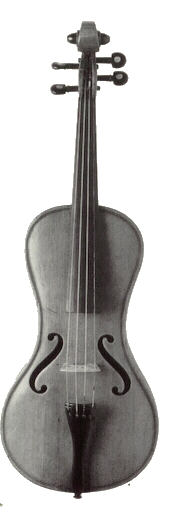
Source: amaranthpublishing.com/William...ount.html
We also were able to hold THE violin, owned by one Mount's friends,
that is pictured in his painting, "Just In Tune". Again, note the pearl
dots on the pegs: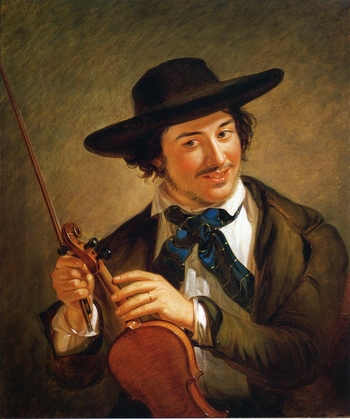
Source: amaranthpublishing.com/William...ount.html
Mount had a 'thing' for fancy pearl-inlaid pegs, and tailpieces.... We also
were able to page through his hand-notated tune notebook... with little
sketches in the corners, here and there.
All reminiscing aside...
You are correct, that Greg Adams and George Wunderlich are NOW the
keepers of the BEST "data" on Boucher dimensions. MANY more variants
have been found, during the last 15 years. (Hank Schwartz has done some
documentation on Boucher banjos, too.)
Best we can say is that, at some point, the decorative double-ogee on
early Boucher banjos DID function as an indicator of the octave. But
that is not true for ALL Boucher banjos.
Best-
Ed Britt
Edited by - BrittDLD1 on 01/07/2011 16:02:33
BrittDLD1 - Posted - 01/07/2011: 15:53:03
quote:
Originally posted by deuceswilde
Set up properly, the hump at the fifth string is 5 ...
rudy - Posted - 01/07/2011: 19:42:49
Ed,
Thanks much for your reply, that makes total sense and certainly begins to put the matter in it's proper perspective. Your idea of the "conceptual" Boucher is probably much closer to what I'm shooting for than many of the instruments I've seen, as your evaluation of the scale proportions for "The Banjo Player" are spot on.
I haven't used dividers on a painting, but I've imported a lot of the pictures into CAD, flipped them around and scaled them to check proportions. That's when I realized that the idea of Bouchers being made with any modicum of consistancy wasn't all it was cracked up to be.
It's becoming much clearer... The Boucher saga continues.
Jonnycake White - Posted - 01/07/2011: 22:26:49
If it's of any worth, I made a double ogee neck on my first minstrel banjo. I wasn't trying to copy Boucher completely, just steal some of his ideas. I put the point of the ogee at the 7th fret position and the upper notch at the 9th fret postion. I guess I really don't play any higher than that anyway.
BTW, what is the correct pronuciation of Boucher? Boo-SHAY? BUTCH-er? Anyone know?
BrittDLD1 - Posted - 01/08/2011: 01:30:18
According to one of his descendants (who attended one
of the Banjo Collector's Gatherings) it's "Boo-SHAY". And
that is now the 'accepted' pronunciation for the banjo.
Although, William Esperance Boucher was apparently
from the Alsace-Lorraine region of France, on the
Prussian-German border. And the Germanic pronunciation
of that name is supposedly closer to "BOO-ker".
That whole area was in dispute for centuries. It was like a
football... snatched back-and-forth between French and
Prussian/German rule. (No wonder he left...)
It was under French rule when Boucher emigrated, in the
1840s. (But one source has him leaving for America, on a
ship from Hamburg, Germany... Just to confuse matters)
Best-
Ed Britt
Edited by - BrittDLD1 on 01/08/2011 06:43:07
tomberghan - Posted - 01/10/2011: 04:26:21
quote:
Originally posted by BrittDLD1
It was under French rule when Boucher emigrated, in the
1840s. (But one source has him leaving for America, on a
ship from Hamburg, Germany... Just to confuse matters)
rudy - Posted - 01/10/2011: 05:41:32
Hi, I'm back!
For anyone who is interested in the development of my "Conceptualized Boucher" as Ed so aptly titled it, I've done a preliminary CAD drawing of the front view to work out the scale length and ogee points for the basic design.
I've had a fair amount of input from individuals that are familiar with the Boucher saga, and here's a quick pic of what I've come up with. It's not a high quality image, but it's enough to show the relative locations of the ogee points. The bridge position is slightly to the rear of center for two reasons:
1. In my experiance, I've found that placing a bridge at the exact center point greatly reduces overtones that I find personally pleasing. In other words, it makes for a banjo that is dull sounding when used with synthetic strings.
2. Synthetic strings (as well as gut) have a bit of inconsistancy in their manufacturing process and the ideal mathematically generated note positions often don't line up with where they actually occur on a fretless banjo. The bridge position can be shifted a bit toward the neck or tailpiece if it is desired for the notes to be more acurately relected by the ogee points.
The mathematical scale position behind the head centerpoint also allows the bridge to move forward without being coser to the neck than the bridge, which I just find unattractive. There are actually several of the older drawings and paintings that show Bouchers with the bridge much closer to the neck. That just ain't right!
Too much information?
Edited by - rudy on 01/10/2011 05:47:50
Jonnycake White - Posted - 01/10/2011: 09:13:00
Looks good so far, Randy. I'll put it on my "to do" list right after the "Conceptualized Ashborn" and of course I might now need to do a "Conceptualized Tilton" also. But first I must finish the banjola and one or two banjos I've already started.
And thanks to Ed for that info on Boucher - I always suspected it was "Boo-SHAY".
BrittDLD1 - Posted - 01/10/2011: 09:35:26
Nice drawing, Rudy!
quote:
Originally posted by rudy
... bridge position is slightly to the rear of center for two reasons:
...
2. Synthetic strings (as well as gut) have a bit of inconsistancy in their manufacturing
process and the ideal mathematically generated note positions often don't line up with
where they actually occur on a fretless banjo. The bridge position can be shifted a bit
toward the neck or tailpiece if it is desired for the notes to be more acurately relected
by the ogee points.
quote:
... There are actually several of the older drawings and paintings that show Bouchers
with the bridge much closer to the neck. That just ain't right!

rudy - Posted - 01/10/2011: 09:39:18
Get to work, Jon! Time's a wastin'.
I suspected as much with the pronunciation also as I have a friend with the same name and that's how she says it.
I'm always appreciative of Ed Britt as he may not tell you what you want to hear but his replies are always honest and truthful.
rudy - Posted - 01/10/2011: 09:44:52
Who would guess Ed was typing as I was replying?!? I hope he's not thinking I'm just kissing up...
Ed,
Thanks and keep those cards and letters coming! That's just a rough initial image of the finished plan. It will have side and rear views and other details such as making the brackets, nuts, and adjustment wrench in the home shop.
BrittDLD1 - Posted - 01/10/2011: 09:46:40
quote:
Originally posted by rudy
... his replies are always honest and truthful.
tomberghan - Posted - 01/11/2011: 04:27:47
By the way, the correct term is "Mensur" (not mensure)
As in "mensuration" . . . The branch of mathematics that deals with measurement, especially the derivation and use of algebraic formulae to measure the areas and volumes of geometric figures.
But yeah, what Ed said.
I will step into the fray and suggest that moving the bridge right in the middle of a performance during the minstrel show would have most likely be done for comic effect and/or novelty similar to listening to a Scruggs-Keith tuner. The other obvious reason to slide the bridge in the middle of performance was to change the key (change the pitch) while maintaining the same fingerings . . . just like using a capo.
If you look at photos, paintings, and drawings of minstrels, they are always dressed in comedic costume, playing the fool. The Minstrel Show was decended from the "Italian Comedia" which had been popular in Europe for centuries. In fact, many of the shows were farces of Italian Opera that were popular during that time. REF: "Behind the Burnt Cork Mask: Early Blackface Minstrelsy and Antebellum American Popular Culture (Music in American Life)"
So, sliding the bridge (making goofy/silly sounds), spinning the banjo, throwing the banjo, etcetera . . . anything for a laugh. Being precisely in tune was likely near the bottom of the list of priorties!
Terms of Use | Privacy Policy | Privacy Consent (EU/GDPR Only)
Copyright 2026 Banjo Hangout. All Rights Reserved.


