
DVD-quality lessons (including tabs/sheet music) available for immediate viewing on any device.
Take your playing to the next level with the help of a local or online banjo teacher.
Weekly newsletter includes free lessons, favorite member content, banjo news and more.
Premier Sponsors


|
Please note this is an archived topic, so it is locked and unable to be replied to. You may, however, start a new topic and refer to this topic with a link: http://www.banjohangout.org/archive/168292
Hunter Robertson - Posted - 01/16/2010: 08:29:25
I've usually played Darlin' Cora out of gCGCC with 3 fingers but someone asked about it in the tab section recently and I took a closer look at the recording by B.F. Shelton. A few sources thought he was playing out of eCGCC and it does seem to fit just right. Shelton's tuned a bit flat of D on the recording.
This clip is a foreshortened version of Shelton's introduction, not quite what he plays but enough to give the idea. You could keep the index on the first string or use it on the top two (or whatever, depending on what you want it to sound like), the thumb handles the rest.
Tuning: eCGCC
"Fretting":
4th string (low string) - 0,4,5
3rd - 0, 4
2nd - 0,4
1st - 0
Here's the recording by Shelton: http://juneberry78s.com/otmsampler/...'%20Cora.mp3
Hunter
Edited by - Hunter Robertson on 01/16/2010 13:53:54
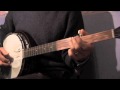 VIDEO: Darlin' Cora - 2-Finger Banjo (click to view) |
Bill Rogers - Posted - 01/16/2010: 12:18:02
The best-known revival take on Shelton is, of course, Pete Seeger's: http://www.youtube.com/watch?v=bw4DxfIZIHo
tomberghan - Posted - 01/16/2010: 12:44:07
Thanks Hunter!
That is a very nice contribution. It sounds pretty complicated, but when you show how it is done, it looks pretty simple. You play it very well of course.
How is life in France? I think this tune would go VERY well with some of your local red wine and cheese! I know the song is about corn mash, but I think red wine would work too! Nice to see you again on the BHO. Visit more often.
Best Wishes,
Tom
janolov - Posted - 01/16/2010: 12:57:28
Thanks Hunter, I really like your playing.
Darling Cora is one of my favorites and the first song I learned thumb lead. I have always played it in open D tuning (f#DF#AD), learned from Pete Seeger's book. I have just recently tried the triple C/D tuning and it is really easier!
omiimii - Posted - 01/16/2010: 13:16:34
i heard george gibson play a very similar version of this last summer and was
curious what he was playing. thanks so much for this post. i love this song
and am excited to have it opened up to me! i also love mike seeger's clawhammer
version, so it looks like now i have two versions of the song to learn!
p.s. hunter, if you have the time would you either put up a slower lesson version
or maybe an up to speed full version? or even better yet, combine them into one
video? i know you might not have the time for this but it would be greatly appreciated
and utilized, i am sure.
Edited by - omiimii on 01/16/2010 13:22:14
Hunter Robertson - Posted - 01/16/2010: 13:49:53
Thanks guys.
Absolutely right Bill, Seeger tabbed it in his book and that version you linked to is obviously straight from Shelton's playing.
Tom, thanks. Yeah, once you get used to the basic movement it's pretty much downhill from there. Luckily there are always complications to keep things interesting! Things are good thanks, not least because there are very acceptable substitutes for that good old mountain dew here. Nice to have a place to talk banjo here on the HO for sure.
Janolov, it does just glide out from under the fingers in one of these triple-C tunings. I think I have a preference for a version I worked out in gCGCC which is a conglomeration of Shelton's playing and various sung versions I've heard of it, but this eCGCC version really seems to fit what he was doing.
Omiimii, George Gibson was one of the guys I had read something from about the song and tunings for it. I think he's from the same area as Shelton and Buell Kazee (who recorded the song as well). I'll get a slower version up, sure. If you're interested in 2 and 3 finger picking you should try and get Art Rosenbaum's books, he does a good job of covering a lot of different styles (especially the out of print first one...).
Hunter
Hunter Robertson - Posted - 01/16/2010: 15:44:59
Omiimii,
Here you go. I switched to a fretted banjo which will hopefully make things a little clearer (too bad the fingers aren't transparent, but what can I do?). Hope it helps.
Hunter
Notes on the video:
Another right hand figure which I didn't film that's useful: thumb on an inside string, thumb on the 5th, index on the first - bum ditty.
Listening again after making the video to what he's doing while singing, I think he's playing simpler figures rather than the whole melody. Anyway, have a listen for yourself!
Tuning: eCGCC
Fingerings:
4th String (low string) - 0, 4, 5
3rd - 0, 3 (occasional blue note), 4
2nd - 0, 4
1st - 0
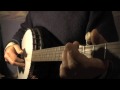 VIDEO: Darlin' Cora part 2 - 2-Finger Banjo (click to view) |
omiimii - Posted - 01/16/2010: 16:32:31
quote:
Originally posted by Hunter Robertson
Omiimii,
Here you go. I switched to a fretted banjo which will hopefully make things a little clearer (too bad the fingers aren't transparent, but what can I do?). Hope it helps.
Hunter
Notes on the video:
Another right hand figure which I didn't film that's useful: thumb on an inside string, thumb on the 5th, index on the first - bum ditty.
Listening again after making the video to what he's doing while singing, I think he's playing simpler figures rather than the whole melody. Anyway, have a listen for yourself!
Tuning: eCGCC
Fingerings:
4th String (low string) - 0, 4, 5
3rd - 0, 3 (occasional blue note), 4
2nd - 0, 4
1st - 0
robertsart - Posted - 01/16/2010: 17:03:29
Thanks for posting this Hunter.
Anybody know other tunes in this strange archaic tuning?
Scott Roberts
www.oldgroove.com
oldwoodchuckb - Posted - 01/16/2010: 17:05:30
Beautifully done Hunter. You are one superbe banjo man.
I am curently serving duty as a cat lap and can't get up, but I wonder if the Seeger version form the book has that strong VII chord (if your nominal key is D then it would be a C chord). Pete's sung version has that chord (to my current ear) waay to domineering the arrangement. Back when I was two fingering it out of his book I really thought that sound was the coolest. Now I vastly prefer Shelton's (and your) version where the chord change is only hinted at. I'm very aware of that VII chord sound - they call it a flat Seven (bVII) over on the Theory board but technically since the seventh note of the scale is a full tone below the tonic it is a Seventh - nothing flat about it.
I'm rambling semi- articulately at the moment but we were discussing this very subject at a few recent jams. It seems that there is a constant stream of new written old time tunes in D with each one having more C chord than the last. I like Waiting For Nancy but some of them have no tune at all, just riffs on that D to C back to D motion and no "tune" at all.
I guess everyone goes through an I-VII-I phase. (not that there's anything wrong with it) But I really prefer teh old - no harmony style, where you played the C Note, instead of going to the C chord. There are equivalents in A - I like Old Joe Clark without a heavy G chord - same with June Apple.
Edited by - oldwoodchuckb on 01/16/2010 17:06:07
omiimii - Posted - 01/16/2010: 17:23:28
quote:
Originally posted by oldwoodchuckb
Beautifully done Hunter. You are one superbe banjo man.
I am curently serving duty as a cat lap and can't get up, but I wonder if the Seeger version form the book has that strong VII chord (if your nominal key is D then it would be a C chord). Pete's sung version has that chord (to my current ear) waay to domineering the arrangement. Back when I was two fingering it out of his book I really thought that sound was the coolest. Now I vastly prefer Shelton's (and your) version where the chord change is only hinted at. I'm very aware of that VII chord sound - they call it a flat Seven (bVII) over on the Theory board but technically since the seventh note of the scale is a full tone below the tonic it is a Seventh - nothing flat about it.
I'm rambling semi- articulately at the moment but we were discussing this very subject at a few recent jams. It seems that there is a constant stream of new written old time tunes in D with each one having more C chord than the last. I like Waiting For Nancy but some of them have no tune at all, just riffs on that D to C back to D motion and no "tune" at all.
I guess everyone goes through an I-VII-I phase. (not that there's anything wrong with it) But I really prefer teh old - no harmony style, where you played the C Note, instead of going to the C chord. There are equivalents in A - I like Old Joe Clark without a heavy G chord - same with June Apple.
Hunter Robertson - Posted - 01/16/2010: 17:24:10
No problem Omiimii. For the question of tunings, here's what Anita Kermode's tuning list ( http://www.zeppmusic.com/banjo/aktuning.htm ) has to say:
"gCGCC "Darling Cora" tuning. First string lowered to play in unison with 2nd.
According to George Gibson this is quite an old tuning, giving 'a wonderful droning sound'. His father used it for Darling Cora, and GG believes that B. F. Shelton did as well.
I realize that I made an error in listing eDADD, and I've now eliminated this tuning (though, who knows, there may be some use for it!). My previous story ran that Art Rosenbaum (in London, 1995) - having been tuned to aDADE - ran his 1st string down to D, and played us Darling Cora as he thought Shelton had, in aDADD (gCGCC tuned up 2 steps), instead of in the open-D (f#DF#AD) tuning Pete Seeger used for this song. I later went back to Shelton's classic recording and decided that he had his fifth string tuned lower (to match 1st string at the 4th fret). That's not 'E', that's 'F#'! So: if B.F. Shelton were doing this tune in the key of C, his tuning would be eCGCC, and if in the key of D, f#DADD. He is 2-finger picking, with a thumb lead; and in fact, on recordings I've got, is in the key of C#...My conclusion: this is another great episode in the saga of "wonderful droning sounds" to be found on the 5-string.
B.F. Shelton, Darling Cora, 1927 ("Music of Kentucky Vol 1";"Old Time Mountain Ballads")."
Here's an interesting thread on the subject too, with George Gibson taking part: http://www.mudcat.org/thread.cfm?threadid=14314
Keep in mind that on the recording Shelton is actually in a triple-C#+ tuning, so D isn't too far away.
Scott, that's the only one I play in eCGCC now, but nearby are:
gCGCC - "Raleigh and Spencer", "Boll Weevil" (both my versions from Tommy Jarrell's fiddling). "Bonaparte's Retreat" goes well there too, though I prefer gCGCD (at D of course to satisfy the devil fiddler).
eCGCD - Wade Ward's "Half Shaved"
Tony, thanks. I agree, too many chords spoil the tune.
Hunter
Edited by - Hunter Robertson on 01/16/2010 17:40:48
majikgator - Posted - 01/16/2010: 19:47:01
Thanks very much Hunter, some very useful (and rare) two finger instruction and of the dearest of all tunes to boot.
oldwoodchuckb - Posted - 01/16/2010: 21:08:02
On the lowered 5th string. One discovery I made long ago was that any song sounds kind of archaic if you lower the 5th to E -- or F# if you are capoed at the 2nd fret.
It takes the high PING out of the 5th string and sort of calms down the banjo back-up for songs in G and Standard tuning (I used it mostly to accompany songs).
Also good with tunings like old g (eDGDE) where the 4th and 1st set up a hollow almost ghostly sort of feedback in the banjo.
In D
I like to use F# against Double D (f#DADE)- I find this a lot easier than re-tuning the whole banjo to 0pen D (f#DF#AD) which calls for so many large string changes it takes the instrument ten minutes to settle in. This is how I do "Old Reuben" when people want to sing it in D. As far as I'm concerned I get the "quintessential" sound of Open D without the PITA of actually tuning to 0pen D.
Another one that I used a lot is the one Hunter uses (f#DADD ) Triple D - lowered 5th string.
This gives me great tunings for tunes like of Muskrat. Any tune that doesn't call for a lot of up-the-neck stuff in D can be switched from Double D to Triple D, and any D tune in a major or mixolydian mode can use the F# 5th string.
I think I've experimented with putting the 4th of the scale on the 5th string (like a G in D tuning) but it just didn't work for me - OTOH I know more now. OTOH I've been to two jams in two days and my hands are just pulsing with pain, so I don't want to dig out the banjo again.
Chris Berry - Posted - 01/16/2010: 21:15:10
quote:
Originally posted by oldwoodchuckb
I'm very aware of that VII chord sound - they call it a flat Seven (bVII) over on the Theory board but technically since the seventh note of the scale is a full tone below the tonic it is a Seventh - nothing flat about it.
oldwoodchuckb - Posted - 01/16/2010: 21:25:12
I was just reading that thread on mudcat and came across that line about the lineage
BF Shelton to Pete Seeger to The Kingston Trio
But I think Pete actually also invented the Kingston Trio version of the song. I haven't heard either record in about 50 years now, but The Weavers did Darlin' Corey on an early 50s lp and I think Pete played it out of plain old "G" on that record. The banjo solo was up high, where it stood out over the top of the singing. I think the KT arrangement was simply the Weavers arrangement for 3 voices instead of 4.
I think most of the KT early arrangements can be traced back to The Weavers, or The Easy Riders (how many people remember the Easy Riders? - the leader of the group was Terry Gilkyson?? spelling was never my subject who wrote "South Coast").
Bisbonian - Posted - 01/17/2010: 08:46:49
Thank you so much, Hunter, for putting this up. Darlin' Cora is certainly one of my favorite tunes, and I've always loved the way Pete Seeger played it, but I just wasn't getting it from the Tab. Really helps to see and hear it, even if your fingers aren't transparent.
I don't think I can link to it anywhere, but have you ever heard Joel Mabus' version? Check your email. The notes on Joel's Flatpick and Clawhammer CD say that he is playing it out of eCFBbC, for yet another variation.
Edited by - Bisbonian on 01/17/2010 09:10:47
Hunter Robertson - Posted - 01/17/2010: 10:25:53
You're welcome Majikgator and Bisbonian.
quote:
Originally posted by Bisbonian
I don't think I can link to it anywhere, but have you ever heard Joel Mabus' version? Check your email. The notes on Joel's Flatpick and Clawhammer CD say that he is playing it out of eCFBbC, for yet another variation.
oldwoodchuckb - Posted - 01/17/2010: 10:53:15
Chris
In Mixolydian mode the seventh is actually a full step below the tonic. The G Mixo scale is the same as the C major scale complete with F natural but started on the G note. Darlin' Cora, Old Joe Clark, June Apple, Red Haired Boy, and hundreds of other tunes use this scale. Since the seventh is in these scales a full tone below the tonic it should logically simply be called that "VII" but to make it clear current practice is to call it bVII as if the scale were major.
robertsart - Posted - 01/17/2010: 12:12:25
quote:
Originally posted by oldwoodchuckb
In Mixolydian mode the seventh is actually a full step below the tonic. The G Mixo scale is the same as the C major scale complete with F natural but started on the G note. Darlin' Cora, Old Joe Clark, June Apple, Red Haired Boy, and hundreds of other tunes use this scale. Since the seventh is in these scales a full tone below the tonic it should logically simply be called that "VII" but to make it clear current practice is to call it bVII as if the scale were major.

omiimii - Posted - 01/17/2010: 12:38:00
quote:
Originally posted by robertsartquote:
Originally posted by oldwoodchuckb
In Mixolydian mode the seventh is actually a full step below the tonic. The G Mixo scale is the same as the C major scale complete with F natural but started on the G note. Darlin' Cora, Old Joe Clark, June Apple, Red Haired Boy, and hundreds of other tunes use this scale. Since the seventh is in these scales a full tone below the tonic it should logically simply be called that "VII" but to make it clear current practice is to call it bVII as if the scale were major.
Somebody please tell me I'm not the only one who doesn't understand a word of this... Otherwise I might have to take up an instrument even dumber than the banjo.
Jon A. - Posted - 01/17/2010: 12:54:49
Not that I can really play either, but the tab in Pete's The Goofing-Off Suite book is different that the tab in How to Play the 5-String Banjo. The one in Goofing-Off moves up and down the neck more, and it is fully tabbed out.
Bisbonian - Posted - 01/17/2010: 14:26:43
robertsart, omiimii, a year ago I would have said the same thing. But I've been reading oldwoodchuck's words on modes for long enough that it is starting to make sense.
Now, if only I could figure out if that was a good thing....
;)
oldwoodchuckb - Posted - 01/17/2010: 15:23:47
I'm creating a lot of thread drift here, and will start a new thread, but you have probably destroyed your life by getting involved with modes, and you have definately lowered your chances of getting into banjo heaven - which is right around the corner from doggie heaven, two blocks east of hippie heaven, on the Blue Line - be sure to take the A tram.
Edited by - oldwoodchuckb on 01/17/2010 15:25:50
Hunter Robertson - Posted - 01/17/2010: 15:44:17
quote:
Originally posted by oldwoodchuckb
I'm creating a lot of thread drift here, and will start a new thread, but you have probably destroyed your life by getting involved with modes, and you have definately lowered your chances of getting into banjo heaven - which is right around the corner from doggie heaven, two blocks east of hippie heaven, on the Blue Line - be sure to take the A tram.
Edited by - Hunter Robertson on 01/17/2010 15:45:59
majikgator - Posted - 01/17/2010: 17:46:06
as long as you don't let the theory interfere with your playing you'll be alright
Chris Berry - Posted - 01/17/2010: 23:53:05
quote:
Originally posted by oldwoodchuckb
Chris
In Mixolydian mode the seventh is actually a full step below the tonic. The G Mixo scale is the same as the C major scale complete with F natural but started on the G note. Darlin' Cora, Old Joe Clark, June Apple, Red Haired Boy, and hundreds of other tunes use this scale. Since the seventh is in these scales a full tone below the tonic it should logically simply be called that "VII" but to make it clear current practice is to call it bVII as if the scale were major.
Rizo - Posted - 01/18/2010: 16:04:22
quote:
Modes: The Road to Perdition or How Old-Time Music Destroyed My Life
The True Confessions of a Banjo Player
arkred - Posted - 01/30/2010: 17:33:19
Speaking of tunings, has anyone heard Hattie Stoneman's banjer tuning on Cumberland Gap? Only other person I ever heard use that tuning for Cumberland Gap was an old banjer picker from around Townsend, TN named Commie Tipton. He lived up in the mountains and played thumb and index finger style. Had a tuning for just about every song he did.
gailg64 - Posted - 01/31/2010: 07:45:55
I didn't realize Hattie recorded with the banjo (no doubt she played it, everyone did!). If it was one of the old recordings it could have been her brother Bolen Frost who had a really nice 2 or 3 finger style.
G
quote:
Originally posted by arkred
Speaking of tunings, has anyone heard Hattie Stoneman's banjer tuning on Cumberland Gap? Only other person I ever heard use that tuning for Cumberland Gap was an old banjer picker from around Townsend, TN named Commie Tipton. He lived up in the mountains and played thumb and index finger style. Had a tuning for just about every song he did.
Emiel - Posted - 01/31/2010: 08:43:15
quote:
Originally posted by Hunter Robertson
Keep in mind that on the recording Shelton is actually in a triple-C#+ tuning, so D isn't too far away.
Hunter
Hunter Robertson - Posted - 01/31/2010: 09:35:12
Yeah Emiel, totally right. The C#+ is just what my recording of him is at (after who knows what manipulations), and the triple part is an assumption that seems to work out (with some backing information from other players from the area). He could also have been tuned a bit higher. Usually when I tune up I don't tune to a reference pitch, just tune the banjo relative to itself, so my other assumption about Shelton's tuning is that he did the same. Lots of assumptions!
Arkred, this must be that recording here? http://www.folkways.si.edu/TrackDet...?itemid=4501 Nice. Do you know what tuning it's in? Sounds like it could be f#BEAD. What were some of the tunings Tipton used?
Hunter
Emiel - Posted - 01/31/2010: 11:32:16
Yes, I do think you're right about the tuning (relatively), sounds just like that. And of course, maybe he wasn't tuned exactly to C, on the other hand he may have been... I just tuned my banjo like that and found out that it's also a nice tuning for "John Henry". You can play the melody using thumb-lead two-finger-picking on the second string and use the first string as a second drone. Then for variation you can play the melody on the first string in a blues alternate bass (4th and 3rd) finger-picking pattern with no use of the 5th string. Very nice also for three-finger picking mixing the 2nd string as well.
Hunter Robertson - Posted - 01/31/2010: 11:50:53
quote:
Originally posted by Emiel
I just tuned my banjo like that and found out that it's also a nice tuning for "John Henry". You can play the melody using thumb-lead two-finger-picking on the second string and use the first string as a second drone. Then for variation you can play the melody on the first string in a blues alternate bass (4th and 3rd) finger-picking pattern with no use of the 5th string. Very nice also for three-finger picking mixing the 2nd string as well.
matt m - Posted - 02/01/2010: 04:30:21
Thanks for that tuning.
I've always been a bit disappointed by the Seeger tab - to my ears it clearly wasn't the tuning Shelton was playing. Didn't quite have that 'Eastern' sounding quality to it.
The closest I'd got was playing it in Cumberland Gap tuning (f D G C D), which I immediately preferred to D tuning.
BRUNO25 - Posted - 02/01/2010: 04:47:57
Arkred, I think Hunter is right. That sounds to me like f#BEAD. If I'm not mistaken, both Hobart Smith and Jack Burchett used this tuning for Cumberland Gap. It too, is known as Cumberland Gap tuning. I'd have to look again to be sure, but I think Jack may have also dropped the drone to D (dBEAD.) I tried that once and really liked the f# better.
brokenstrings - Posted - 02/01/2010: 22:41:42
Thanks for this thread. Darlin' Corey is one of my favorites, and I love that triple-C or triple-D tuning. BTW, George Gibson lives two towns away from me and gave me some instructions on playing it.
Hunter Robertson - Posted - 02/02/2010: 12:59:34
That's a handy kind of neighbor to have Jessy! So what were some of the instructions?
Hunter
Terms of Use | Privacy Policy | Privacy Consent (EU/GDPR Only)
Copyright 2026 Banjo Hangout. All Rights Reserved.


