
DVD-quality lessons (including tabs/sheet music) available for immediate viewing on any device.
Take your playing to the next level with the help of a local or online banjo teacher.
Weekly newsletter includes free lessons, favorite member content, banjo news and more.
Premier Sponsors


|
Please note this is an archived topic, so it is locked and unable to be replied to. You may, however, start a new topic and refer to this topic with a link: http://www.banjohangout.org/archive/157163/2
beezaboy - Posted - 09/20/2009: 04:16:23
Is this IT?
orgs.usd.edu/nmm/PluckedString...anjo.html
Beezaboy
beezaboy - Posted - 09/20/2009: 04:54:02
But Buddy Wachter says Vega in 1912.
a.parsons.edu/~amyf/banjo/history.html
Beezaboy
BrittDLD1 - Posted - 09/20/2009: 06:36:22
quote:
Originally posted by beezaboy
Is this IT?
orgs.usd.edu/nmm/PluckedString...anjo.html
beezaboy - Posted - 09/20/2009: 07:32:54
Been thinking about changing the title of this thread to
"THE FIRST COMMERCIAL TENOR BANJO".
Balch, Britt, reading Music Trade Review, and U.S. Patents
has convinced me that the USA is replete with tinkerers.
So it is quite possible that a Mandolinist seeking a proper
instrument to be heard in the dance orchestra or on stage
in a vaudeville-type performance shaved the neck on a
banjeaurine and tuned it GDAE (Mandolin). We'll probably
never find this guy and even if we saw an old photo of it
we would not know how it was tuned.
No, what I am looking for is something like this 1919 Orpheum news
(see link below) for the FIRST such Tenor Banjo so the "invention"
and the "inventor" can be documented and not subject to mystery
and conjecture.
arcade-museum.com/mtr/MTR-1919...-5-47.pdf
Note that the text reports that this line of banjos has been on the
market "for some time" (prior to 1919).
So WHO & WHEN is the inquiry?
The Orpheum banjo depicted has the appearance of what I consider
to be The Tenor Banjo.
Beezaboy
BrittDLD1 - Posted - 09/20/2009: 07:36:02
Oops... was working on this -- while Beeze was posting his.
quote:
Originally posted by beezaboy
But Buddy Wachter says Vega in 1912.
a.parsons.edu/~amyf/banjo/history.html
Edited by - BrittDLD1 on 09/20/2009 07:48:59
beezaboy - Posted - 09/20/2009: 07:40:58
quote:
Nope.
Neck looks too short for a tenor. It appears to be a 4-string
Mandolin-Banjo -- with Mandolin/violin scale-length.
 But it is a FOUR STRING. And ca. 1910
BrittDLD1 - Posted - 09/20/2009: 07:51:12
quote:
Originally posted by beezaboy
What I can't figure out is WHY hasn't a museum or collector
posted a photograph of the First Commercial Tenor Banjo?????


Edited by - BrittDLD1 on 09/20/2009 08:08:29
beezaboy - Posted - 09/20/2009: 08:25:14
quote:
As for "Who ADVERTISED the first 4-string 'Tenor' banjo?"
To the best of existing knowledge -- it was quite simply, Farris.
BrittDLD1 - Posted - 09/20/2009: 09:36:27
quote:
Originally posted by beezaboy
IMO - Farris' 1885 4-string was tuned GDAE and "fingered like a violin". This
instrument was a melody maker not the percussive Tenor Banjo tuned
CGDA and was apparently developed for the popular "classical" banjo
orchestras on the late 19th Century.
Our Tenor Banjo tuned CGDA evolved to supply an instrument for
dance orchestras and for Mandolinists to make the "easy" switch.
This knowledge is well documented.
quote:
Likewise, Schall's "Banjorine" is no more a Tenor Banjo than A. Stathopoulo
linked above. Both are Mandolin-Banjos with four strings. Stathopoulo with
a short scale...Schall with probably an S.S. Stewart banjeaurine scale.
Schall's Banjorine was tuned "like a mandolin".
beezaboy - Posted - 09/20/2009: 12:05:48
Posted - 09/06/2009 : 07:03:46
--------------------------------------------------------------------------------
quote:
Who made it?
Clues please!
Somebody must have a catalog or advertisement ca. 1908 - 1912 for this banjo:
Defined: 1. 17 frets; 2. approx. 11" head; 3. probably open back;
4. 19 1/2" - 21 1/2" scale; 5. four steel strings; 6. tuned CGDA;
7. Market = Mandolinists wishing to play the snappy, cutting rhythm instrument
desired by leaders of dance bands that were prolifigating after 1900 when overlapping musical trends included Ragtime and Dance music.

NYCJazz - Posted - 09/21/2009: 07:53:37
quote:
Originally posted by beezaboy
But Buddy Wachter says Vega in 1912.
a.parsons.edu/~amyf/banjo/history.html
Beezaboy

BrittDLD1 - Posted - 09/21/2009: 11:03:46
quote:
Originally posted by NYCJazz
BTW this was posted by another one of Cynthia's students, Amy Finkel, a VERY talented artist.
...
A film you might enjoy:
stringsofmyheart.com/index2.htm

Edited by - BrittDLD1 on 09/21/2009 11:04:37
beezaboy - Posted - 09/26/2009: 12:23:53
CLUE or CONUNDRUM!
Focus S.S. Stewart:
Samuel Swain Stewart died 1898 (Mugwumps).
George Bauer contined to make S.S. Stewart banjos 1901-1910 (Mugwumps).
Keenophone Co. acquired Bauer company and S.S. Stewart name 1911 (Mugwumps).
Keenophone was a small victrola manufacturer in Philadelphia, Pa.
Keenophone sold S.S. Stewart name to Buegeleisen & Jacobson (N.Y. jobber) 1915.
Now, a review of Music Trade Review reveals that while S.S. Stewart was under Keenophone ownership (1911-1914) an entity named S.S. Stewart Co. moved up from Philadelphia to New York City and set up a manufacturing facility at 46 East 13th Street, N.Y. to manufacture banjo-mandolins, banjos, banjeaurines, etc.
On November 30, 1912 a spokesman for S.S. Stewart Co. on 13th Street announced that "we expect to get out a number of new styles of banjo-mandolins..."
On May 30, 1914 the S.S. Stewart Co., 46 East 13th Street, New York, announced that the company added three new styles of banjos and banjo-mandolins.
In 1915 one of the Stewart products is described as a" 'cello, tango, banjo-mandolin"
In 1915 S.S. Stewart name is acquired by Buegeleisen, who appears to be a consummate jobber, not a manufacturer. After 1914 the S.S. Stewart, 46 East Thirteen Street manufacturing facility disappears from the pages of Music Trade Review and I'll wager that Buegeliesen closed the factory down promptly after acquiring the Stewart name and contracted out the making of Stewart branded instruments.
Meanwhile.... Do you think the boys at S.S.Stewart Co., 46 East 13th Street, New York, N.Y. (a division of Keenophone) developed the physical 17 fret Tenor (tango) Banjo at their factory during the period 1912-1914?? Could the inventor of the Tenor Banjo be a talking machine company!
Beezaboy
beezaboy - Posted - 10/02/2009: 07:30:06
Another shred of evidence:
If Wm. L. Lange developed the first CGDA 17 fret tenor banjo - We'd Know.
If Vega developed the first CGDA 17 fret tenor banjo - We'd Know.
If David Day and Bacon developed the first CGDA 17 fret tenor banjo - We'd Know.
I think the tenor banjo came out of a smaller shop. That's why we don't know.
How about that banjo factory on East 17th Street, New York City 1912-1914!!!
It was making S. S. Stewart branded banjos. Several Music Trade Review articles attest to this fact.
Well here is an interesting tidbit abstracted from BMG magazine.
Fred S. Stewart had joined Joe. W.Stern & Co. of 34 East 21st St., New York City,
when the firm of Stewart & Bauer had failed and Stern’s started to produce the S. S.
Stewart’s Son Improved " 4 S " banjos at prices ranging from $9.00 to $65.00, the
Instruments were said to be made under the personal supervision of Fred S. Stewart.
They were advertising this instruments for at least three years but no later mention
has been found. In August 1914 Buegeleisen & Jacob-son, of New York City
announced they had bought the "patent rights" of the Stewart banjo and would resume the manufacturer of banjos bearing the S. S. Stewart name.
Well, the address for Fred Stewart in the abstract and the address for the Stewart factory I gleaned from Music Trade Review are different but Fred Stewart (S.S.'s eldest son) was in New York making banjos somewhere and perhaps by 1912-1914 Fred Stewart was in the 46 East 13th Street factory and the one introducing their new model:
a "CELLO, TANGO, BANJO-MANDOLIN".
See where I'm going! CELLO = CGDA; TANGO = 4 string banjo;
BANJO-MANDOLIN = short scale (not traditional standard 5-string scale).
We'll keep on plugging!
Beezaboy
Edited by - beezaboy on 10/02/2009 10:20:33
NYCJazz - Posted - 10/02/2009: 10:55:03
Go go go!
I hope this turns out to be the one!
I'm literally 4 blocks from that location right now!
DanielT - Posted - 10/02/2009: 11:16:57
Just an aside here, not intending to hijack:
quote:
Originally posted by BrittDLD1
An Albany, NY danceband player is credited with recording the first Irish tunes
on tenor banjo, in the '20s. (Can't remember his name, right now.)
quote:
Originally posted by BrittDLD1
There was also a fellow here in Boston, who was an "early adopter" of the tenor, for Irish
traditional tunes.
quote:
Originally posted by BrittDLD1
Barney Mckenna is usually credited with popularizing the tenor for Irish tunes,
during the 1960s.
beezaboy - Posted - 10/02/2009: 11:25:10
Please see the S.S. Stewart ad in Music Trade Review
February 14, 1914. By golly, there is S.S. Stewart on East
13th Street in NYC. Proclaiming a "new Stewart factory"!!
Boy, I sure wish I could write for their catalog but its probably
too late!
arcade-museum.com/mtr/MTR-1914...-7-51.pdf
Nathan - If you have time could you run by 46 East 13th Street
and get us each a S.S. Stewart catalog. We'll see if they have a nice
plectrum for you and a 17 fret, CGDA, tenor for me!
Beezaboy
DanielT - Posted - 10/02/2009: 11:55:17
Okay, so who is it who has all the data who will set up a public Google Map with ALL the NYC banjo factories/manufacturers on it? Now THAT would be some public service.
beezaboy - Posted - 10/02/2009: 12:04:26
BTW - Don't remember if I've posted this before but anyway
here is an early (Nov. 11, 1916) tenor banjo. This is very close!
Looks a lot like J.B. Schall's Banjorine.
mugwumps.com/schall_1.gif
But Bruno was strictly a jobber...not a maker. Somebody
designed and manufactured this genre of banjo and we're
going to make every effort to track it to its original lair!!
arcade-museum.com/mtr/MTR-1916...20-55.pdf
Beezaboy
beezaboy - Posted - 10/02/2009: 12:14:09
Daniel T - Hard job because the addresses changed a lot. For example,
Buegeleisen and Jacobson were major players. They were jobbers.
In the beginning (teens) they were on University Place. By 1922 they'd
moved to 5-7-9 Union Square. Haven't even figured out how to create a
list and I find a new maker (to me) quite frequently. This week I accidentally
discovered Albert Houdlett & Sons, 40 Melrose Street, Brooklyn, N.Y. active
in 1922. The articles indicate that Houdlett had a factory. The banjo brands
were Lynbrook, Nu-Way and Nu-Art. Heck, I've never seen any of these
brands so am advertising in Hangout now. See what develops.
Beezaboy
DanielT - Posted - 10/02/2009: 12:27:12
quote:
Originally posted by beezaboy
Daniel T - Hard job because the addresses changed a lot.
NYCJazz - Posted - 10/02/2009: 14:25:45
Wow!
The B&J location is even closer to me!
I'm a block off Union Sq. Park (where I've been spending my lunch hour practicing) That address is a Staples now.
BrittDLD1 - Posted - 10/02/2009: 19:36:28
quote:
Originally posted by DanielT
Just an aside here, not intending to hijack:quote:This would be Mike Flanagan of the Flanagan Brothers. He was originally from Waterford and, as I understand, played Vegas. ...
Originally posted by BrittDLD1
An Albany, NY danceband player is credited with recording the first Irish tunes
on tenor banjo, in the '20s. (Can't remember his name, right now.)...quote:This, I believe, would be Neil Nolan. I think he came from Maine and played in Dan Sullivan's Shamrock Band. ...
Originally posted by BrittDLD1
There was also a fellow here in Boston, who was an "early adopter" of the tenor, for Irish
traditional tunes....
BrittDLD1 - Posted - 10/02/2009: 19:45:35
quote:
Originally posted by DanielT
Okay, so who is it who has all the data who will set up a public Google Map with ALL the NYC banjo factories/manufacturers on it? Now THAT would be some public service.
DanielT - Posted - 10/02/2009: 22:46:52
quote:
Originally posted by BrittDLD1
I tried creating a map of the Boston area banjomakers about 10 years years ago...
BUT... with Urban Renewal -- many of the buildings, street addresses,
street names, and even the streets themselves, are long gone....
beezaboy - Posted - 10/05/2009: 12:54:40
I just bought ebay item 250503455490 - S.S. Stewart 140.
This may be an example of the first tenor banjo.
Here's why I think...
The peghead is not traditional Stewart nor is the inlay
the star and crescent moon. The pot is wood not spun-over.
The peghead on ebay Stewart 140 is almost identical to one of
Fred Stewart's S.S. Stewart Son's "4S" banjos. See:
billsbanjos.com/4S.htm
On Sept. 11, 1911 Keen-O-Phone acquired the S.S. Stewart name.
On April 6, 1912 a Keen-O-Phone rep was in New York taking banjo orders.
On Nov. 30, 1912 a rep for S.S. Stewart Co. on East 13th Street gives an interview.
On May 30, 1914 The S.S. Stewart Co. 46 East 13th St., NYC announced three
new banjos made with "five ply veneer wood rims".
On July 25, 1915 B&J which then "merchandised" the S.S. Stewart
line announced a No. 140 S.S. Stewart "'cello, tango banjo mandolin".
So....????
Trouble is: a later drawing (1916) of B&J S.S. Stewart "Tango
Banjo Mandolin" in Music Trade Review depicted an ordinary
short Banjo-Mandolin with a spun-over rim. I have not been able
to find a picture of the "'cello, tango banjo-mandolin".
At the time of all of this Keen-O-Phone (owner of S.S. Stewart
trademarks since 1911) was apparently in financial difficultyand
apparently sold the Stewart name to B&J sometime in 1915 according
to Mugwumps.
It is a mystery who was mangaging and designing banjos at Keen-O-Phone's
The S.S. Stewart Co. factory at 46 East 13th Street, New York during the period 1912-1915 because in all the Music Trade Review articles the Stewart spokesman
is never identified. Could it have been Fred S. Stewart? He might have
been maintaining a low public profile due to the prior (about 1904) S.S. Stewart name litigation. Afterall, the peghead on the ebay tenor banjo is Fred Stewart's
peghead.
This is like a Sherlock Holmes mystery.
I'll confer with Watson tonite.
Beezaboy
Edited by - beezaboy on 10/05/2009 13:05:25
beezaboy - Posted - 10/14/2009: 05:13:49
Some hypotheses supported by some evidence in the literature so far:
I. VEGA produced the FIRST TENOR BANJO!
A. Bollman, Kimmel, Unger article in Pickin' June, 1978 states 1912.
B. Bollman documents Fairbanks by Vega Imperial Electric Tenor Banjo SN 28473
approximate construction date 1912.
C. Tenor Banjo tutorial written between Apr., 1913 and Apr., 1914 depicts a
drawing of a Vega Regent 17 fret tenor banjo and includes a photograph of a
woman holding a Vega Regent 17 fret tenor banjo.
D. Karen Linn (Barbaric Twang) documents a 1915 Vega ad in Crescendo for
Tenor Banjo.
E. American Guild proposal to name instrument "Tenor Banjo" 1915 Convention.
II. "Tenor Banjo" is not a slurred adaptation of "Tango Banjo". The fretted musical
instrument trade caused this confusion.
A. Tenor Banjo named for its percieved place in orchestra from earlier (1907)
placement of the Tenor Mandola as one of the "correct" instuments in the
mandolin orchestra by the American Guild of Banjoists, Mandolinists and
Guitarists. Therefore, "Tenor Banjo" was named by the Guild.
B. A "Tango Banjo" is synonymous with "Banjolin". They are same instrument. A 4-
string banjo mandolin. (Source: E.N. Guckert 1919).
III. The physical structure of a Tenor Banjo was derived from the 5-string
Banjeaurine generally and the Vega "Banjorine" (a banjeaurine) specifically The
instrument's concept was from S.S. Stewart's "Banjo-Banjeaurine" but the
Vega ititeration had but 17 frets to the body. Therefore, the original Tenor
Banjo had 17 frets because Vega made it and it's Banjorine had 17 frets. Other
manufacturers copied Vega's model and the 17 fret neck became the standard
until the early 1920's.
IV. The Tenor Banjo and the Banjo Mandolin co-existed as stage, band and
orchestra instruments and while the Tenor Banjo can count the Banjo Mandolin
in its lineage, the Tenor Banjo did not supplant the Banjo Mandolin which
retained its popularity thru the teens and into the 1920's. The Tenor Banjo did,
however, become more popular than the Banjo Mandolin as time progressed
into and through the 1920's
V. The Melody Banjo is merely a hybrid (like the 5-string Piccolo Banjo) and is but a
historic footnote to the Banjo Story.
Hopefully, more to follow.
Beezaboy
BrittDLD1 - Posted - 10/14/2009: 07:26:54
quote:
Originally posted by beezaboy
Some hypotheses supported by some evidence in the literature so far:
... I. VEGA produced the FIRST TENOR BANJO! ...
Edited by - BrittDLD1 on 10/14/2009 07:30:21
beezaboy - Posted - 10/14/2009: 08:59:01
Hello Ed:
Thank you for your encouragement. I'm going to continue to seek
evidence about the First Tenor Banjo. I am astounded that so far
I've found no ..."Drum Roll, Please-type" announcement for the
first Tenor Banjo. Nor any claims from a manufacturer to have been
the FIRST...the ORIGINAL...ACCEPT NO SUBSTITUTES.
Clearly, more erudite researchers have explored this subject but
even a blind squirrel can find a nut!
Beezaboy
beezaboy - Posted - 10/16/2009: 14:57:55
A few posts ago I mentioned the S.S. Stewart factory at
46 East 13th Street, New York, N.Y. This factory really
intrigues me. It was only operating, it appears, from Nov. 1912
to approx late 1914 or early 1915. If anyone has any info
about it I would appreciate a heads-up. Anyway, Buegeleisen
& Jacobson jobbers purchased the S.S. Stewart tradename in
about mid-1915 and promptly announced its new "No. 140 S.S. Stewart
'Cello, Tango Banjo Mandolin" which I think was designed in the
New York factory. Well, I got a 1915 reprint Buegeleisen & Jacobson
catalog and there it is pictured!! It looks like a "Tenor Banjo". Four string
open back, 11" spunover rim, extended fingerboard, 19 frets to the
rim with 21 overall. Here is the catalog text:
"The S.S. Stewart Cello-Tango Banjo Mandolin
Is designed specially for Mandolin players who do dance
orchestra work. The quality of tone is exactly the same as
a Banjo. It has four strings, is tuned like a Mandolin, and played
with a pick. It is not necessary for the Mandolinist to learn a
new system of fingering, as the regular violin or piano scores
may be used in connection with this instrument.
Interesting
Beezaboy
blarneystar - Posted - 10/17/2009: 05:45:00
I got a copy of the 1912-1913 Bruno catalog from Bernunzio.
The same Bruno illustration that was used in the 1916 Music Trade Review article referenced above is on the last page, which shows their "banjorines." Below the five-string banjorines is a "banjorine mandolin." I'd love to attach or insert the image, but I can't figure out how to do that here.
The text, however, makes clear that this instrument, which looks extremely tenor banjoish, was to be tuned GDAE - "THIS BANJORINE is designed for Mandolin players who do concert playing, and cannot be detected from a Banjo by the general public as the quality of the tone is exactly the same as a Banjo. It has four strings, tuned like a Mandolin and played with a pick. To play this instrument it is not necessary for the mandolinist to learn a new system of fingering, as regular Violin or piano scores can be read and executed the same as if on the Mandolin."
It had a 10 1/2" rim - smaller than the 12 inch head on the five-string Bruno banjorines - and 21 frets, but only 17 are free of the neck, the remainder extending over the head. So I'd call this a 17-fret instrument for practical purposes.
This is a 1912 tenor banjo - it's just not tuned CGDA. It is quite like Schall's 1907 banjorine and may have been inspired by it. If the only difference between this instrument and a "real" tenor banjo is the tuning, then I don't think that's much of a difference. I play Irish music and tune my tenor banjo GDAE. It's still a tenor banjo.
Vega may have been the first to market a CGDA-tuned tenor, but I think we have to give Louis Stepner and J.B. Schall the credit for creating the modern instrument. Farris's "banjolin" (at least in the only version that I've seen) was mandola length, so it wasn't quite there yet.
Don Meade
beezaboy - Posted - 10/17/2009: 10:26:20
Don: Good and valid points. I've been thinking on this.
The Bruno "Banjorine Mandolin" has almost the same text
as Buegeleisen's 'Cello, Tango Banjo Mandolin. Both
instruments appear very similar to Schall's Banjorine. (I just
this a.m. ordered the Bruno catalog you refer to.)
So, I am working on another hypothesis. There was No one FIRST
TENOR BANJO there were actually THREE FIRST TENOR BANJOS.
Perhaps, two of them were treble clef melody instruments designed to appeal
violinist and mandolinists experiencing a change in US music.
This instrument was designed to actually carry the melody line by,
generally speaking, sounding individual melody notes.
The other of them was a percussive instrument (CGDA) read on
the same treble clef after Universal Notation but sounding 5
notes lower. This instrument had a relationship to the Tango
Banjo Drum we've seen advertised in Music Trade Review in that
it was a rhythm instrument for the dance band and would also
appeal to the violinist and mandolinist it being still tuned in 5ths.
The third FIRST TENOR BANJO is the short neck 4-string that looks
like this (almost 17 frets):
orgs.usd.edu/nmm/PluckedString...anjo.html
All of these instruments were breaking through the soil about 1912-1914.
Schall's credit should be where credit is due. Was his banjorine an accident for
our discussion of the history and evolution of the Tenor Banjo?
Did he aim for this and hit that. Open minds will prevail.
BTW: I've written to the Library of Congress about securing copies of
The Cadenza for appropriate years and we'll see how that goes.
Also, Buegeleisen and Bruno were jobbers. Wonder who actually
Designed and then manufactured the instruments in question.
Beezaboy
BrittDLD1 - Posted - 10/17/2009: 12:22:12
quote:Hi Don --
Originally posted by blarneystar
... Vega may have been the first to market a CGDA-tuned tenor, but I think we
have to give Louis Stepner and J.B. Schall the credit for creating the modern instrument.
Farris's "banjolin" (at least in the only version that I've seen) was mandola length, so it
wasn't quite there yet.
Don Meade
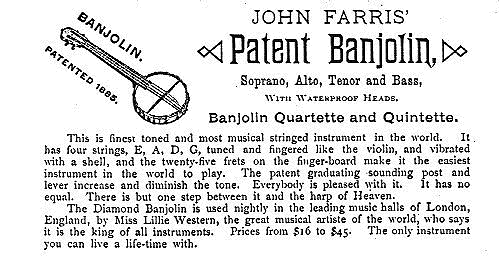
Edited by - BrittDLD1 on 10/17/2009 12:29:13
BrittDLD1 - Posted - 10/17/2009: 12:46:00
PS:
In another BHO topic:
banjohangout.org/topic/160125
FRAILIN posted a photo of his relatives WITH what possibly
appears to be a Farris 8-string Banjolin:
"...Here's my grandfather (with mando) and great uncle as young men
(around 1907). Uncle Cliff is holding an open-back 5-string. I've always loved
the banjo but could never explain why.
Note the bridge running completely across the head.
The neck appears to be slightly longer than a mandolin scale, so possibly it's
an "alto" size (size of a "pony" 5-string). Or maybe not... it's a bit hard to tell.
Among the instruments on the floor, there appears to be a standard roundback
mandolin -- and a slightly larger roundback mandola, to the right of it (for scale).
Best-
Ed Britt
••• A good fiddle tune will bring two or more people together who might otherwise be enemies. •••
Edited by - BrittDLD1 on 10/17/2009 13:26:17
blarneystar - Posted - 10/17/2009: 23:51:31
Great photo! That banjolin looks to me like the mandola-length "soprano" version that we've seen before, except that it has eight strings (like the version in his patent drawing). Farris did advertise longer banjolins with four strings. I'm not sure where that Mugwumps ad appeared, but you can find similar 1880's ads in the Yale Banner and the Hartford County Directory via a Google Books search.
The Banner ad is nearly the same as the Mugwumps one but the 1885 Directory ad features an eight-string soprano version ("The King of All Instruments"). Both include a pitch for his "quartette" or "quintette" of lead banjolin supplemented by alto, tenor and cello versions.
However, I've never seen an example, or even a picture, of a non-soprano banjolin. Farris probably would not have advertised something he hadn't actually built, but it would also seem the demand just wasn't there yet for an instrument of that type. He would have been trying to appeal to the banjo and mandolin clubs that were then popular, but they weren't buying.
By the time Schall made Stepner's banjorine in 1907, the dance bands of the day were finding a use for a louder, more cutting version of a mandolin-tuned instrument. The four-string banjorine (soon to be called a tenor banjo) coexisted with banjo mandolin in this role for a few years, displacing it by the early '20s because it had proved to be a superior instrument.
So I'm willing to give Farris the posthumous glory of being the inventor of the tenor banjo. The main point I was trying to make is that the tuning of an instrument doesn't really define it as something else if it is physically the same as a modern tenor banjo. If a banjo has four strings and a neck longer than that of a mandola but shorter than that of a plectrum banjo, it's a tenor banjo. The differences between Farris' banjolin, Schall's banjorine, the Bruno banjorine mandolin and whatever turns out to have been first CGDA-tuned tenor banjo, they are all basically the same instrument.
Don Meade
beezaboy - Posted - 10/18/2009: 06:33:42
Don and Ed: You gentlemen have made some excellent points
that are sincerely appreciated and your views are respected.
BUT me-thinks you are two quick to conclude that Farris or Schall
were the innovators of The Tenor Banjo merely because of its appearance.
Perhaps Schall's banjorine must be considered in Tenor Banjo lineage for the Mandolinist to Banjoist link. But, let me quote Chas McNeil (of esteemed tutor fame):
"In about the year 1900, I heard an old-time mandolinist play a banjeaurine
tuned in fifths, C,G,D,A (reading from the lowest pitched string to the highest).
He had eliminated the fifth string as being unnecessary".
Rhetorical Question: "Would this episode then define a banjeaurine as
a Tenor banjo?"
IMO the designed tuning of the instrument is essential in the definition
of the instrument and the percussive Tenor Banjo was designed CGDA
for its place in the orchestra, I think.
Furthermore, Farris' banjo (according to the ad) had 25 frets and what
appears to be a 10" head and was designed to be tuned like a violin.
Well admittedly, its a banjo; its got 4 strings; but it predates the music
that inspired the real Tenor Banjo by at least a decade probably two
decades as Ragtime hit its stride about 1905.
Ergo, Farris' creation was not the first tenor banjo and (borrowing from
Don Meade's observation) wasn't even successful in the mandolin or banjo
clubs and orchestras of the day.
No, right now I'd have to bet my money on David L. Day.
But, We'll see.
Beezaboy
Edited by - beezaboy on 10/18/2009 06:34:18
blarneystar - Posted - 10/18/2009: 08:43:58
Guitars were tuned a lot of different ways before EADGBE became standard, and there have been plenty of other tuning systems developed since then. Some people pick them with fingers, some with a plectrum, and some just strum. The instruments are are all still guitars. If it looks more or less like a tenor banjo, but it is tuned differently or not played "percussively," it's still a banjo.
beezaboy is stubborn however, and I dont' expect to convince him. I would still be interested in learning more about early Vega instruments and finding out how the viola tuning became the standard.
blarneystar - Posted - 10/18/2009: 08:49:42
I forgot to answer beezaboy's rhetorical question: A five-string banjeaurine with the fifth string taken is being played like a tenor banjo but has a basic physical difference. Once you make a banjeaurine with a four-string neck, you've made a tenor banjo. Farris did that in an idiosyncratic way. Schall's instrument, designed by Stepner, is the basic modern instrument in all ways but tuning.
blarneystar - Posted - 10/20/2009: 08:05:03
FYI - a 1912 Vega banjo catalog is available online:
acousticmusic.org/Instrument-C...html#Vega
The last page features five-string banjorines, available in five styles, but no mention yet of a four-string version.
blarneystar - Posted - 10/20/2009: 08:45:29
[url][acousticmusic.org/userfiles/fi...g.pdf/url]
Bacon catalog of 1912 - the "tenor banjo-mandola" is listed but not shown, on the page with the five-string banjeaurine and the banjo mandolin.
If it's called a "tenor mandola," I'd bet that they tuned it mandola style, and it would make sense if they used the banjeaurine-length neck.
So it looks like David Day was making a CGDA tenor banjo in 1912.
blarneystar - Posted - 10/20/2009: 08:46:42
I clearly haven't figured out how to insert a link correctly. Just drop the superfluos "/url" at the end of the link to view the page.
blarneystar - Posted - 10/20/2009: 08:58:24
Oops. I forgot that David Day was still with Vega at this time. So credit goes to Fred Bacon or whoever was running this part of the business (still in Vermont at the time) for him.
beezaboy - Posted - 10/20/2009: 16:41:13
FWIW a "Banjolin" (as envisioned by Farris in his 1885 patent
#315135) now on ebay with the extended fretboard broken off:
cgi.ebay.com/ws/eBayISAPI.dll?...:MEWAX:IT
I read recently that the "lin" refers to the violin not the mandolin
which observation has some credibility as the mandolin was not as
popular in 1885 as it would become at the turn of the century and
perhaps Farris' creation with 22 frets as drawn coincided with
notes on the violin neck.
Beezaboy
blarneystar - Posted - 10/20/2009: 16:58:24
Hey Beez, did you send the right link? The page I went to had a beat up Cole banjo mandolin.
On Farris' banjolin, the patent claim (which you can find via Google search, but not Google books), is really mostly for his bridge and post, which he explains are needed because of the high tension of the strings. If he was really using mandolin (not octave mandolin) tuning, that really would be an issue. Maybe the Stepner/Schall banjorine was tuned that high as well. Did they not want, or not have the strings available, to tune it an octave lower? The impracticality of tuning a mandola-length or longer instrument that high might have been what made them go for the CGDA tuning.
beezaboy - Posted - 10/20/2009: 18:30:26
Don:
That Cole looked like a Banjolin to me (with the extended fretboard broken off)
You'll be interested to see Farris' patent and drawing of his patented "Banjolin". I put the patent number in just prior post. You can go to US patent office website and search that number. Its an 8 stringer in his drawing. In the book Banjos of the 19th century the authors, Bollman et al, are careful to note that Farris' 4 string was a "later" creation from what he patented and apparently they were commenting on what is described in the Farris Music Store ads.
Thanks for the heads-up on the Bacon Tenor Banjo-Mandola. I have that catalog here at home but never noticed that offering. Too bad no drawing of it but the name is very, very intriguing.
I'm just hanging out now waiting for the Library of Congress to anwer my letter about which of the Cadenza microfilm reels to order. I'm hoping to acquire the appropriate reel(s) and find an ad or article in the Cadenza that will shed more light.
Beezaboy
DanielT - Posted - 10/20/2009: 20:59:10
quote:
Originally posted by beezaboy
You'll be interested to see Farris' patent and drawing of his patented "Banjolin". I put the patent number in just prior post.
blarneystar - Posted - 10/22/2009: 10:27:58
It seems that the Bacon catalog on the acousticmusic.org could note be from 1912, as listed on that site. It has no publishing date, but there are endorsement letters printed in it that are dated 1913.
Also, according to Mugwumps and other sources, Bacon in this period did some banjo building in Vermont but also sold instruments made by Vega, Lange and others.
Bruno, which I cited before, was strictly a wholesale jobber, not a manufacturer.
So we don't really know who made the GDAE-tuned "banjorine mandolin" advertised in the 1912 Bruno catalog or the (presumably) CGDA-tuned "tenor banjo-mandola" in the c. 1913 Bacon catalog. Ed Britt's speculation that these instruments were made by small-time banjo builders before they were adopted by the bigger-name companies is probably correct, but I'm still on the hunt for more info about what Lange and Vega were up to in this area c. 1910.
The unt
beezaboy - Posted - 10/22/2009: 17:55:32
Maybe we should cast our eyes westward to Chicago.
Pleijsier in his book "Washburn" states:
"The tango craze that started in the early 1910's
clearly accounted for a boost in Lyon & Healy's banjo sales,
which triggered the need for the introduction of the 1913
banjo line with its much larger palette of available styles."
But, alas, no tenor banjo is depicted in the 1913 drawings
Pleijsier selected for the book.
Here is pretty much what I envision the First Tenor Banjo
would look like on ebay:
cgi.ebay.com/ws/eBayISAPI.dll?...:MEWAX:IT
This serial number (8205), though, is substantially post 1915
according to Pleijsier. But the banjo is similar to Stewart's
Banjo Banjo-Banjeaurine without the 5th string which is what
I expect us to discover. When we finally discover it!
Beezaboy
Terms of Use | Privacy Policy | Privacy Consent (EU/GDPR Only)
Copyright 2026 Banjo Hangout. All Rights Reserved.


