


Hello,
I am hoping that someone can help me identify my father's banjo. It was given to him by Whitey Kaufman of the Whitey Kaufman and his orchestra.
It's in wonderful condition.
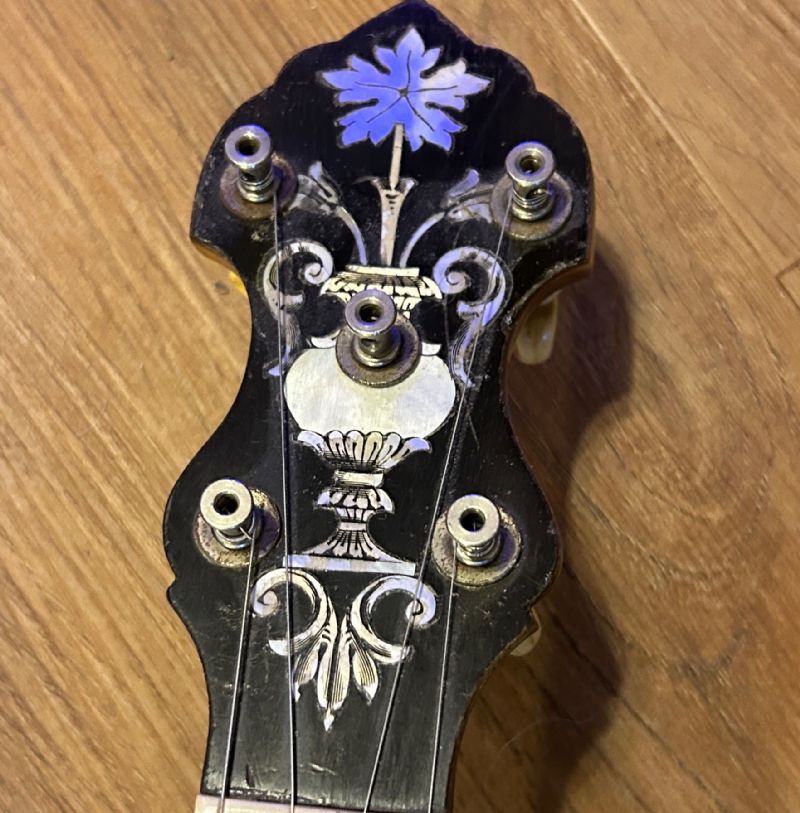
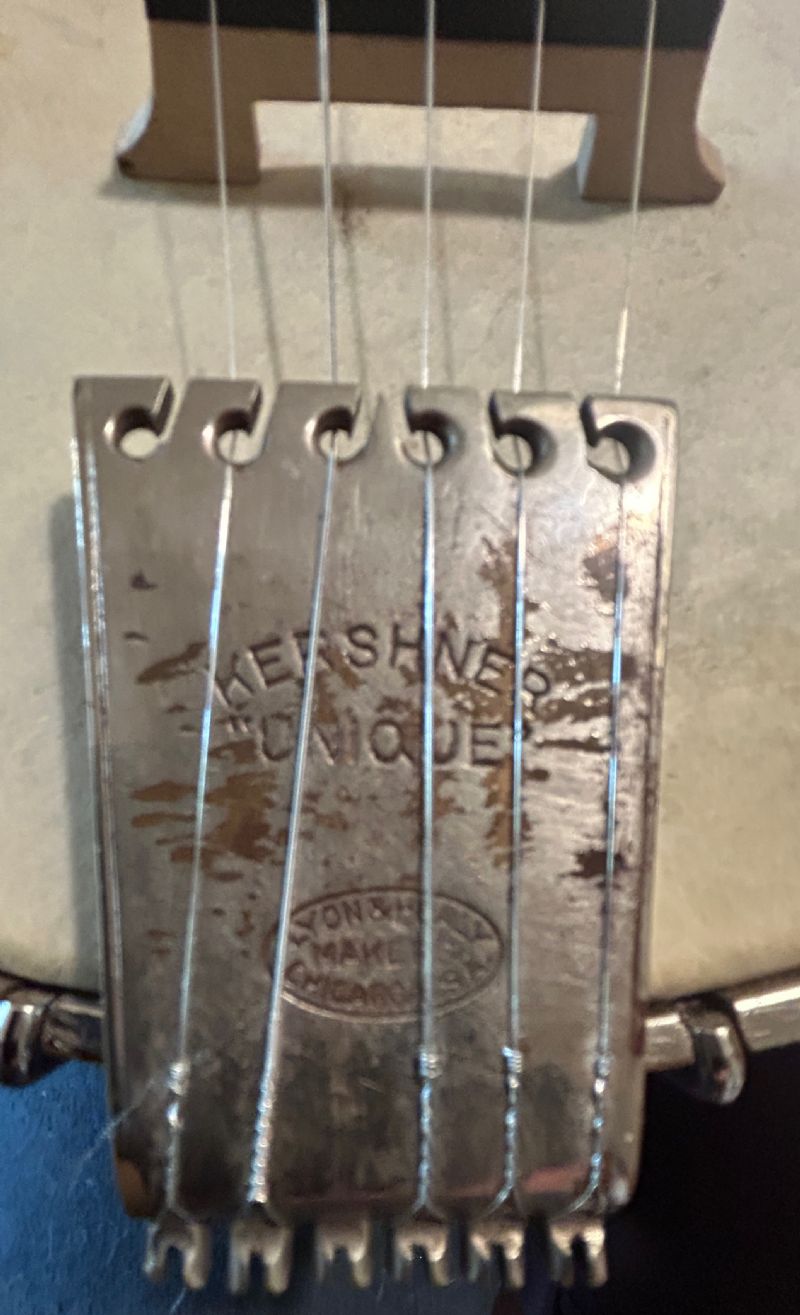
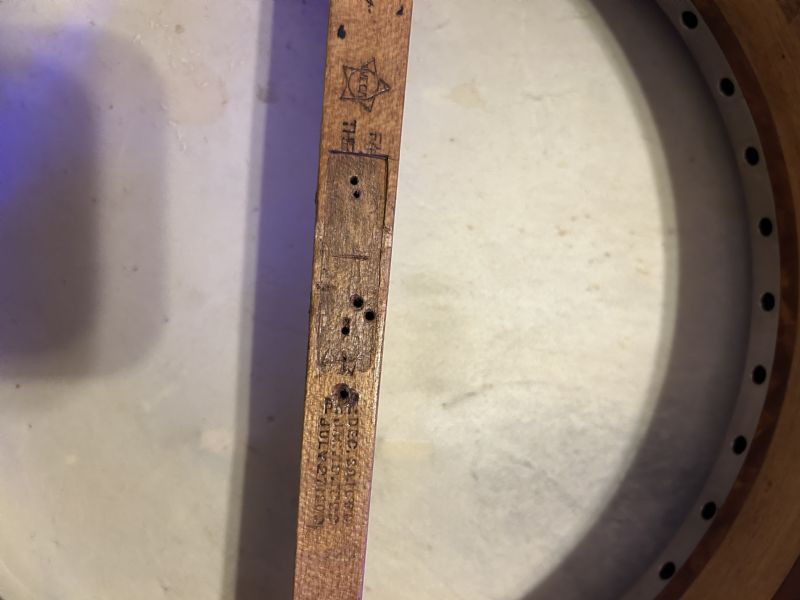
Edited by - jillyb58 on 10/28/2026 13:03:56

You'll need to post pictures of the front, back, sides, and inside the pot. The more the merrier.

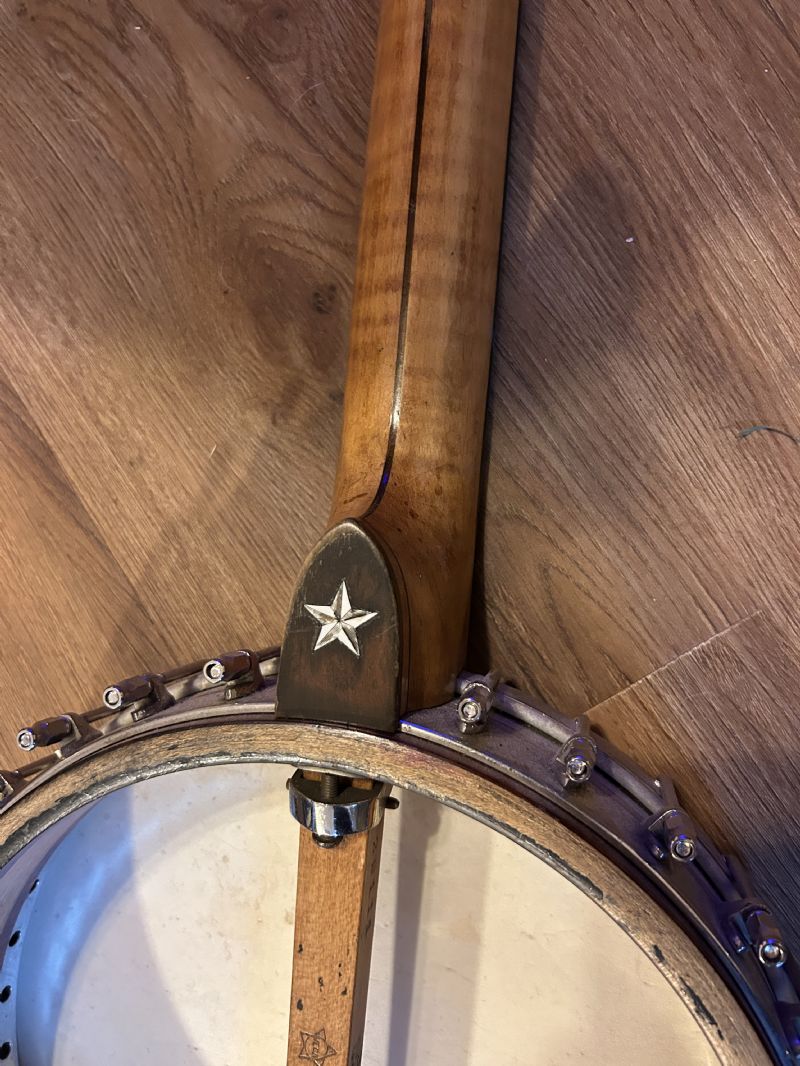
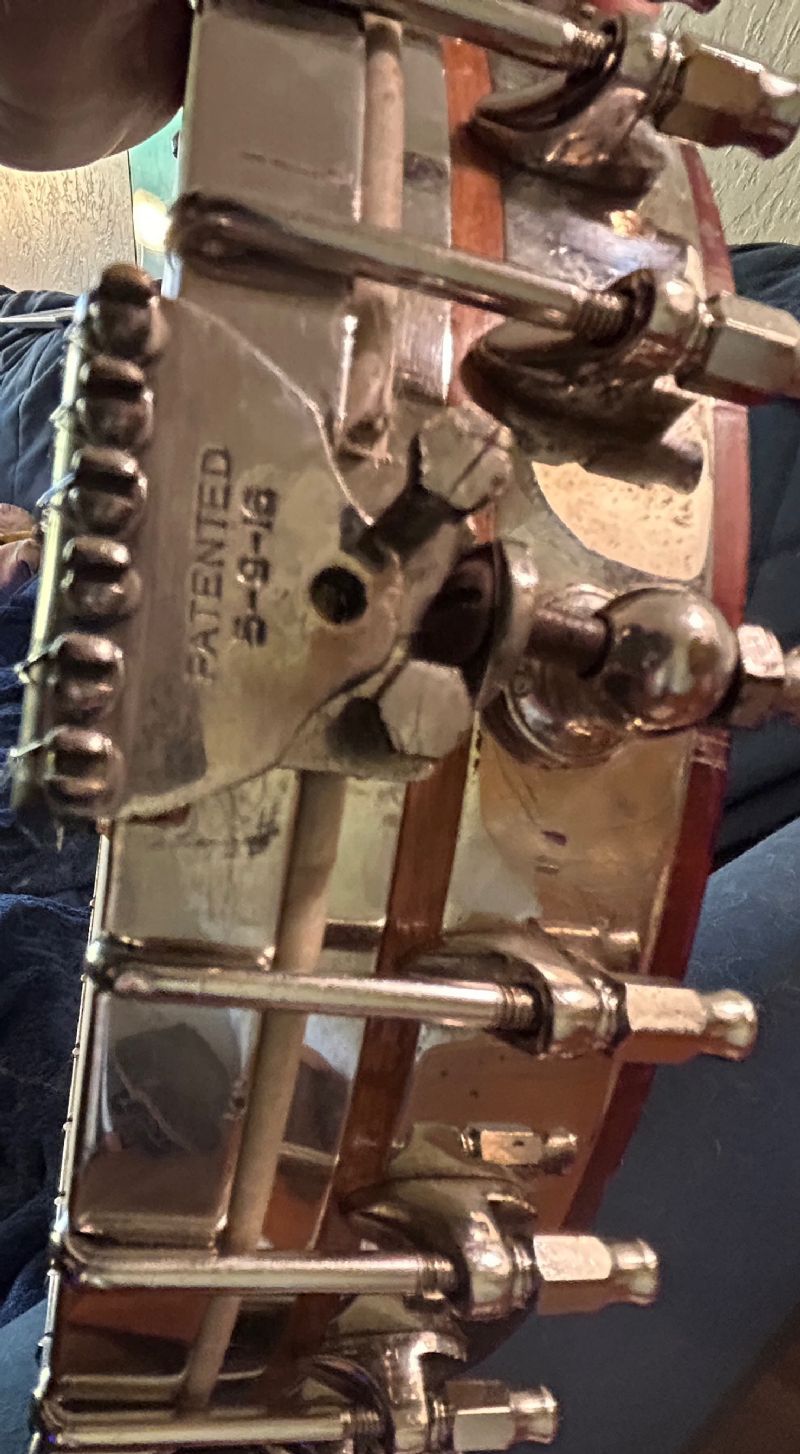
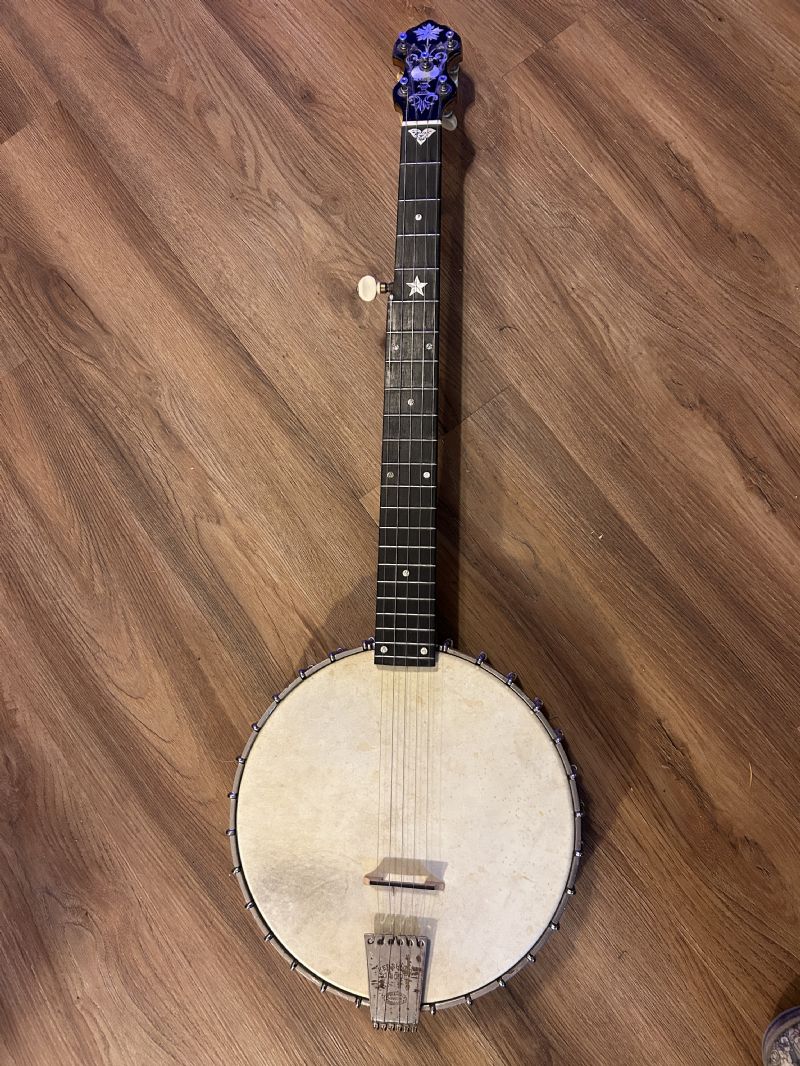
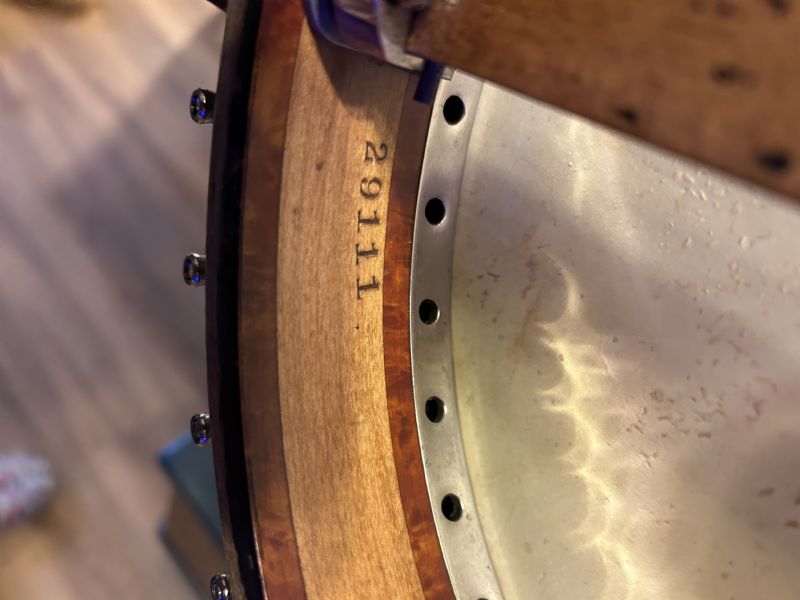
Here are some of the photos I have. I can post some more soon.
Old Vega Tubaphone pot. An old Kershner 6-string tailpiece… And indeed, this banjo can be strung with 6 strings, 5 long and one short string…
Yes, I do remember that originally it was strung with 6 strings. My mom took it in for new strings for my dad's birthday one year, and for some reason the guy only put on 5. It has stayed that way since.
Someone told me, I needed to see if it was a 3 or a 4 ? Not sure what that means, but I can't find anything like that on the banjo.
Is this something special, or just an ordinary banjo?
Thanks for any feedback.
Not an "ordinary banjo"… I do think, the pot looks small, compared to the neck width and the tailpiece. We need some Vega experts to comment, maybe mikehalloran or Bob Smakula?
Thanks!
It appears to be a custom ordered six string Tubaphone. The elevated fingerboard, maple neck, and extra string are all unusual. Are there any other markings in the dowel stick beyond what you've pictured?
jillyb58
Post some closeup pictures of the area of the tuner in the side of the neck. The proportions don't exactly look like Vega work. I get a feeling that the banjo might have originally been a 5-string plectrum and converted to 6-string. Though with the banjo having an original 6-string Kershner tailpiece hints that my theory is probably not going anywhere.
Bob Smakula
smakulafrettedinstruments.com
While I have nothing to add about the OP banjo, the "6 string" (not guitar, but 5+1) banjo was often advertised as being intended for accompaniment playing to banjo solos within the structure of duets that were popular during the "classic era".
This would be a very odd choice, given the effort and expense, to custom order, for use in the context of a jazz orchestra.
On the other hand, a prominent band leader likely acquires "stuff" over their lifetime and it would not be unusual that at some point this was just a "oh you are a band leader, we have my dad's banjo, here, take it" situation.
What is the diameter of the head to the nearest 1/16"?
"Is it a 3 or 4" might refer to Fairbanks and Vega calling their "basic" Tu Ba Phone banjo a "Style 3". There was no Style 3 Tu Ba Phone that I'm aware of.
The tailpiece comes from a guitar-banjo model, I believe. I don't know what letter Vega used to indicate a guitar-banjo. But it would be stamped into the dowel rod someplace. Vega used style R, style K, style M, style N, etc for various other models.
I'm a bit suspicious about that fingerboard. Those don't look exactly like typical Vega inlays, and I believe white binding should be showing clearly on the edges of the fingerboard. A close up of the "5th" (short) string tuner and pip would also be helpful. Vega used a pip there that looked like a little bowler hat. In case the fingerboard has been "worked over"...
I'm not convinced this banjo is factory issue...but what do I know?
quote:
Originally posted by The Old Timer
"Is it a 3 or 4" might refer to Fairbanks and Vega calling their "basic" Tu Ba Phone banjo a "Style 3". There was no Style 3 Tu Ba Phone that I'm aware of.
I'm a bit suspicious about that fingerboard. Those don't look exactly like typical Vega inlays, and I believe white binding should be showing clearly on the edges of the fingerboard. A close up of the "5th" (short) string tuner and pip would also be helpful. Vega used a pip there that looked like a little bowler hat. In case the fingerboard has been "worked over"...
N.O. 3 is a catalog Fairbanks and Vega 5-string and 4-string Plectrum Tubaphone model. The peghead and fretboard inlays of the OP banjo are standard for that era's Tubaphone N.O. 3. Two details that are on the N.O. 3 Tubaphone and not on the OP banjo are the necks are Mahogany and the heel is carved. The maple neck with no carving on the heel was a standard on the 5-string plectrum. One of the reasons I think it is possible this banjo might be a modified Vega 5-string plectrum.
Bob Smakula
quote:
Originally posted by The Old TimerWhat is the diameter of the head to the nearest 1/16"?
"Is it a 3 or 4" might refer to Fairbanks and Vega calling their "basic" Tu Ba Phone banjo a "Style 3". There was no Style 4 Tu Ba Phone that I'm aware of.
The tailpiece comes from a guitar-banjo model, I believe. I don't know what letter Vega used to indicate a guitar-banjo. But it would be stamped into the dowel rod someplace. Vega used style R, style K, style M, style N, etc for various other models.
I'm a bit suspicious about that fingerboard. Those don't look exactly like typical Vega inlays, and I believe white binding should be showing clearly on the edges of the fingerboard. A close up of the "5th" (short) string tuner and pip would also be helpful. Vega used a pip there that looked like a little bowler hat. In case the fingerboard has been "worked over"...
I'm not convinced this banjo is factory issue...but what do I know?
quote:
Originally posted by Bob Smakulajillyb58
Post some closeup pictures of the area of the tuner in the side of the neck. The proportions don't exactly look like Vega work. I get a feeling that the banjo might have originally been a 5-string plectrum and converted to 6-string. Though with the banjo having an original 6-string Kershner tailpiece hints that my theory is probably not going anywhere.
Bob Smakula
smakulafrettedinstruments.com
Thank you for the information. I've been learning so much from everyone who has replied. I'll try to get some more photos up here soon.
Jill
quote:
Originally posted by The Old TimerWhat is the diameter of the head to the nearest 1/16"?
"Is it a 3 or 4" might refer to Fairbanks and Vega calling their "basic" Tu Ba Phone banjo a "Style 3". There was no Style 3 Tu Ba Phone that I'm aware of.
The tailpiece comes from a guitar-banjo model, I believe. I don't know what letter Vega used to indicate a guitar-banjo. But it would be stamped into the dowel rod someplace. Vega used style R, style K, style M, style N, etc for various other models.
I'm a bit suspicious about that fingerboard. Those don't look exactly like typical Vega inlays, and I believe white binding should be showing clearly on the edges of the fingerboard. A close up of the "5th" (short) string tuner and pip would also be helpful. Vega used a pip there that looked like a little bowler hat. In case the fingerboard has been "worked over"...
I'm not convinced this banjo is factory issue...but what do I know?
Sounds like you know a whole lot more than I do...I've had this banjo since my dad passed in 2008 and have never inspected it as much as I have lately. Never knew there was so much to learn about a banjo. Thank you!
Jill
quote:
Originally posted by Joel HooksWhile I have nothing to add about the OP banjo, the "6 string" (not guitar, but 5+1) banjo was often advertised as being intended for accompaniment playing to banjo solos within the structure of duets that were popular during the "classic era".
This would be a very odd choice, given the effort and expense, to custom order, for use in the context of a jazz orchestra.
On the other hand, a prominent band leader likely acquires "stuff" over their lifetime and it would not be unusual that at some point this was just a "oh you are a band leader, we have my dad's banjo, here, take it" situation.
I always thought that a banjo in a jazz band was an interesting choice as well. Now I need to try and find some of this music and listen to it. The story my dad told was that Whitey gave him the banjo. I never really thought too much about it, but it seemed important to my dad. He loved this banjo.
Jill
"Banjo" was a prominent feature of early jazz (and current nostalgia jazz bands).
But those banjos came with qualifiers:
Plectrum Banjo (like a regular banjo, 5th string removed or not included, played with a plectrum, and shortly after becoming popular adopted steel strings).
Tenor Banjo. While this uses the same construction of a regular banjo, the system (tuning, playing) comes from the mandolin family of instruments.
Both of these are 4 string banjos.
quote:
Originally posted by The Old TimerWhat is the diameter of the head to the nearest 1/16"?
"Is it a 3 or 4" might refer to Fairbanks and Vega calling their "basic" Tu Ba Phone banjo a "Style 3". There was no Style 3 Tu Ba Phone that I'm aware of.
The tailpiece comes from a guitar-banjo model, I believe. I don't know what letter Vega used to indicate a guitar-banjo. But it would be stamped into the dowel rod someplace. Vega used style R, style K, style M, style N, etc for various other models.
I'm a bit suspicious about that fingerboard. Those don't look exactly like typical Vega inlays, and I believe white binding should be showing clearly on the edges of the fingerboard. A close up of the "5th" (short) string tuner and pip would also be helpful. Vega used a pip there that looked like a little bowler hat. In case the fingerboard has been "worked over"...
I'm not convinced this banjo is factory issue...but what do I know?
The Tubaphone No. 3 was Vega's standard entry level Tubaphone five string or plectrum, equivalent to the Style M tenor in appointments.
The guitar banjos did not use letter designations regularly, and were mostly just labeled "Whyte Laydie", "Tu-ba-phone", "Little Wonder" ect. There are some exceptions, as with most things Vega.
Terms of Use | Privacy Policy | Privacy Consent (EU/GDPR Only)
Copyright 2026 Banjo Hangout. All Rights Reserved.


