Hello All,
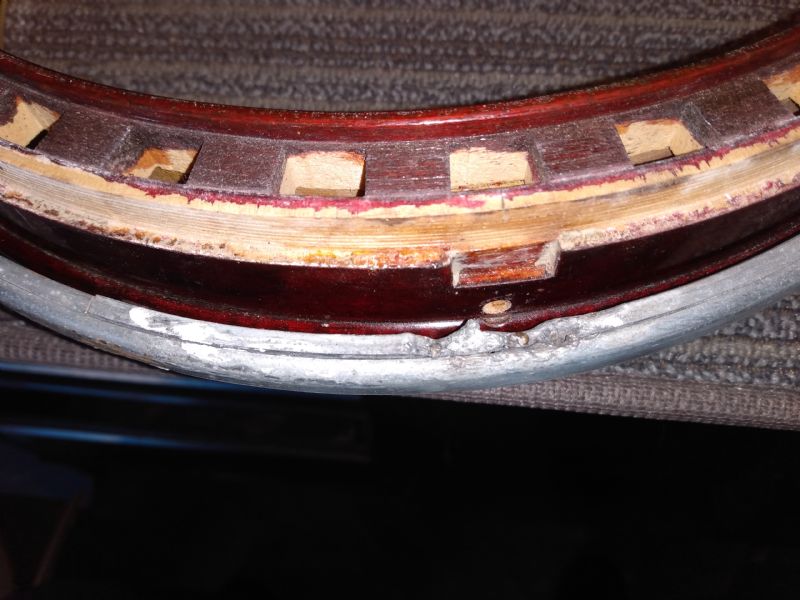
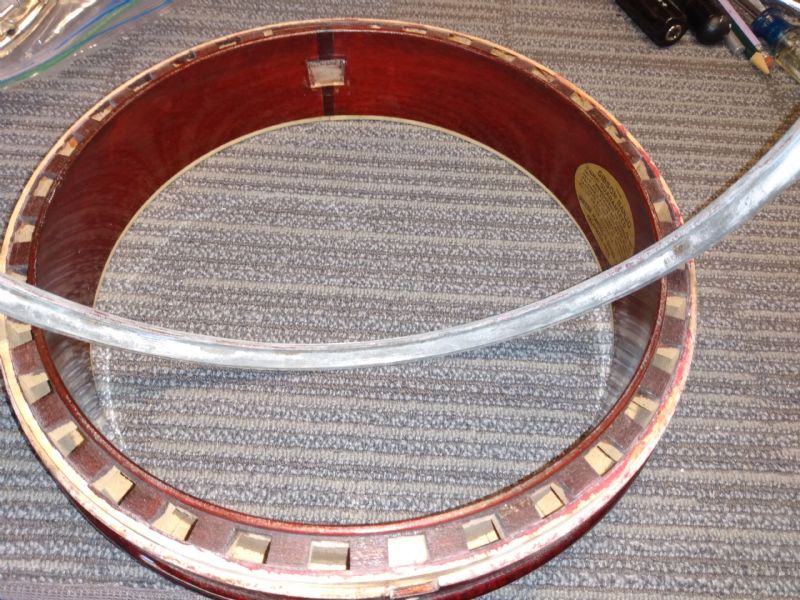
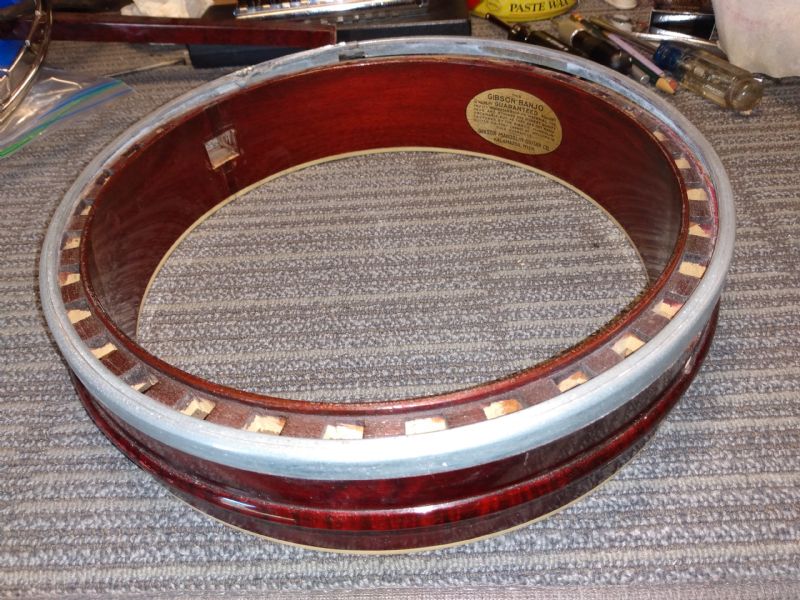
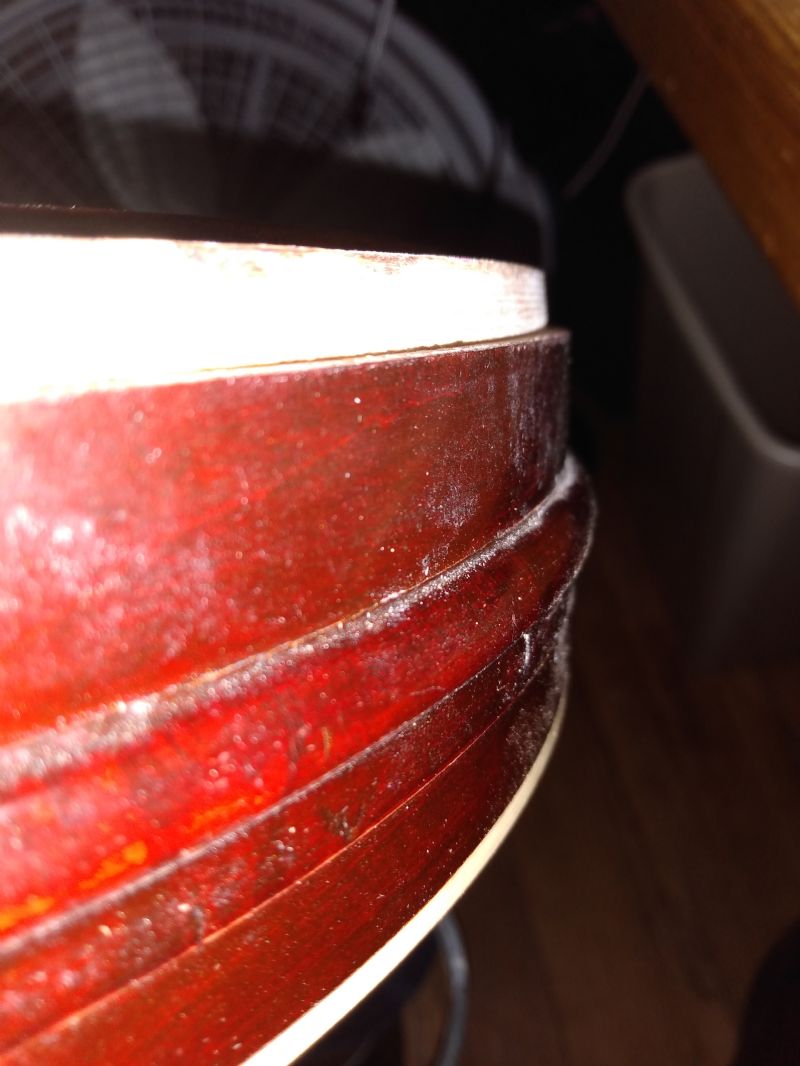
I’m repairing a 20’s Gibson Tenor banjo which had a split head. That’s no problem for me but, as these things go, I discovered other problems when I got the old head off. Principally, I found that the tone ring had split circumferentially. The tone ring on this banjo seems to be made of a zinc alloy, or maybe spelter metal. I tried soldering it back together with some special alloy solder (for this purpose), but all I managed to do was melt the tone ring a bit (see photos).
Can any of you suggest the source for a replacement (it’s a 12” pot), or whether you’ve had any success making a replacement from brass or some other material? Or, maybe there’s a broken head out there that I could salvage the ring from?
I’m keen to repair this banjo, as its part of a set (with a MB and rare cello-banjo).
Thanks in advance for your thoughts and advice!
- David in PA

I've got no advice on the tone ring, However, I'm fairly that is a "Kraske" rim, which was a "hollow" rim made from an outer and inner solid ply, separated by blocks of wood.
Gibson did not use many of these type of rims, so they are somewhat uncommon (rare?) but not particularly sought after, or highly regarded, except by collectors.
Is that rim really 12" diameter?

quote:
Originally posted by ponyshed
Or, maybe there’s a broken head out there that I could salvage the ring from?
Are we talking about the flesh hoop inside a skin head? That is not a tonering. Both ends don't need to be connected.
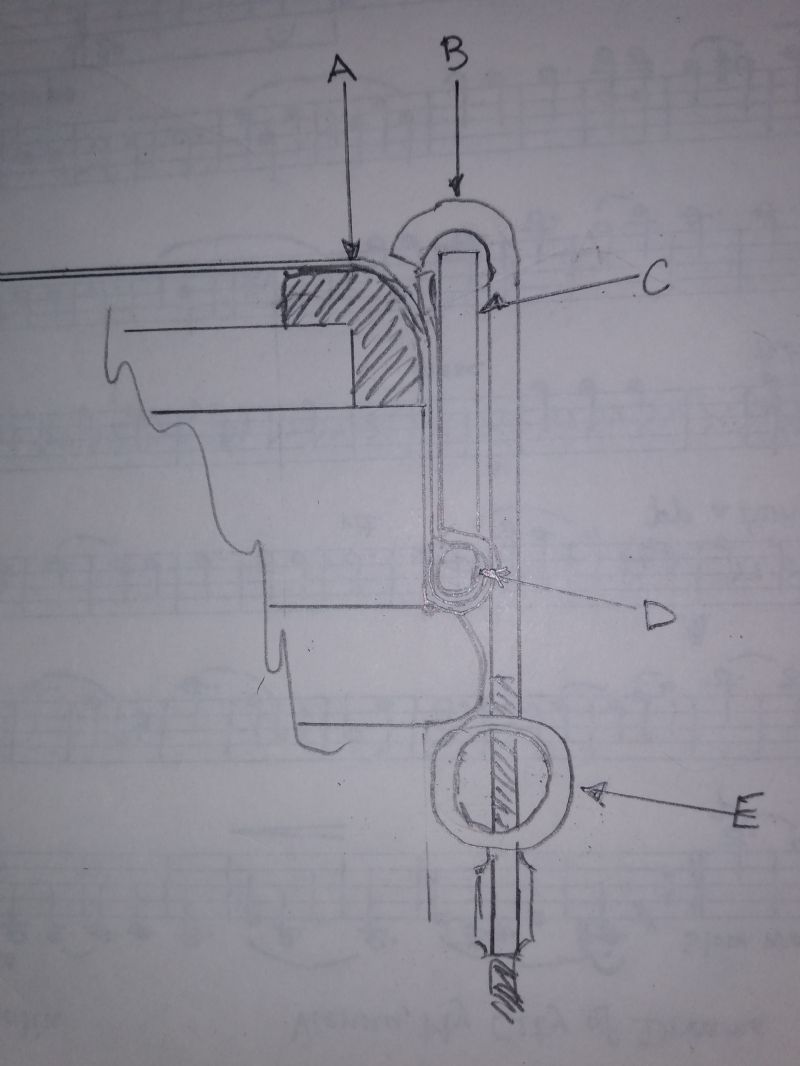
I’ve attached a photo and a sketch to clarify: the part I am interested in is marked “A” in the attached sketch. It is shown as a cross-section in position, “B” is a bracket hook, “C” is the tension hoop, “D” is the flesh hoop and “E” is the tension ring.
It's also a kind of less-known tonering on a Krasky-type Gibson rim that has split circumferentially. Does it need the be soldered? Won't it be the best to just put it back as it is and put a new head on it? Or won't the parts stay in place, because of the split?
This is a spec part for a factory banjo made to a budget. Ok?
Then I think you could research how to make a replica form of something used in casting, and upgrade to something like new silver. It’s soft, but the sterling silver spoons used in making a passive distributor inside the rim (1935) were real nice and went “ding.”
The 1909 plated silver spoons went “chunk.” I rejected them
Just an idea. I will forego photos to keep from drifting, peruse my photos if you like. I get gold-plated stainless spoons from an antique dealer friend, but copper and silver could be alloyed easily.
I think you could make them sound better.
I had a chance to re-head a Stewart Thoroughbred with all hardware free of zinc frost ( an attic find) for a novice.
The flesh hoop was wrapped in cheesecloth which was still intact from the original head’s moisture, but the string was gone. I used wax-coated dental floss to resist the new moisture after lacquering the hoop to make a lasting new thang.
The head tightened up overnight and was dry the next day to begin tightening the hardware.
Maybe this helps, toss the cheap one after keeping the form and increase the content with better stuff than pot metal.
Edited by - Helix on 10/26/2026 16:53:39
I had never heard of a Kraske, Krasky? hoop before, but I also know there are many strange and interesting variations on a theme that emerged from Kalamazoo. I own / have owned a number of them in my career (the aforementioned Gibson cello banjo, a Gibson violincello, a Gibson Tenor Lute (a real hybrid duck), Gibson mando-basses, etc. However, my main “axe” these days is a custom Weber liuto catabile (think of a mandocello, with a high e-string.) I dare mention these irrelevancies on a banjo site, because there is some non-zero crossover interest, I’m sure.
Regardng the tenor banjo again: how can I identify the model and year TB? The serial number is “400” and it has a mark “10” to match the neck with the hoop and otherwise… nothing. It DOES have the Gibson decal inside the hoop. It’s no Mastertone (I have no illusions this banjo is worth very much, I am just a fan of repairing viable vintage instruments.)
Especially, thank you, Helix, for the casting advice. I think I’m just going to re-assemble this the best I can and cover this tone-ring up with a new goatskin and then do the Aztec shuffle down to the jam. Cold beers await!
I thank you all for your thoughts, although I think some of them were more thoughtful than others.
The Kraske wood rim (not normally referred to as a "hoop"), the fact that this banjo has a dowel stick instead of coordinator rods, and that particular version of the gold, oval Gibson label mark this as a pre-1925 banjo.
The serial number "400", I would guess makes it a 1922-23, if not 1920-21.
If it is indeed a 12" diameter rim, I would say this instrument was made fairly early in Gibson banjo production, which started in 1919.
A couple photos of the neck, and especially the headstock, would probably help in pinning down the year and model of the banjo.
__________________________________________________________________________________________________________________________________________________________________________
EDIT: After a little bit of Internet "research", and thanks to the BanjoHangout archives, you may have a first-year-of production (1918-1919) Gibson banjo. Read thru this attached article.
Edited by - RioStat on 10/27/2026 09:50:40
Terms of Use | Privacy Policy | Privacy Consent (EU/GDPR Only)
Copyright 2026 Banjo Hangout. All Rights Reserved.