


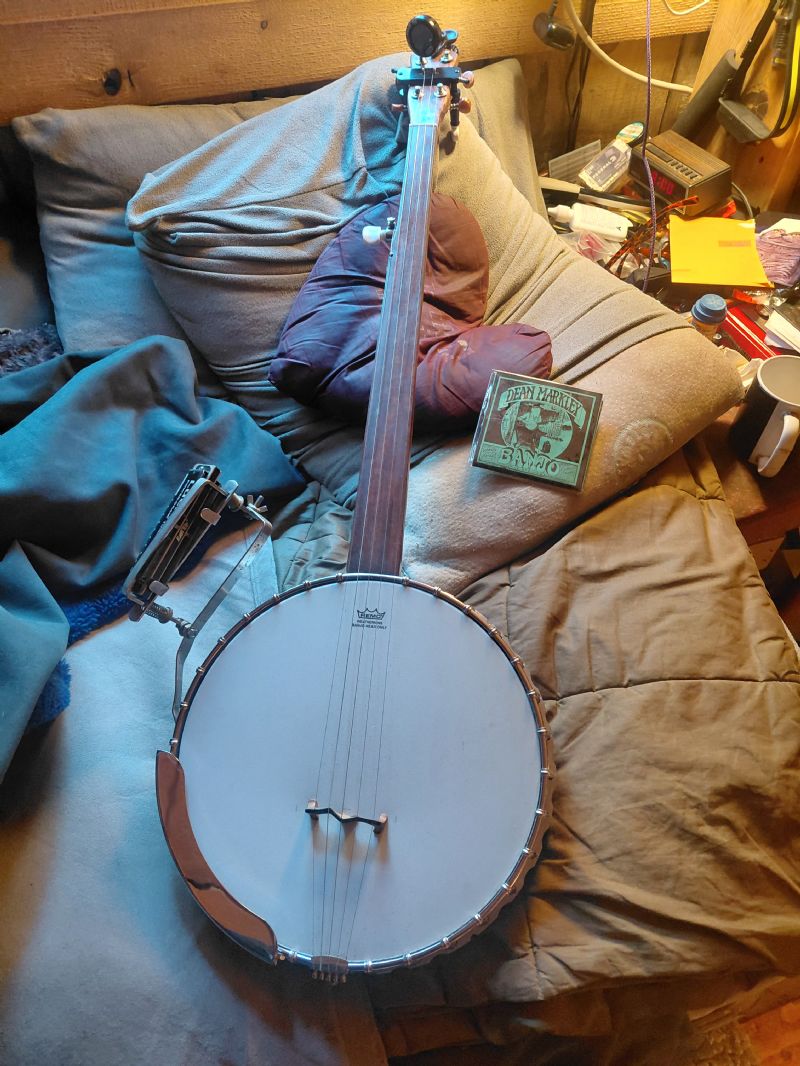
I made an aluminium fretless banjo 5 string..
It came out just fine for what I wanted it for..
The question is...
I started out in open G..
I have since detuned it down through ..F...E..n ..D..
The lower I tune it the louder it seems to get..
These are medium strings..
Tuned back up.. it is not as loud..
Could be me ears.. but I do not think so..
Could it be the combo of string n head tension that is making this happen?
Edited by - STUD figmo Al on 10/23/2026 06:04:07

Pic of the banjo n brand of strings in question..

You could try adding 1/8 of a turn once around the head nuts and see if that brings up the volume,Al.
You'll perceive a boost in volume (up to a point) when detuning strings because the lower tension allows them to oscillate more freely. But you sacrifice brightness and clarity of tone that helps you cut through other sounds. And really under-tensioned strings start to behave erratically in terms of intonation.
The simple way to test it yourself is to play into an app that measures decibel levels (I use Spectroid). Is the lower tuning actually that much louder, or is it mostly perception?
quote:
Originally posted by steve davisYou could try adding 1/8 of a turn once around the head nuts and see if that brings up the volume,Al.
We are on the same page..
But I actually baked off the nuts..a tiny bit..
To me suprise it did seem to get louder..
Edited by - STUD figmo Al on 10/23/2026 06:37:37
"But I actually baked off the nuts..a tiny bit.
"To me suprise it did seem to get louder."
Considering the banjo, the head, the strings, the bridge, the tuning, the tightness of the coordinator rods, the downpressure of the tailpiece on the bridge, and the player's touch, banjos can be set too darned tight, too constricted. This is why (for a typical Mastertone design) as the head gets tightened, the tone and volume will reach an optimum point, and then after that the bass and the volume start to fall off. Therefore, sometimes when the head tension is decreased, volume and bass increase. More is not always "better."
This banjo is a simpler design, nevertheless there is an optimal range considering string tension (which also increases the tension on the head) and head tension, and I think you're finding out where it is.
I have also wondered about string tension. Mostly I am trying to use strings with 12 to 16 lbs of tension (using Stringjoy tension calculator). I play without picks (clawhammer or 2-finger) and I need as much volume as I can get and lower tension seems to help to a point. I've done a lot of trial and error (a lot of error) to find the right string gauges. I would love to know what tension others use.
Re. "... play into an app that measures decibel levels... "
My phone is decidedly not smart [i.e. it has b-i-g square buttons] so I did a quick Google search and came up with https://decibelpro.io/ for my laptop. Dunno if it's what others can use, and I might not do anything productive* with it, but it is straightforward and easy to use.
* but I've already spent some time comparing my two banjos from different distances and angles and w/w.o a capo. [Now to get my lovely and talented assistant to check the readings from 2 meters behind me, and Bob will be my uncle.  ]
Edited by - Owen on 10/23/2026 10:38:27
I've experimented with different strings and gauges, too. One thing I've found is that having a relatively even distribution of pressure across the bridge seems to make a difference.
I actually wrote a little program to calculate the pressure each string puts on the bridge. You can find it on my website, "ddBluegrass.de" (ddbluegrass.de/). It's called String-O-Mat — just a little German banjo nerd project!
For the calculation, I group the two outer strings together (G4 and D3), keep the G3 string separate, and group the other pair (B3 and D4). I find this makes it easier to get an overview of how the pressure is distributed across the bridge.
Of course, string tension is only one part of the equation, but I thought you might find it interesting.
Mainly I assess the tension by feel (with respect to how I play) and tone.
For many years I've been using GHS JD Crowe Studio, which are 9.5, 11, 12, 20, 9.5. These are fairly balanced in tension as banjo strings go, except the .012 third string feels a little light, but has better tone and a quicker response to me on my Prucha compared to .0125.
Mr. JD's "Stage" set is 10, 11, 12, 20, 10.
Shows that you don't need heavy strings to get power.
Some players that use(d) heavier gauges on some strings, such as Jens Kruger, Bela Fleck, Bill Keith, often mention(ed) the feel to them, particularly on the outside strings 1st and 5th. Not so much the volume difference.
Another aspect of string tension between different strings on different notes is the difference in stiffness of the strings.
For example, a .010 string tuned to D on the 1st string has the same tension as a .015 string tuned to G on the 3rd string. But the .015 string is stiffer -- takes more force to bend it or stretch it. So the two strings will feel different even though they have the same tension.
That's why low strings are wound -- the winding adds mass but not much stiffness. Take a plain, unwound .024 4th string tuned to the low D and it will feel like plucking a steel bar or a string on a piano.  Wound .024 4th will have some give to it.
So a "balanced" feel to strings when you're actually playing is a combination of both tension and stiffness.
"...aluminium fretless banjo 5 string"
I might guess that the aluminum body might be resonant at some frequencies, which would have an impact on loudness. Not much you can do about it, but some tunings might sound just better than others.
Check out what Roger Siminoff has done with his research on string tension. I've been very happy using his stings for the last few years btw.
straightupstrings.com
quote:
Originally posted by Alex Z....Mr. JD's "Stage" set is 10, 11, 12, 20, 10.
Shows that you don't need heavy strings to get power...
This has been my latest realization, after years of assuming. I've always used medium gauge sets on my tone ring banjo, because I assumed that was the law. I've always used lights on my Goodtime, because I don't want to warp the neck. I assumed lights wouldn't work as well on my Sierra. In the past I bought a banjo from an older gentleman, who included a bag FULL of string sets. Different gauges, different brands, from lights, to heavier strings than I've ever used before. I've been working my way through them, and still learning. With my average set up, 90 head tension, parallel tailpiece, and 3/23 - 1/8 action, the heavier the strings, the worse my banjo sounds, and I have no desire to mess with my set up, for the sake of strings. The real shocker came from using GHS PF190 lights on my tone ring banjo, and it sounds the best it ever has, without any loss in volume. And they fret easier. It's nice to know I can buy multi packs of lights, and they will work great on all my banjos.
quote:
Originally posted by Alex ZShows that you don't need heavy strings to get power.
As I and other classic-style players will tell you, light-gauge nylon can hold its own against steel with the right technique and setup.
Any change made in set up should be a new lesson in setting up one's own banjo.
For banjo, there is no uniformity of what "light" or "medium" means, as there is for guitar. Have to know the individual string gauges. For example, GHS:
- "Light" PF 130 -- 10, 12, 14, 22, 10
- "Light" PF 150 -- 10, 12, 14, 22, 10
- "Light" PF 140 -- 9.5, 11, 12, 20, 9.5
- "Regular Light" PF 170 -- 9, 11, 13, 20, 9
- "Custom Light" PF 155 -- 10,11,12.5, 20, 10
- "Medium Light" PF 145 -- 10, 12, 13, 22, 10
- "Medium Light" PF 135 -- 10, 11, 12, 20, 10
- "Almost Medium" PF 185 -- 10.5, 11.5, 13, 20 10.5
- "Medium" PF 180 -- 11, 13, 16, 24, 10
- "Medium" PF 160 -- 11, 13, 16, 26, 10
I was using PF 180 on my Serria, and PF 140 on my Goodtime. Then I found a few sets of PF 190’s, which I never even heard of before. They sound fantastic on all my banjos, and are light enough to use on the Goodtime. I like them enough, where I’ll prolly order them in bulk when I run out of what I have.
Two more variations on "light" and "medium," from the cryogenic strings:
- "Light" PF 190 -- 10, 11, 13, 20, 10
- "Medium" PF 200 -- 11, 12, 14, 22, 11
Plus the Sonny Osborne strings:
- PF 175 -- 11, 12, 13, 22, 11
Edited by - Alex Z on 10/24/2026 15:03:29
Terms of Use | Privacy Policy | Privacy Consent (EU/GDPR Only)
Copyright 2026 Banjo Hangout. All Rights Reserved.


