


Got a Japanese metal pot integrated arch top tone ring banjo, and I really like how it sounds both fingerpicking and clawhammering.
I think it’s a Iida Model 226, but not 100% sure.
I’d like to scoop out the last five frets. I’ll include pics here, just curious if there’s any peculiarities I should be aware of. I have a luthier friend who I think could do a basic competent job, which is all I’m looking for. Just want to know if there’s any secret trapdoors or pitfalls to be aware of.
Thanks for any knowledge.
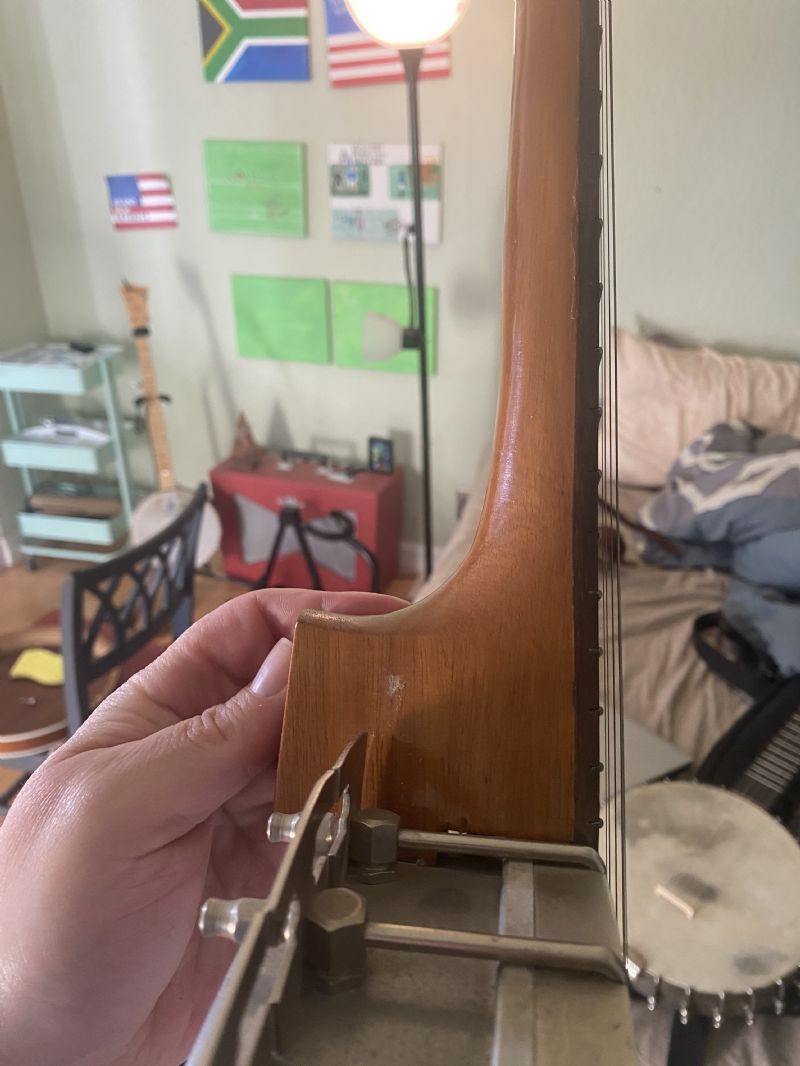
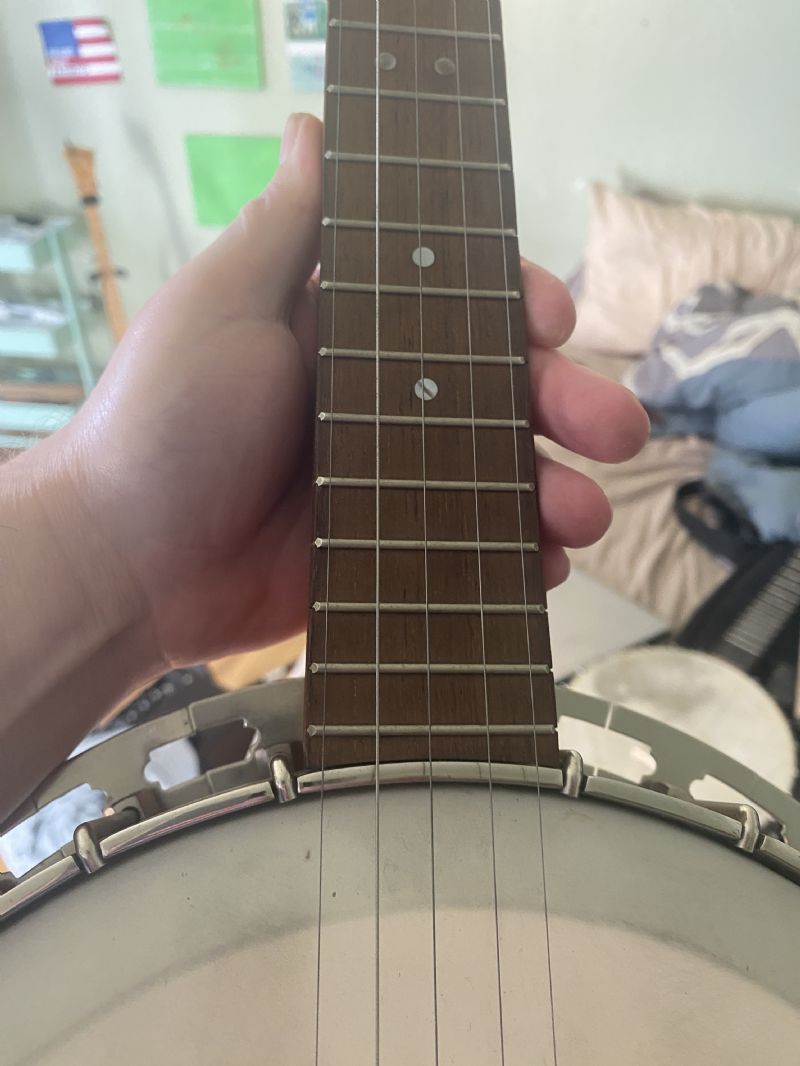
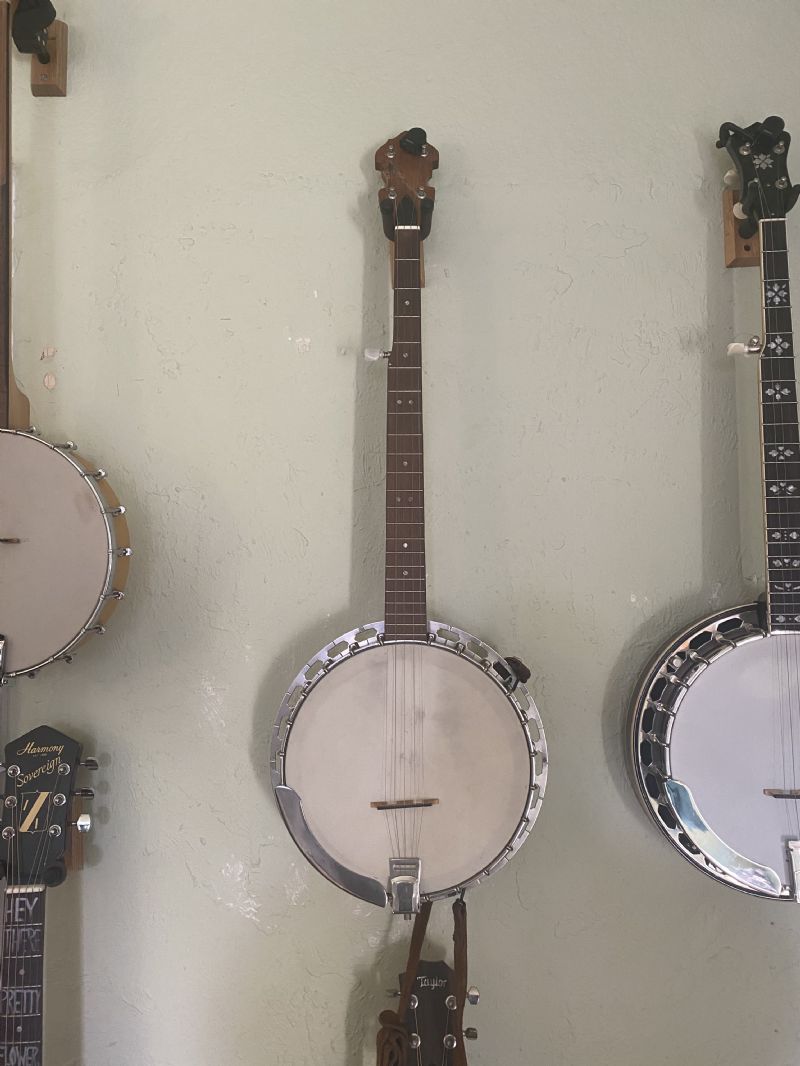

It looks like a Saga kit banjo from the 1970s or 1980s.

Before you scoop, watch several videos of clawhammer folks. See how many of them actually use their scoops. However, scoops are nice looking things!
Hi lapsteel,
I appreciate the advice. I’ve been playing clawhammer for 16 years and my default position is striking near where the pot meets the neck, but I like the option of playing over the neck, and a scoop makes that easier.
I respect everyone’s personal preferences, but I know that I want a scoop. It helps me make the music I want to.
I do a lot of banjos repairs/setups and restores here. I haven't yet scooped neck but I can see how it can be done. One could use a bench belt sander to give the nice curve, The second way is to use a router. I think makers use a template to give them the type of edge they want. Research it thorougly.
The action looks pretty high as is. Not sure why you would want to “scoop” it. Never understood the concept of it.
Just keep in mind, once you scoop, it’s done. No going back.
quote:
Originally posted by Alvin ConderThe action looks pretty high as is. Not sure why you would want to “scoop” it. Never understood the concept of it.
Just keep in mind, once you scoop, it’s done. No going back.
It might take some getting used to but claw the dip area, where the head slopes down. This is the way I claw my arch top. If the tone you get there is too bright to your taste then there's all kind of ways to neuter the tone.
quote:
Originally posted by Alvin ConderThe action looks pretty high as is. Not sure why you would want to “scoop” it. Never understood the concept of it.
Just keep in mind, once you scoop, it’s done. No going back.
As far as I can understand it, the voice of the banjo will change depending on where the string is struck. I have an Enoch Trademen and I am comfortable playing just inside the rim but I tend to hit the head. However, playing over the scoop changes the tone and no head hitting noise. I have my string action set to 3/32" at the 12th fret.
Seems like it would be a standard scoop job on a standard neck. It's just a matter of deciding on the edge shape and depth you want. If your luthier friend is not a banjo person, they may need some guidance.
quote:
Originally posted by Alvin ConderThe action looks pretty high as is. Not sure why you would want to “scoop” it. Never understood the concept of it.
Just keep in mind, once you scoop, it’s done. No going back.
Hi Alvin,
Respectfully, I'm not sure what is hard to understand about the concept of a scoop. It allows for a player to play over the neck without their striking nail or thumb hitting the fingerboard. It's as simple that. Some players may not mind hitting the fingerboard, or play light enough to avoid doing so, or have their action cranked up high enough to avoid it, but for those of us who fall outside those camps, scoops are great features that make playing a banjo more enjoyable.
And yes, I'm aware of that carving out a chunk of wood from the neck is usually a one-way street.
Thanks.
Best,
Bryce
quote:
Originally posted by bFunkquote:
Originally posted by Alvin ConderThe action looks pretty high as is. Not sure why you would want to “scoop” it. Never understood the concept of it.
Just keep in mind, once you scoop, it’s done. No going back.Hi Alvin,
Respectfully, I'm not sure what is hard to understand about the concept of a scoop. It allows for a player to play over the neck without their striking nail or thumb hitting the fingerboard. It's as simple that. Some players may not mind hitting the fingerboard, or play light enough to avoid doing so, or have their action cranked up high enough to avoid it, but for those of us who fall outside those camps, scoops are great features that make playing a banjo more enjoyable.
And yes, I'm aware of that carving out a chunk of wood from the neck is usually a one-way street.
Thanks.
Best,
Bryce
And yes, I'm aware of that carving out a chunk of wood from the neck is usually a one-way street.
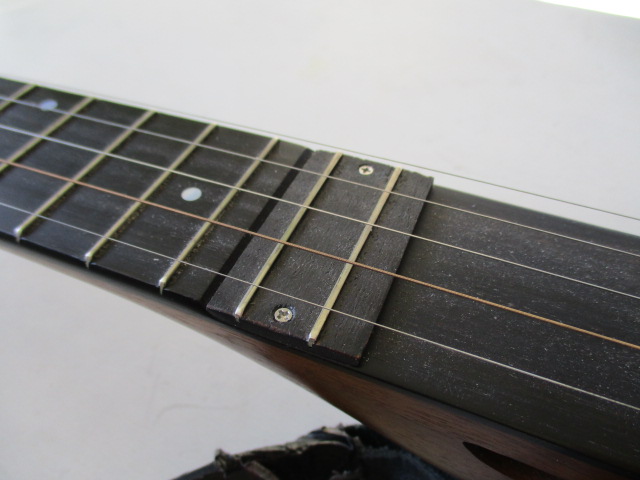
That is not strictly true. When I got my Enoch Tradesman I found the scoop was a bit too long. I like playing way up the neck and one of the notes I couldn't play because it fell within the scoop area. What I did was to make a removable fretboard covering that particular fret. It's only held in place by two small screws. The rest of the scooped area is still fine to play over.
Looking at them pictures a little closer this time.... Hmmm, the action of the strings near the rim is plenty tall enough that, with a bit of practice, you can merrily clawhammer your way to a lot of playing enjoyment without even thingking about scooping.
If you realy realy realy feel you must scopp then consider rounding off the fret board at its edges near the pot a bit so you can "claw" over the neck near the pot without any probs.
Keep in mind: the olden masters like Wade Word etc. never did, or needed to, do any kinda scooping.
The reason for a "scoop" is clear and well established.
First appearing in the modern form from the hands of Bob Flesher in the mid 1960s (circa 1964), the scoop is exactly what is needed to play 1990s-2000s festival style old time in the context of fiddle accompaniment jamming.
quote:
Originally posted by Joel HooksThe reason for a "scoop" is clear and well established.
First appearing in the modern form from the hands of Bob Flesher in the mid 1960s (circa 1964), the scoop is exactly what is needed to play 1990s-2000s festival style old time in the context of fiddle accompaniment jamming.
Joel, was there any banjos made earlier with a scoop or is the 1960's the definitive time peeriod for it?
quote:
Originally posted by banjonzquote:
Originally posted by Joel HooksThe reason for a "scoop" is clear and well established.
First appearing in the modern form from the hands of Bob Flesher in the mid 1960s (circa 1964), the scoop is exactly what is needed to play 1990s-2000s festival style old time in the context of fiddle accompaniment jamming.Joel, was there any banjos made earlier with a scoop or is the 1960's the definitive time peeriod for it?
Early banjos, such as those made around the American Civil War to the early 1870s would sometimes include an aesthetic freture that looks like, and was no doubt the inspiration of, the modern scoop. But there is no evidence or indication that it was more then a visual element. There seems to be period era confusion as to just why some early banjos had them leading to speculation. Stewart claimed is was because they did not play that high and did not need that part of the Fingerboard. There is a second hand account claiming that Horace Weston said it was for playing the banjo with a violin bow (I think this came from Thomas Armstrong long after Weston died).
The modern scoop, the subject of the OP, was first done by Bob Flesher to aid in imitation Kyle Creed’s style, though Creed did no use a scoop, nor build banjos with them.
Terms of Use | Privacy Policy | Privacy Consent (EU/GDPR Only)
Copyright 2026 Banjo Hangout. All Rights Reserved.


