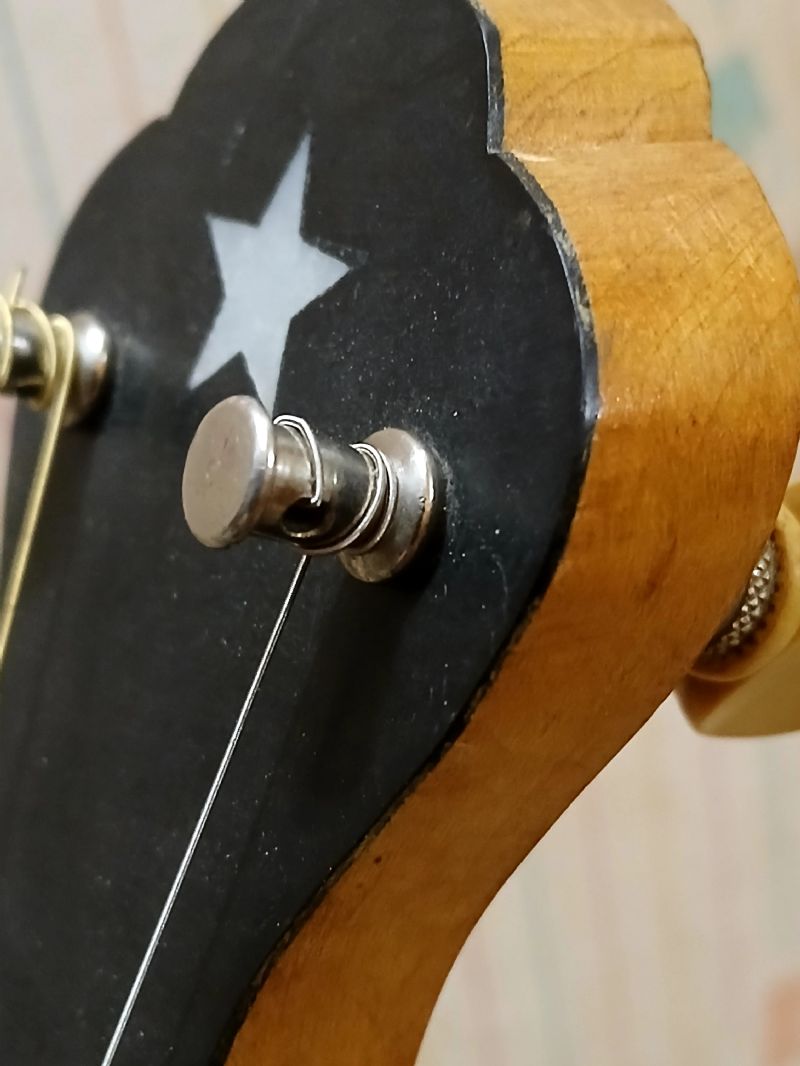
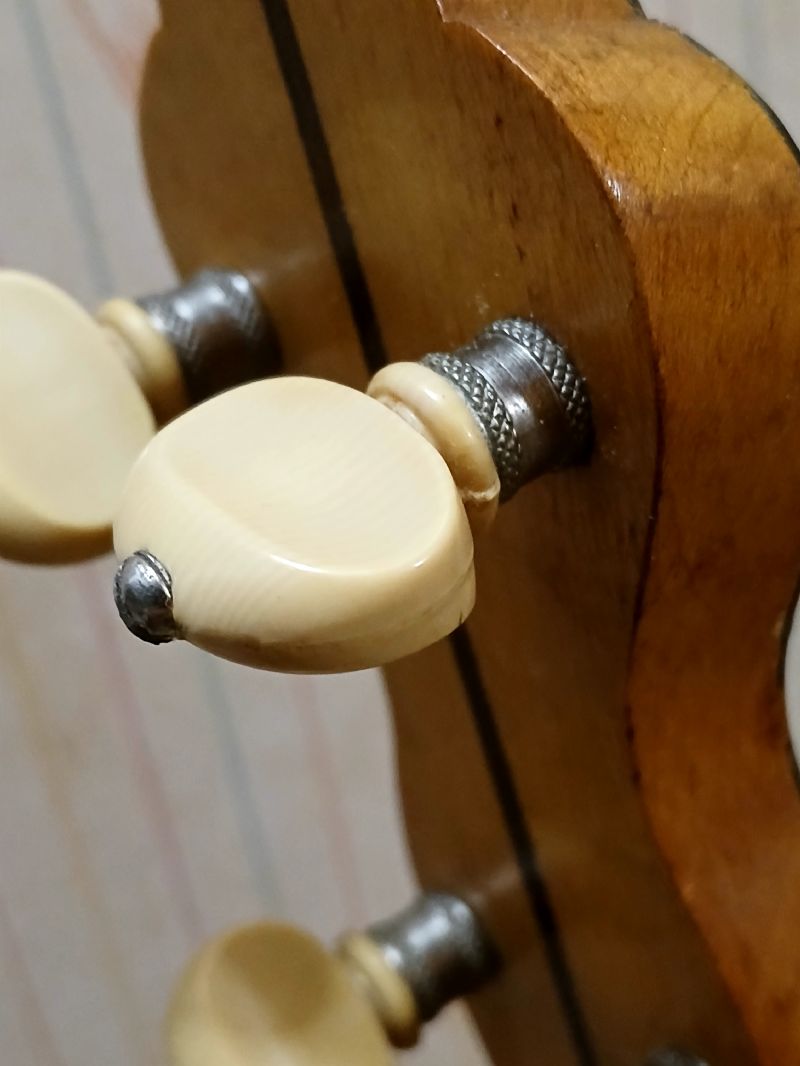
Recently got a "project" banjo to fix up and give to a grandaughter. An old Slingerland May Bell 17 fret open back. After only about an hour or two, it really looks nice. It's not a high end instrument, but the metal parts have no tarnish or rust and really shine and the birds-eye maple pot is eye catching. With a couple hooks, a new Waverly tailpiece, strings(GDAE), and a bridge, it plays and sounds great. Suspect the old skin head is responsible for that.
The only fly in the ointment is the original friction tuners. I have dissassembled them completely and there is no rust, tarnish, or grime. But, in order to hold tuning they have to be adjusted so tight that a 12 year old will not be able to tune without a pair of pliers or something.
Short of replacing them with planetary tuners, is there anything I can try to make them turn more easily and smoothly, but hold tuning?

Can you post a couple of closeups of at least one of the pegs (back and front)?

But, But, But, you can't change the tuners, the banjo would not be original!!!!!!!!!!!!!!!!!!!!!!!!!!!!!!!!!!!!!
There are several strategies for improving old friction tuners. I suspect Dan will jump in with suggestions. Often just a washer in the right location.
Vintage and antique instruments that are in pristine condition should be kept original and placed in the hands of collectors.
Player grade instruments--some wear on the back of the neck, tarnished metal parts, scratches, maybe a repaired crack or replaced inlays, replaced fingerboard, etc. should be serviced to optimize playability. That often means changing the tuners. Tuners wear out. New tuners make tuning a nice old banjo easy and less frequently needed. Playability is more important than originality.
I come across this all the time with old banjos I repair. Over time the wood compresses under the tension and tightness of the tension screw at the top of the button that holds everything together.
The wood becomes glazed (shiny) and slick so the screw has to be tightened even more to hold it without slipping.
What I do is remove the tuners and de-glaze the two points where the tuner shaft bear. I do this with a bit of sand paper.
I make some thin leather washers to fit between the tuner shaft and the wood underneath the peghead. I have even done it to the top of the tuners. That may work. The tension has to such that is holds without slipping and also be able to be turned to tune the string. Just my 2c worth.
I would like to post pictures. But I have no idea how. I have some good close ups, but cannot make them load.
Did you clean the bearing surfaces on the wood as well as on the metal? Use any sort of lubricant?
Yes, those surfaces were wiped. There really was no grease, grime or dirt. I did not use any lubricant. Should I? If so, what and where?
I read something here just recently, but I can't find it. Someone wrote that they use Wirbel soap for violins. I didn't think it was a bad idea, but I haven't tried it yet.
Maybe someone else will chime in.
Looking back at Dan's question about cleaning, I re-tried that. I had wiped the face surfaces of the peghead but the bearing surfaces are really mostly the tapered holes mating with the tapered shaft ends. So I threaded a small thin strip of buckskin through the holes and twisted it. It wiped off a small amount of black dust. Seems to have solved the problem.
What about some of the violin peg paste stuff on the bearing surfaces? Hill makes one and Hindersine is another. I have never tried this on metal surfaces so at this point it's just an idea. Might be worth trying.
I have used Hill violin peg lube on screw tension friction tuners with success, but the combination of friction tuners and steel strings will always be fussy. I would not hesitate to install a set of Gotoh planetary banjo tuners on a Maybell Slingerland banjo.
Bob Smakula
smakulafrettedinstruments.com
quote:
Originally posted by TuedelbandI read something here just recently, but I can't find it. Someone wrote that they use Wirbel soap for violins. I didn't think it was a bad idea, but I haven't tried it yet.
Maybe someone else will chime in.
I believe that's what's called in English "peg soap" or "peg dope", which has been mentioned.
I've always used Lava soap (which contains a bit of very fine abrasive) on wooden pegs, and it does also work on metal-to-wood bearings. It's not rough enough to cause significant wear (much less any noticeable drag on the peg!), but does improve the fit on a microscopic level. Kind of like grinding the valves on a car engine.
Terms of Use | Privacy Policy | Privacy Consent (EU/GDPR Only)
Copyright 2026 Banjo Hangout. All Rights Reserved.