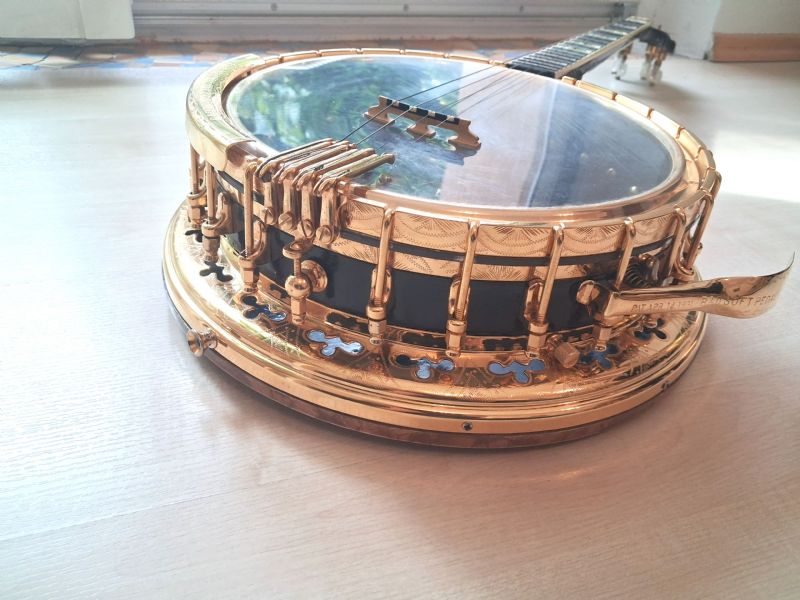
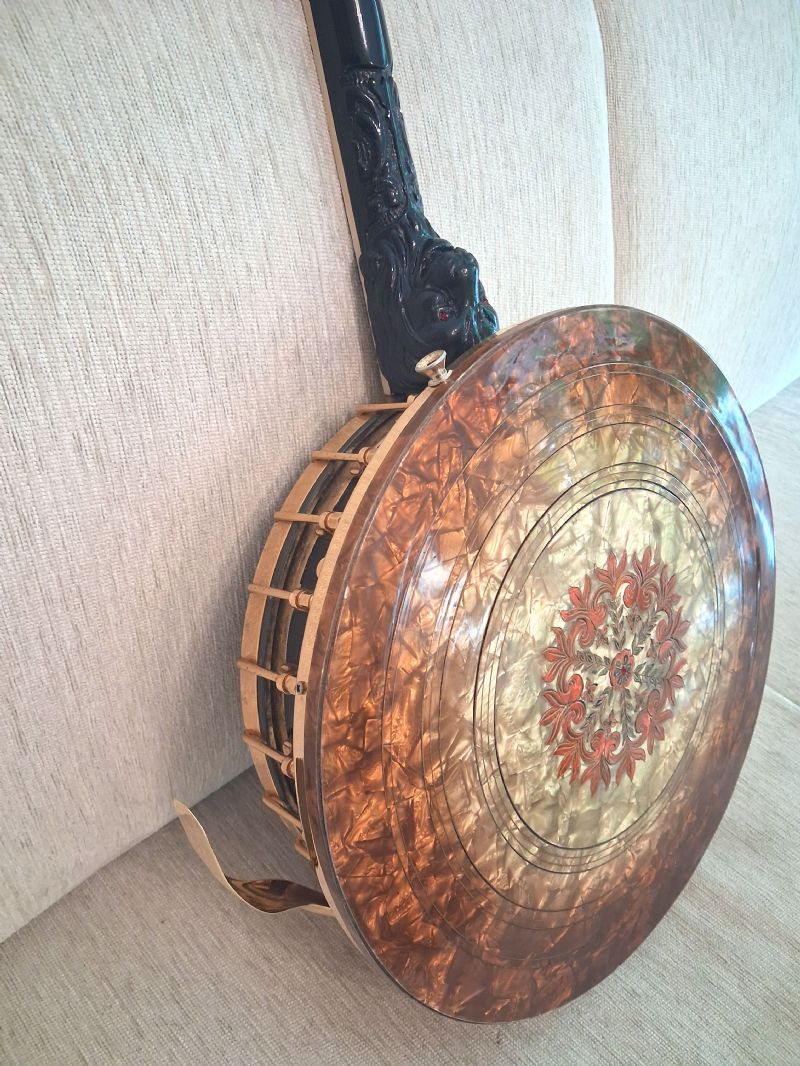
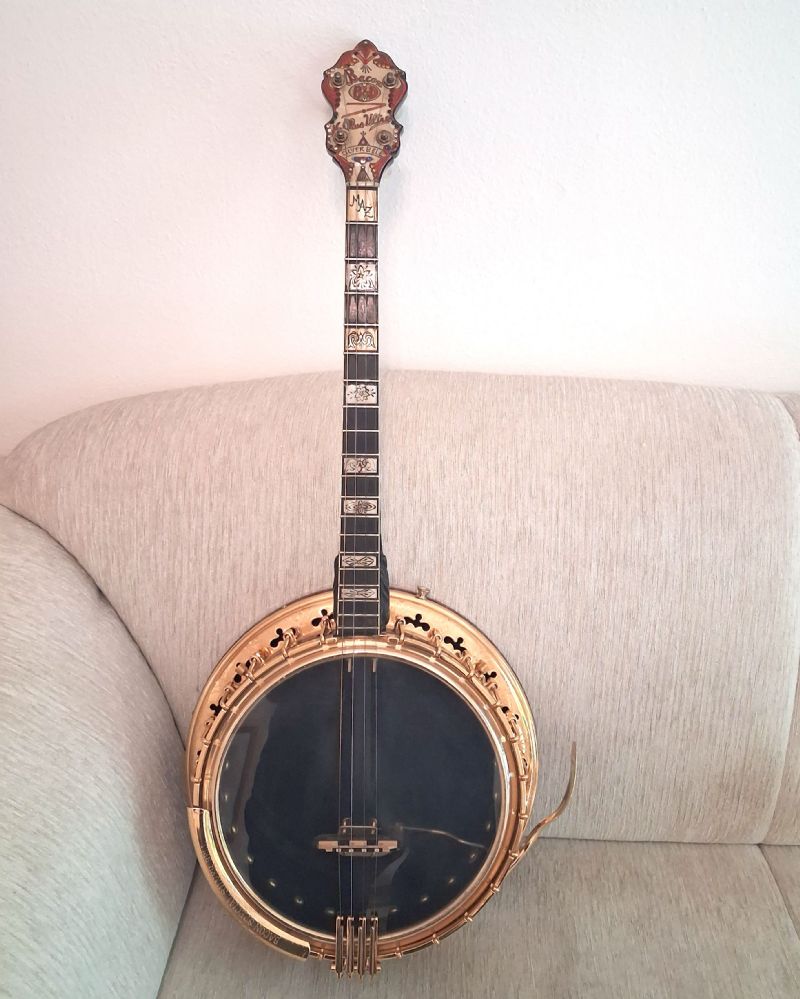
We own a Bacon & Day tenor banjo Ne plus ultra Silver Bell. We can't find any serial number, but we guess it's a number 6. What we are most puzzled by is the engraving "MAZ" at top of the neck. Does anyone know anything about it?
Grateful for any hint
Simone
edit sorry something went wrong ... photos missing ... little bit overwhelmed in an english-speaking forum but giving my best ;-) I'll try again
Edited by - Simone on 10/11/2026 11:47:06

Most of us can barely read, we need photos. Take the resonator off if you have not already. There will typically be serial numbers stamped on the inside of the rim and on the dowel stick. Often the model number is stamped on the dowel holding the neck to the rim.

Quite possibly the initials of the original owner... Bacon did custom work on high end models.
I'm so sorry, no photos uploaded ... I fixed it in first message!
I'm talking about this ..."MAZ" - dedication? Musician? Manufacturer? Luthier?
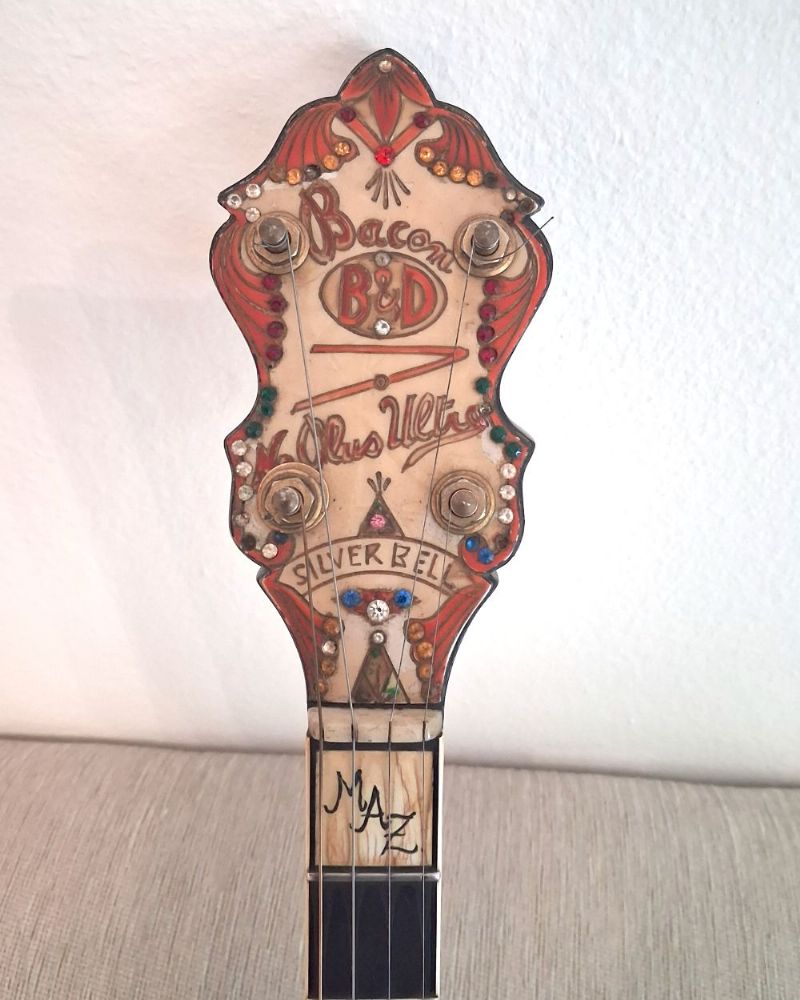
Probably MAZ is a bit of customization, with the owner's initials.
What a prize. You have the "Lion Head" version (another is an elephant head including tusks!) "Ne Plus Ultra" means None Better. I believe that would make it a No. 6. There were none better!
Where are you located?
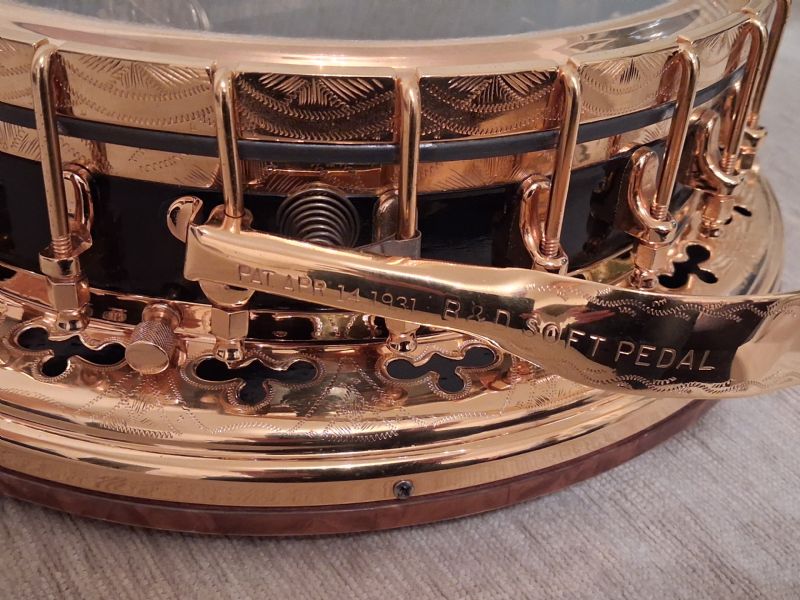
With the cloverleaf flange holes and other details, This banjo was likely made after Gretsch acquired the Bacon Banjo Company after the hurricane of 1938. It will not be as valuable as a pre-Gretsch instrument, but still should be a really good tenor banjo.
Like Banner Blue mentioned, remove the resonator and check the dowelstick and/or the wood rim's interior as the likely place for stamped serial numbers. The number will help determine a manufacturing date.
I agree with the other Banjo Hangout members that MAZ is likely the initials of the original owner.
Bob Smakula
smakulafrettedinstruments.com
Edited by - Bob Smakula on 10/11/2026 14:12:46
This is a Gretsch era NPU. It is not collectible, but it a very nice banjo in its own right
This fabulous instrument strikes me as the epitome of a collectible.
Thank you very much for first hints and identifying specific details!
We are located in Germany, Bavaria. When buying his banjo, my father didn't care for manufacturer, model etc - he felt in love with this banjo when first hearing its sound. That was the only deciding factor.
Now, 70 years old, he finished playing in his band and even thinks about selling. That's where I get involved. Completely at a loss when it comes to banjos, I sent him to an expert in old stringed instruments in Munich. Dad came back full of enthusiasm, the information "maybe it's a number 6", and many stories about the golden age of jazz ;-)
Not sure if Dad brought back every information he got, that's why I'll check the inside of rim and the dowel stick this evening.
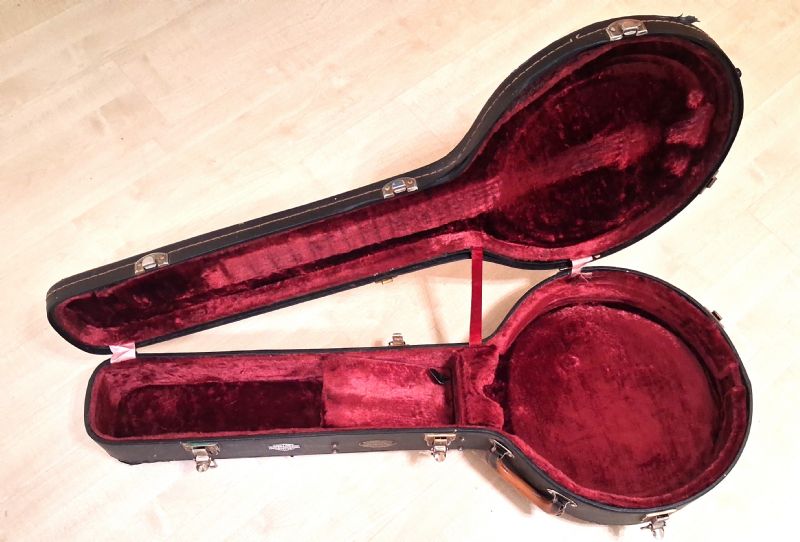
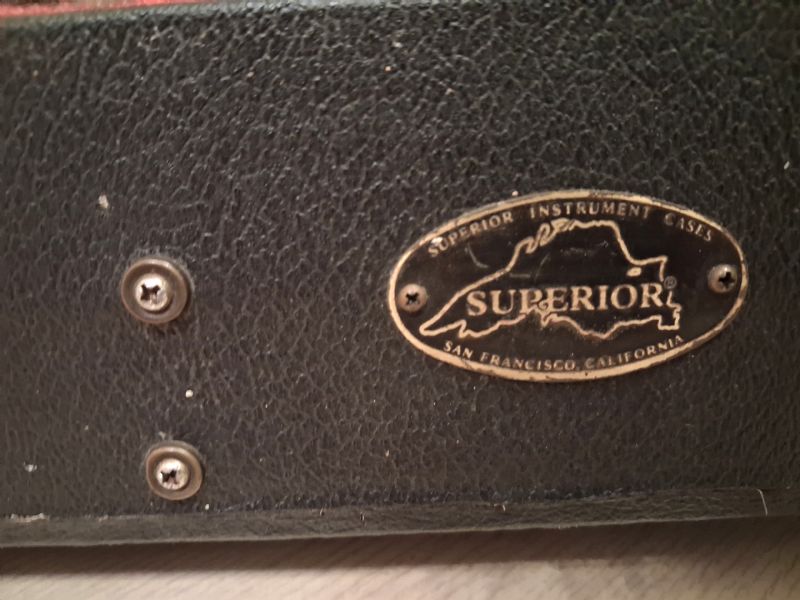
And I'll have a look at the case. (I've completely neglected it up until now.) It has been signed as original. Maybe there are further hints
A superb tenor player -- and singer -- from Massachusetts was Jimmy Mazzy, who played with the Paramount Jazz Band of Boston. Whether it belonged to him or not, it's a banjo worthy of his talents.
Bob Smakula, I was afraid I'd be wrong about it being an earlier B&D No. 6, so I'm interested in two points from your reply.
A "real" earlier B&D would have f holes in the flange instead of cloverleaf holes? What in particular makes the Gretsch not "collectible"? Were they made in great numbers? (Not "rare") Are they in some way deficient compared to B&D's? Were shortcuts taken? Do they sound/feel a lot of different?
Thanks if you care to educate me/us a bit further.
no serial number, no model number.
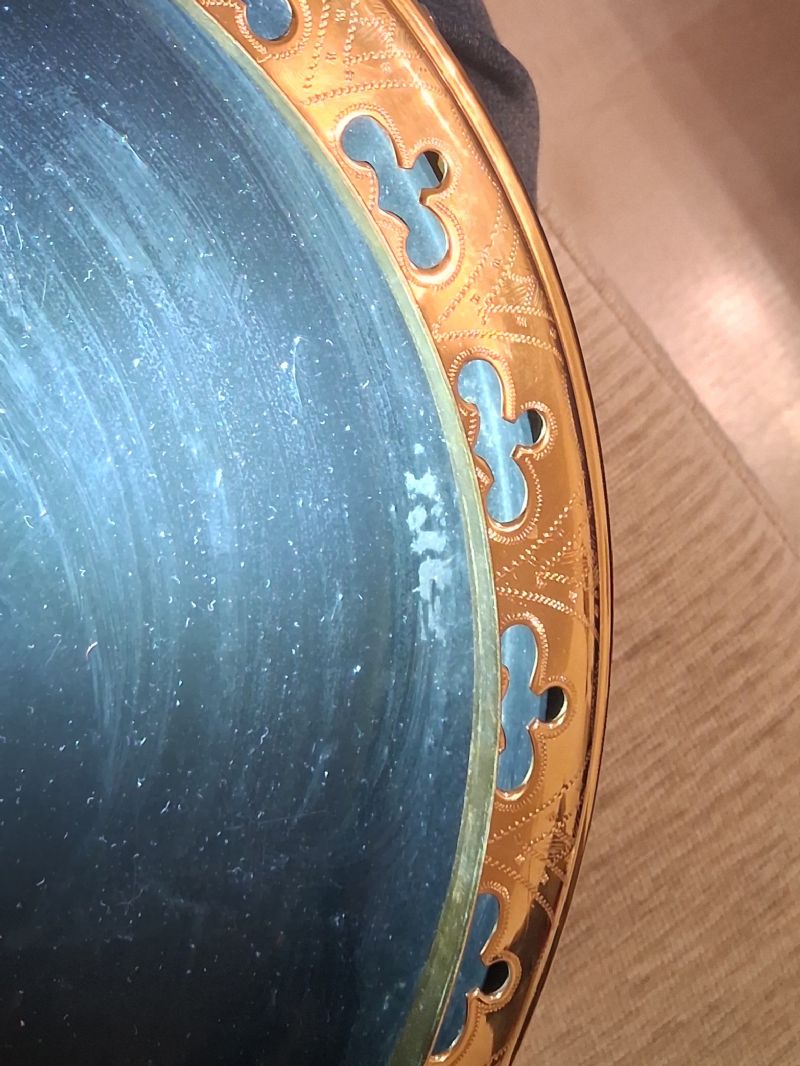
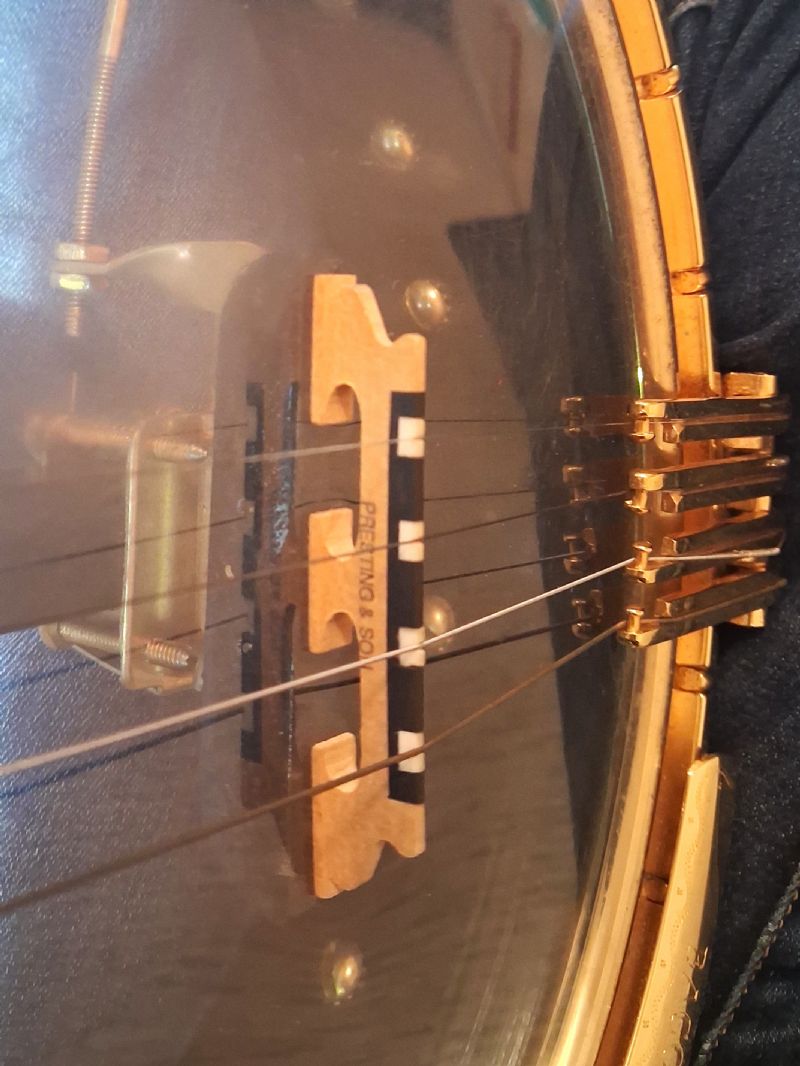
Inside resonator there are some strange spots that even the expert found puzzling (photo).
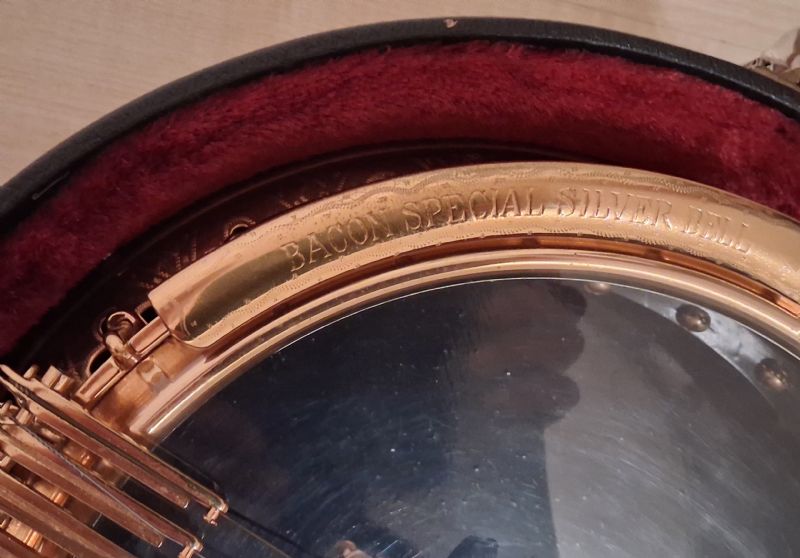
Stamps or engravings we have only on 3 parts: Bridge - Presting & Son; "Bacon Special Silver Bell" and "Pat. Apr. 14 1931 B&D Soft Pedal".
I'm adding a photo of banjo case.
Thank you in advance for further information!
quote:
Originally posted by Bob SmakulaWith the cloverleaf flange holes and other details, This banjo was likely made after Gretsch acquired the Bacon Banjo Company after the hurricane of 1938. It will not be as valuable as a pre-Gretsch instrument, but still should be a really good tenor banjo.
Like Banner Blue mentioned, remove the resonator and check the dowelstick and/or the wood rim's interior as the likely place for stamped serial numbers. The number will help determine a manufacturing date.I agree with the other Banjo Hangout members that MAZ is likely the initials of the original owner.
Bob Smakula
smakulafrettedinstruments.com
It's the specific combination of several details which prompts this temporal classification, isn't it?
That's my first conclusion after 3 days of looking at dozens of photos ... looking for details a layperson can recognize and without any knowledge of technology concerning banjos. I've found the cloverleaf flange holes on banjos from ca. mid 1930s and dominant in Gretsch-era; the peghead type with small ears at NPUs No 6, Montana and Sultana starting in 1930s; I found the font type and curleycues on pegheads all estimated post-Groton; the inlay decoration with inaccurate flowers from 30s to late 60s ... For a layperson, it's all very confusing to figure out.
So thank you 1000 times for giving me the clue and anchor "post 1938/post 1940"!!
And what can I say: we caught fire. We would like to know more about this "Bacon by Gretsch"-NPU with this style . Online we found three with exactly this style, at Gruhn, Kendzia and 12 fret (Plectrum). And we are puzzled by the given years of manufacturing!
12 fret: 1940s 1940s Bacon Ne Plus Ultra Plectrum Banjo by Gretsch | archive.12fret.com
Gruhn: ca. 1960 Grestch Bacon & Day Silver Bell Ne Plus Ultra c. 1960 | Gruhn Guitars
Kendzia: after 1940 Lot page - Auktionshaus KENDZIA
(Kendzia: I didn't know what to make of the serial number even after I had read the studies on the subject by Polle, Ed Ball, Mike etc. on BHO ... the "Made in USA" stamp seems to point to the Baldwin-time, starting 1967, doesn't it?!)
Assuming that all the dates are correct: Why are there 3 items of same style spread over 30 years? Why didn't the optical style develop? Why is a late 1960s banjo NPU No 6 looking the same as a late Groton-NPU No. 7, that is to say looking like a package of rhinestones that had burst open?
I would absolutely love to have a look into late Groton-catalogs (who made promotion during the transition-time late 1938 until early 1940, Bacon or Gretsch?) an in Gretsch-catalogs showing "Bacon Banjos by Gretsch". All digitalized catalogs I found (acousticmusic.org, digitalcommons.georgiasouthern.de) are too early or do not speak about "Bacon Banjos by Gretsch".
Do you know where I can find the right catalogs? Do you have any idea of this never changing style of our banjo?
thank you, Simone
quote:
Originally posted by Simonequote:
Originally posted by Bob SmakulaWith the cloverleaf flange holes and other details, This banjo was likely made after Gretsch acquired the Bacon Banjo Company after the hurricane of 1938. It will not be as valuable as a pre-Gretsch instrument, but still should be a really good tenor banjo.
Like Banner Blue mentioned, remove the resonator and check the dowelstick and/or the wood rim's interior as the likely place for stamped serial numbers. The number will help determine a manufacturing date.I agree with the other Banjo Hangout members that MAZ is likely the initials of the original owner.
Bob Smakula
smakulafrettedinstruments.comIt's the specific combination of several details which prompts this temporal classification, isn't it?
That's my first conclusion after 3 days of looking at dozens of photos ... looking for details a layperson can recognize and without any knowledge of technology concerning banjos. I've found the cloverleaf flange holes on banjos from ca. mid 1930s and dominant in Gretsch-era; the peghead type with small ears at NPUs No 6, Montana and Sultana starting in 1930s; I found the font type and curleycues on pegheads all estimated post-Groton; the inlay decoration with inaccurate flowers from 30s to late 60s ... For a layperson, it's all very confusing to figure out.
So thank you 1000 times for giving me the clue and anchor "post 1938/post 1940"!!
And what can I say: we caught fire. We would like to know more about this "Bacon by Gretsch"-NPU with this style . Online we found three with exactly this style, at Gruhn, Kendzia and 12 fret (Plectrum). And we are puzzled by the given years of manufacturing!
12 fret: 1940s 1940s Bacon Ne Plus Ultra Plectrum Banjo by Gretsch | archive.12fret.com
Gruhn: ca. 1960 Grestch Bacon & Day Silver Bell Ne Plus Ultra c. 1960 | Gruhn Guitars
Kendzia: after 1940 Lot page - Auktionshaus KENDZIA
(Kendzia: I didn't know what to make of the serial number 19138 in combination with the text "after 1940", even after I had read the studies on the subject by Polle, Ed Ball, Mike etc. on BHO ... the "Made in USA" stamp seems to point to the Baldwin-time, starting 1967, doesn't it?! is it January 1969 #138? but why don't they just tell it?)
Assuming that all the dates are correct: Why are there 3 items of same style spread over 30 years? Why didn't the optical style develop? Why is a late 1960s banjo NPU No 6 looking the same as a late Groton-NPU No. 7, that is to say looking like a package of rhinestones that had burst open?
I would absolutely love to have a look into late Groton-catalogs (who made promotion during the transition-time late 1938 until early 1940, Bacon or Gretsch?) an in Gretsch-catalogs showing "Bacon Banjos by Gretsch". All digitalized catalogs I found (acousticmusic.org, digitalcommons.georgiasouthern.de) are too early or do not speak about "Bacon Banjos by Gretsch".
Do you know where I can find the right catalogs? Do you have any idea of this never changing style of our banjo? @bobsmakula @banjotrader and others
thank you, Simone
Edited by - Simone on 10/16/2026 06:46:03
Let me save you time with all your research.
- It is a post Groton banjo.
- post hurricane era B&Ds were Bacon Banjo part. Not the style of NPU which are Gretsch design (e.g Pyralin colour, etc)
- dating Gretsch era is futile, nobody cares because they are not collectible.
- the neck back design would be helpful to see and gives a hint of era
- the necks are often just ebonized maple, not actual ebony on the Gretsch era
Terms of Use | Privacy Policy | Privacy Consent (EU/GDPR Only)
Copyright 2026 Banjo Hangout. All Rights Reserved.