Hey folks,
I am brand new here, and for that sake, brand new to the banjo!
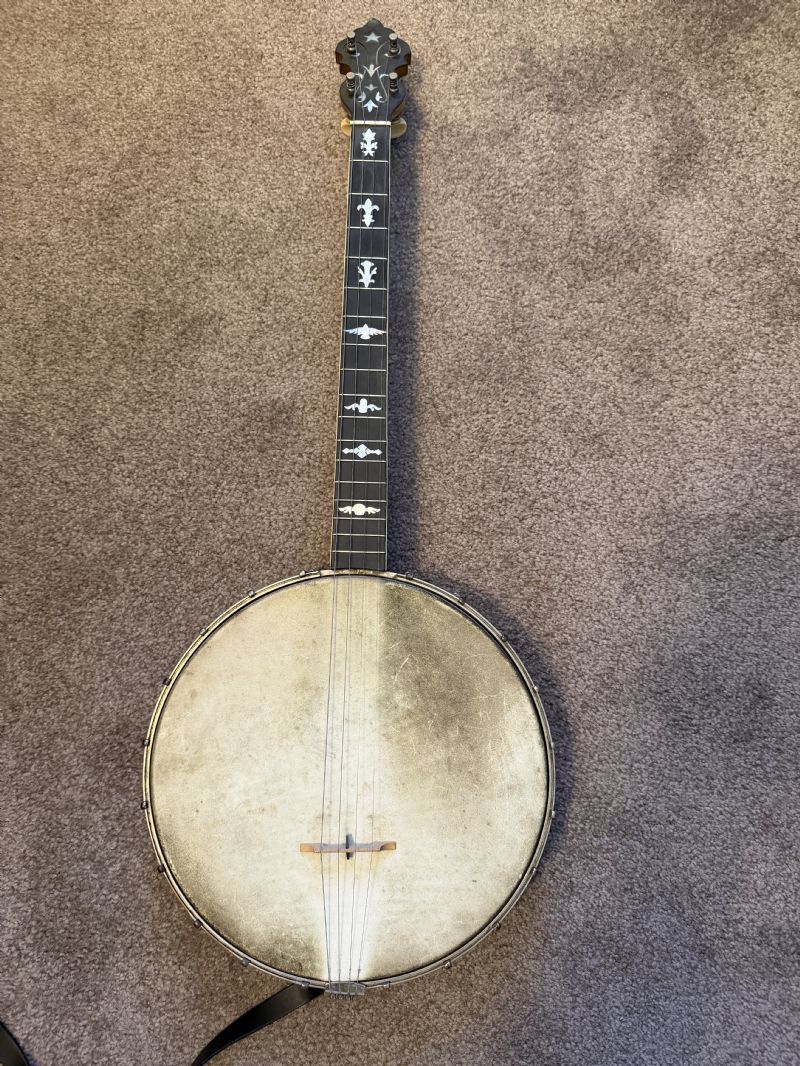
When my Grandfather passed away in the mid 1970's I was given his tenor banjo. Family lore was that he took it with him in the 1920's when he and his brother were barnstormers.
While I play guitar, the years (decades!) went by and I never had the time to learn the banjo. Now that I am retired, I want to take it up.
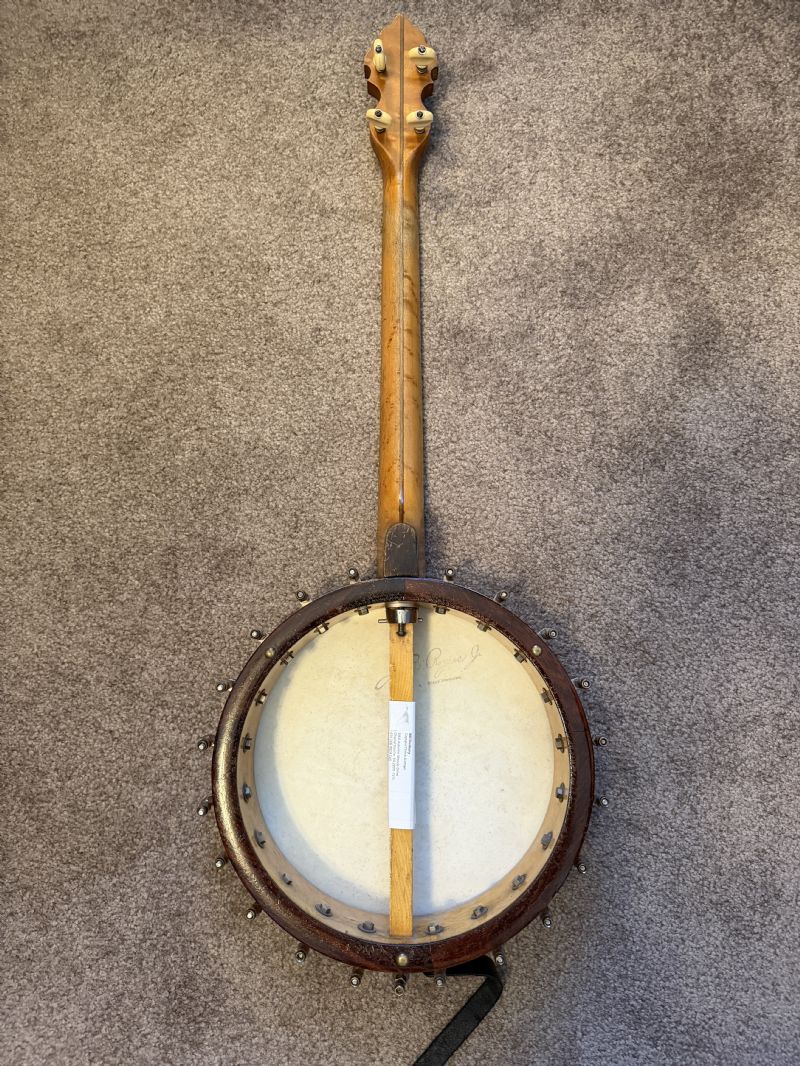
I am interested in this banjo's 'origin story', but there are are few hints on the instrument or case. The underside of the head has 'Jos. B. Rogers, Jr.' which I understand from poking around here made banjo heads.
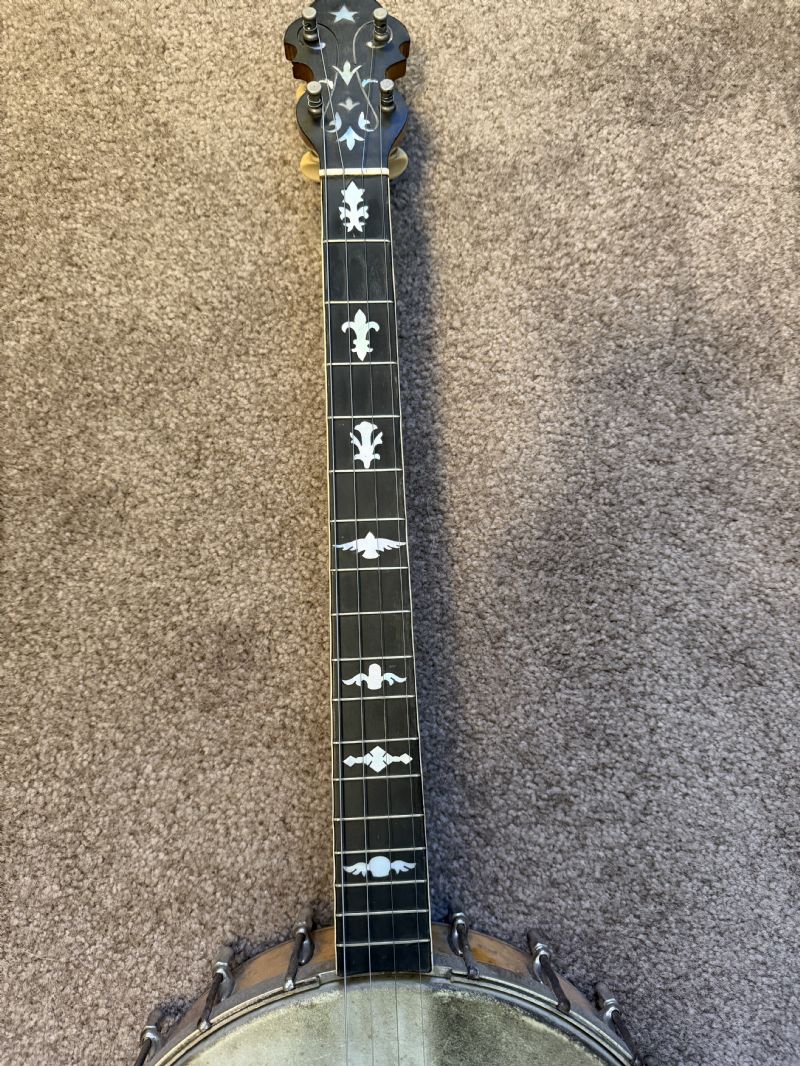
I have included a few pictures. The neck has 17 frets and the tuners are 'peg' type and not geared.
Any help is appreciated.
Thanks!
Dux

Nice banjo. You want to adjust the head tension. The height of the strings needs to be about 1/8 of an inch at the 12th fret. If it is higher than that and the bridge is 1/2 an inch or lower the neck angle will need to be adjusted. Make sure there is not an upward bow in the neck. You have a choice of playing the banjo tuned EADG or CGDA depending on style of music being played. These tunings require different gauges of strings. There is a trade off between keeping the banjo original or replacing the friction tuners with geared tuners, such as Gotoh brand, for easier tuning.
These are topics you can explore more deeply on your own.
Not sure who made it but it is not junk.

Is anything stamped on the dowel rod underneath the paper wrapping ?
Thank Rob,
I will check those adjustments and play around with the string tunings. I am wondering what gauges of strings are best for the different tunings?
While I would like to keep the instrument 'original', the peg tuners are a painintheyouknowwhat to keep the instrument in tune, so I may have to try a set of geared tuners.
Dux
Thanks for the reply. There is nothing stamped on the wooded dowel. The papers is actually a business card I put there just in case the instrument gets 'lost'
I have not removed the head yet to see if there are any engravings there. Since the head and hardware has been removed since at least the mid 1970's, I would guess that some of the hardware is probably going to be difficult to loosen.
Dux
If the diameter is 10 3/4, it’s probably a Slingerland.
Measure the rim across the bottom in several places. If it's 10 3/4", like Bill mentioned, it's a Slingerland. The rim and hardware do have a Slingerland appearance, but the neck doesn't quite mesh with what I have observed on Slingerland banjos. The shape of the peghead also suggests Lyon & Healy. I am inclined to think it was made in Chicago because it has 20 brackets and shoes. That was typical of Chicago-made banjos.
The inlays look more like Wm. Lange. He was based in New York but it's very possible that other makers could have used the same inlay patterns he did. Makers usually got their inlays from suppliers; they didn't cut them in house.
quote:
Originally posted by billduxburyWhile I would like to keep the instrument 'original', the peg tuners are a painintheyouknowwhat to keep the instrument in tune, so I may have to try a set of geared tuners.
The friction pegs you have on there are the design I like best, and if you get the bearing surfaces (on both metal and wood) clean, smooth, and lubricated with a bit of dry soap, they can be surprisingly functional. They do take a little getting used to, and keeping a screwdriver handy to adjust the tension screws, but if you're used to guitar tuners, I'd say the same about standard planetary-geared banjo pegs. Yes, the geared pegs are easier to use, but not nearly as much so as you might think (if the friction tuners are performing optimally). And you will have to enlarge the peg holes to install new pegs.
Terms of Use | Privacy Policy | Privacy Consent (EU/GDPR Only)
Copyright 2026 Banjo Hangout. All Rights Reserved.