


Page: 1 2
Who invented Modern Western Music Notation?
It was invented by Guido of Arrezo, an Italian Benetictine Monk.
Pythagoras a Greek Philosopher, and Music Theory
Edited by - Jack Baker on 10/04/2026 04:58:22

I’m pretty sure Carlton Haney knew . We need more Carlton Haneys .

No, Guido de Arezzo was not the first to invent musical notation in human history, but he was the inventor of the system that gave rise to modern Western notation.
Before him, music was already written in other ways, but his innovations changed the rules of the game forever.
The Evolution Before Guido de Arezzo
To understand his true credit, we have to look at what existed before him:
• Mesopotamia (c. 2000 BCE) — Sumerian Cuneiform: Clay tablets containing instructions for tuning lyres and singing. This is the oldest known musical record.
• Ancient Greece (c. 1st Century CE) — Alphabetical Notation: They used letters of the alphabet placed over the text to indicate the notes. The most famous example is the Seikilos Epitaph.
• Early Middle Ages (c. 8th-10th Centuries) — Primitive Neumes: Symbols drawn above Gregorian chant texts. They only served as a visual reminder; they showed whether the voice went up or down, but not the exact pitch. If you didn't know the melody beforehand, it was impossible to sing it.
And all this time I thought it was Bill Monroe.....
Hi Joseba,
Thank you for your correction....Jack
Originally posted by Joseba AndoniNo, Guido de Arezzo was not the first to invent musical notation in human history, but he was the inventor of the system that gave rise to modern Western notation.
Before him, music was already written in other ways, but his innovations changed the rules of the game forever.
The Evolution Before Guido de Arezzo
To understand his true credit, we have to look at what existed before him:
• Mesopotamia (c. 2000 BCE) — Sumerian Cuneiform: Clay tablets containing instructions for tuning lyres and singing. This is the oldest known musical record.
• Ancient Greece (c. 1st Century CE) — Alphabetical Notation: They used letters of the alphabet placed over the text to indicate the notes. The most famous example is the Seikilos Epitaph.
• Early Middle Ages (c. 8th-10th Centuries) — Primitive Neumes: Symbols drawn above Gregorian chant texts. They only served as a visual reminder; they showed whether the voice went up or down, but not the exact pitch. If you didn't know the melody beforehand, it was impossible to sing it.
I just have to say, the historical Pythagoras did not invent anything having to do with music. The math behind simple musical ratios was already known before his time, and the musical system he advocated for was regressive and divorced from musical practice at that point in Greek history. Unfortunately, we in the West seem stuck with Pythagoras as the mythological progenitor of music.
Yes,
As I was hoping my earlier post had explained. HA! this is why I rarely post anymore. I do hope my Tabs are better received...Jack
Edited by - Jack Baker on 10/04/2026 05:49:46
Hi Jack,
Here’s a BBC production you might find interesting.
It’s part a a 6 piece series Howard Goodall Big Bangs of Music.
m.youtube.com/watch?v=Sl8PpGuk...c%3D&ra=m
Rick,
Thank you so much. Really interesting to read and see....Jack
quote:
Originally posted by Jack BakerYes,
As I was hoping my earlier post had explained. HA! this is why I rarely post anymore. I do hope my Tabs are better received...Jack
So is this a Red Herring or a Appeal to Pity Fallacy?
This seems to be a pattern. Make a post, receive replies, then declare "this is why I rarely post anymore"... because people interacted with your post.
Hi Jack Baker! This was absolutely not a criticism of your post at all, but rather a way to expand on the fascinating history of music. Your contributions with the tabs are great and always highly appreciated!" Andoni
Joel,
There is something Mentally wrong with you. See a Doc real quick as you don't seem to know much about anything Musical as far as I can se...J
Originally posted by Joel Hooksquote:
Originally posted by Jack BakerYes,
As I was hoping my earlier post had explained. HA! this is why I rarely post anymore. I do hope my Tabs are better received...JackSo is this a Red Herring or a Appeal to Pity Fallacy?
This seems to be a pattern. Make a post, receive replies, then declare "this is why I rarely post anymore"... because people interacted with your post.
Edited by - Jack Baker on 10/04/2026 11:15:55
quote:
Originally posted by Jack BakerJoel,There is something Mentally wrong with you. See a Doc real quick as you don't seem to know much about anything Musical as far as I can se...J
Originally posted by Joel Hooksquote:
Originally posted by Jack BakerYes,
As I was hoping my earlier post had explained. HA! this is why I rarely post anymore. I do hope my Tabs are better received...JackSo is this a Red Herring or a Appeal to Pity Fallacy?
This seems to be a pattern. Make a post, receive replies, then declare "this is why I rarely post anymore"... because people interacted with your post.
Ad Hominem Fallacy.
OOOOh,
Big Latin attack. Joel, I'm impressed...What have you contributed to BHO other than a stolen Depressing tab?....Joel, go to a Bingo game and beat up the old folks there....Ha you are a joke......Henchman eh--does all the King's dirty work?
Edited by - Jack Baker on 10/04/2026 12:54:44
Joseba,
Thanks for the addition; it is welcome....Jack
Originally posted by Joseba AndoniHi Jack Baker! This was absolutely not a criticism of your post at all, but rather a way to expand on the fascinating history of music. Your contributions with the tabs are great and always highly appreciated!" Andoni
quote:
Originally posted by Jack BakerYes,
As I was hoping my earlier post had explained. HA! this is why I rarely post anymore. I do hope my Tabs are better received...Jack
What are you replying Yes to? Which earlier post are you referring to? What response to this post has warranted your HA!?
Ian,
So sorry, I was referring to Joel Hooks ridiculous attack on Me, and, my earlier posts...Jack p.s. let's just put this one to beddy bye....Jack pps. curses! where did I put my teeth?
Actually, off to my Spanish Class which my Wife and I have been attending for about 2 years. I love the Country (many visits), The Language and Most of all, The People of Mexico...
Edited by - Jack Baker on 10/04/2026 13:41:18
Ok Jack. Thank you.
quote:
Originally posted by Jack BakerOOOOh,
Big Latin attack. Joel, I'm impressed...What have you contributed to BHO other than a stolen Depressing tab?....Joel, go to a Bingo game and beat up the old folks there....Ha you are a joke......Henchman eh--does all the King's dirty work?
I think you might have me confused with someone else. I can't recall positng any tablature anywhere on the internet. Perhaps 15-20 years ago I might have, but it certainly was not "stolen".
Accusing me of stealing is pretty serious, could you provide evidence?
What does "Henchman eh--does all the King's dirty work" mean?
Joel,
Read a little and you'll find out about "Henchman" and "The King's Work" You can't be illiterate forever....Go to bed Joel, you need the rest....Use your brain. Go to your Profile page and get some of your own answers Joel....Now go to bed Joel and stop with the Dramatics and behave......
Edited by - Jack Baker on 10/04/2026 17:24:15
quote:
Originally posted by Jack BakerWho invented Modern Western Music Notation?
It was invented by Guido of Arrezo, an Italian Benetictine Monk.Pythagoras a Greek Philosopher, and Music Theory
I was going to wait until morning before weighing in on this, but after looking over the discussion, I thought it prudent to respond now, before it gets locked. Back when I was in the fifth grade in Cincinnati, in 1960, my parents sent me 8 miles across town on the city bus to attend the Archbishop's Choir School. In the mornings we would study our academic lessons, while every afternoon was spent in choir practice with our old German choir director, who had been knighted by the pope for his efforts in preserving the practice of the ancient liturgical music. Every Sunday, the choir sang at the "high" mass downtown at the Cathedral of St. Peter in Chains. While we sang many of the hymns from the late Renaissance, written by composers like Palestrina, the majority of our time was spent learning and singing the Gregorian chant, which is more properly called plainsong. I still have the hymn book, which was called the Liber Usualis in latin, which is two inches thick, with well over 1,700 pages. Below is an image I just took of it. You can see where I wrote in the English translation of some of the lines. It was really beautiful music to sing. We were just kids, but we loved every minute of it. I want to raise a number of points about the importance of this plainsong music for us today, but it is this old geezer's bedtime. If the thread hasn't been locked by morning, I'll put in my two denarii!
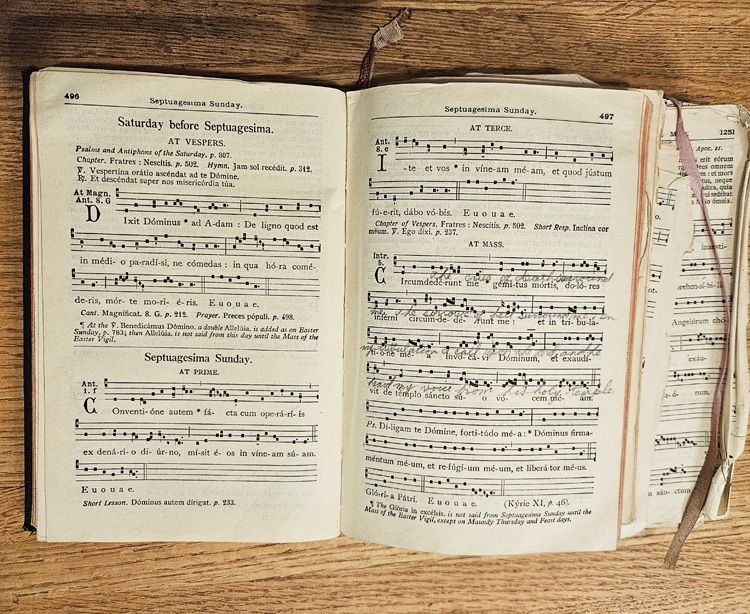
Okay, Jack and Joel, stop the back and forth jabs, take it OFF the Hangout, please.
Don,
I've still got my Liber, too. Vatican II made a big mistake in dumping Gregorian chant, one of the supreme artistic achievements of Western culture, and replacing it with faux-folkie, anodyne drivel, all in the name of "relevance." Not all change is progress.
quote:
Originally posted by Tim JumperDon,
I've still got my Liber, too. Vatican II made a big mistake in dumping Gregorian chant, one of the supreme artistic achievements of Western culture, and replacing it with faux-folkie, anodyne drivel, all in the name of "relevance." Not all change is progress.
I was sad to see it go, too, although I understand why the church did it. The Second Vatican Council made the decision around the time I went on to high school in 1965, and within a year or two, the archdiocese closed the choir school. Singing in the choir was a very formative experience for me, as was the long bus ride back and forth! Actually, by 8th grade, I would usually hitchhike.
Tim, please correct me if I inadvertantly make an error here.
I am going to try and keep this brief. Note there are four lines in the plainsong staff, but it works like our later five line staff, with notes both on the lines and in the spaces. Obviously, the notes are more varied in shape, and yes, those shapes to mean something, but I will leave that to your imagination. Note that there is no meter, no 2/4, 3/4, or 4/4 designation; the larger vertical lines identified the ends of the phrases or sentences, while the small verticals at the top designated when it was time to take a breath. The chants relied soley on the natural rhythm of the text, which the Latin language had in abundance. Chant used the same relative intervals between notes as our modern scale, but without There is a clef, the small C shaped symbol biting the top line at the beginning of each chant, which designated which line was the first note doh. They also employed a Fa clef for some transcriptions. Chant used the same relative intervals as our modern scale, but did not look at it quite the same. In our modern western music, we have basically two scales, major and minor. If we just walk up the white keys on the piano, major scale starts on C, and minor scale starts on A. In plainsong, the governing term was "mode," and there were seven of them, one for each of the white keys on the piano. These were Ionian (starting on C), Dorian (starting on D, etc.), Phrygian, Lydian, Mixolydian, Aeolian, and Locrian. The modes could be further divided between Authentic and Plagial, but don't worry about it. The modes were also not associated with specific pitches. A modal scale could start on any particular pitch, just as our modern scales.
I took up five string banjo in my junior year in high school, three years after I had left the choir school experience behind, and church music had switched to what Tim calls the "faux-folkie, anodyne drivel" we have today. When I brought my first banjo home, my mother took to her bed all afternoon, and wailed at the top of her voice, "my son is going to be a hillbilly." That was strange, given that both my parents were country music fans who square danced every weekend, and made an annual pilgrimage to the Grand Ol' Opry every summer. But my father soon brought her around, and they began taking me to the many bluegrass festivals that were within driving distance of Cincinnati. That first summer, they took me to Bean Blossom. I will never forget how it struck me when I heard Ralph Stanley take the stage with the Clinch Mountain Boys, and break into his soulful rendition of Pretty Polly." OMG, I thought, he's singing in Dorian mode! That started me on my old-time journey, that I am still not done with.
Now I'm going to ask you to consider an idea that I have never seen explored. I have always assumed that the "secular" music of those medieval times, the ballads and love songs sung by common people around their hearths at the end of a long day in the fields, followed a musical structure not unlike the one the choirs sung in the cathedrals in their great cities. When many centuries later those folk left their homes in the Scottish highlands, or rural Germany, and moved across the ocean to settle in the Appalachian highlands, I believe they brought those ancient, still preserved musical ways with them, ways that had long been forgotten by much of their own Old World bourgeois society. So their old songs and tunes would sometimes use a modal scale different from our modern major or minor. The two most commonly used, of course, were, and are Dorian and Mixolydian. But I would argue that other aspects of the ancient plainsong also survived. While our fiddle tunes, and many of our songs now follow a strict meter when we pull out our banjos, fiddles and guitars, many of them don't. Think about how many of our old fiddle tunes have myriad extra beats, or missing beats in them. it is even more pronounced when listening to the old acapella ballad singers. Watch the video below of Nimrod Workman singing Oh Death, recorded by Alan Lomax in 1982.
Nimrod Workman Singing Oh Death
Now, I am actually of the belief that both the monks who transcribed the plainsong chants back in the 12th Century, and the musicologists who transcribed our fiddle tunes and ballads in the 20th, are making the mistake of sticking to the chromatic scale, when the traditional music, both then and now, used notes that fell between the keys of the piano. But that is another discussion.
quote:
Originally posted by Don Borchelt
Now I'm going to ask you to consider an idea that I have never seen explored. I have always assumed that the "secular" music of those medieval times, the ballads and love songs sung by common people around their hearths at the end of a long day in the fields, followed a musical structure not unlike the one the choirs sung in the cathedrals in their great cities. When many centuries later those folk left their homes in the Scottish highlands, or rural Germany, and moved across the ocean to settle in the Appalachian highlands, I believe they brought those ancient, still preserved musical ways with them, ways that had long been forgotten by much of their own Old World bourgeois society. So their old songs and tunes would sometimes use a modal scale different from our modern major or minor. The two most commonly used, of course, were, and are Dorian and Mixolydian. But I would argue that other aspects of the ancient plainsong also survived. While our fiddle tunes, and many of our songs now follow a strict meter when we pull out our banjos, fiddles and guitars, many of them don't. Think about how many of our old fiddle tunes have myriad extra beats, or missing beats in them. it is even more pronounced when listening to the old acapella ballad singers. Watch the video below of Nimrod Workman singing Oh Death, recorded by Alan Lomax in 1982.
Nimrod Workman Singing Oh DeathNow, I am actually of the belief that both the monks who transcribed the plainsong chants back in the 12th Century, and the musicologists who transcribed our fiddle tunes and ballads in the 20th, are making the mistake of sticking to the chromatic scale, when the traditional music, both then and now, used notes that fell between the keys of the piano. But that is another discussion.
Interesting. Immigrants inevitably disebark with their familiar forms intact. I'm sceptical about a continuity with medieval music. The Protestant Reformation dismantled and eradicated that monastic past and radically reshaped the church which was the dominant institution in every aspect of ordinary British people's lives. Secular administration was not a reality until the nineteenth century. It may be fruitful to look closely at congregational psalmody. That was central to Anglican worship for hundreds of years. And church attendance, in parish churches rather than the bishop's domain of the grand cathedrals, was compulsory. This was the deeply ingrained culture of the majority of English families who left and sailed to the New World.
Edited by - EEB on 10/05/2026 14:35:45
Page: 1 2
Terms of Use | Privacy Policy | Privacy Consent (EU/GDPR Only)
Copyright 2026 Banjo Hangout. All Rights Reserved.


