


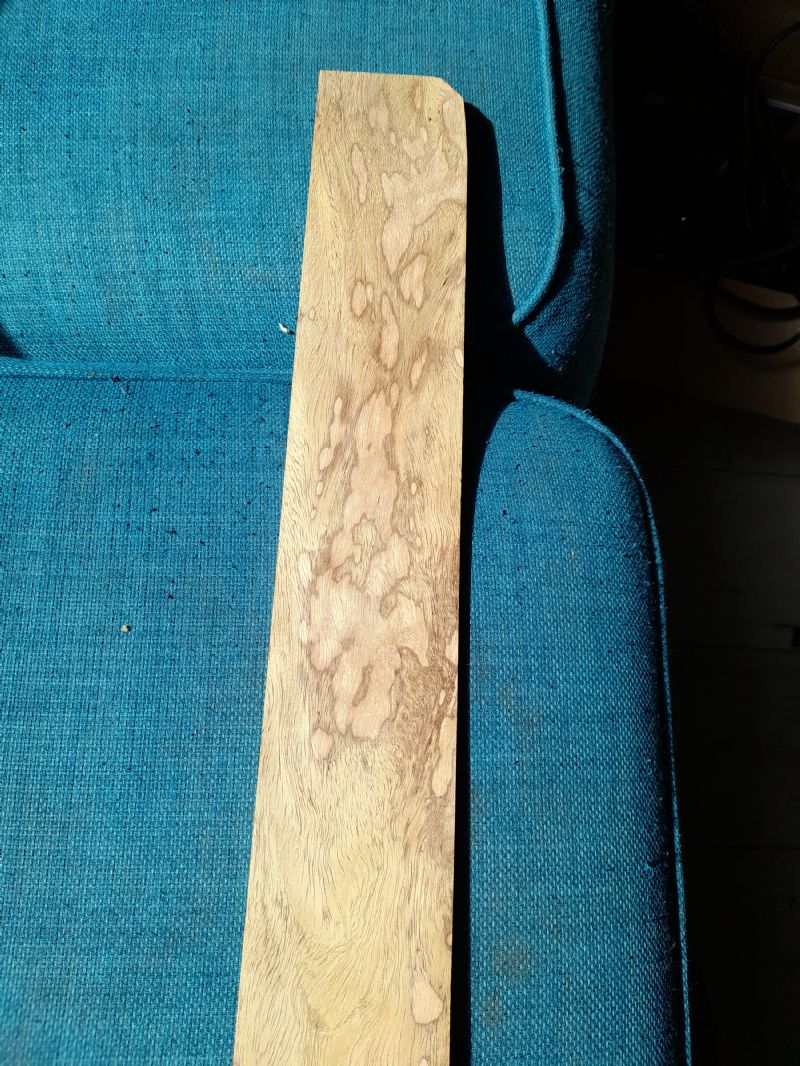
I have this piece of what I think is mango, taken from an old TV cabinet. It appears to have some sort of spalting which looks kinda cool. I was wondering if it would be appropriate to use this for a fretless banjo fingerboard? It's not quartersawn and it's a bit of a nightmare to plane, it tears out a bunch, as the grain is all over the place. But presuming I can sand it to be smooth, is there any reason I shouldn't use this as a fingerboard? It's going onto a short-scale two-piece maple neck.
Edited by - Ash Ludd on 09/23/2026 07:25:23

Nylon or steel strings? If nylon I would think you could use anything you want, and the only wear you'll see will be from fingernails.

I have a mango rim in use since about 2009. The neck is bamboo
What I like about the grain is that it seemed to be folded like taffy. That’s the way the tree grows to compete with others.
Frankly I’m happy to see you thinking of re-purposing this exotic into something useful.
Yes, it isn’t straight grained, and it’s chippy, but with patience, I think you have something unique that might take a small amount of golden stain, may be just oil of your choice. Good project
Also: spalting is nasty to breath
When smooth, you can always do what Jaco Pastorius did with his Jazz bass: cover it in a polyurethane finish. These are available gloss or satin from many vendors — Varathane is a popular brand.
Before anyone posts that Jaco used epoxy, he didn't. Polypoxy is actually a polyurethane finish with poxy part of the name.
Terms of Use | Privacy Policy | Privacy Consent (EU/GDPR Only)
Copyright 2026 Banjo Hangout. All Rights Reserved.


