


Jonty's recent dinner post, inspired me to post this topic. Its been a while as I recall...
The roast chicken! So many ways and considerations to to roast a chicken. There is no wrong way to do a roast chicken-other than under cooked or way over cooked, me thinks. There is size of bird preferred, seasonings, herbs, coatings, the cavity, roasting temps, pan preference, etc, etc, etc.
While I think the French ways are best, I like em all.
How do you do your roast chicken? Brad

Dave used to fix ours on the covered bbq grill. He'd take a can of beer and open it and then put the chicken on the beer can, put the whole thing in the grill, close it and cook it for an hour on a medium heat. That's not exactly roasted in an oven, but just as good or better. Only seasonings were salt and pepper. Always moist and tasty.

quote:
Originally posted by TexasbanjoDave used to fix ours on the covered bbq grill. He'd take a can of beer and open it and then put the chicken on the beer can, put the whole thing in the grill, close it and cook it for an hour on a medium heat. That's not exactly roasted in an oven, but just as good or better. Only seasonings were salt and pepper. Always moist and tasty.
Sounds good to me. Marilyn is of the German "way" and likes simple seasonings, prefers S&P only when possible. Brad
A bunch of differnt ways..
Smoker..grill... oven in she shack
How ever we feel at that time..
I've yet to find a chicken that won't turn out grand after 90 minutes in the oven at 180 degrees C. I like to keep seasonings fairly simple so that I can use the juices to make the gravy without it having any strong seasoning flavours - usually a quick sprinkle of SPG and an onion stuffed where the sun don't shine. Once it's done, I put the chicken on a carving board, foil it and cover in tea towels (dish towels?) whilst i whack the oven up, put the Yorkshire puddings in and then make the gravy on the stove top with the roasting pan and all the juices. Fortunately, the chicken takes exactly the same time to rest as the puddings take to rise - it must be Kismet.
I bought a rotisserie for my weber charcoal grill and if we are having a nice simple dinner of chicken, baked potatoes and salad - I do love to cook the chicken over charcoal (or at least near the charcoal) on the rotisserie.
Oh, and always with the wishbone out - a little job that makes carving so much easier.
The best chef at my cooking school in Paris - he had two Michelin stars at one point, and was teaching part time after retiring from the biz - was THE MAN when it came to roasting chickens. Great ingredients, careful technique, ultimate simplicity.
It starts with the chicken itself. When you go to a poultry market in France (not a supermarket, not a butcher shop - there are stores that sell NOTHING but poultry, and you'll find at least three different types/grades of chickens in them) the target is poulets de Bresse - a chicken that has its own appelation controlee, much like good wines. These are ultra-select free-range birds of a certain breed, raised under specific (and measured) conditions - only a limited number of farmers produce them. As you can imagine, they're pricey - but boy howdy, do they ever taste good!
They are also rather small. One bird will feed two, as part of a multi-course meal. The size is part of why the finished product is so good.
Chambrette would season them with salt and pepper, inside and out, truss them, and then slam them into a roaring-hot oven - 450F or higher. After ten minutes or so he'd baste every five more. He'd remove after about 30 total and let it rest for ten more. And serve.
Skin? Crispy, crackly, fabulous. Meat? Just barely cooked through. Heaven.
The trick in the US is really finding a good bird for this. Most "roasters" you see are too big for this technique to work. In fact, most whole "fryers" are as well.
I can work with nearly any size bird, but this technique does rely on a smaller one. And sourcing truly excellent chickens can be a challenge. There are no artisan producers around here, but I have found a source that I've found reliable - Hudson Valley Farms in New York's Catskill mountains. Their chickens are as good as I've found domestically, and they're what's on the table each Thanksgiving (personally, I detest turkey). The cost of the shipping can exceed that of the chickens themselves, and I don't know how far west and south they ship. But the birds I order from them always come through beautifully - and the price is worth it for special occasions.
These birds are a BIT larger than the Bresse chickens, so I back off on the oven temp a bit and cook them a bit longer. But the results are just fine.
Edited by - eagleisland on 09/24/2026 04:48:24
quote:
Originally posted by eagleislandThe best chef at my cooking school in Paris - he had two Michelin stars at one point, and was teaching part time after retiring from the biz - was THE MAN when it came to roasting chickens. Great ingredients, careful technique, ultimate simplicity.
It starts with the chicken itself. When you go to a poultry market in France (not a supermarket, not a butcher shop - there are stores that sell NOTHING but poultry, and you'll find at least three different types/grades of chickens in them) the target is poulets de Bresse - a chicken that has its own appelation controlee, much like good wines. These are ultra-select free-range birds of a certain breed, raised under specific (and measured) conditions - only a limited number of farmers produce them. As you can imagine, they're pricey - but boy howdy, do they ever taste good!They are also rather small. One bird will feed two, as part of a multi-course meal. The size is part of why the finished product is so good.
Chambrette would season them with salt and pepper, inside and out, truss them, and then slam them into a roaring-hot oven - 450F or higher. After ten minutes or so he'd baste every five more. He'd remove after about 30 total and let it rest for ten more. And serve.
Skin? Crispy, crackly, fabulous. Meat? Just barely cooked through. Heaven.
The trick in the US is really finding a good bird for this. Most "roasters" you see are too big for this technique to work. In fact, most whole "fryers" are as well.
I can work with nearly any size bird, but this technique does rely on a smaller one. And sourcing truly excellent chickens can be a challenge. There are no artisan producers around here, but I have found a source that I've found reliable - Hudson Valley Farms in New York's Catskill mountains. Their chickens are as good as I've found domestically, and they're what's on the table each Thanksgiving (personally, I detest turkey). The cost of the shipping can exceed that of the chickens themselves, and I don't know how far west and south they ship. But the birds I order from them always come through beautifully - and the price is worth it for special occasions.
These birds are a BIT larger than the Bresse chickens, so I back off on the oven temp a bit and cook them a bit longer. But the results are just fine.
I will share this with Marilyn for sure. We too, complain about the lack any small birds in our shops around here. There is a brand that is "organic" often 2.5-3.5 lb, with no liquid injection, and pricey. One local met market used to carry some local chickens that were 2-3 lb fresh, but nobody wanted to buy them I think, but us. I remember when gramma would get a whole cut up chicken in the CI skillet at one time to fry up, so good. We ate a lot of chicken dishes while in France and find it hard to come close to that in our own kitchen. Brad
quote:
Originally posted by rinembI will share this with Marilyn for sure. We too, complain about the lack any small birds in our shops around here. There is a brand that is "organic" often 2.5-3.5 lb, with no liquid injection, and pricey. One local met market used to carry some local chickens that were 2-3 lb fresh, but nobody wanted to buy them I think, but us. I remember when gramma would get a whole cut up chicken in the CI skillet at one time to fry up, so good. We ate a lot of chicken dishes while in France and find it hard to come close to that in our own kitchen. Brad
France is interesting. Their beef is only so-so; their avocados, which mostly come from Israel, are remarkably flavorless. And their bacon - which they call poitrine - is overly salted and overly smoked and must be blanched before use.
But nearly everything else - poultry, pork, produce - is VASTLY superior to what we get in the States. My first meal in Paris was a salade Nicoise in a non-descript little cafe like dozens of others; what stood out was that the tomato tasted mid-summer wonderful, and this was on a chilly, rainy day in early April. Botton line is that with few exceptions, the French simply won't stand for ingredients of low quality. We may dazzle them with abundance, but they excel in quality. And the chickens are not the poorest example of this.
One thing I've learned - when doing a braised chicken dish such as a coq au vin, we can come closer if we have access to fowl - a/k/a retired laying hens. The meat is far tougher, and thus requires a long soak in hot wine, but the flavor is pretty darned good - even here in the US.
quote:
Originally posted by eagleislandquote:
Originally posted by rinembI will share this with Marilyn for sure. We too, complain about the lack any small birds in our shops around here. There is a brand that is "organic" often 2.5-3.5 lb, with no liquid injection, and pricey. One local met market used to carry some local chickens that were 2-3 lb fresh, but nobody wanted to buy them I think, but us. I remember when gramma would get a whole cut up chicken in the CI skillet at one time to fry up, so good. We ate a lot of chicken dishes while in France and find it hard to come close to that in our own kitchen. Brad
France is interesting. Their beef is only so-so; their avocados, which mostly come from Israel, are remarkably flavorless. And their bacon - which they call poitrine - is overly salted and overly smoked and must be blanched before use.
But nearly everything else - poultry, pork, produce - is VASTLY superior to what we get in the States. My first meal in Paris was a salade Nicoise in a non-descript little cafe like dozens of others; what stood out was that the tomato tasted mid-summer wonderful, and this was on a chilly, rainy day in early April. Botton line is that with few exceptions, the French simply won't stand for ingredients of low quality. We may dazzle them with abundance, but they excel in quality. And the chickens are not the poorest example of this.
One thing I've learned - when doing a braised chicken dish such as a coq au vin, we can come closer if we have access to fowl - a/k/a retired laying hens. The meat is far tougher, and thus requires a long soak in hot wine, but the flavor is pretty darned good - even here in the US.
While we are at it. Marilyn loves chicken cassoulet. She like likes to keep the hard to find tarbais beans on hand. However, our favorite French restaurant in Kansas City (the French Cafe and French Market) makes and jars fresh made chicken cassoulet in their market fall to spring. We always come home with a jar, and the French butter, and cheeses, etc. The original owners are from the Alsace Area. The kids are now in charge I believe. Brad
Brad
quote:
Originally posted by Wet SpanielI've yet to find a chicken that won't turn out grand after 90 minutes in the oven at 180 degrees C. I like to keep seasonings fairly simple so that I can use the juices to make the gravy without it having any strong seasoning flavours - usually a quick sprinkle of SPG and an onion stuffed where the sun don't shine. Once it's done, I put the chicken on a carving board, foil it and cover in tea towels (dish towels?) whilst i whack the oven up, put the Yorkshire puddings in and then make the gravy on the stove top with the roasting pan and all the juices. Fortunately, the chicken takes exactly the same time to rest as the puddings take to rise - it must be Kismet.
I bought a rotisserie for my weber charcoal grill and if we are having a nice simple dinner of chicken, baked potatoes and salad - I do love to cook the chicken over charcoal (or at least near the charcoal) on the rotisserie.
I usually wash the dust off my rotisserie equipment once a year or so, for the gasser. It is my favorite chicken outside. That or when doing a roast chicken outside I tend to spatchcock it, by giving it a brief time over the hot side-skin down, load the smoke box with wet shavings, then move it to the cool side to roast until done. Inside chickens are Marilyn's choice and cook. Brad
Nobody has made a chicken like this before….
Rub it down with butter…then I coat it with Tony Chechere’s…inside and out. Wrap it in foil and put it in a heavy duty ziploc bag.
Next I set it on the oil pump back in the engine compartment of the locomotive and let her sit for about 6 hours.
It doesnt crisp up…but it sure is tasty and comforting to have something hot to eat on a cold winters night up in the mountains at work!
quote:
Originally posted by Texican65Nobody has made a chicken like this before….
Rub it down with butter…then I coat it with Tony Chechere’s…inside and out. Wrap it in foil and put it in a heavy duty ziploc bag.
Next I set it on the oil pump back in the engine compartment of the locomotive and let her sit for about 6 hours.
It doesnt crisp up…but it sure is tasty and comforting to have something hot to eat on a cold winters night up in the mountains at work!
Darned shame that the age of steam is past... my bet is that a couple of minutes sitting on a shovel in the firebox would get that skin just about perfect! 
quote:
Originally posted by Texican65Nobody has made a chicken like this before….
Rub it down with butter…then I coat it with Tony Chechere’s…inside and out. Wrap it in foil and put it in a heavy duty ziploc bag.
Next I set it on the oil pump back in the engine compartment of the locomotive and let her sit for about 6 hours.
It doesnt crisp up…but it sure is tasty and comforting to have something hot to eat on a cold winters night up in the mountains at work!
Spending most of my life around and on drilling rigs, I saw similar stuff. Back when most of the roughnecks were WW2 and Korean War vets-and married. their wives daily fixed up food in foil and when the hands got to the rig they all put their foil packages directly on the motors. A bank of Jimmy's or a bank of Cats. Mostly reheats but some not. Back then the only electric power was with we2 salvage light plants. So no plug in coffee makers, no microwaves, etc. Man they ate good. Brad
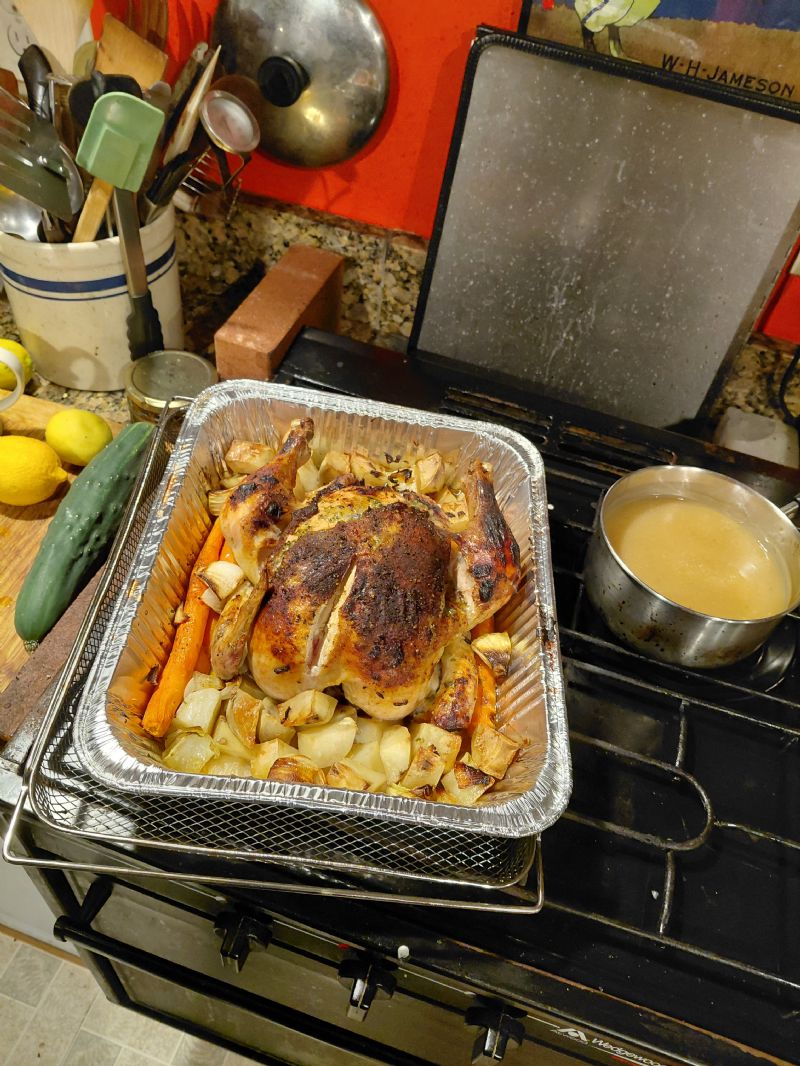
Since you asked.... :0)
quote:
Originally posted by STUD figmo AlSince you asked.... :0)
Marilyn could have taken that pic of her roast chickens. Brad
Terms of Use | Privacy Policy | Privacy Consent (EU/GDPR Only)
Copyright 2026 Banjo Hangout. All Rights Reserved.


