


Page: 1 2
It doesn't get talked about a lot here on the Hangout but it's handy to keep in mind that sometimes loud is too loud. The laws in Ontario, Canada (where I live) say that employers must make workers wear hearing protection when the volume in their surroundings exceed 80 dBA.
For whatever's it worth, do take a look at these volume level numbers that I had posted on my old, and departed website:
https://web.archive.org/web/20180825082342/http://banjobridge.com/volumechart.htm

Banjos don't HAVE to be loud. Many are PLAYED too hard/loud.

I remember this chart. A very thorough experiment, comparing various banjos and combined bridge designs.
In ordinary playing, banjos don't have a wide dynamic range, compared to a violin or piano (pianoforte - "softloud") or even acoustic guitar. So banjos are going to sound fairly loud all the time. And, banjos put out zero dBA when they are in the case. 
All I know is that when I play in a jam or busking for a few hours, the next day my ears are ringing a lot more than usual.
I cannot recommend hearing protection enough. As musicians, we should value our hearing more than the average person. But the opposite seems true. I find musicians are much more likely to put themselves in loud environments without any thought to their hearing in the future.
Hi Fi ear plugs are cheap and readily available. The banjo is loud enough that you will still be able to hear it clearly even while you have the plugs in.
I wear a set to jams and when I practice indoors and it really helps cut down on the post jam ear ringing/muffled sensation.
Anything at or above 80db IS damaging your hearing, and such damage is cumulative. Science has not yet figured out a way to repair hearing once it's lost.
I damaged my hearing early on in life, and now I live with constant tinnitus that there is no fix for.
A lifetime of earplugs is substantially cheaper than a single pair of hearing aids.
-Just a few good reasons why you should value what you have before you lose it.
Living in a condo, and practicing with a mute, has probably been a godsend for my hearing. When I play with my friends, I’m always the furthest from the mic, and come through loud and clear. Interestingly, when I play my resonator banjo, I can’t gauge where I am in the mix, as good as I can with my open back banjo. I hear a lot more of myself with the open back, and what I hear in the mix, is very accurate. With the resonator banjo, I can be blasting folks out, and not realize it.
as retired career jet engine mechanic, I have that wonderful tinnitus ringing 24-7, but don't even notice it unless something reminds me of it... like a BHO thread. I have to protect what hearing I have left.
Edited by - Dean T on 09/19/2026 11:05:47
I have had both fiddles and dreadnaught guitars drown out my banjo, and it's a Stelling! Instruments are often played too loud as people don't realize how different the sound is from behind the instrument and in front of it.
We had one banjo player in our group that always played too loud, played over other instruments, grabbed breaks away from other banjo players and was just generally obnoxious. He was asked several times to tone it down but when he ignored the suggestion several times, he was told to shape up or get out. He got out. What a relief.
Yeah I can't stand those banjo players! Oh, I resemble that remark..... (Ha!) banjered
I'm not saying a banjer can't get loud, but horns are arguably louder. We had a flute player who was a pleasure. I understand most of the time it's the operator, but horns with an ambature like a trumpet or trombone, well, they can and should mute them in a circle jam.
I can't recall the name, but there is a musician's ear-plug that knocks down the sound 10db. If I remember them ; )
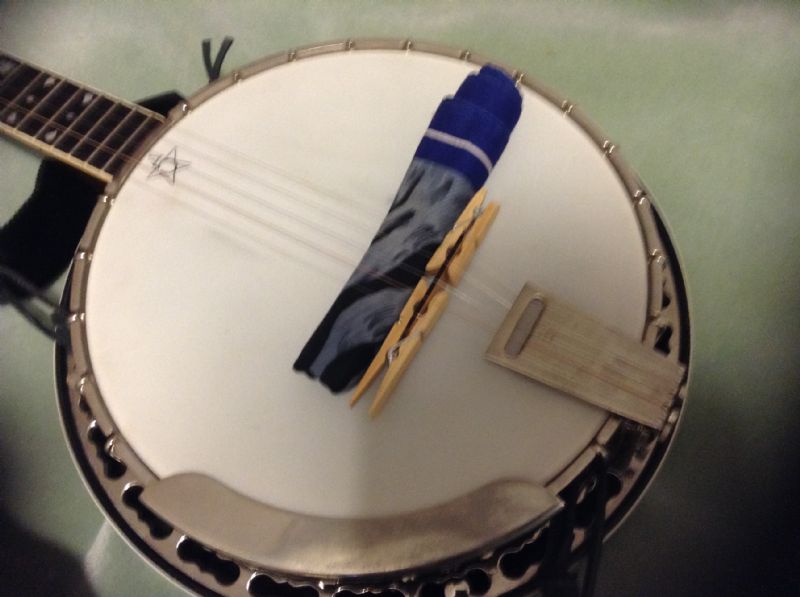
I love the look and feel of my Wildwood Troubadours, but they are loud. I have to stuff them with some bubble wrap and swear by my Mike's Banjo Mutes. I have had Tinnitis for 40 yrs now.
I practice with this homemade setup…..
I certainly agree that we should all take far more care with our hearing. I've been playing banjo now for more than 50 years, and for the past four years I've needed to use hearing aids. In truth, I should have started using them about ten years ago as my wife noticed my hearing was failing then. I'm in my 70s, so I guess a degree of hearing loss is to be expected, but I'm convinced that half a century's exposure to two hours' banjo playing every day must have contributed to the problem. When we were newly married, we lived in an apartment and had very little money to buy furnishings. I played banjo in a spare bedroom containing nothing but the chair on which I sat. I was young and never once considered the volume a problem. The apartment was well soundproofed and my neighbours heard very little of my playing. I suspect that the damage was done in the four years we lived there.
No disrespect intended, but this strikes me as data in search of a problem.
However, in the spirit of saving our hearing, here's a pretty good guide to loud things in life-
noiseawareness.org/info-center...e-levels/
But, but, but Joseph .... playin' banjo [especially if you're doing renovations and using it to remove paint] isn't included in the data on the list in the link. Wot to do?* 
* Maybe some TIMing [using a mute] ....... while I figure it out.
[However, it's good to know. Thanks]
It's up to each of us how loud we play.
A banjo can be played at a "whisper" if needed.
Learn how to play in balance (fit in) with what's going on.
quote:
Originally posted by NNYJoeNo disrespect intended, but this strikes me as data in search of a problem.
yeah, whatever...
". . . data in search of a problem."
The original experiment was not about hearing loss, but about the performance of various bridge constructions on different banjos. And the results were measured and repeatable information, where prior to that there was only anecdotal speculation (a common communication device on the BHO ) on what made a difference in the output of various bridges and how that was different on different banjos.
If exposure to loud dBA is not a "problem" for some, then the original experiment doesn't add anything to the hearing loss situation, only retains its value as banjo bridge experimentation.
The poster noted: "The laws in Ontario, Canada (where I live) say that employers must make workers wear hearing protection when the volume in their surroundings exceed 80 dBA."
If exposure to loud dBA is a a situation that some want to be aware of, then the experiment provides evidence that being around banjo picking can cause exposure to sound well above 80 dBA. As the poster said, "for whatever it's worth . . ." Maybe worth it for some, not worth it for others.
Edited by - Alex Z on 09/20/2026 10:05:30
I bet archtop players have worse hearing than flathead players. I should know!
For the last few years I have gone to modified spillway and big foot bridges --for a more even response but less overall volume I suppose--I mostly play solo so it is not as important--The 3 footed regular type helps my first string too much
this of course is in conjunction with my lack of control
Edited by - Tractor1 on 09/21/2026 06:50:58
quote:
Originally posted by TScottHiltonI cannot recommend hearing protection enough. As musicians, we should value our hearing more than the average person. But the opposite seems true. I find musicians are much more likely to put themselves in loud environments without any thought to their hearing in the future.
Hi Fi ear plugs are cheap and readily available. The banjo is loud enough that you will still be able to hear it clearly even while you have the plugs in.
I wear a set to jams and when I practice indoors and it really helps cut down on the post jam ear ringing/muffled sensation.
Anything at or above 80db IS damaging your hearing, and such damage is cumulative. Science has not yet figured out a way to repair hearing once it's lost.
I damaged my hearing early on in life, and now I live with constant tinnitus that there is no fix for.
A lifetime of earplugs is substantially cheaper than a single pair of hearing aids.
-Just a few good reasons why you should value what you have before you lose it.
Good fitted earplugs (not simply the foam ones) are not exactly cheap... but overall a good investment.
The data just solo banjo. The dBA can easily be even more in jams, or on stages, with multiple other instruments; so any earplug (even foam if all have) might be a really good idea. Esp in club venues with monitors needing to be louder over a lot of background ambient level of people talking, good IEM (besides reducing feedback issues) can actually reduce exposure.
You can use a phone app, while not to rely on as official accuracy, (compared to actual test equip), can give a general comparable idea; if pay attention to how to set it up, set baseline.
--------
That said, some of this might be a little overstated fear (of over 80dBA). The thing should point out about warning to sound level exposure; even though it doesn't seem "loud". It's generally given as a average sustained level over a prolonged duration, period of time in hours. The OP recommended 80dBA is probably like a typical workplace shift 8 or more hours? (and often might have exposure to certain continuous Hz). As well, is probably taking that, multiplied with workplace of long term frequency (how often) and duration over months/years. Of course it doesn't state will cause damage, but "might" put one at risk, (and like using more toward worst-case scenarios to deem what is "safe").
At 4 hours, or 2 hours, 1 hour... the higher dBA, (into the 90dBA+) is considered bit less risk situation. Also consider that playing music (esp at home) can be more intermittent, with more ear rest; exposed to loud for periods maybe a few minutes at a time (not continuous over an hour or two). And perhaps just few times week/month; not like workplace over months/years. All this makes for difference individual determination of what "potential" overall long term risk when comes to playing music, apples/oranges to environmental/workplace standards?
I agree with protecting the ears, and value of long term hearing, is still important; certainly should awareness to long exposure to loud; avoid and/or use protection; but just not that worried about if picking up an instrument and playing a tune is over 80dBA. Nor occasionally going to an acoustic jam for few hours, that might at times get up around maybe 100dBA.
Edited by - banjoak on 09/21/2026 18:23:04
quote:I agree with protecting the ears, and value of long term hearing, is still important; certainly should awareness to long exposure to loud; avoid and/or use protection; but just not that worried about if picking up an instrument and playing a tune is over 80dBA. Nor occasionally going to an acoustic jam for few hours, that might at times get up around maybe 100dBA.
Don't forget: hearing damage is accumulative, it get stored over the years and there's no reset button, "no money back." Typical bonus features of hearing damage: tinnitus, hyper acousis and deafness for which there are no medical cures..
Oh, these are proven facts but hay, everyone is entitled to their own opinion...
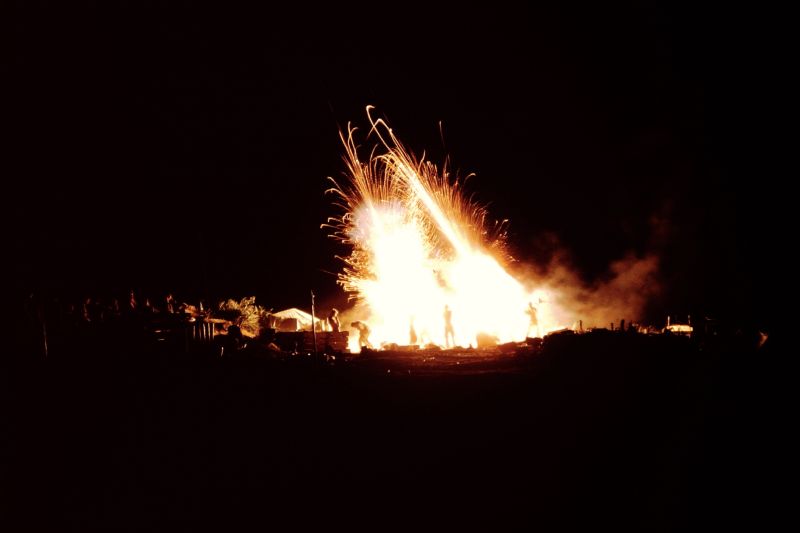
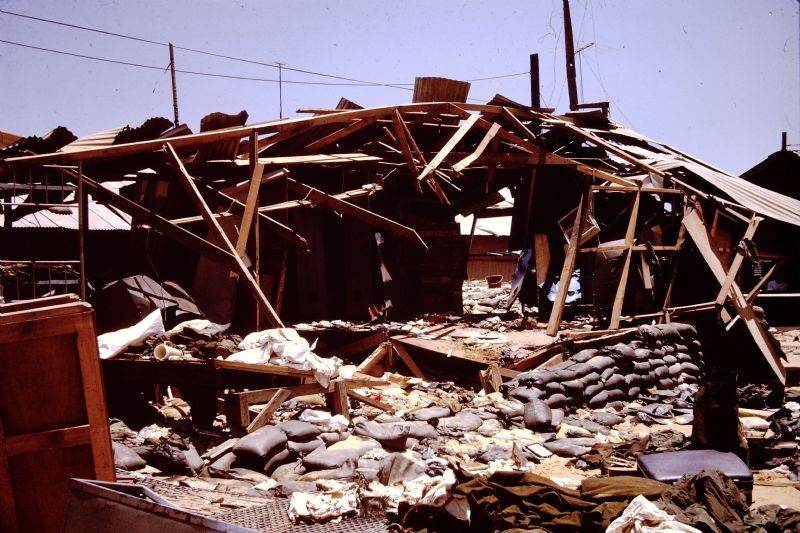
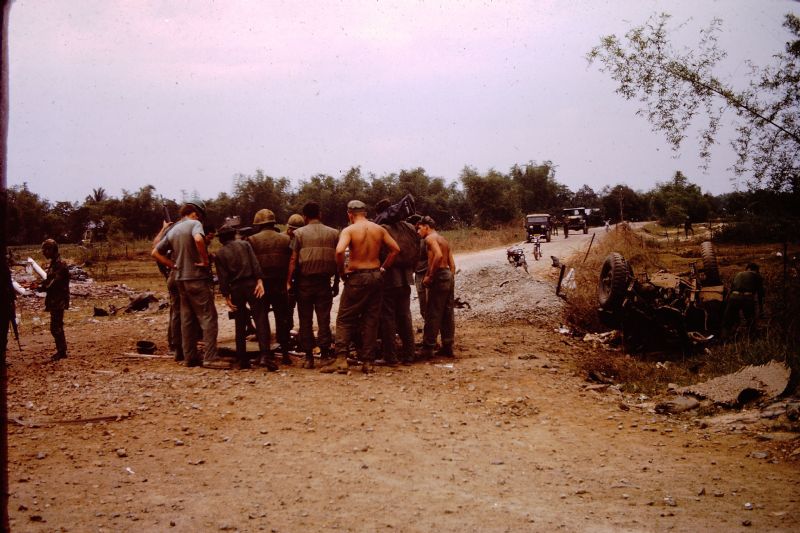
Sitting on the running board of a six-by truck 30' from a land mine explosion, being subjected to 122MM rockets, and being next to an artillery battery (in this case 4.2" Mortars) is not a good recipe to retain good hearing. After the jeep (seen to the right on its top) hit the IED, my right ear rang for three days ....... maybe a burst ear drum, but I never went to the corpsman because these was no blood, except for some scrapes and gravel abrasions to my forearm. I am sure the cannon cockers had ear protection, but for us Marine Combat Engineers, we never saw any ....... certainly not issued. At least the VA finally paid for my hearing aids!
"not that worried about . . . occasionally going to an acoustic jam for few hours, that might at times get up around maybe 100dBA"
!!
National Institute of Health:
"Noises are more likely to damage your hearing if they are:
85 dBA and last a few hours.
100 dBA and last at least 14 minutes.
110 dBA and last at least 2 minutes."
Edited by - Alex Z on 09/22/2026 08:06:57
Huh? What was that?
For those who might be wondering about ear protection, here are some affordable non-custom options that work well for casual jam goers and concert attendees:
us.loopearplugs.com/products/s...347976937
eargasm.com/products/high-fide...hallenger
hears.com/products/hears-earpl...869862724
I have yet to try anything from Hears, but I've found that the Eargasm brand plugs are more comfortable when wearing for hours at a time, but seem to filter out less sound than my Loops, which reduce db levels more effectively for me, but become uncomfortable in the ears after a few hours.
I agree that the custom musician earplugs that you can have made at the audiologist can be pretty pricey ($600 and not likely to covered by insurance). But to me, $50-$70 on a non custom option is a wise investment if it prevents a several thousand dollar hearing aid purchase in my future, or at least delays it.
quote:
Originally posted by Bart Veermanquote:I agree with protecting the ears, and value of long term hearing, is still important; certainly should awareness to long exposure to loud; avoid and/or use protection; but just not that worried about if picking up an instrument and playing a tune is over 80dBA. Nor occasionally going to an acoustic jam for few hours, that might at times get up around maybe 100dBA.
Don't forget: hearing damage is accumulative, it get stored over the years and there's no reset button, "no money back." Typical bonus features of hearing damage: tinnitus, hyper acousis and deafness for which there are no medical cures..
Oh, these are proven facts but hay, everyone is entitled to their own opinion...
I wasn't disputing facts, or dismissive of long term, cumulative or occupational hearing damage risks.
Just pointing to it's possible to misinterpret data and meters, chart and literature from occupational workplace safety... especially given the complexity of measuring, accuracy, and diversity of factors and actual environments to consider; and question if actual comparable situation/environment. One difference to evaluate is time weighted average (TWA) vs intermittent shorter periods/peaks, and/or transient spikes. Periods of rest also plays a role. With all these, it can have grey area; would be difficult to make any direct 1:1 cause/effect that "will". Rather just general guidelines, of safe vs some degree of potential risk.
With that, I was pointing to consider that workplace as compared that for amateur; with occasional, recreational exposure... like playing at home, or typical acoustic jam, or performance with time weighted average typically more in the low-mid 80s. (it's not symphony orchestra, or rock concert, DJ/EDM club). The mention of at times near 100, is not time weighted average, but simply about how might have a few brief moments or spikes with peaks into mid-upper 90s on the meter. Audience applause or clapping can have a little more duration, and easily get in or above that range, but it's still relatively short. Not anything comparable to time weighted average or sustained 100 dBA, for anywhere near 14 minutes.
To clarify, I am in agreement that a sustained, or TWA 100 dBA is very freaking loud, and risk damage. Even without risk data, I find discomforting, annoying, fatiguing, a bit painful, for much long duration; and so typically avoid them. Even TWA in low 90s seems pretty loud to me, and I probably wouldn't want to stay in that environment/situation too long. If constantly have to shout over, to someone less than a meter away to be heard... it's generally too loud for me, and question if I need to be there. If I have reason to need to be in those, i.e. play gigs, doing sound or just as audience/crowd where it's getting above; I definitely want good ear plugs. (this might include just bars/restaurants, worship services, sporting events, or airplane... often pretty loud).
There is a bit of irony... folks want to acquire, yearn, have/boast of an instrument that's louder, have set up to be louder (inc make bridges), and to play as loud as possible; out do competition in loudness war. (louder is gooder philosophy). But then worry about hearing loss, advocate for protection, reduce the sense of loud?
Page: 1 2
Terms of Use | Privacy Policy | Privacy Consent (EU/GDPR Only)
Copyright 2026 Banjo Hangout. All Rights Reserved.


