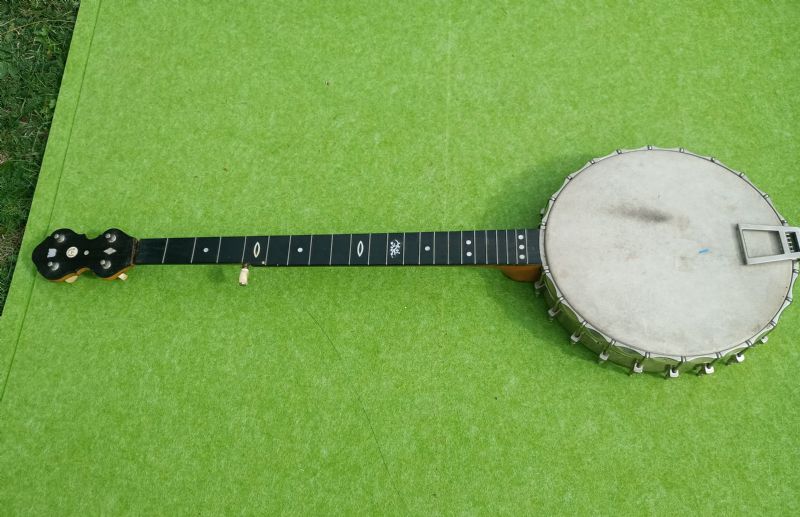
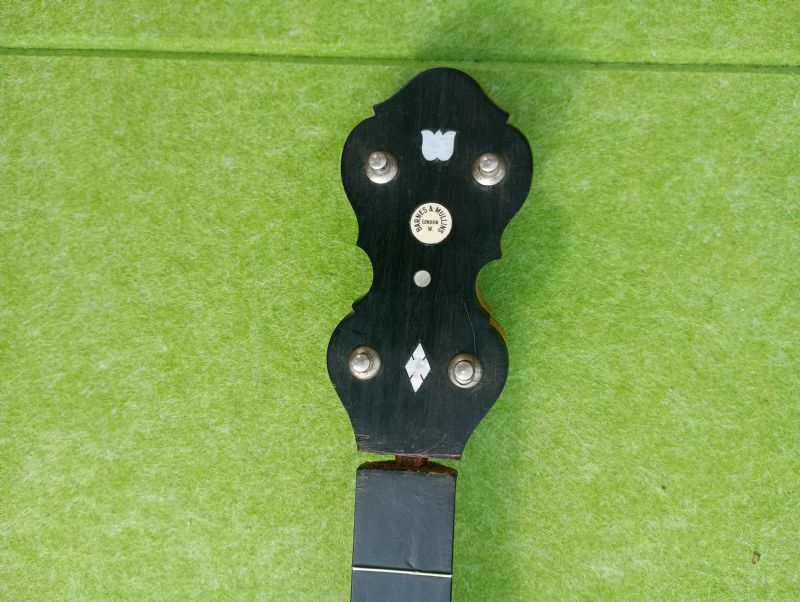
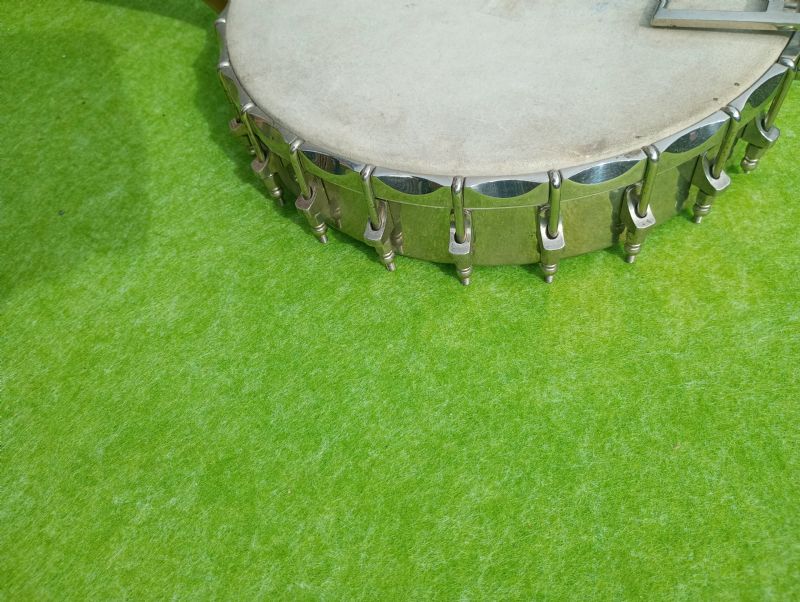
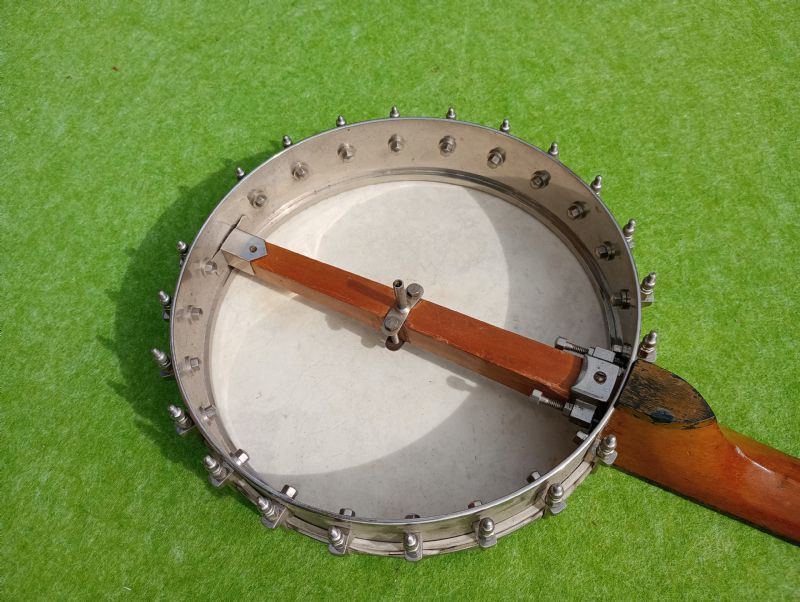
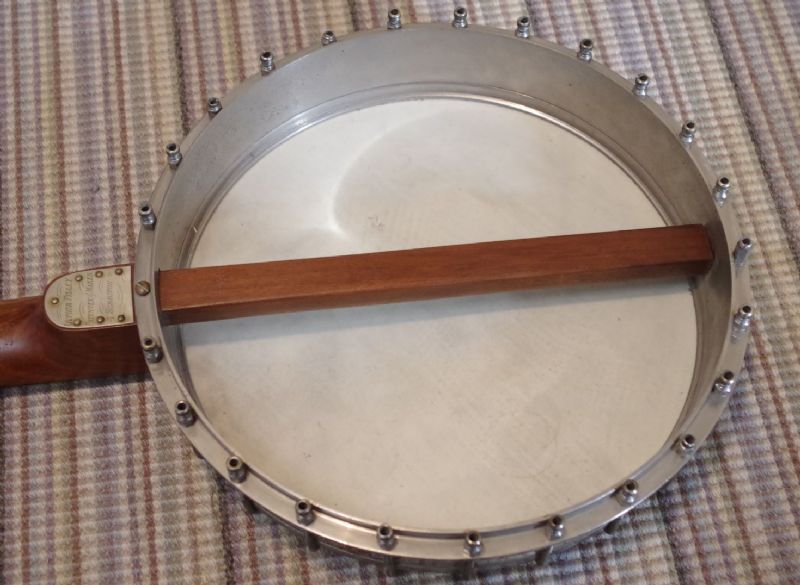
I picked up this Barnes and Mullins quite cheap and somewhat broken. The thing that surprised me was that the pot was all metal. No "spunover" thing here. Was that at all common back in the day? Was it a thing for the cheapest banjos? This one feels quite heavy. The scalloped tension hoop makes me think it might have been made by Clifford Essex. The rim has an integrated tone ring shaped flange at the top.

That looks like one of the "Lyratone" banjos built by Abbott for Barnes and Mullins, definitely not a "cheapie", great sound , lot`s of volume ! I had a similar banjo mandolin which I converted to a tenor, a real accordion hammer !

Before I started work on the repair I partly tightened up the remaining three old corroded strings briefly and thought the sound had a lot of potential. I could have sent it back as it advertised as functional when it's not but this convinced me to keep it.
Any ideas of what sort of metal they used? I don't have a decent magnet to check for things like steel.
I agree with Derrick. Abbott made. I have one with an identical rim and tailpiece. I'm pretty sure mine is plated brass. I also have a couple of R J Ward smooth arm (fretless) banjos circa 1890 with all metal rims. Buchanan of Glasgow was also making an all metal rimmed banjo. Hewett also. There were probably a couple of other English makers but their names escape me at the moment.
I have a pair of Tilley banjos (5 & 7 string, 1880's). They have a substantial metal rim with an integral flange for the hooks. Not plated. German silver ? The 5 string is sweet, loud and easy playing. My goto noodler.
Edited by - AndrewD on 09/20/2026 02:21:25
These all metal pot banjos can sound distinctive and very nice indeed.
They weren’t, as we today might imagine, cheap low-end banjos. Rather they reflect the modernism and technological culture of the Victorian era. In the popular imagination transition from wood to metal was at the cutting edge and a glimpse of the future. Andrew’s Tilley 'Matchless' banjo, that was awarded an industry gold medal at exhibition in 1885, reinforces this market profile, as he was a reputable (and innovative) banjo maker and performer, who would not have associated himself with low quality or inferior tone. Another highly-reputed London based maker Harry Spratt also offered an all-metal pot banjo in the 1880's. Innovation is also an indicator of seeking individual advantage in the intensely competitive, commercial nature of banjo manufacture in the 1880's boom. Tilley and Spratt certainly played their metal-pot banjos in many public performances. But there's no evidence to suggest that the leading players ditched their wood rim banjos for all-metal pot instruments. In this relatively early pre-zither banjo period as far as we can tell, Dallas, Bacon, Temlett Snr and Weaver banjos were very much the professionals and semi-pros banjos of choice.
Edited by - EEB on 09/20/2026 06:21:13
…and Birmingham based banjo maker Matthew.
That is a beauty. There were certainly some real pretty banjos coming from the UK.
Terms of Use | Privacy Policy | Privacy Consent (EU/GDPR Only)
Copyright 2026 Banjo Hangout. All Rights Reserved.