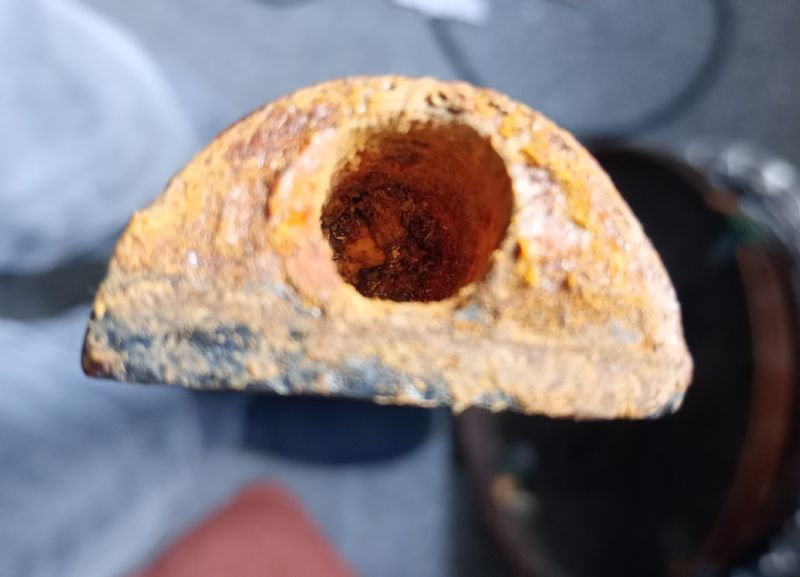
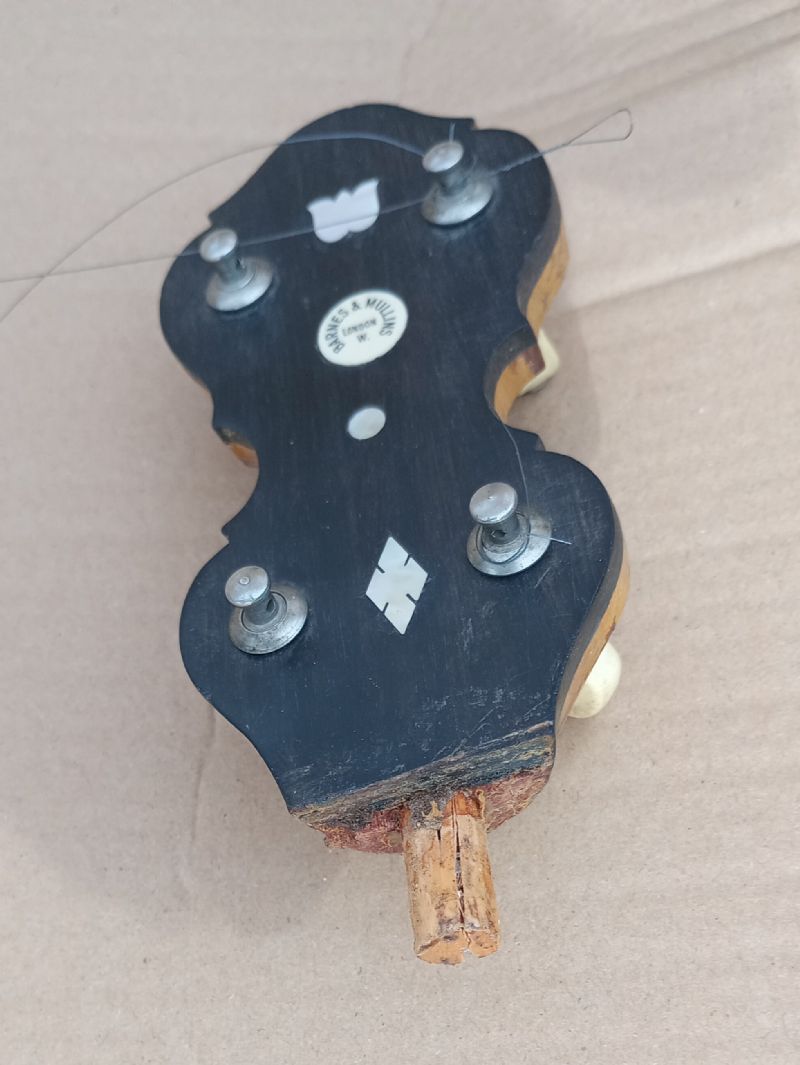
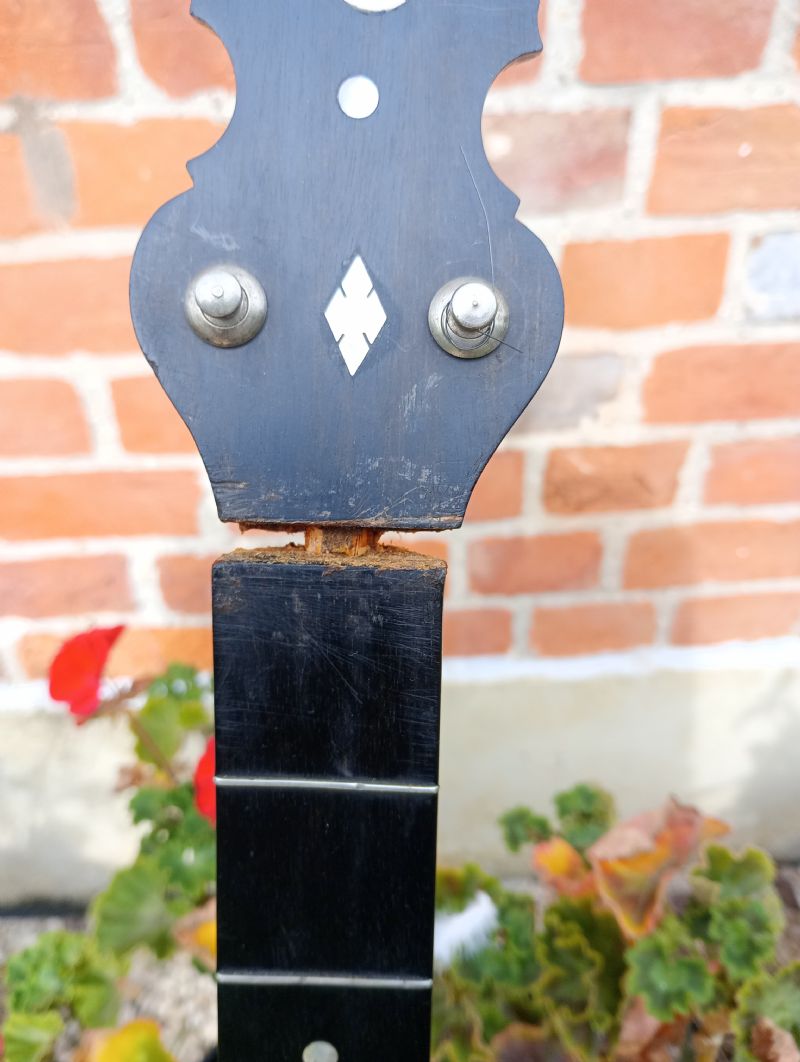
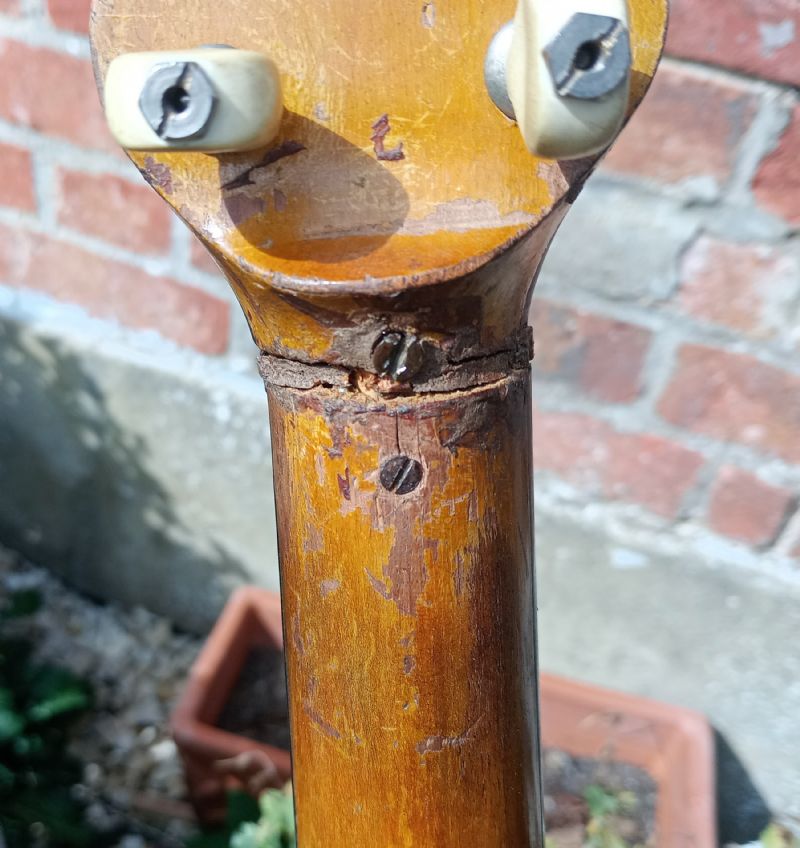
I bought a "fully functional" vintage Barnes and Mullins (possibly made by Clifford Essex). It arrived with a nasty old neck repair which was loose - I could waggle it up and down. Two small screws and some sort of filler material in the gap. There's a picture below. You can also see it the photos that the peghead was not attached quite square with the neck.
As expected when the filler material was cleared out (It was quite loose). There 's a dowel connecting the neck and headstock. The small screw in the neck came out fairly easily and it was easy to remove the headstock with dowel attached. The filler material was filling the area of wood below the nut. The other screw is less keen to move and the dowel is held tightly with glue.
So what do I do now? It would seem sensible to get the old dowel out and replace it. It's a bit split at the neck end and has a hole where the screw was. And it's not quite straight which is why the peghead was not square with the neck. The main question is how to fill the rest of the gap around a dowel. I assume I'll need to carve a piece of suitable wood for this. Or am I missing a better option? Bear in mind I only have simple hand tools and a Dremel like device.Cleaning up surfaces and removing any old glue will be done.

Assuming the bone nut was sitting in the gap. I probably would cut the dowel at the end, removing enough material that there is no gap at all, and then carve a bit out at the beginning of the headstock to install the nut.
Epoxy to glue the headstock to the neck should be fine. Get rid of the screws and fill the holes with wood and sawdust.
Edited by - pfalzgrass on 09/19/2026 05:32:32

I had a Weyman tenor banjo with a similar repair. I believe the person I sold it to as-is made a new neck for it. Probably the best thing you can do with your Barnes & Mullins.
Bob Smakula
smakulafrettedinstruments.com
Barnes and Mullins banjos were made by Barnes and and Mullins.
It is likely that Barnes Brothers made the post 1922 Metal Hoop Specials and Professionals (which were first put on the market that year) for CE.
I agree with Bob, salvage the peghead cover, fretboard and dowel stick and make a new neck.
By the way I don`t think those are the original tuning pegs.
quote:
Originally posted by Bob SmakulaI had a Weyman tenor banjo with a similar repair. I believe the person I sold it to as-is made a new neck for it. Probably the best thing you can do with your Barnes & Mullins.
Bob Smakula
smakulafrettedinstruments.com
quote:
Originally posted by deke46I agree with Bob, salvage the peghead cover, fretboard and dowel stick and make a new neck.
While I agree that this approach would be best, making a new neck is beyond me both in terms of skills and tools. I could send it off to a luthier to make a new neck This might be long term solution but I feel I want to see what I can do even if it is a failure.
quote:
Originally posted by Joel HooksBarnes and Mullins banjos were made by Barnes and and Mullins.
It is likely that Barnes Brothers made the post 1922 Metal Hoop Specials and Professionals (which were first put on the market that year) for CE.
I do find the whole vintage banjo manufacturing thing very confusing. I was under the impression that many Barnes and Mullins banjos were made for them by other makers. I have another Barnes and Mullins that was made by Windsor (essentailly a rebadge of a Windsor wood rim banjo).
quote:
Originally posted by pfalzgrassAssuming the bone nut was sitting in the gap. I probably would cut the dowel at the end, removing enough material that there is no gap at all, and then carve a bit out at the beginning of the headstock to install the nut.
Epoxy to glue the headstock to the neck should be fine. Get rid of the screws and fill the holes with wood and sawdust.
I thought about doing this but the peghead would need a bit of reshaping to match the two parts and I'm not so keen on that.
quote:
Originally posted by deke46By the way I don`t think those are the original tuning pegs.
You're right about that. The tuners aren't good. They don't have shafts that fit properly in the holes so with strings on they get pulled out of straight. One has a bent shaft. So getting some better tuners will be another task. At least I have it glued up using a dowel and wood insert for the gap. The good thing is that with strings on the neck seems ok with good action.
I agree with others. The only way to have a fully functional, aesthetically pleasing neck is to replace this one. Some call it alligator dentistry, I usually call it a "farmer repair", bur whatever, uninformed people can certainly ruin fine instruments with their well-meaning but uninformed "repairs".
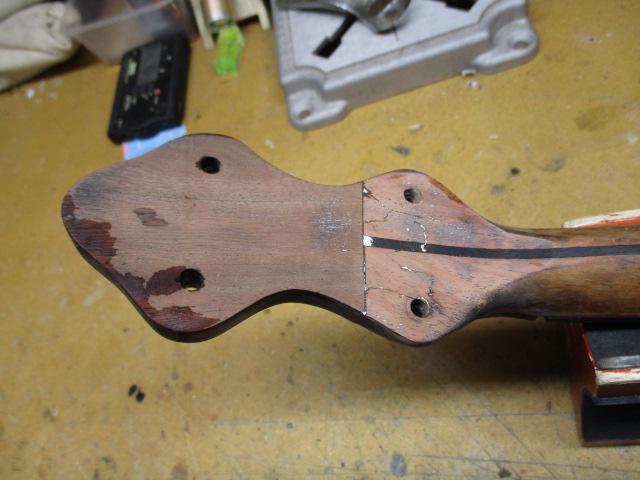
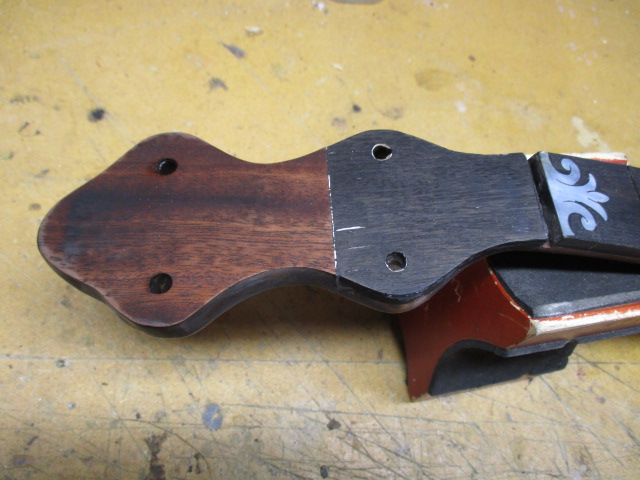
The peghead in these photos are from a J.A.Turner (British) banjo I am restoring.
At some point before I got it, it appears the peghead was broken off and someone made a replacement (not matching the shape of its original). It was only glued on as a butt joint. I removed it, drilled two matching holes in both pieces and glued in two pieces of 1/8" brass rod.
My intention is to disguise the joints front and back.
You could use the existing 'dowel' and fill the gap at the rear with something that matches the wood of the neck. The repair can be disguised.
quote:
Originally posted by banjonz
You could use the existing 'dowel' and fill the gap at the rear with something that matches the wood of the neck. The repair can be disguised.
I used a new piece of dowel. the problem was that the holes on each part were not drilled evenly so the new dowel was not quite straight and the peghead was then off centre. I left the holes alone but with some judicious sanding and adding a couple of bits of thin venner in places I got it all straight. As this is not really a restoration (not enough skills here) but to get a working banjo I not looking for perfect, although it needs to look reasonably decent. I used a piece of beech for the gap as it was what I have. It's a decent enough match and strangely now it's almost sanded to shape it seems to take on the orangey hue of the adjacent finish.
Are you brave enough to show us a picture Graham?
I’m sure you’ve done the best job you can and if it plays well, that’s a result, in my book!
Terms of Use | Privacy Policy | Privacy Consent (EU/GDPR Only)
Copyright 2026 Banjo Hangout. All Rights Reserved.