This week’s Tune Of The Week is “Lake Erie”, one of many tunes that have been passed down into Old Time circles from the recordings of Tennessee fiddler John Sharp. This tune was included on Bruce Molsky and Bob Carlin’s 2004 album “Take Me As I Am”, as the second tune in the “John Sharp Medley” (it starts around 01:08 into the video).
Here are a few other online versions to listen to
The source recording
The source recording of John Sharp was made in 1949 by his neighbor, Sergeant Alvin York (a well-known figure in his own right, one of the most decorated US Army soldiers of World War 1). The recording was made using a wire recorder and features Sharp accompanied by Virgil Anderson on banjo. The tune is also sometimes referred to as “John Sharp II”.
Playing the tune
You can find music notation on the Traditional Tune Archive.
The tune appears in Volume 2 of the Portland Collection, but in D major, following Kerry Blech’s version.
There’s a tab and video of my arrangement below. It’s in standard A tuning (aEAC#E – capo on 2nd fret). There’s nothing irregular to deal with, but the B part climbs up the neck to some quite high notes.
Background
‘Fiddlin’’ John Sharp
John Sharp (1894-1965) was born near Pall Mall and Jamestown, Tennessee. During the 1930s he led the Kentucky Wildcats string band (which included Virgil Anderson on banjo). There is a good source of biographical information here.
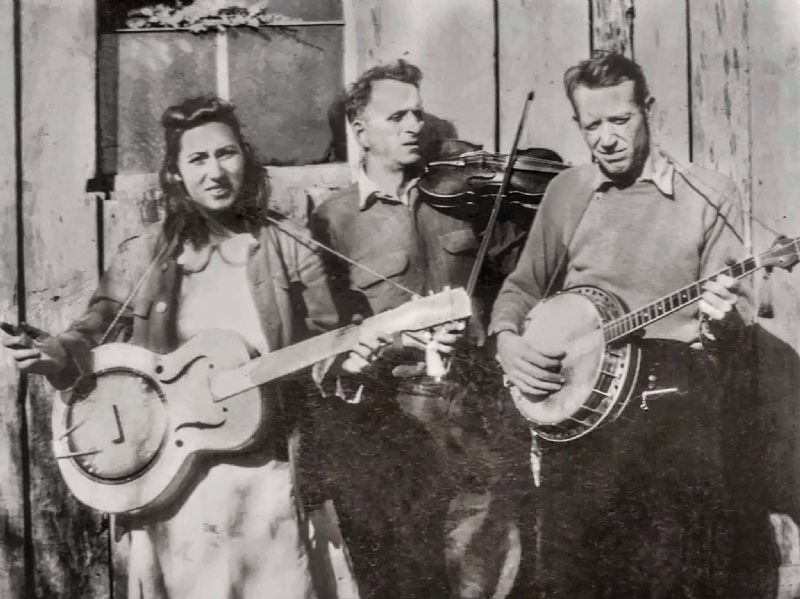
In a 2023 Facebook post, the photograph below was included, showing him with daughter Evelyn and Red Morris on banjo.
Further recordings were released as ‘Sharp’s Hornpipe’ Vols. 1 and 2. You can hear these on Soundcloud – ‘Lake Erie’ is included as part of a medley in Track 4, Volume 1.
Earlier sources for ‘Lake Erie’
There is one clear piece of evidence that ‘Lake Erie’ is an older tune, but no apparent information about where it came from originally. A 1908 Edison Cylinder recording by William Craig features the tune as part of a medley, calling it “Shores Of Lake Erie”.
In the notes underneath the YouTube post of the cylinder recording, Tim Gracyk also includes some interesting information about William Craig. Although Edison claimed Craig was from Scotland, and that this is a Scottish tune, Gracyk speculates that neither of these may be true:
“The fiddler William Craig recorded for Edison around 1908 to 1911. Craig was among the first players of Scottish music featured on commercial records. James Scott Skinner was the first.
The Edison Phonograph Monthly of June 1908 states this: "A new Edison artist, William Craig, the violinist, of Glenburnie, Scotland, is presented with this Record. Mr. Craig was especially engaged to give us a series of the celebrated Scotch dances, Strathspey and Reel [Lady Binnie / Shores of Lake Erie]. His first selection offers an opportunity for some dexterous bowing and shows him to be a violinist of very unusual ability. Piano accompaniment."
The August 1911 edition states, "William Craig dead. A dispatch from Glenburnie, Scotland, announces the death at that place on July 10th of William Craig, the violinist, who made Edison Standard Records 9893, 10120, 10357 and 10440."
Death records in Scotland have no William Craig passing on July 10, 1911. Glenburnie is a name used for several places in Scotland, most notably in Lanarkshire and at Newburgh, Fife.
It seems likely that the Edison trade journal made a mistake in citing Scotland. Canada is more likely. A man named William Craig died on July 10, 1911, at Kingston, Frontenac County, Ontario, Canada. His age was 73. This Craig is buried at Cataraqui Cemetery in that Canadian city. His wife was Eleanor Isabelle Waggoner Craig, born in 1845 at Kingston and buried in the same cemetery after her death in 1925 at age 80. They were married in 1863. Glenburnie is a rural community outside the city of Kingston, Ontario.”
In the Traditional Tune Archive entry for this version of the tune there is some further speculation:
“Unfortunately, very little is known about Craig, who recorded for a few years for Edison in the first decade of the 20th century…. "Shores of Lake Erie" does not appear to have Scottish or Irish antecedents although it was identified on the label as an "Irish reel"; it may be that the title is a mistake by the American record company, mishearing it from 'Loch Erne' or some similar name.”
There is another older tune called “Lake Erie” which appears in Elias Howe’s Music Companion, The Third Part (1842), but this doesn’t appear to be related.
There is some evidence of the tune spreading into wider circulation as a result of Craig’s cylinder recording, which may be how it found its way to John Sharp:
“Michigan fiddler Patrick Bonner said he learned The Shores of Lake Erie when phonographs first appeared, by hearing another fiddler's phonograph. “Well, I picked [The Shores of Lake Erie] up when the phonographs came out first. Some fiddler in town or downtown, somebody had a phonograph, so I picked it up and learned it.”
The trail goes cold trying to go back further than Craig’s recording. He specialised in recording traditional Scottish/Irish tunes, so it seems unlikely that he would have included an original composition among the small selection of tunes he recorded for Edison. ‘Lady Binnie’, which it follows on the recording, is quite a well-known tune. Maybe there is a version of this tune sitting in an old tune collection or manuscript under a different name, or perhaps William Craig was emulating the style of other Scottish and Irish reels he had played to create a nice medley?

Very nice tune and a great write up! The mystery of these fiddle tune names is always interesting to explore.

You found a hidden tune in the CD "Take Me As I Am", Mark. Your delicate playing sails smooth on it, as does Pat's (banjukebox). Walt and Claire sound great together. Jaybird has a wild and intentionally sharp-noted B part, and enlightened me with some of these words: "There ain't much lore to give on this tune, other than it's similarity to Bile Them Cabbage Down in the first part." I couldn't place the familiarity of the melody till I read that note. I'd take exception to the lore part though, Mark, as you found lots of "lore." Perhaps the suggestion that the tune was really named for a lake in Ireland with a similar name is right on the mark (no pun intended).
I had to tweak my bridge a bit to get those high notes in tune. The recording is in open G as I'm not fond of capos or re-tuning a whole step up unless it's needed. In the tab you'll notice the chordal positions and two times in the B part I use the thumb uncommonly, as far as its normal timing on off-beats, allowing more time to get to the 9th fret.
Terms of Use | Privacy Policy | Privacy Consent (EU/GDPR Only)
Copyright 2026 Banjo Hangout. All Rights Reserved.