


Hey friends,
I have a trapdoor Gibson that I won at an auction a few years ago. The conversion neck it came with was fine, though not great, and I'd dreamed of getting one with a Gibson logo on it. I found one recently and bought it from a fellow BHO member, who shipped it to me, no problem.
The thing is, although it had previously been mounted to a different trapdoor, the channels don't quite align.
As you can see in the photo, the round channel for the tension ring is well aligned with the squared channel for the tension hoop (apologies if I'm using the wrong terms) but for some reason the bottom of the extended fingerboard is 1/8" above the head, and the bottom of the heel is nowhere near flush with the rim.
I expected to need a taller bridge with the extra height of the extended fingerboard, but with all that space, it looks like I'd need an inch-high bridge.
Am I missing something? Did the trapdoor this neck came off of just have a much bigger pot, or is there some adjustment I'm missing? And can this be fixed without filling in and re-cutting those channels?
Thanks for any help you can offer.
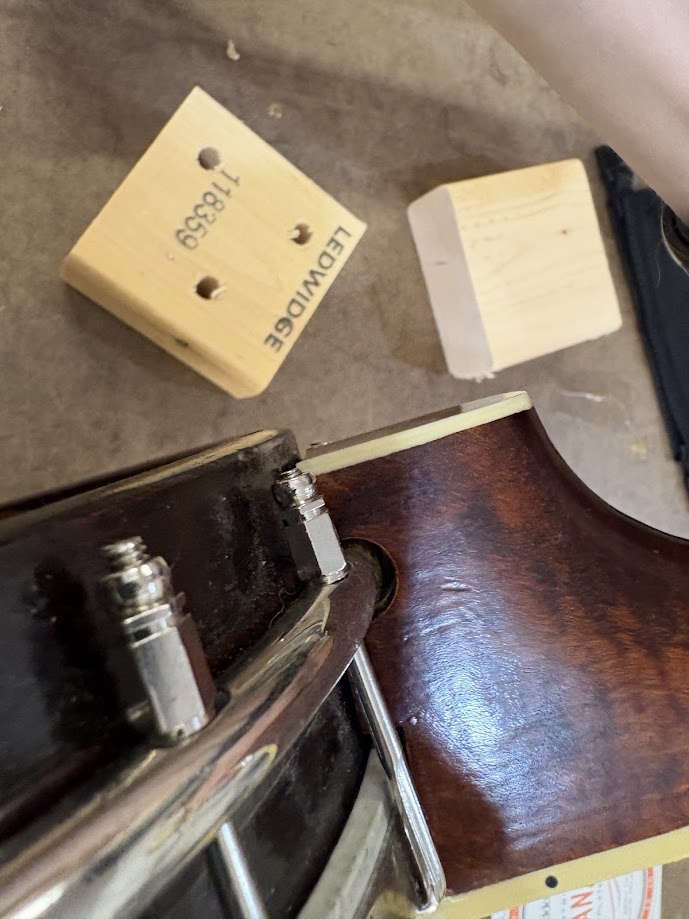
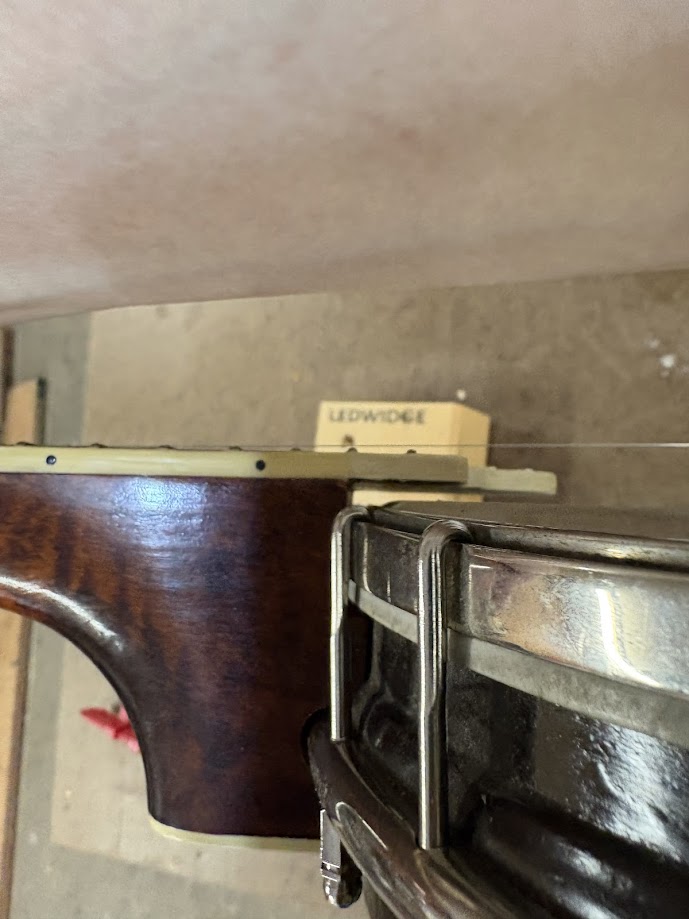

Did the conversion neck have the elongated fingerboard too?
Not all those early Gibson banjos had elongated fingerboards. Some of them ended right at the end of the neck heel, nearly touching the tension hoop. Obviously those sat lower on the rim than a neck with an elongated fingerboard which had to sit much higher on the rim.
Perhaps your rim originally had a short/regular fingerboard where all the connection points through the rim sat in a different spot? Now you put an extra tall neck with fingerboard extension on a rim originally designed for a much less tall neck heel?
I've never owned one of this type banjo, whether Gibson, Vega or other. But I've always wondered how they got that fingerboard to ride so high ABOVE the plane of the head, and how that affected securing the neck to the rim. AND how an owner would change a head with that fingerboard extension in the way.

Hey Dick,
Yeah, the neck that was on it when I bought it stopped right at the rim and was basically flush with the head. Here's a couple photos of the banjo when I got it.
There was a thread when I first got in which some folks figured out that it had started life as a RB, so it had a five string neck on it. But that neck and any record of what it might have looked like are long gone.
Retrofret has a six string trapdoor for sale with an extended fingerboard; maybe I'll run down there and take a look.
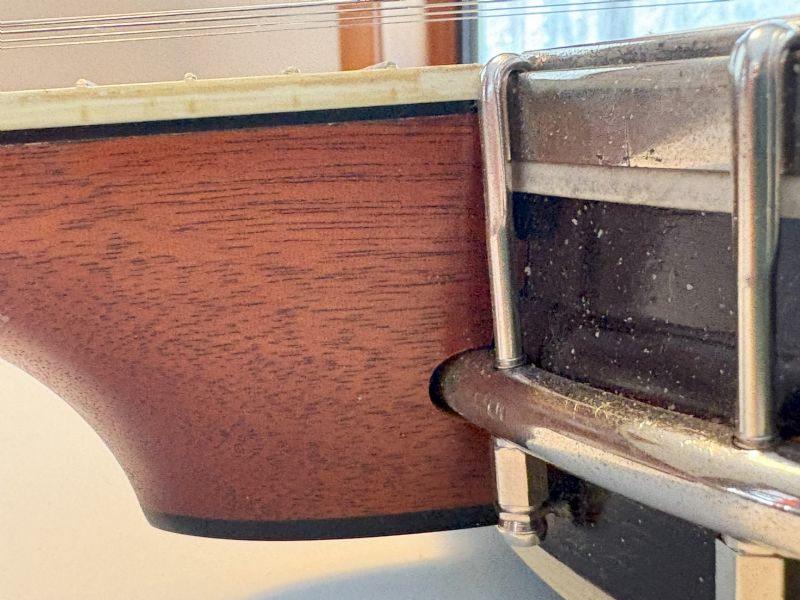
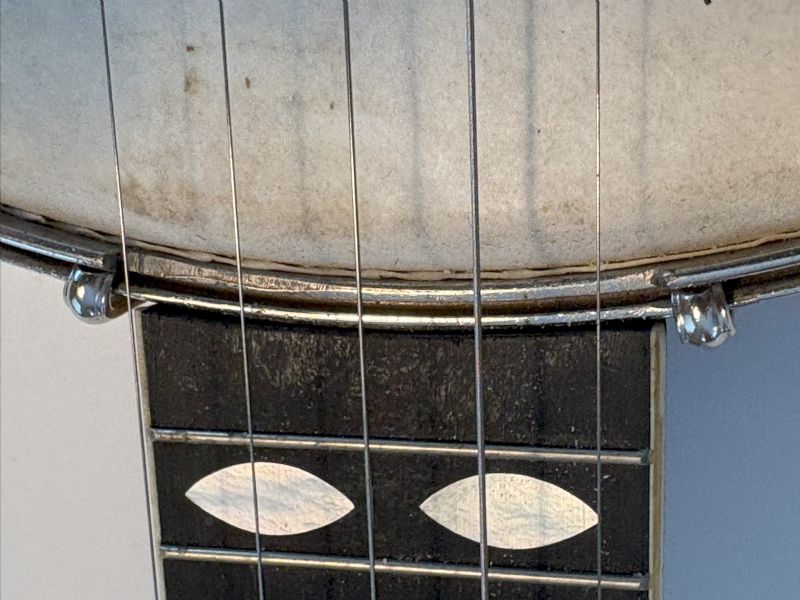
Retrofret may have high prices, but they also have great descriptions. They gave the dimensions of their trapdoor:
Overall length is 36 1/8 in. (91.8 cm.), 10 5/8 in. (27 cm.) diameter head, and 3 in. (7.6 cm.) in depth, measured at side of rim. Scale length is 26 1/2 in. (673 mm.). Width of nut is 1 1/8 in. (29 mm.).
I just measured mine and the depth is 2.5". So evidently Gibson made two different depth pots for the trapdoor. Bummer I had to buy a neck to learn that.
Is there a way to salvage this?
Tall bridge is not the end of the world. I'm guessing (only guessing) the extended fingerboard alters the geometry.
The lower part of the heel not being in contact with the rim is bad and needs correcting. But tightening the co-rod to pull the heel into contact will probably pull the strings down to the fretboard. So I think the first thing to try is shimming the heel at both contact points -- the upper and lower lag bolts -- to find what amount of added wood at both places produces a neck angle that works. And this might require experimenting with bridge heights, which you can do with craft sticks just for testing. After you've found what the heel needs, you can decide whether a luthier (or you, if you have the skill) should permanently add wood to give the heel the right angle.
People often says shims should only be temporary and having heels recut is the best long-term solution, but I think yours needs wood added not taken away. The upper part already clears the tension hoop and the lower part clears and aligns perfectly with the tube (not sure what else to call that piece). So cutting away any wood from the end of the heel would make it not fit.
Good luck.
Anyone have a source for really tall bridges that they like?
Tallest I've seen is a 3/4" at Banjo Ben.
quote:
Originally posted by Old HickoryThe lower part of the heel not being in contact with the rim is bad and needs correcting.
I figured it would be easier if we had a visual to work with. Please refer to the numbers in the photo.
I think what you're saying is that #3 absolutely has to touch the rim. As I understand it #1 should not touch the rim, and it's best if #2 touches the rim, but isn't mission critical.
What I've got going on now is that #1 is touching the rim, making it hard to get #2 and #3 to touch. Which tells me I should shave a bit of wood off of #1 until 2 and 3 sit flush. Does that track? It doesn't answer my height above the head issue, but it would allow me to attach the neck appropriately.
I had also considered filling in the rounded channel between 2 and 3 and re-cutting it a little closer to the freboard, and moving the hanger bolts up a little as well, but I worry the higher bolt would be too close to the truss rod. And I'd never get the color to match in my little patch.
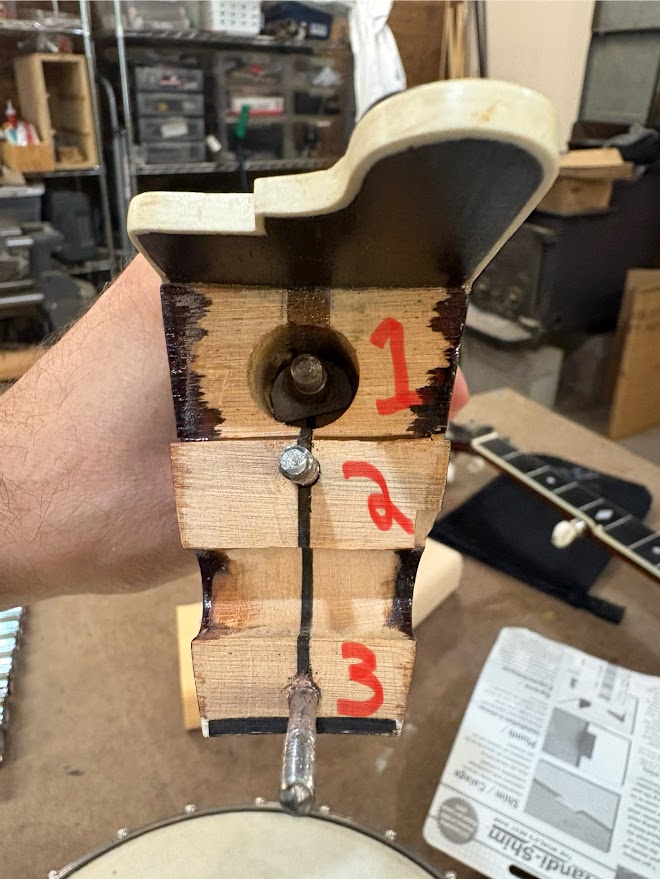
It is "mission critical" that 2 and 3 both make solid contact with the pot. This happens when the coordinator rods are tightened. Or the one rod and one nut.
On a Gibson style banjo, 3 must touch the rim. What 2 touches depends on the type of banjo: whether there's a tone ring, whether there's a one- or two-piece flange, or shoes, and maybe even when it was made (because a pre-war rim for two-piece flange is different from a 70s rim for two-piece flange.
2 might touch a tone ring skirt only, or a ring skirt and a bit of rim wood, or all wood in the absence of a tone ring.
I think 1 should touch nothing. The tension hoop needs to be free to move up and down. The consensus is there should be a gap between the neck and hoop. Those who disagree are in the minority. Doesn't make them wrong. But they're outnumbered.
If you remove wood from 1 the neck will tilt even further forward and so raise the action even more!
Add temporary wood shims at 2 and 3 to see if you can make this work. Which is what Old Hickory said earlier.
Put a straight edge on your fingerboard extension. Maybe lay a ruler or piece of scrap flat metal . Where your bridge normally sits, measure distance between straight edge bottom and head. That is size bridge you would need.
Well, it’s much easier to add a shim than to remove wood.
What are folks using for shims? I’ve never had to consider sound transmission when shimming something. (I mostly make kayaks.)
quote:
Originally posted by kayakeradam
What are folks using for shims?
Amazon sells some brass feeler gauges. You get a variety of thicknesses and it's pretty easy to cut.
(ps, I consider all shims to be temporary, even the ones in there for 10 years).
I guess I could slice off a super thin piece of maple on the table saw and sand it down to get where I need it.
I could also plug the hanger bolt holes with some dowel and re-drill new holes 3/16" higher so it aligns better. Good or bad idea?
quote:
Originally posted by kayakeradamWell, it’s much easier to add a shim than to remove wood.
What are folks using for shims? I’ve never had to consider sound transmission when shimming something. (I mostly make kayaks.)
I use veneer. Years ago I bought a 10-pack of maple veneer cards (business card size) on Etsy for just a few bucks. A bit over .02-inch thick.
I've also used .01 and .02-inch thick wood fiber veneer that used to be sold by Luthiers Mercantile. Now defunct.
People use cut-up aluminum drink cans or flashing. Brass shim stock such as sold at craft stores. Pieces of credit card.
Since you have a big gap to fill at one of the lag locations, it may be that you have to add something so thick it's more equivalent to building out the heel than merely shimming. Someone did that on a banjo I bought 8 years ago. They modified a '70s RB-250 neck Âade for 2-piece flange to work with 1-piece flange by adding a wood extension to the lower lag area of the neck. A permanent change, too serious to call shimming.
My guess is you'll need to shim the upper and lower locations at different thickesses to create the neck angle that will work.
Good luck.
quote:
Originally posted by kayakeradamI could also plug the hanger bolt holes with some dowel and re-drill new holes 3/16" higher so it aligns better. Good or bad idea?
Bad idea. As I mentioned before -- and I think you said in your opening message -- the neck currently aligns perfectly with the tube portion of the two-piece flange. If you relocate the bolts, raising or lowering the neck's interface with the pot, you'll need to enlarge the cutout in the heel where the heel goes. I think raising the bolts lowers the neck, so you'd have to lower the bottom of the neck cutout.
I'd say only relocate the bolts if nothing else gets you to a solid two-point neck-to-pot connection and playable action.
quote:
Originally posted by Old Hickoryyou'll need to enlarge the cutout in the heel where the heel goes. I think raising the bolts lowers the neck, so you'd have to lower the bottom of the neck cutout.
Thanks, Ken. If I did relocate the bolts, I'd either fill in the rounded cutout and then rout a new groove, or I'd just expand the existing groove. I've seen jigs that put a router on a spinner so you can mirror the curve of the pot.
Though, honestly, that sounds like a massive pain the tuchus. And probably not worth it. I'll see if I can get the neck on straight and how big a bridge is needed for reasonable action and decide what I want to do.
Luckily I still have my beloved Deering Sierra to play while the Gibson enjoys a vacation in the shop.
quote:
Originally posted by kayakeradamThanks, Ken. If I did relocate the bolts, I'd either fill in the rounded cutout and then rout a new groove, or I'd just expand the existing groove. . . . .
And you got the point even though I mis-typed.
I meant to say: you'll have to enlarge the cutout in the heel where the tube goes
Terms of Use | Privacy Policy | Privacy Consent (EU/GDPR Only)
Copyright 2026 Banjo Hangout. All Rights Reserved.


