


Not so much banjo repair as 'Replacement of consumables' - and the knot would technically be a bend.
Also, this doesn't involve metal or wound strings.
Thinking particularly of people who, when replacing strings have experienced both the 1st and 5th string breaking beyond the bridge - at the knot they tied to form the loop. This is an event that, in the interval between the arrival of an order for replacements, leaves them with a length of perfectly good string, and also the intact string that they removed - with a work-tested loop end. (They're re-ordering as they find this particular type of string transformational to the sound of the banjo, and in a good way)
In short, is there a bend that's particularly kind to use in joining lengths of 0.56mm banjo strings?
I'd immediately use the brilliant-for-ropework carrick bend, but I've a feeling that in this case it would not be kind to the material.
Mark

When I first got my Cello Banjo, the nylon strings I purchased were too short for the 2nd and 3rd (29" Scale). I simply tied on extensions between the bridge and tailpiece. No special knot/bend used...and it was fine. I did make sure my extensions were thicker than the string they extended.

Thanks, good to know that worked for you. There might be enough length in these strings to have a second go at putting a loop in to them and fitting them - and this time use a perfection loop knot. If that doesn't work well I'll see if there's the length left to extend them.
Mark
I will attempt to describe the knot I was taught to use to tie 2 ropes (pot warp) together to repair or lengthen 2 pieces of rope.
Point one end away from you and the other end toward you.
Pinching the overlap,tie an overhand knot over and under the other string and pull that knot tight enough so it holds the simple overhand knot in place by itself.
Turn the half-done strings 180 degrees and see the same thing you started with the 1st time.
Repeat the over-under simple overhand knot exactly as the first one going over then under the other string.around the other string,pulling it tight enough that it keeps the knot on its own.
Then pull the two pieces away from each on either side of the now double knot.
The harder the string is pulled the tighter the knot locks itself.
We call this a "Water knot".
I've retied broken guitar and banjo strings back together with the venerable "water knot" and they stayed together for months afterward and stayed in tune after the knot seated.(2 behind the nut and 1 after the banjo bridge.
Did you notice I started with "rope" and ended wiith "string"?
I wasn't sure it would work the first time I tried it on strings.Pleasantly surprised.
Edited by - steve davis on 08/19/2026 10:12:57
It's hard to describe a knot.
this happened to me when i was switiching over to nylon strings, and not wanting to buy a whole new set to have the same thing happen again, i looked on here for potential solutions, and am now using fishing line for my 1st and 5th strings. (h2ox monofilament 30#) i got green, but would actually go with something bright next time cos i can't see the strings. generally the fishing line feels a little looser than the actual nylguts, but i've kinda gotten used to it. next time i might just try marrying some line onto the end like mentioned above.
Edited by - oodora on 08/19/2026 11:52:00
The perfection loop knot is all I have ever used with nylon or Nylgut strings, and I've never lost a string because of a poorly tied perfection loop.
I recently purchased a gizmo for putting a loop end on strings. I’ve often tied knots in strings to get out of trouble at gigs I can’t say what kind of knots I’ve used. I’m no Boy Scout but they always worked.
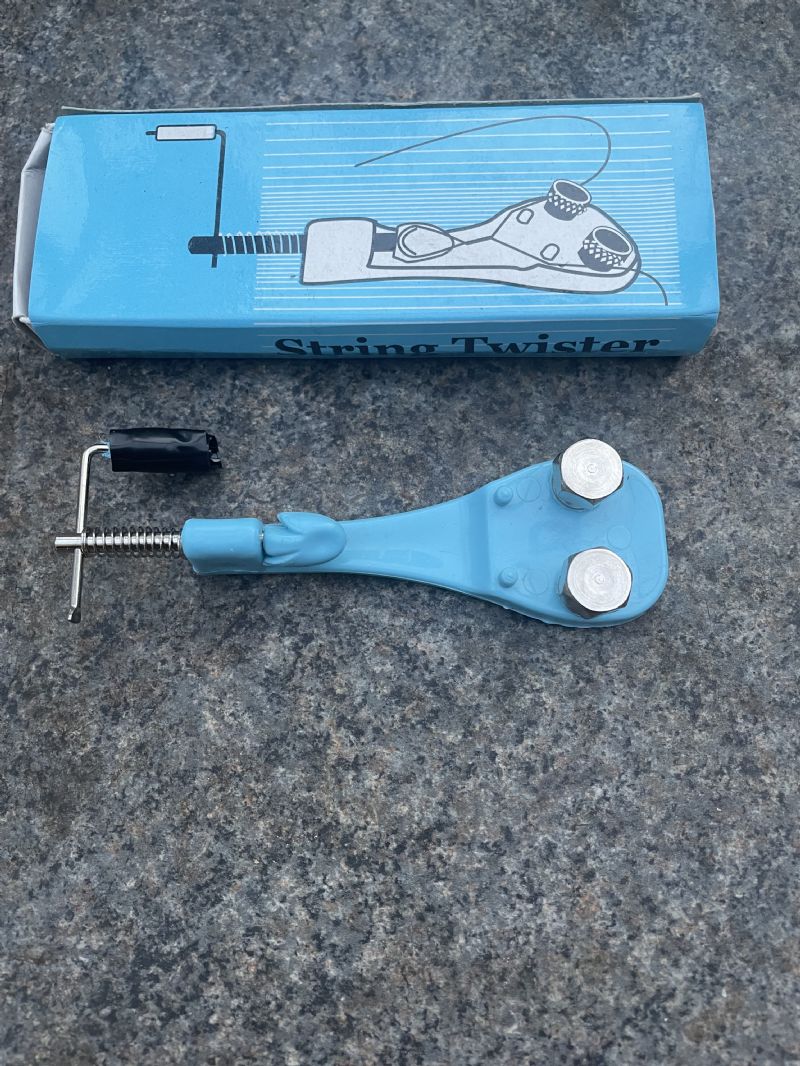
Steve,
If I follow you, it sounds like, or similar to, a fly-fisherman's "barrel knot" -- or whatever other name it may go by.
It's not the easiest thing to tie in nylon monofilament, but you're right about its holding power.
I had a first string break at the tuning peg. I didn't have a lot of length to work with so I tied a sheets bend in the string. It has been on the banjo since 2010.
Yes. I know two things skeptical pickers are going to say:
One] My strings need replacing. (I play a pre-war archtop with plenty of pop with dead strings.)
Two] A sheets bend is generally used to join two sheets (ropes) of different sizes.
YMMV
Heavythumb
It's very handy to know how to retie a broken string when there's a blizzard happening and you don't have any spares.
After checking out the online "double fisherman's knot" I would call our "water knot" a "single fisherman's knot".
Not twice around/just once on either string end.
Edited by - steve davis on 08/21/2026 07:16:11
Thanks, everyone. The story so far - both strings, 1 and 5, having parted at the loop end and at a similar tension, it emerged that the surviving lengths were sufficient to give this another go, this time using a perfection knot, so in the end I didn't need to join two pieces.
The first string, courtesy of the change of knot, was then happy to be brought up to pitch. The second one not so much, but that was my fault as by the time it was a semitone off the note, it developed too much of a change in direction between the exit to the tunnel through the neck and the roller and parted there... but the loop end with its perfection knot was fine.
So, for tying loops in strings, it's good to avoid bowline knots, and in particular, they will efficiently cut Aquila Reds. That aside, with regards to these, there's an entire (short) chapter to be written on how to bring them up to pitch, and once the second set I've ordered arrives I'll be a little more qualified to write it. When fitting them, in terms of 'Feel' they're about as communicative as they can be - and can be rewarding to work with even before enjoying the result.
Mark
Terms of Use | Privacy Policy | Privacy Consent (EU/GDPR Only)
Copyright 2026 Banjo Hangout. All Rights Reserved.


