Probably a stupid idea, but...
Some of my non-banjo-related music research has put me in contact with historical side drums, the kind of big rope-tensioned snare drums used by fife and drum groups. It occurred to me that the same tensioning method could be miniaturized and applied to the banjo. Ears/tabs (the leather rings you slide vertically to make finer tension adjustments) may not work given how shallow a typical banjo rim is; I'm not sure. Because side drums have two heads and banjos have one, the rope segments opposite the head would pass through holes drilled through the rim and then back over the lip of the rim.
What's the point?
1. While bringing it up to tension is not exactly quick or easy, the process can be repeated indefinitely and (if using a natural head) in accordance with seasonal changes (compare to other minimal-hardware options e.g. gluing and/or tacking)
2. Makes for a relatively lightweight pot construction
3. Removes the need to make or source expensive shoe and hook hardware
4. Looks cool (probably)
Has anyone tried something like this? I am not referring to designs where the rope passes through perforations in the head and directly around the flesh hoop. This would have a tall-ish tension hoop with holes in it for the rope to pass through.

Bob Thornburg used to make rope-tensioned gourd banjos...not exactly as you describe (no tension hoop). You might look him up.

quote:
Originally posted by banjoboyd
Because side drums have two heads and banjos have one...
Not necessarily. Some very early banjos (American and English-made) had top and bottom skins. Many London drum-makers in the 1850's added banjos to their sales list or in some cases went over entirely to banjo manufacture.
This construction would enable you to maximise the technical know-how of your side-drum colleagues. A rim deep enough to accommodate the tension system would be a main consideration. And not 'stupid' at all; dispensing with metal fittings, I would venture that a double-skinned cord-tensioned banjo would be even cooler.
Edited by - EEB on 08/16/2026 06:12:57
There is historical precedent, see Albert Baur’s second letter.
On a rope-tensioned snare drum, and on Thornburg's gourds (which were tensioned somewhat like Indian tablas), you get your adjustment by using the leverage provided by having a long piece of rope you can move sideways (pulling with leather, pushing with wood). I can't imagine someone wanting a banjo pot more than 5" deep, but I can't see how you'd make any kind of rope system work on that. There's a reason that the shallow snare drums that everyone (that's not marching) plays now didn't show up until there were metal tension hoops and screw tensioners.
How about just one head, and have the ropes over the back edge of the rim and connected together to a ring or wooden block in the middle...? You could twist pairs together with short sticks between the rim and the center for some adjustment. I reckon it would need at least twice as many turns through the tension hoop as you'd put on a snare drum of similar diameter, and much lighter rope. More like heavy twine.
quote:
Originally posted by Joel HooksThere is historical precedent, see Albert Baur’s second letter.
"I have seen banjos with holes drilled through the top hoop and corresponding ones in the rim; cords were drawn through these holes, and on the cords were ears similar to drum tighteners. Before playing, the performer would tighten up the head of his banjo as a drummer does his drum. I never saw many of this style of tighteners, but a man having a banjo constructed in this manner thought himself above the ordinary mortal who owned a simple tack head banjo."
This is exactly what I'm envisioning. So it is possible to use ears on a shorter scale (assuming these banjos did not have comically deep rims). It would take some testing to figure out the right combination of 1. cord and ear size/material and 2. the angle formed by each pair of cords (as a function of rim depth, hoop diameter, and number of holes/loops).
Dan -- I like the "twist-stick" idea as well. But couldn't the sticks also sit along the outside of the rim, where the shoes would normally be? I have seen some goblet/barrel drums (I forget from where) tensioned like this.
Another possibility that just occurred to me is using wedges for each cord loop on the inside of the rim. Ditto for twist-sticks, although that may make them a bit hard to reach...
Edited by - banjoboyd on 08/16/2026 21:06:38
It's not my thing, but...
I wonder if it would be possible to take heavy wire/rod and thread one end, bend the other over a hoop, and then use nuts to tighten the head? This would need to pass through some sort of bracket hardware fixed to the rim or hooking under the bottom edge.
It just might work.
quote:
Originally posted by banjoboydWhat's the point?
1. While bringing it up to tension is not exactly quick or easy, the process can be repeated indefinitely and (if using a natural head) in accordance with seasonal changes (compare to other minimal-hardware options e.g. gluing and/or tacking)
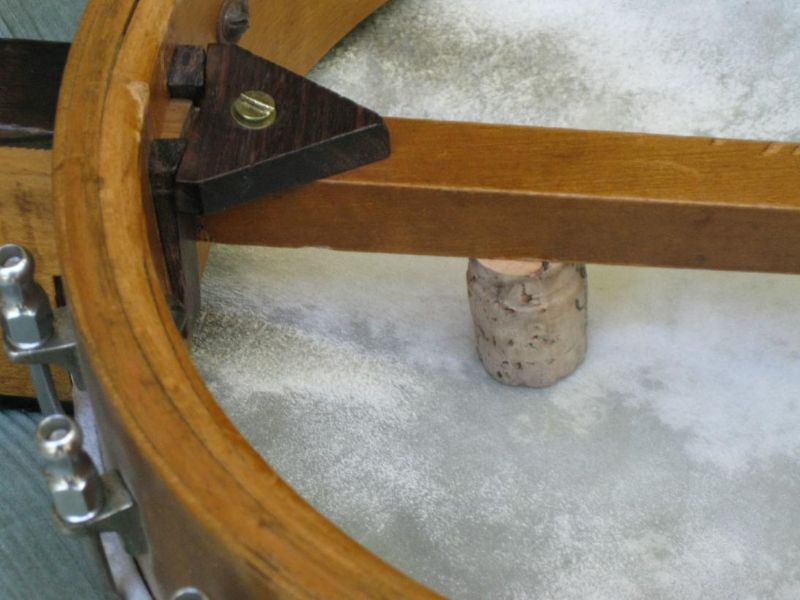
Sliding the cork to different positions is a way to deal with seasonal changes.
Terms of Use | Privacy Policy | Privacy Consent (EU/GDPR Only)
Copyright 2026 Banjo Hangout. All Rights Reserved.