I’ve been playing banjo for over 20 years, after playing guitar for at least that long. I use four finger picks on both, and never really discerned any style. I just play what I think a song needs. I can fake simple three finger good enough to fool a non banjo player, and can kind of clawhammer simple back up, and finger pick along with anything my friends want to play. What differs between my guitar playing and banjo playing, is incorporating the drone string to banjofy the sound.
All of a sudden, after all these years, I see discussion of “fingerstyle” banjo playing, like it’s a genre of its own. Of the two threads running, I’m still not sure what it is, where’s it’s from, if it’s a specific style, or if it is just a broad term that encompasses any use of up picking. So, I googled it. Is this about right, or is it way off?
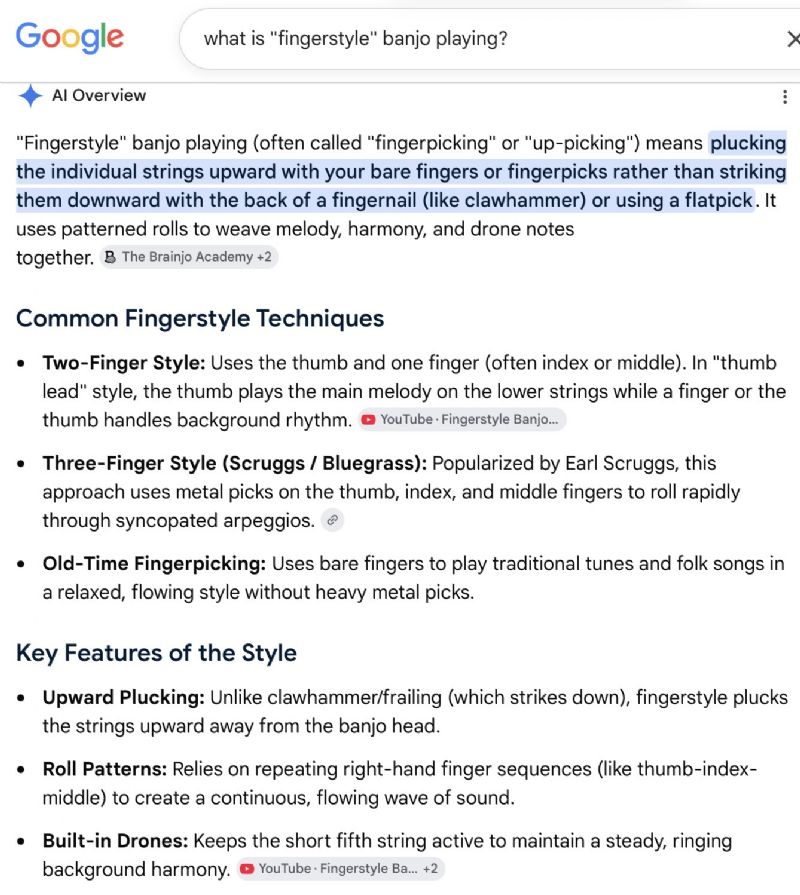
Edited by - Dean T on 07/31/2026 14:46:20

Simple answer: bare fingers and thumb most typically on gut or nylon strings but also on steel. But there is a more complex history and context…
Firstly finger-style is a technique with specific primary source description and tutor books beginning from the early 1850’s on both sides of the Atlantic. Those sources very clearly outline the technique. They do not name it.
But secondly, finger-style constitutes a vast repertoire relating to the huge popularity of the banjo and primacy of this technique, throughout the second half of the 19th century and continuing until the end of the First World War. Is this ‘genre’ as we know it? Not really, because culture and society were markedly different and commercialism, marketing and mass-communication were in their infancy.
Your question touches on the contemporary reality of a lack of tightly defined genre ‘boundaries’ that are so familiar to us. The quieter, relaxed and more intimate consequence was that there was no imperative to name this technique; it was simply ‘banjo playing’. Occasionally it would be distinguished in print from ‘down-stroke’ technique or ‘pick-playing’.
Post-1918 the banjo saw a decline in popularity and the alternative plectrum-style and competition from the rising popularity of the guitar. We then see finger-style used as a term to describe this technique to differentiate from plectrum-style. Players continue to use finger-style but the advent of American bluegrass and the folk revival adaption of Appalachian music into 'old-time' as a genre decreased the visibility of the older style. Decreased visibility leads to decreased knowledge and neglect. But it's never 'gone away'; finger-style has the longest continuous history of any banjo technique.
Edited by - EEB on 07/31/2026 16:12:23

Thank You! That helps a lot
Edited by - Dean T on 07/31/2026 16:51:33
i consider it as anything using fingers pulling up and thumb going down --a steadfast tradition of "finger stye" banjo has never really reached the masses--as a genre
" Classic Style "was put forth by some of it's own advocates a few years back --to describe the way of playing the banjo by learning music properties along the lines of learning to play an instrument in an orchestra--you can google classic banjo and read all about it--and even get help learning some--it was really ''kicking in'' about the time music recordings became available--some great one of a kind tunes --and '' now days ''practitioners are doing it great justice--It could be the next big thing with the right ''eye candy'' in the right movie
my opinion I ask no agreement--
I play using picks -most of the time it is not bluegrass --just banjo music -using the fingers--I call it a finger style also
Edited by - Tractor1 on 07/31/2026 17:23:35
quote:
Originally posted by Tractor1i consider it as anything using fingers pulling up and thumb going down --a steadfast tradition of "finger stye" banjo has never really reached the masses--as a genre
" Classic Style "was put forth by some of it's own advocates a few years back --to describe the way of playing the banjo by learning music properties along the lines of learning to play an instrument in an orchestra--you can google classic banjo and read all about it--and even get help learning some--it was really ''kicking in'' about the time music recordings became available--some great one of a kind tunes --and '' now days ''practitioners are doing it great justice--It could be the next big thing with the right ''eye candy'' in the right movie
my opinion I ask no agreement--
I play using picks -most of the time it is not bluegrass --just banjo music -using the fingers--I call it a finger style also
Well, kind of.
If by "learning music properties" you mean standard notation, that was just how one learned to play instruments. It is very difficult for us to understand today, but it was in fact quite common and normal. And by the post American Civil War Industrial Revolution, doing things "scientifically" (like using music to learn music) was like really cool and stuff. Or, as was said, "all the rage" (unless you were an Aesthetic, then it was "Too To and "Utterly Utter").
Not to mention that notation was really the only way to buy, sell, give, trade, send, and record music at that time (along with in person teaching if one was lucky).
If by "in an orchestra" you mean the so called "banjo orchestras" or, more commonly, "banjo clubs", well, that concept did not really exist until Thomas Armstrong introduced the idea about 1885/1886. Which leaves out 30+ years. Additionally, as clubs were popular, they were only one part of this massive working class musical movement which was largely enjoyed in the "solo with accompaniment" format. Or even just solo playing.
A little "inside baseball" context.
The "orignial banjo style" of paying was to strike down with the index nail (or thimble after about 1845) and pluck with the thumb. This is today called by the 1970s term "clawhammer". This was called "banjo style" or "stroke style" or "thimble style" interchangeably.
But it was in very short order that people who took interest in the popular form of the banjo as we know it applied the method used to play the Spanish Guitar to the banjo.
This is where it can get confusing, so please try to follow along.
Today the "Classical Guitar" is a modern form of the "Spanish Guitar", which before Segovia (and nylon strings) was mostly played with bare fingertips, or with minimum nails only supporting the flesh of the fingertips (which did the sounding).
So "guitar style" refers to that. This all predates using a mandolin pick on the guitar, which would not become a thing until well after the mandolin became popular after the 1879/1880 Spanish Students tour (which is a weird story and worth reading up on). Even then, the plectrum played guitar really did not catch on until after Nick Lucas and Eddie Lange.
"Guitar style" was the name historically used for "finger style". And while correct, we live in 2026, so calling it that might confuse with plectrum playing (which itself is relatively modern).
To recap:
"Banjo style"= clawhammer
"Guitar style"= fingerstyle (or classic style).
joel you are the definite expert on the van epps crowd and i thank you--but one thing I still hold out-is the picture you paint that has no -finger pickers that learned in the other ways-- I figure it would be very natural for a hobbyist to be -- up picking some --I have run into folks all my life that picked up a tune or 2 on the banjo-- that way-- no picks --no rolls -- it was a big wilderness and many scenarios---
Edited by - Tractor1 on 07/31/2026 19:39:51
I wrote “quite common and normal”, I did not write “all”.
There were even some pretty famous Banjoists who were known ear players.
There are recordings of Ruby Brooks who was an ear player. But Brooks had his partner Harry Denton who could read and write and wrote out Brooks compositions.
Horace Weston was another ear player.
Exceptions though.
I think AI is terrible at this, for the time being.
We humans like to put things in files that have names. We also like to differentiate in order to separate ourselves from others. We also appear to lean into pedantism, especially on the internet.
Descriptive terms have usually been treed, much like taxonomy. There's a tree that starts with "I play music" which eventually branches to the 5 string banjo. There it splits into a wide variety of playing styles on two separate branches, formerly called: Banjo Style and Guitar Style (as noted by Joel). However, both of those terms are so antiquated that moderns usually do not comprehend them. There is a level of pedantism that rejoices in that. 
One problem is that there is no global, controlling, body for describing various banjo styles. There is no short, obvious description available (at some level) without resorting to waving one's arms and demonstrating specialized techniques in all their glory. For the unwashed, it really isn't an issue. A generic "I play the banjo" response is sufficient to end the conversation.
Is "fingerstyle" sufficient to describe a given type of play? I guess it depends. You have said you don't play a specific style, but that you're good enough to get along. You use your fingers to pluck the strings. I'd say you play "fingerstyle"...full stop. Picks don't really matter. Material/music played doesn't matter. String type doesn't matter. Banjo construction doesn't matter.
What matters is that you communicate what you are doing. Everything else is just faff. Your target listener is going to drive how far you go with your descriptors. My wife's eyes glaze over once I get past "I play banjo". My jam group knows only Old Time/Clawhammer, Irish and Bluegrass. Some people only grok artist names: do you play Jens or Fleck?
I play lots of 5-string styles. I'm about 50:50 fingerstyles vs clawhammer styles...and each is split into several sub styles depending on what I'm trying to accomplish. How I characterize each depends on how far down the tree you want to go.
Material doesn’t matter? So if I played Foggy Mnt. Breakdown on a gut string banjo with bare fingers, it becomes finger style? I think some people would object to that. But I agree that defining labels is a minefield. We are lacking content here, which would do more to get us on solid ground than all the back and forth.
A minefield indeed when we introduce the thread of genre to the weave. Because genre is constructed around a sense of distinct identity.
But viewed simply as distinct and specific technique - which finger-style clearly is - the field immediately reverts to its natural untroubled environment.
Then you encounter a fundamental internal musical reality that has nothing to do with external factors.
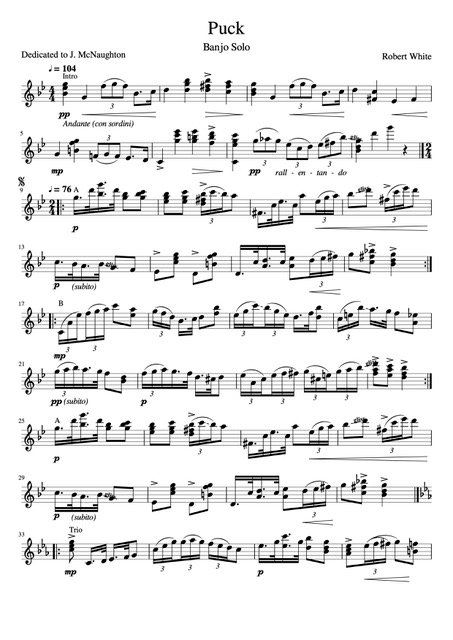
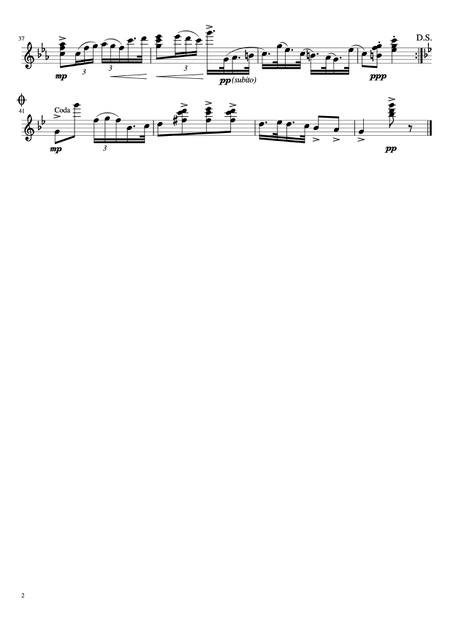
This essence is associated with playability. It is, as Laurence hints, only identifiable in actual content i.e. playing. If we consider what are compositions written for finger-style: Alf Newton’s 'Dinky’s Patrol’ composed in 1896 or Robert White’s ‘Puck’ composed in the 1950’s are products of that technique. It would make little musical sense to attempt the original notation with either Scruggs-style or clawhammer.
When compositions are played in other ways than originally conceived we move into the realm of arrangement i.e. the adapting of a tune to make it playable in a different style. That necessity for adaption highlights the fundamental internal technical differences that define specific technique or ‘style’. This is a form of borrowing.
We only borrow and adapt from what is outside our common experience.
Edited by - EEB on 08/01/2026 01:13:09
I imagine that back in the day it was called playing the banjo. People just did what they did. I play "fingerstyle". If you use fingerpicks and don't do Scruggs style picking are you playing "fingerpick style"? Very early on I decided to ignore styles and play some tunes on the banjo instead.
quote:
Originally posted by GrahamHawkerI imagine that back in the day it was called playing the banjo. People just did what they did. I play "fingerstyle". If you use fingerpicks and don't do Scruggs style picking are you playing "fingerpick style"? Very early on I decided to ignore styles and play some tunes on the banjo instead.
'Deciding to ignore style' is a big claim. A well-intentioned attempt rather than a fact. That attempt does not make the cultural reality of style and practical reality of technique 'disappear'.
The OP specifically asked for an exact definition of fingerstyle. It's that request that is being responded to here. It would be quick and easy to offer a simplistic and proscriptive definition. 170+ years that encompass huge cultural changes in musical influence alone mean that simplistic definition wouldn't helpfully answer his question.
It's a well-founded truism that those of us convinced that we act entirely independently of cultural or stylistic influence do no such thing. We all exist within an 'invisible' culture of history, ideas and convention. Claiming complete 'independence' of that context is equivalent to claiming not to breathe the oxygen that surrounds us.
Edited by - EEB on 08/01/2026 03:34:46
quote:
Originally posted by GrahamHawkerI play "fingerstyle". If you use fingerpicks and don't do Scruggs style picking are you playing "fingerpick style"?
What are your picking fingers doing? The picks are irrelevant to technique.
I would imagine your fingers relationship to the strings conform to the many published technical definitions of finger-style.
Picks were not historically used by finger-style (aka guitar-style) players. But technique is not a sealed 'time capsule'; it is a continuum that accomodates adaptations. Technique is a comfortable space co-habited by traditionalists and modern adaptation.
quote:
Originally posted by Joel Hooksquote:
Originally posted by Tractor1i consider it as anything using fingers pulling up and thumb going down --a steadfast tradition of "finger stye" banjo has never really reached the masses--as a genre
" Classic Style "was put forth by some of it's own advocates a few years back --to describe the way of playing the banjo by learning music properties along the lines of learning to play an instrument in an orchestra--you can google classic banjo and read all about it--and even get help learning some--it was really ''kicking in'' about the time music recordings became available--some great one of a kind tunes --and '' now days ''practitioners are doing it great justice--It could be the next big thing with the right ''eye candy'' in the right movie
my opinion I ask no agreement--
I play using picks -most of the time it is not bluegrass --just banjo music -using the fingers--I call it a finger style alsoWell, kind of.
If by "learning music properties" you mean standard notation, that was just how one learned to play instruments. It is very difficult for us to understand today, but it was in fact quite common and normal. And by the post American Civil War Industrial Revolution, doing things "scientifically" (like using music to learn music) was like really cool and stuff. Or, as was said, "all the rage" (unless you were an Aesthetic, then it was "Too To and "Utterly Utter").
Not to mention that notation was really the only way to buy, sell, give, trade, send, and record music at that time (along with in person teaching if one was lucky).
If by "in an orchestra" you mean the so called "banjo orchestras" or, more commonly, "banjo clubs", well, that concept did not really exist until Thomas Armstrong introduced the idea about 1885/1886. Which leaves out 30+ years. Additionally, as clubs were popular, they were only one part of this massive working class musical movement which was largely enjoyed in the "solo with accompaniment" format. Or even just solo playing.
We struggle to comprehend today just how literate earlier Americans were. For example, there was near-universal literacy at the time of the Founding. Nearly every frontier cabin had copies of Shakespeare and the King James Bible. By the 1850s, immigration had diminished literacy rates slightly but not significantly. Learning to play an instrument by reading musical notation would have been natural to our forebears.
quote:
Originally posted by EEBquote:
Originally posted by GrahamHawkerI play "fingerstyle". If you use fingerpicks and don't do Scruggs style picking are you playing "fingerpick style"?
What are your picking fingers doing? The picks are irrelevant to technique.
I would imagine your fingers relationship to the strings conform to the many published technical definitions of finger-style.
Yes that's why I said I play fingerstyle. But I didn't look at the various ways of playing a banjo (finger style rarely comes up) and decide that's the one for me or choose that way because I heard someone playing that way. I just played that way because it was comfortable based partly on one of the ways I played guitar which also included a lot of droning. And much easier than spending ages failing to learn a style like clawhammer.
quote:
Originally posted by Laurence DiehlMaterial doesn’t matter? So if I played Foggy Mnt. Breakdown on a gut string banjo with bare fingers, it becomes finger style? I think some people would object to that. But I agree that defining labels is a minefield. We are lacking content here, which would do more to get us on solid ground than all the back and forth.
My sense is...no, it's still bluegrass, just played in an atypical fashion. Bluegrass and old-time (as it is conventionally understood) banjo parts are largely the product of rhythmically elaborating upon and filling in some underlying melody not original or specific to the banjo. That is rather different than composing a banjo solo meant to function as a standalone, self-contained musical work. There are exceptions and grey areas on both sides, of course.
There's a funny piece in a 1960s(?) issue of the British B.M.G. magazine in which the author, a fingerstyle banjoists, goes "Have you all heard about this newfangled 'bluegrass' thing from across the pond?" And they include their own arrangement of "My Grandfather's Clock" in (what they understand to be) "the bluegrass style." But is it bluegrass? No. It's an arrangement imitative of bluegrass, but it's not really something a real bluegrass player would arrive at.
quote:
Originally posted by GrahamHawkerquote:
Originally posted by EEBquote:
Originally posted by GrahamHawkerI play "fingerstyle". If you use fingerpicks and don't do Scruggs style picking are you playing "fingerpick style"?
What are your picking fingers doing? The picks are irrelevant to technique.
I would imagine your fingers relationship to the strings conform to the many published technical definitions of finger-style.
Yes that's why I said I play fingerstyle. But I didn't look at the various ways of playing a banjo (finger style rarely comes up) and decide that's the one for me or choose that way because I heard someone playing that way. I just played that way because it was comfortable based partly on one of the ways I played guitar which also included a lot of droning. And much easier than spending ages failing to learn a style like clawhammer.
Hopefully, if this section is amended to acknowledge finger-style/guitar-style and becomes established, there will be content here that you find interesting and contribute to.
Edited by - EEB on 08/01/2026 10:46:05
quote:
Originally posted by EEB
Hopefully, if this section is amended to acknowledge finger-style/guitar-style and becomes established, there will be content here that you find interesting and contribute to.
I think fingerstyle is already covered here though rarely. And generally people shouldn't play the banjo like a guitar.
quote:
Originally posted by banjoboyd
There's a funny piece in a 1960s(?) issue of the British B.M.G. magazine in which the author, a fingerstyle banjoists, goes "Have you all heard about this newfangled 'bluegrass' thing from across the pond?" And they include their own arrangement of "My Grandfather's Clock" in (what they understand to be) "the bluegrass style." But is it bluegrass? No. It's an arrangement imitative of bluegrass, but it's not really something a real bluegrass player would arrive at.
The advent of bluegrass in the U.K. through the lens of the BMG magazine in its last throes is like watching an Ealing Comedy where the plot centres around what to do with a gone-astray consignment of Stetson hats that turn up on the doorstep.
There is been a fringe theory that gets thrown out now and again that attempts to connect Bluegrass (Scruggs) as an extension (improvement?) of the "classic banjo" (fingerstyle) movement. Yet, the BMG reverse engineering fails are interesting.
I have put forward my theory that "Bluegrass" banjo was actually heavily influenced by the once immensely popular Hawaiian Guitar.
While there was at least one patent for "fingerpicks" before the popularity took hold in the US, as well as a single mention of using banjo thimbles backwards as "picks" by S. S. Stewart, it is pretty darn conclusive that fingerpicks as we know them today was a product and invention Joseph Kekuku's Hawaiian Guitar.
Steel strings, fingerpicks, rolling over chords-- friends, Scruggs was playing Hawaiian Guitar style banjo.
For some reason the enormous popularity of Hawaiian music during Scruggs' developing years gets downplayed. Heck Flatt and Scruggs even included a Hawaiian Guitar in their lineup (except they called it by the maker's trademark).
Originally posted by GrahamHawkerAnd generally people shouldn't play the banjo like a guitar.
Says who?
Terms of Use | Privacy Policy | Privacy Consent (EU/GDPR Only)
Copyright 2026 Banjo Hangout. All Rights Reserved.