Hi,
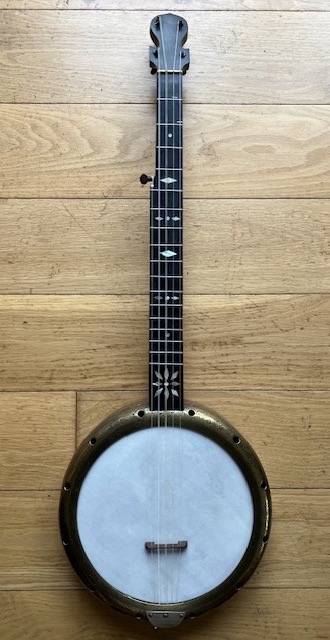
My 12” hide head banjo is driving me nuts. Sometimes the B string sounds almost like it has a chorused effect, especially fretted at the 3rd and 4th fret. It has nylon strings. I’ve changed the tailpiece and tried adjusting head tension. I’ve tried tuning with a D’Addario or Petersen tuner. Intonation is spot on.
Does anyone know what causes this sound? It’s my only 12” setup, so I don’t have anything to compare against. It’s especially problematic in a jam situation where it sounds muddy or out of tune against other instruments.
Trying to figure out if a Remo head would mitigate this or if maybe 12” banjos just have some overtones that sound like chorus effects.
Thanks,
Michelle

Have you tried varying the picking distance from the bridge?

quote:
Originally posted by martyjoeHave you tried varying the picking distance from the bridge?
Its a clawhammer banjo, and I usually play over the scoop.
I have tried different bridges?
quote:
Originally posted by SoprisHi,
My 12” hide head banjo is driving me nuts. Sometimes the B string sounds almost like it has a chorused effect, especially fretted at the 3rd and 4th fret. It has nylon strings. I’ve changed the tailpiece and tried adjusting head tension. I’ve tried tuning with a D’Addario or Petersen tuner. Intonation is spot on.
Does anyone know what causes this sound? It’s my only 12” setup, so I don’t have anything to compare against. It’s especially problematic in a jam situation where it sounds muddy or out of tune against other instruments.
Trying to figure out if a Remo head would mitigate this or if maybe 12” banjos just have some overtones that sound like chorus effects.
Thanks,
Michelle
It sounds like (no pun intended) sympathetic string vibrations where the others are sounding when a particular frequency is achieved. Can you isolate it to a particular string(s) that is/are causing it? Experiment with playing each string individually at the frets you have ID'd it occurring while muting the others individually. Try to isolate an issue can he frustrating. Once you have isolated the cause, the issue is how to resolve it.
Another factor may be head tension. I am still trying to discover if there is a single tension setting (as per drum dial) for vellums/hide heads. Opinion is divided. Try that and report back.
quote:
Originally posted by SoprisHi,
My 12” hide head banjo is driving me nuts. Sometimes the B string sounds almost like it has a chorused effect, especially fretted at the 3rd and 4th fret. It has nylon strings. I’ve changed the tailpiece and tried adjusting head tension.
I think Wayne may have identified the cause.
Have you tried different synthetic strings? If currently using nylgut you could try rectified nylon.
I'd also check the slots (nut and bridge) that the offending string is running in. An incorrectly seated string may affect tone. A soft pencil can be used to make the string move easier in the slots.
Edited by - EEB on 07/29/2026 16:44:51
Thanks! I think sympathetic vibration is part of it, but after digging in, I am pretty sure I hear the temperament of the frets being naturally funky on the B string.
Meaning, if it’s perfectly in tune when it’s open, when I push down the string at the first fret the C note is slightly off key, then at the second fret, the C sharp note is a tiny bit more off key. It starts to go more cleanly back into tune at the third fret and it’s really clean by the fifth fret. I am definitely very careful not to press my strings too hard, so I do not think that's the issue.
So those notes are actually going slightly off key compared to the sympathetic vibration which is in tune and it’s why I’m only hearing it on those specific frets.
My 11 inch Nechville does not have the same issue, and in fact, it may simply be down to the nylon strings. I might get motivated here pretty soon and put a metal string back on that B peg and see what happens.
Thank you so much for helping me understand it. It definitely might help to enlarge that slot in the nut a little bit and see if letting the string move more freely makes it behave better. I do usually put some graphite in there but it may just be a little bit tight and not moving as freely as it needs to.
Or may be an issue of the Banjo scale and geometry.
Anyway, very interesting!
Edited by - Sopris on 07/29/2026 17:33:21
How long since you changed strings? That 2nd string might have gone false.
If you tune by ear.... when the open B sounds correctly in tune with the open D and G, it's a significant bit flat of equal temperament, and all the fretted notes on that string will be flat, too. I always tune the B so the C and D on it are in tune with the G, or maybe a tiny bit flat.
If the nut on your banjo is wide enough, it's possible to compensate the 2nd string slot back from the fingerboard, so you could tune the open B closer to a just major 3rd from the G, and have the rest of the notes on that string in 12TET. That's only useful if you never use any other tunings except open G and standard "drop"-C, though. In any other tuning, the compensation will make it impossible to get the 2nd string anywhere near in tune.
Check EVERY metal fastening on the banjo. Loose nuts, bolts, washers, tailpieces tuner buttons, tuner bodies can vibrate sympathetically with a string. This happens on bluegrass banjos too, and you can go NUTZ trying to track it down.
Occasionally I have solved such a problem by finding some obscure screw that is loose enough to vibrate at some note or string.
I have also had these buzzy vibrations at bridge slots, saddle slots, and don't forget the 5th string pip slot too. Be sure your strings are securely seated in the slots/notches.
Good luck.
In a similar situation, after I tried all the above, I took the neck rod cover off at the top of the neck and sure enough the neck rod bolt had come loose. Like Mr. S. Holmes said, "When you have eliminated everything else, whatever remains no matter how unlikely at first it appears, that's it!" banjered
quote:
Originally posted by Sopris
...if it’s perfectly in tune when it’s open, when I push down the string at the first fret the C note is slightly off key, then at the second fret, the C sharp note is a tiny bit more off key. It starts to go more cleanly back into tune at the third fret and it’s really clean by the fifth fret.
Ok, that's intonation.
If you look closely at the 1st and 2nd frets of my Arthur Tilley banjo you'll see his solution for what I think you're hearing on your banjo.
Not exactly practical help, but hopefully this communicates that this quirk has come to players notice before, and that you're not going nuts!
Edited by - EEB on 07/30/2026 02:25:26
Okay, we should rewind a bit. Do you have nylon strings or do you have "nylgut" which are actually polyester?
It is not unusual for polyester strings to be false (uneven in thickness) out of the package.
The real problem is that there is a number of youtube videos giving the VERY BAD advice to "stretch" the strings when putting them on.
These stretching tricks will make the truest polyester (or nylon) false. It is a terrible idea.
Next, strings can go false over time. Polyester are more susceptible to this than nylon, but it does happen to nylon.
And finally, modern banjos made for steel strings are based around the principles developed for plectrum playing. Back angle necks for wire strings means that with nylon one needs to use a much higher bridge to avoid buzzing. A banjo with a 5/8" bridge and steel will need a 3/4" to 1" bridge for nylon.
quote:
Originally posted by Joel HooksOkay, we should rewind a bit. Do you have nylon strings or do you have "nylgut" which are actually polyester?
It is not unusual for polyester strings to be false (uneven in thickness) out of the package.
The real problem is that there is a number of youtube videos giving the VERY BAD advice to "stretch" the strings when putting them on.
These stretching tricks will make the truest polyester (or nylon) false. It is a terrible idea.
Next, strings can go false over time. Polyester are more susceptible to this than nylon, but it does happen to nylon.
And finally, modern banjos made for steel strings are based around the principles developed for plectrum playing. Back angle necks for wire strings means that with nylon one needs to use a much higher bridge to avoid buzzing. A banjo with a 5/8" bridge and steel will need a 3/4" to 1" bridge for nylon.
Hi Joel,
Thanks for the info!
I have Aquila med Nylaguts (gDGBD) I did not stretch them as I put them on a few months ago. Happy to try a fresh B string and see what happens. My bridge is 3/4".
Cheers,
Michelle
quote:
Originally posted by EEBquote:
Originally posted by Sopris...if it’s perfectly in tune when it’s open, when I push down the string at the first fret the C note is slightly off key, then at the second fret, the C sharp note is a tiny bit more off key. It starts to go more cleanly back into tune at the third fret and it’s really clean by the fifth fret.
Ok, that's intonation.
If you look closely at the 1st and 2nd frets of my Arthur Tilley banjo you'll see his solution for what I think you're hearing on your banjo.
Not exactly practical help, but hopefully this communicates that this quirk has come to players notice before, and that you're not going nuts!
Thanks for the photo! That is super cool. I have a guitar with one of the early true temperament necks and appreciate how it changes the intonation. :) Cool to see it implemented on your banjo. Does it work well in alternate tuning?
quote:
Originally posted by Soprisquote:
Originally posted by EEBquote:
Originally posted by Sopris...if it’s perfectly in tune when it’s open, when I push down the string at the first fret the C note is slightly off key, then at the second fret, the C sharp note is a tiny bit more off key. It starts to go more cleanly back into tune at the third fret and it’s really clean by the fifth fret.
Ok, that's intonation.
If you look closely at the 1st and 2nd frets of my Arthur Tilley banjo you'll see his solution for what I think you're hearing on your banjo.
Not exactly practical help, but hopefully this communicates that this quirk has come to players notice before, and that you're not going nuts!
Thanks for the photo! That is super cool. I have a guitar with one of the early true temperament necks and appreciate how it changes the intonation. :) Cool to see it implemented on your banjo. Does it work well in alternate tuning?
I'm playing finger-style repertoire on this banjo and that doesn't involve much tuning change at all - gCGBD with occasional 'raised 4th' to gDGBD. Though a much greater range of keys from those two tunings.
I posted this photo a while back, showing the short frets at frets 1 and 2. The short fret at 1 caused quite a bit of debate and confused head-scratching!
Edited by - EEB on 07/30/2026 06:48:16
quote:
Originally posted by Dan GellertHow long since you changed strings? That 2nd string might have gone false.
If you tune by ear.... when the open B sounds correctly in tune with the open D and G, it's a significant bit flat of equal temperament, and all the fretted notes on that string will be flat, too. I always tune the B so the C and D on it are in tune with the G, or maybe a tiny bit flat.
If the nut on your banjo is wide enough, it's possible to compensate the 2nd string slot back from the fingerboard, so you could tune the open B closer to a just major 3rd from the G, and have the rest of the notes on that string in 12TET. That's only useful if you never use any other tunings except open G and standard "drop"-C, though. In any other tuning, the compensation will make it impossible to get the 2nd string anywhere near in tune.
Thanks, After I try a new B string in case the one I put on earlier this year is funky, I am going to see if I can figure out if my Petersen tuner's 'sweetened banjo' tuning drops the B tuning a few cents. I had wondered if I could figure out a more optimal sounding tuning for Nylaguts and just set up a custom tuning for it on the Petersen tuner. :)
quote:
Originally posted by SoprisI have a guitar with one of the early true temperament necks and appreciate how it changes the intonation.
hmm. Perhaps the fault is not so much in your banjo as in your brain-- years of careful listening have honed your pitch perception to where the vagaries of intonation which most of us comfortably tolerate (or just plain cannot hear!) have become an irritating problem for you. Have you considered going fretless?
About the "chorus sound": Is your banjo stuffed with anything to prevent the head from producing unwanted frequenses?
About the second string: if the nut slot for this string is not deep enough, it will have the efect that especially the first couple of frets (that are closest to the nut) wil intonate a little too high, but you have changed to a "nylon" nut, so it should be okay. You can check it by fretting lightly just under the second fret (between the second and third), so the string rests lightly upon the sesecond fret. Then the string should be about as close it can to the first fret WITHOUT touching it (and it goes for all the strings). But you may have been there already. Good luck with solving your problems :). Steen
quote:
Originally posted by Dan Gellertquote:
Originally posted by SoprisI have a guitar with one of the early true temperament necks and appreciate how it changes the intonation.
hmm. Perhaps the fault is not so much in your banjo as in your brain-- years of careful listening have honed your pitch perception to where the vagaries of intonation which most of us comfortably tolerate (or just plain cannot hear!) have become an irritating problem for you. Have you considered going fretless?
I would go insane with fretless :) but yes, I know I am sensitive to noise in general. Sitting between two banjos at a jam is satan's headphones for me!
quote:
Originally posted by steenAbout the "chorus sound": Is your banjo stuffed with anything to prevent the head from producing unwanted frequenses?
About the second string: if the nut slot for this string is not deep enough, it will have the efect that especially the first couple of frets (that are closest to the nut) wil intonate a little too high, but you have changed to a "nylon" nut, so it should be okay. You can check it by fretting lightly just under the second fret (between the second and third), so the string rests lightly upon the sesecond fret. Then the string should be about as close it can to the first fret WITHOUT touching it (and it goes for all the strings). But you may have been there already. Good luck with solving your problems :). Steen
Thank you, Steen! This idea of the slot not being deep enough sounds like it could be the issue, and the geometry as you describe it makes sense that it would cause this issue. My luthier is off canoeing in Maine and so I just converted my banjo back to steel strings until we can do some work on it. Intonation is perfectly fine with steel strings.
Sounds like I need either a second nut for it or better yet a dedicated setup for Nylagut.
Cheers,
Michelle
Terms of Use | Privacy Policy | Privacy Consent (EU/GDPR Only)
Copyright 2026 Banjo Hangout. All Rights Reserved.