I’m wondering if among finger-style players here there’s much (or any) variation in preferred string spacing at the bridge?
Commercial capped bridges for use with steel strings generally come as standard or Crowe spacing. But the uncapped simplicity of bridges for use with gut or nylon inclines me to think that there are probably more finger-style players that make our own bridges (though that is a question in itself).
Speaking personally I can relate how the experimenting bug that goes with making my own bridge design did lead me away from the ‘rote’ of a fixed ‘standard’ or recommended spacing.

When thinking of such things, I tend to exclude the entire concept of "Crowe Spacing".
"Crowe" refers to J. D. Crowe (b. 1937) who is part of the Bluegrass world. This is also based on the idea that there exists a "standard spacing" (who's standard?), with which the one single deviation was likely established in the 1960s (though I have been able to find no date when this Crowe spacing concept became common).
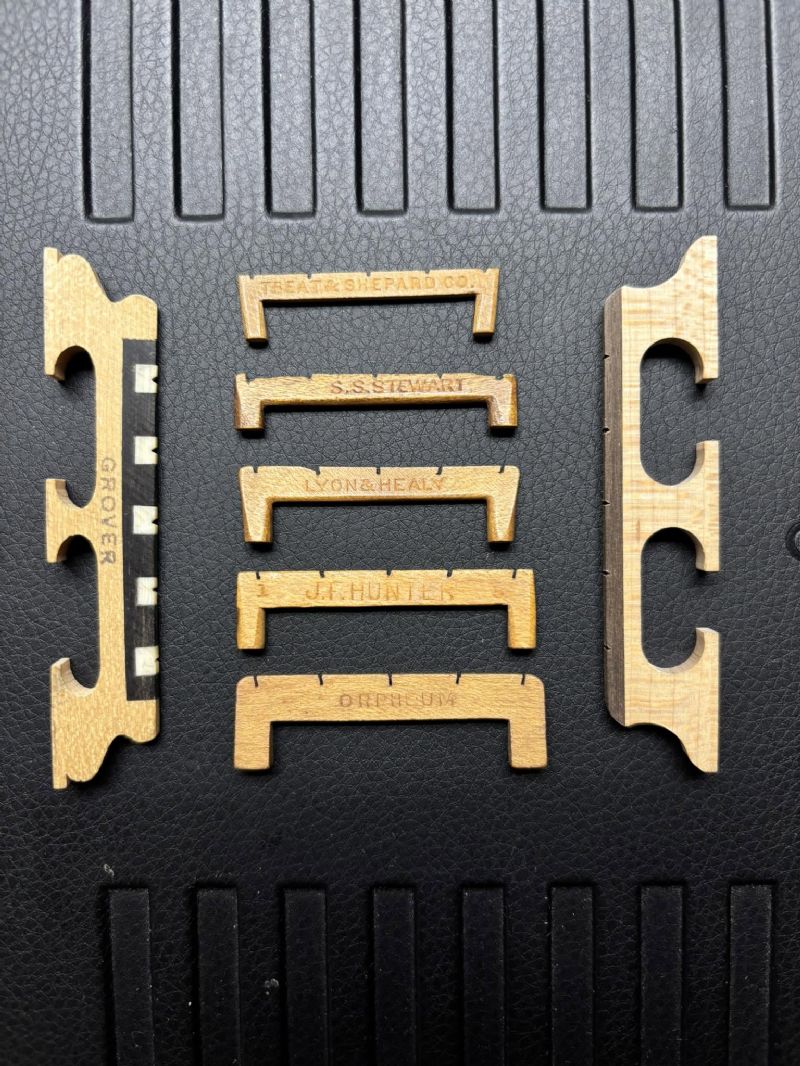
I am not that picky about spacing but my go to is what was used by S. S. Stewart as his stock bridge. Fred Van Eps' bridges were the same spacing as that used on the A. D. Grover standard bridge (and some early non tips) is a bit wider.
I have a pretty large variety of originals now that, when I get time, I make myself duplicates of as close as I can.
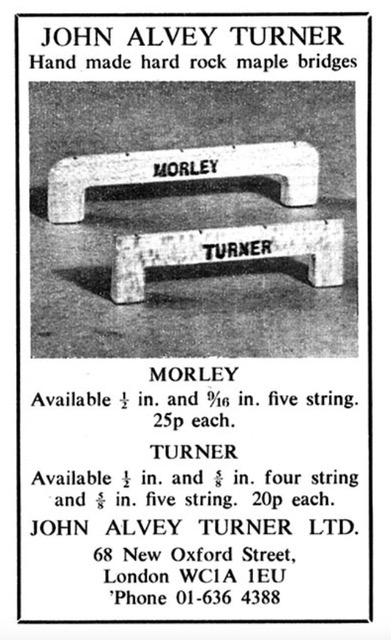
One other point I would like to add, the "Morley" pattern bridge, as mfg and sold by John Alvey Turner, used extra space between 5th and 4th strings. I do not know when these were first made but the earliest advertisement I have been able to find was from June 1972. The clipped corners, I presume, was done because Joe Morley would often use his little finger on the corner of the bridge as a muting effect.
The bridge on the banjo he is playing in his tutor is not that pattern so it was likely not yet in production as late as 1929.

This something that is worth experimenting with, and there is definitely a case to be made for Crowe spacing. However, when I tried it, it placed the outside strings too close to the edge of the neck. So it seems like neck design and bridge spacing are codependent to an extent.
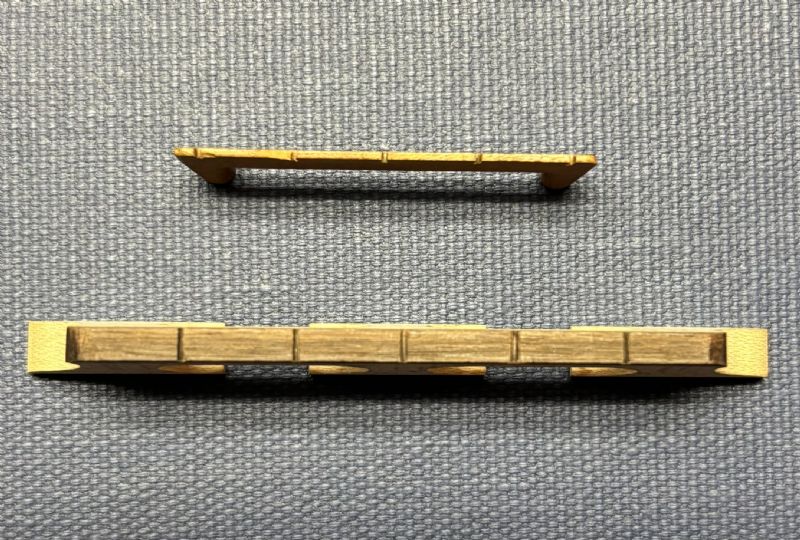
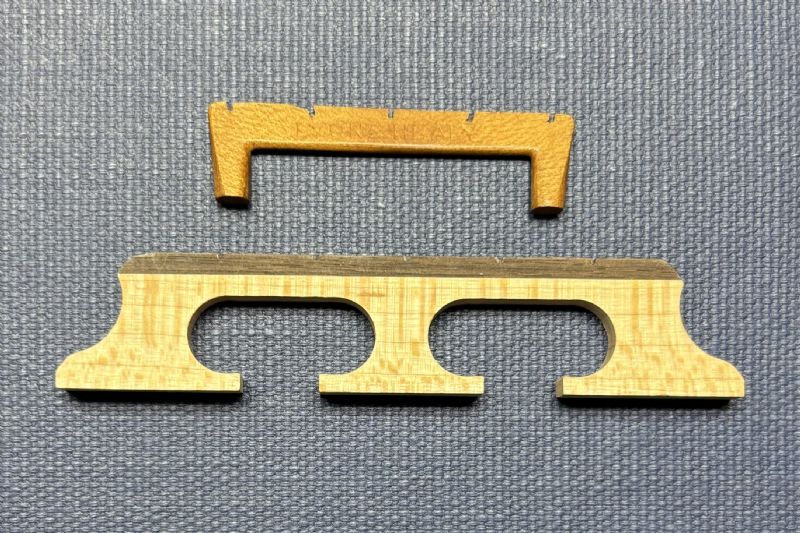
Below are some reference images of bridges designed for gut along with "modern" bridges for wire.
quote:
Originally posted by Joel Hooks
One other point I would like to add, the "Morley" pattern bridge, as mfg and sold by John Alvey Turner, used extra space between 5th and 4th strings. I do not know when these were first made but the earliest advertisement I have been able to find was from June 1972. The clipped corners, I presume, was done because Joe Morley would often use his little finger on the corner of the bridge as a muting effect.
The bridge on the banjo he is playing in his tutor is not that pattern so it was likely not yet in production as late as 1929.
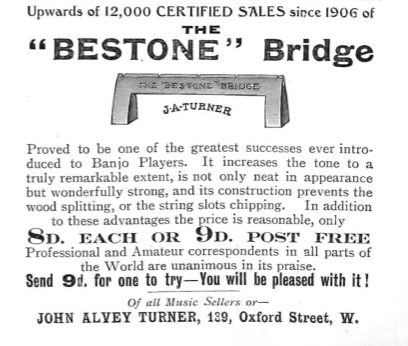
I'm assuming that you're referring to this JAT ad?
The treble-bass side gradual 'widening' on regular string spacing rules increases string spacing on the bass side. This Morley-style bridge takes that a (wide) step further with the notable extra width between the 4th and 5th.
Maybe this gave him the room to generate more attack on the bass string? Or else he just had big thumbs!
Edited by - EEB on 07/28/2026 12:51:18
Yes, that is the one. J
AT advertised their "Bestone" bridge in Keynotes. I'm not so sure that the "Morley" bridge was extant before the 1970s.
I have a few originals, I'll double check, but I believe the strings are all spaced evenly except for 4 and 5.
JAT’s popular ‘Bestone’ bridge could be said to represent a version of ‘standard’. It also has a much wider gap between 4th and 5th strings.
With a basic set of tools and emery paper this style bridge is easily made. Experimenting with different wood is also easily done. I’m curious if there is a tendency for finger-style players to adjust the 'standard' or typical string spacing to their own spec?
Edited by - EEB on 07/29/2026 02:53:55
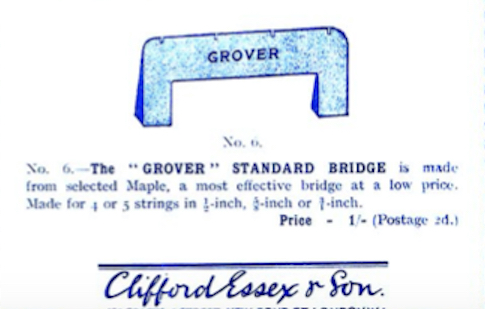
The Grover uncapped bridge with its more even string spacing is another version of ‘standard’ and was originally listed by Clifford Essex Ltd as their No.6 standard bridge.
I was able to locate three original Morley bridges, 1 is 1/2" and 2 are 9/16".
All notches are evenly spaced except for between the 4th and 5th. When I was making copies of these I had matched my notching template to the originals.
As to the question, while I tend to like narrower (such as SSS spacing), I am indifferent and my hand seems to self adjust instantly. I will say I don't like the "modern" standard as I find it is too wide for fingerstyle.
quote:
Originally posted by Joel Hooks
As to the question, while I tend to like narrower (such as SSS spacing), I am indifferent and my hand seems to self adjust instantly. I will say I don't like the "modern" standard as I find it is too wide for fingerstyle.
My preferred spacing is probably wider than the Stewart spec, though I'm not sure of his exact recommended measurements. I use my own design bridge that has evolved in stages. To date I've made about 25 of this style bridge, mostly for my own use but also several for friends. The influence was an original old (walnut) bridge that turned up in a vintage banjo case. A solid foot style but with small grooves in the foot, not really qualifying as arches. These grooves have gradually become arches with altered spacing and the overall body very much thinned. My latest version is English maple 13mm height which is fractionally higher than 1/2". I like it a lot. Apple also works well. But I'm just about to make a Morley-style bridge of Canadian hard maple for a direct comparison of the two bridges on the same (Weaver) banjo. I now fancy to try a wider spacing between 4th and 5th too.
Edited by - EEB on 07/29/2026 16:13:15
As much as possible, I try to match the string spacing to the fingerboard width. I like equal spacing, "standard" 42 mm or slightly narrower like 40 mm. What may be less common is that I've taken to slightly sloping bridges so that they sit a bit lower toward the treble side.
quote:
Originally posted by banjoboydAs much as possible, I try to match the string spacing to the fingerboard width. I like equal spacing, "standard" 42 mm or slightly narrower like 40 mm. What may be less common is that I've taken to slightly sloping bridges so that they sit a bit lower toward the treble side.
That is similar spacing to my current set-up. But experimenting with the wider 4th to 5th spacing will shortly require an adjustment/rethink. I do use a Stewmac slot rule that very slightly widens the spacing toward the bass side, but not so that gradation is noticeable to the eye.
Interesting that you modify your bridge height from bass to treble. I had a feeling that this thread might reveal player modifications! I taper my bridges in a different plane; thinning toward the treble side. A feature that I've included almost from the start of my bridge making. Recently I was reading through Tarrant Bailey Snr's delightful 'From A Bath Chair' articles in the later BMG's and was amused to find a brief reference that he made his own bridges and that they were also tapered to be thinner on the treble side. A salutary lesson, if one was ever needed, that these old players had done it all and 'worn the T-shirt' before we were born!
Edit: I'll see if I can find Tarrant Bailey Snr's reference and post it here.
Edited by - EEB on 07/30/2026 03:13:37
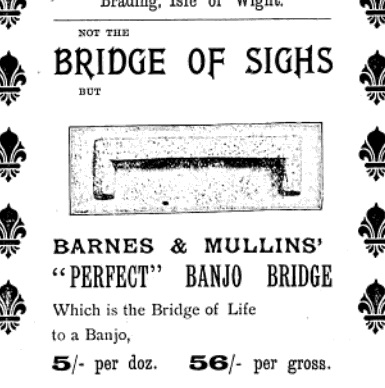
And, yes, the name does seem to be a pun.
Terms of Use | Privacy Policy | Privacy Consent (EU/GDPR Only)
Copyright 2026 Banjo Hangout. All Rights Reserved.