


I'm not an instructor or great player but do enjoy going to jams, playing at nursing homes, etc. and have the sometimes suggested 10,000 plus hours of practice over the last 18 years. Please ignore me if this information is not needed or wanted.
I looked up an old column by Eddie Collins in his I think self published book "Beginner's Corner: The First Five Years". Probably out of print now.
In the April, 2004 issue is his first column called "Knowing How You Learn". Sadly not available in the digital editions of Banjo Newsletter.
It would answer the almost weekly posts of new players that cannot learn songs, and are tired of the suggestions "you can't learn by tab", "you have to learn by ear", "you have to pay an instructor", "you have to start young", "you have to learn my way", "you aren't practicing enough, etc.....".
He lists 4 ways people learn: Visual Learners, Auditory Learners, Tactile Learners, and Kinesthetic Learners. Maybe it would be possible for him to download column or somebody scan it. Very well written for us common folks to read and understand.
Phil
P.S. I think I should mention I have never met Eddie Collins but have purchased many of his banjo books and individual tabs with cd of tabs over the years.

this thread is a deep one--It could be an interest to all musicians--here are some things that come to my mind --on the subject
memorizing songs note for note --which I do more than the usual suggestions advocate--some of my arrangements are 50 years old--or memorizing licks and shooting with amazing accuracy at the melody or chord structure with them--they both are users of the same techniques
the other day I googled muscle memory vs other memories--An expert stated muscle memory and memorized songs (singing}
stayed much better in the older memory problems --much better than other thoughts
the net covers much territory on all of this--here is a good link I just ran across-among many=
thinkingbeyondscience.in/2026/...nk-about/
John Harvard said style was avoiding one's weakness --
three fingers -learning patterns can go on and on--but grabbing a short one after memorized well-and then trying to emphasize a certain finger for a bit--then moving on to the next finger for a bit--helps me spot weakness--then from time to time I discover it is too much unnecessary hand movement--or might even be the left hands fault --any way I get the strongest and the practice it into muscle memory--at least for
the night
Edited by - Tractor1 on 07/16/2026 09:06:12

Great topic! There is a book I started reading awhile back…’Anyone Can Play Music’ by Josh Turknet. He is a neuroscientist (and banjo player) that discusses brain function and how we learn. One of the more interesting topics for me is his findings on practice time and efficiency. Some people reach the 10,000 hour proficiency level we all aspire to a lot sooner. He explores how they are doing that. Interested to hear others point of view on this topic.
banjohangout.org/myhangout/hom...?id=14470 Maybe Eddie could post the column.
Unlike classical music, which must be played exactly as it is written (with room for interpretation, as long as it doesn't alter the notes or other markings on the page), bluegrass music has infinite permissible variations and is governed, essentially, by what sounds good. As a multi-instrument folksinger and teacher once told me, "Sight is the least importance sense for playing this kind of music."
That said, I'm sure there are lots of people who consider themselves visual learners. But are they -- or is visual learning simply what they're most used to? How they learned in school? How they processed information at work?
I don't regard visual learning as the optimal way to learn to play the banjo (beyond some basic introductory steps), and I would hate to see anyone wedded to visual learning only because it's how they learned other things and have never tried anything else.
"John Harvard said style was avoiding one's weakness --"
I love that!
quote:
Originally posted by lyndabee"John Harvard said style was avoiding one's weakness --"
I love that!
Actually, it was John Hartford, and he said: "Style is based on limitations."
yep I was wrong twice but it did get the point across so I don't feel completely useless--I have no idea how I remembered that the wrong way --maybe I put things in my mind the way I would say them--
What about the stuff you try to learn, then you go to bed and sleep, then your brain works stuff out, then the next day you can do the stuff you couldn't yesterday? What do they call that?
Cuz I use that alot.
Yep, I’ve heard for years that you should practice the difficult parts of tunes right before bed,, next day they’re a lot easier to play. The mind is a powerful thing….
I believe that Tactile Learners, and Kinesthetic Learners are the same thing. The four styles often cited are auditory, visual, reading/writing,and kenesthetic. There are also four sub styles. I agree, knowing one's style of learning is helpful, but nobody is entirely one style, most people learn using all four styles, they just respond to one style better than the others. It generally takes some testing to determine what style, or combination of styles are most effective for the individual.
Though it might sound like I think that I am an expert on the subject, I am not. I have however been tested extensively. I barely graduated from high school and went into the Navy. I did pretty well in the Navy and when I got out in 1974 I went to college on the GI Bill. I was enrolled by the VA in a study to determine how to help colleges and voc tech schools serve the needs of non traditional learners. There was lots of efforts by the VA for the colleges and voc tech schools to help the non traditional student to succeed academically.
Anyway, I graduated from college and I'm quite sure that can be attributed to that study and I learned a lot about myself being a part of it. So I agree with Phil in theory.
Some folks are really cautious of learning. Very careful. Terrified to be "wrong."
Other's are explorers. Fearless. Possibly doing things wrong many times before arriving at the best solution.
What's up with that? Supportive upbringing vs. Suppressed/oppressive upbringing?
Edited by - Nopix on 07/17/2026 18:34:59
I searched the word kinaesthetic --and according to some academics-- it turns out to be --, a form of procedural memory Some noted that ''muscle memory ''was the same-- others said they were quiet similar --stating that-- both were forms of procedural memory---
One in depth, scholarly article did mention -that studies had found -sleeping on it after practice was important--
I am so glad I have lived to the time --I can look this type of intelligence up and skim enough-- to slightly understand --what those with great knowledge are putting forth
kin·aes·thet·ic
[?k?n?s???t?k, ?k??n?s???t?k]
kinesthetic (adjective)
relating to a person's awareness of the position and movement of the parts of the body by means of sensory organs (proprioceptors) in the muscles and joints:
"kinaesthetic learning through a physical activity"
"walking therapy can improve kinaesthetic awareness"
Edited by - Tractor1 on 07/17/2026 18:47:42
quote:
Originally posted by NopixSome folks are really cautious of learning. Very careful. Terrified to be "wrong."
Other's are explorers. Fearless. Possibly doing things wrong many times before arriving at the best solution.What's up with that? Supportive upbringing vs. Suppressed/oppressive upbringing?
Start with birth order. My older brother is an engineer and plays like he has a rod up his axe.
I had 3 older brothers - the abuse was passed down from oldest to youngest ;-)
I put it in my mind “I’ll show them!”
IF my brain sorts musical things out while I sleep, I'd hate to see where I'd be without that process. 
I think back to when I was first learning to play the banjo. There was no tablature to refer to and my learning process was a combination of visual and auditory styles. I used to hang out in Washington Square in NYC on Sundays where bluegrass jams and other kinds of acoustic music occurred. I remember watching the banjo players very closely hoping that after my 2 hour trip back to the Bronx I would still retain what I had seen. Sometimes I did and sometimes I didn’t but I was also listening to records very carefully and between these two learning methods, I very gradually taught myself to pick. I would have loved to have tabs at that time and eventually when the Scruggs book came out, I couldn’t wait to get my hands on it. Today people talk about an over reliance on tab which I believe can happen if it’s used to the exclusion of auditory learning. Music is after all an auditory experience. My point is that despite the idea that people learn in different ways, it requires a combination of learning methods to get the job done. Throw muscle memory into the mix and you have the best chance of being a successful picker. I’m also of the opinion that it’s okay to copy someone else's style. Don’t worry about being a banjo clone. You can never copy someone's style exactly. Even if you learn everything Scruggs did note for note, you’ll find yourself in a situation where you have to play a song Scruggs never played and you’ll do fine. Be a banjo thief. Learn licks that you like from other players. I guarantee that you will come up with your own ideas.
quote:
Originally posted by Laurence Diehl
Start with birth order. My older brother is an engineer and plays like he has a rod up his axe.
And a great mandolinplayer as well 
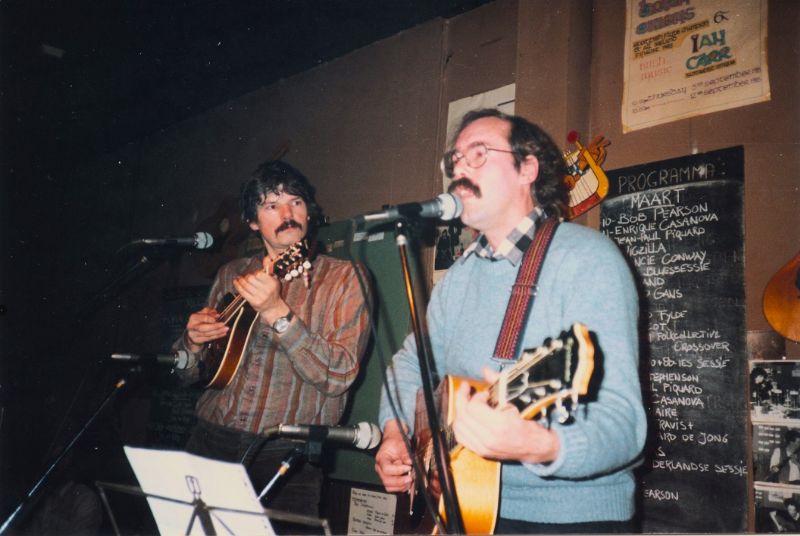
Here we just quit playing in an Amsterdam Bluegrass band, taking the opportunity playing together that evening.
quote:
Originally posted by Bronx banjoI’m also of the opinion that it’s okay to copy someone else's style. Don’t worry about being a banjo clone. You can never copy someone's style exactly. Even if you learn everything Scruggs did note for note, you’ll find yourself in a situation where you have to play a song Scruggs never played and you’ll do fine. Be a banjo thief. Learn licks that you like from other players. I guarantee that you will come up with your own ideas.
Great post!
Sort of mimics my learing curve, back in 1973, It was then, I decided to 'move up' from mandolin banjo to 5 string 3 finger style.
The actual spark was seeing Earl Scruggs in the Beverly Hillbillies, also broadcasted over here. Before actually seeing him, no matter what I did, I couldn't remotely imitate that sound on my dad's mandolin banjo, quite frustrating to a 10 year old.
Seeing Scruggs in person I noticed his banjo was very different from mine and He was picking with his fingers. My parents later told me I exclamated 'That's what I will do when I grow up'.
Some ten years later, after hearing Bluegrass banjo on the radio, I found out that the Flying Burrito Brothers would visit our city the next month in our national music hall, the Concertgebouw. No need saying I was there and enjoyed it immensely, especially the acoustic set, performed by County Gazette. First time ever I saw someone playing the 5 string live. 
Lees than a month later I had my Framus 5 string and tried to learn from recordings I made from a Country Gazette concert , live broadcast on National radio for one full hour (yes, those were the days... ) .
) .
At first I had no clue about tuning the thing and nothing I tried worked. But a few months later, Country Gazette did a European tour for promoting their first album. This time it was in a small club with time to speak and ask questions. Alan Munde kindly showed me tuning, gave some other tips and from there my playing took off.
Next year they were back at the same venue. I had been studying Alan's break on Sally Goodin and for some reason I had the notes right but there was something wrong with the rhythm... I still had the recording I mentioned, made on a reel to reel machine at 7 ips. playing it back at 3 1/2 gave half speed, one octave lower, but yet I finally could figure my way through the tune.
During the intermission, I went up to Alan, explaining my problem and to my utter shock he handed me his banjo and told me to show him what I'd learned so far. I stil see his smile and hearing his remark 'Ah, I see what you're doing, very clever, but almost impossible to get the timing down that way'. He took the banjo from my shaky hands and showed me how he did it. Turned out that I was playing the entire piece on the first three strings (bringing my thumb over to the 2nd string) where he (and Earl of course) was/were using the (open!) 5th string as well. The right hand is so much more natural once you're getting this (most forward rolls).
This one minute lesson from Alan was the exact boost I needed and THE key moment that helped me over the hump.
A year later I had the chance to sit with Bill Keith (while over here) and learned some stuff that I never would have cracked on my own.
From then on I only had recordings from the radio and only sparsely available albums. Re-recording this material and listening at half speed has been my major learning tool for years until I got hold of books with accurate transcriptions opening up a whole new world. Nowadays I hardly ever try copying other's material as I'm most comfortable in my own 'style'.
But today, like described, you can say I'm learing by hearing and anything else is secondary.
on complicated things such as Hello Dolly with tremendous amounts of chord depth or things with tricky timing hooks like Mr Sandman --I find lead sheets helpful --I can build the passing notes in around the melody --After I get a good feel I can work on adding or changing to make it fit --or maybe improvise a variation--
As to standard fiddle tune types --at this stage I would put it on the PC and open it with Trancribe one of many great programs-- Transcribe loops as much as I choose at the speed and tempo i choose--It works with vids MP4s or wave files--
Terms of Use | Privacy Policy | Privacy Consent (EU/GDPR Only)
Copyright 2026 Banjo Hangout. All Rights Reserved.


