


Page: 1 2
is it just me or does it sound like the banjos on alot of recordings now are tubbier sounding then the old recordings ? remember how the banjo would cut and now it seems like it is almost subdued .... softer ...
i ain't saying it sounds bad ,, in fact it blends better with todays bluegrass but it just seem like it has changed ... thoughts ???
Edited by - 1935tb-11 on 07/11/2026 15:25:55

I think some “modern” players like Bela, Wes, Noam, etc pick far from the bridge, rather than the hard-as-nails approach right in front of the bridge. Could be that others are loosening their heads too.

quote:
Originally posted by 1935tb-11is it just me or does it sound like the banjos on alot of recordings now are tubbier sounding then the old recordings ? remember how the banjo would cut and now it seems like it is almost subdued .... softer ...
i ain't saying it sounds bad ,, in fact it blends better with todays bluegrass but it just seem like it has changed ... thoughts ???
Could it be the recording and banjo construction technology is all completely different? The banjo heads are different, the bridges, the tailpieces and so on.
I agree, it is different, but personally , I like it better. The old stuff just sounds plinky to me. I prefer to hear the tone of the instrument in the music.
This definitely seems to be the case. Bluegrass players these days seem to go for a full, fat tone. I think a lot of it comes from emulating JD Crowe rather than the old Scruggs recordings, which were definitely tighter and brighter.
I like a lot of different sounds, but a well-rounded setup is the most consistently satisfying for me.
Edited by - LouieChee on 07/11/2026 17:06:44
I feel like a lot of the difference in tone has something to do with the recording equipment of today vs. the more primitive recording gear from 3/4 of a century ago.
As far as a difference in the banjos themselves, it could have a lot to do with set up. Some of today's players are still playing prewar instruments. I expect a lot of people have been drawn to the more mellow sound of modern recordings and want their banjos set up for that sound. Components like heads and bridges can make a certain amount of difference.
I think it's two things.
One, it' has to do with blend and two, amplification.
Just about everyone has " plugged-in" to an amp of one sort or another.
You don't have to play as hard to be heard.
You tend to play away from the bridge or use lighter gauge strings.
Step on a foot switch to be heard, then step on again to play your back-up.
This translates into the studio, too. A more homogenized sound.
Folks used to say " mash-it" when the pickers were bearing down, pulling tone.
Now the term that should be used is" smash -it"
Just a little fun.......
Hmmm, uh, could it be that maybe seeing as a few of us now have "matured" ears and all, quite a lot of things don't sound the way they used to...
In my case, what Bart says is definitely one factor in what I hear. Without my hearing aids, my banjos sound quieter and less trebly to me. Truthfully, it's pleasant. I tend to practice with my hearing aids our. With my hearing aids, the banjos have volume and tone that cut through. But I doubt what I'm hearing is really what my banjos sound like.
All that said, I think banjos in modern recordings I hear do have a rounder, fuller, sound than the super bright tone we used to go for decades ago with our tight heads, thinned bridges, and cranked-down tailpieces.
I bought a banjo that was made in the '70s and it brought up old memories when I found that it had a collection of sanded Bridges. Some were so thin that they had broken. Ah those were the days!
I think that tastes and preferences in banjo tone have evolved over time. However, significant hearing loss is resulting in my hearing things very differently from how I did in the past. I have used National Health Service (free) hearing aids for three years, and while they're good for speech they just can't cope with music, especially banjos! I've consulted an audiologist privately and tomorrow I collect some state-of-the-art (expensive!) hearing aids which I hope will mean my recordings of Seldom Scene sound as I remember them. Wish me luck!
As one who has hearing aids, I see a great business opportunity. You can adjust hearing aid frequencies to match your needs. Imagine a JD, Earl, Reno, etc. setting on your new improved 5 String Hearing Aid. There is also a Tenor and Plectrum version for those of you who as missing a string. Muffled setting for Old Timey, no rag needed.
I’d say, All of the above plus strings have changed a little. I have come across old strings in cases like Black Diamonds and so on. From what I can tell the new offerings are very different. Obviously they have improved over time. After all the strings are your engine.
Edited by - martyjoe on 07/12/2026 03:45:50
In the recording studio, compression is the word of the day! In the "good ol' days", recording studios didn't use much compression, which allowed the highs and the lows to be heard.
Secondly, head tension. In the "good ol' days" banjo heads were tuned to "A", which is 440 pitch. In fact, during the prewar years, Gibson banjos left the factory with heads tuned to "A". Nowadays, the preference seems to be a much looser head. Many players have the heads tuned to down to G# or even G now.
Lastly, thicker bridges. In the "good ol' days" bridges were much thinner, but in recent years the trend has been (facilitated by Snuffy Smith I believe) to use bridges that are way thicker.
All of these factors will definitely cause a banjo to sound more "muffled" with less high-end tone. Sometimes this helps with overtones and probably helps in amplifying the banjo too.
I may not have been there and I may not have as much experience as most of the others posting on this forum so please remeber these are just my thoughts and they most likely aren't correct. I personally think it has to do with running more neutral settings all the way around. This includes a head thats not very tight, a tailpice thats not too low, and a stock(usually very thick bridge). I think this is partially because more players are starting to prefer this sound and partially because this is how many banjos are set up when you get them from the music store. You also seee way less archtops, ive looked at photos from old festivals and it seemed that nearly every other banjo was an archtop, I just left a festival where I saw dozens of banjos and only one was an archtop.
a lot of these things mentioned above do bear into the reason for the change in sound. but i am not really talking bout recordings from the 40s thru the 70s.. i mean as late as the the 80s and early 90s . i know recording equipment is changed since 1985 and technics have also.
but go back and listen to hot rize,, johnson mountian boys with tom adams ( i know richard underwood used an archtop). JD on the early BAB albums. terry baucom.. those recordings still had some pop and crackle to them.
i think its is like most said ,, the set up and a desire for a more kinder gentler sounding banjo for the mix . most of todays top artist have a smoother more homogenized sound when you hear them on the recordings.
i am not saying its better or worse just different.... but once in a while don't you want to hear a young kid making a banjo pop and crack like a ball of fire ???????
Good topic. For years the holy grail sound was the foggy mountain banjo album. But i think it may have had more to do with how it was recorded than with the actual banjo.
I still live that archtop sound ralph had on recordings like midnight ramble and fling ding.
Oh yes… that “crunchy” Archtop tone. Less pingy…. Crunchy is the only way I know how to describe it really. Hard to beat that... no matter what type of tune you wanna play!
Edited by - Pick1949 on 07/12/2026 08:46:44
Yes sir. Two kinds of music, with the hearing aid and without. I often dont wear them when I am at home practicings but when I go to pick with someone I can be two loud without them.
I think Bela was the first player to introduce that loose, tubby sound. Noam Pikelny and Alison Brown also use it. When I first heard it I didn’t like it and I thought that it was a waste to spend thousands of dollars on an instrument only to set it up to sound like a cheap bottle cap banjo. I thought a banjo constructed like a Mastertone was meant to be bright and loud. Even the old Gibson catalogs recommended a tight head for maximum tone.
But I’ve come to realize that modern players like Bela are not playing bluegrass and are reaching an audience not necessarily familiar with the genre. So it makes sense to a use a softer sound. And in the end, it’s a matter of which sound you prefer. I personally prefer a brighter sound and I think it’s more suited to bluegrass and the music I like to play. I guess I’m still stuck on that elusive Scruggs tone that is never harsh or pingy sounding, but rather rich and clear.
I’m not so sure ‘bout that,, I don’t like the harsh ping on Groundspeed,, but that’s likely from the studio maladjustments. I prefer Earl’s big tone of the early Columbia recordings. At 00:50
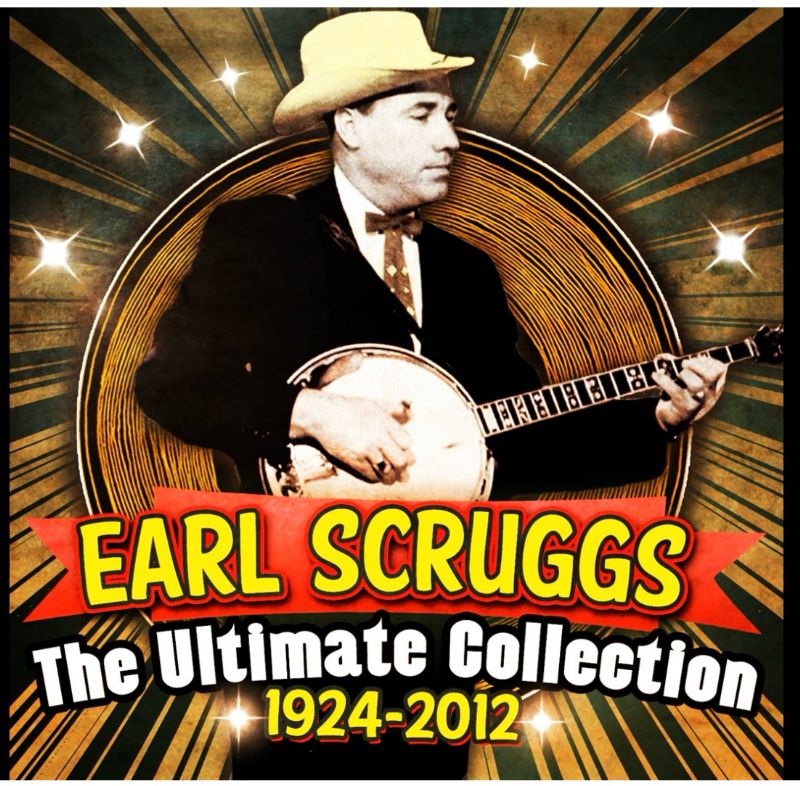
Edited by - chuckv97 on 07/12/2026 19:57:52
Wasn’t “Groundspeed” recororded with an arch-top Granada ? Check Jeff Earnest’s site, it lists two Granadas of Earls; THE Granada 9854-3 and an arch-top Granada 9166-1 listed as the “Groundspeed “ Granada, a tube and plate , 40 hole arch top.
YMMV
Scott
The "sound" my banjo makes has changed a little since I started about 15 years ago ..... but I ain't quittin'. 
Edited by - Owen on 07/14/2026 09:16:56
quote:
Originally posted by bamabanjoWasn’t “Groundspeed” recororded with an arch-top Granada ? Check Jeff Earnest’s site, it lists two Granadas of Earls; THE Granada 9854-3 and an arch-top Granada 9166-1 listed as the “Groundspeed “ Granada, a tube and plate , 40 hole arch top.
YMMV
Scott
I read somewhere that Earl had to borrow a banjo for Groundspeed cuz his was in for repairs. Also that it was the first time he used a plastic head. Maybe someone here can verify that.
p.s. I just found this....
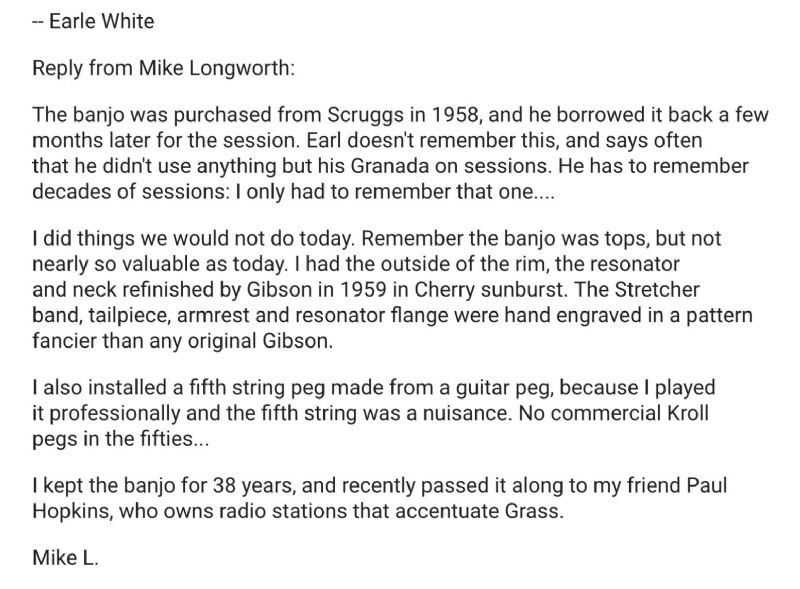
Edited by - chuckv97 on 07/14/2026 10:04:23
Gibson RB-Granada 9166-1
“The Ground Speed Banjo!”
9166-1.jpeg
9166-1 bk.jpeg
reso.jpeg
reso nside.jpeg
armrest.jpeg
tlpc.jpeg
label.jpeg
IMG_1259.jpeg
pghd.jpeg
heelsign.jpeg
FON.jpeg
pghdbk.jpeg
side1.jpeg
side3.jpeg
9166-1.jpeg9166-1 bk.jpegreso.jpegreso nside.jpegarmrest.jpegtlpc.jpeglabel.jpegIMG_1259.jpegpghd.jpegheelsign.jpegFON.jpegpghdbk.jpegside1.jpegside3.jpegside2.jpegncase.jpeg
The Legendary “Ground Speed Banjo!”
1928 Gibson RB-Granada #9166-1 in excellent original condition. An extraordinary sounding banjo formerly owned by Earl Scruggs, and, in our opinion, the banjo he used on a recording session in January of 1959 that yielded two classic performances, “Ground Speed” and “Crying My Heart Out Over You” and two lesser known gems, “Iron Curtain” and “Who Knows Right From Wrong.” Earl Scruggs acquired RB-Granada #9166-1 from Myrlen Goddard in West Virginia in the 1950s, and used it as a back-up to his more famous Granada, #9584-3. Scruggs kept this banjo for nearly half a century and, in a similar fashion to all his personal instruments, he inscribed his name on virtually every part. Based on our research, this is the story of the “Ground Speed Banjo.”
Myrlen Hobart Goddard was born in Fayette County, West Virginia, in 1895 and in 1918 was employed as a miner by the New River Collieries in Eccles, Raleigh County, WVA (1918 draft card). In the 1920s he worked in the same area as miner/musicians Reed Rakes and Posey Rorer, both of whom played with Charlie Poole. Poole’s North Carolina Ramblers was the most popular string band in the country in the late 1920s and they often entertained in the coal camps. In addition to mining, Goddard also worked as a “truck farmer…on his own account” (1930 census). In 1929, he purchased a gold-plated, 5-string Mastertone banjo, RB-Granada #9166-1, from Beckley Music, probably at the behest of another Charlie Poole bandmate, Roy Harvey, who was working at the music store. One wonders, at the height of Prohibition enforcement in West Virginia, what produce Goddard might have been hauling in his truck to account for the purchase of a $200 banjo (Hobart Goddard was fined $25 “for disturbing the peace” in association with a “Moonshine Still Captured” -The Hinton Daily, September 4, 1921). Via Beckley Music, Goddard sent the banjo back to Gibson to have a crack in the heel repaired (Gibson shipping ledger documents return shipping April 9, 1936).
By 1950, Earl Scruggs’ more famous Granada banjo (9584-3) was worn to almost unplayable condition. While that banjo was in Kalamazoo for repair, Scruggs stayed on the lookout for a back-up banjo and continued to do so even after his Granada was returned on May 9, 1951 (complete with bow-tie inlay fingerboard). Flatt and Scruggs played numerous show dates in the Meadow Bridge area of West Virginia, quite often alternating with a feature in a movie theatre. (For example, West Virginia dates include: 6/17/55, the Beckley Memorial Building in Beckley; 7/12/55 in Whitesville at the Liberty Theater (again on 9/26/57 at the drive-in); 7/13/55, in Seth at the Hager Theater; 9/18/55, at the Crab Orchard Drive-in in Beckley (again on 7/18/57 and 6/12/58); 9/23/55, at Gauley Theater in Gauley Bridge (again on 10/19/56); 10/18/55, at the Groves Theater in Summersville; 10/20/55, at the Lester Theater n Lester; 11/14/57, Rialto Theater in Madison (again on 8/21/58 at drive-in); 7/10/58, at the Greenbriar Drive-in in Hinton; 7/30/58, Sunset Drive in Charmco).
In the 1950s, Myrlen Goddard was living in Quinnimont, West Virginia, working as foreman on the tipple for Bellwood Coal Company (US census and draft card). Since the National Recovery Act had helped unions enforce shorter workweeks for miners, there would have been numerous occasions for him to hear Earl Scruggs in person at any of the venues listed above. As the railroads had switched to diesel and more and more people were using gas and oil, the coal business suffered in the 1950s. Possibly, Goddard found it was time to sell his expensive banjo. Or perhaps, he had simply settled down from the Charlie Poole lifestyle. For whatever reason, Goddard offered Earl Scruggs his banjo.
During the winter of 1958-59, Flatt and Scruggs switched locales with Frank “Hylo” Brown, who moved to West Virginia for TV broadcasts and touring, while Flatt and Scruggs filmed their shows in Jackson, Tennessee, and Jackson, Mississippi. Flatt and Scruggs did not appear again in West Virginia in 1958 after the summer shows, so Scruggs must have met up with Goddard at around (or before) the time of the Greenbriar Drive-in show (poster below).
At some point in the late ‘50s, Scruggs commissioned both a new neck for 9584-3 (returning it to the original hearts-and-flowers inlay pattern) and special tuners for such songs as “Flint Hill Special.” During these transitions, he once again required a back-up banjo. On January 23, 1959, Flatt & Scruggs went into the Bradley Recording Studio in Nashville for a Don Law-produced session that yielded four songs including the instrumental, “Ground Speed.” Apparently, Scruggs used 9166-1 on that session, and it also appears to have been the banjo Scruggs played on Red Foley’s cover of “Polka On The Banjo” in February, 1962. We may never know the exact circumstances that inspired him to make these choices. However, after countless hours listening to these recordings and then listening to this banjo, we have come to the conclusion that this is the most likely explanation of the unique sound of the banjo on these cuts. (Using headphones, we did cross reference comparisons on “Flatt and Scruggs 1948-1959” Bear Family Records 4-CD box set, as well as the original vinyl album “Foggy Mountain Banjo.”)
Most of the features and appointments of 1928 Gibson RB-Granada #9166-1 are original and consistent with factory specifications for that model and year. They include curly maple 5-string neck and resonator; rosewood fingerboard with hearts-and-flowers inlay; fiddle-shaped peghead with hearts-and-flowers inlay; gold-plated metal parts; “Granada” pattern engraving on the stretcher band; 3/4 inch maple rim with 40-hole archtop tone-ring; 2-pc brass flange; black-white-black binding and two-concentric circles of wood purfling on resonator; black-white-black binding and wood purfling on neck; clamshell tailpiece; two-band gold-plated tuners with pearl knobs; 2-piece armrest. Factory original specs that are unique to this banjo for this model and year include one of the style 5 engraving patterns on the armrest; tenor banjo (short) Mastertone block; sunburst resonator. After-market alterations include: 5th string spike hole at 7th fret (which has been filled); plastic head, bridge and geared 5th tuning peg; possibly the flower design engraving on tailpiece; and of course, the signature and initials of Myrlen H. Goddard and the many inscriptions by Earl Scruggs. Another interesting observation, the appearance of the numbers on the inside the resonator leads one to believe there may have been some confusion at the factory on exactly which number should be inscribed on the resonator. It seems there was no such confusion for Mr. Goddard or Earl Scruggs, as they both repeated the number in several places.
Now, the legendary “Ground Speed” banjo is looking for a new home. Please inquire for terms. Additional details, photos and copies of documents are also available for serious interested parties.
(Note: In our ongoing research into the history of this banjo, we are “looking through a glass darkly.” However, using draft cards, census records, city directories and newspaper articles, as well as years of interviews, we have pieced together the story of this banjo. Special thanks to Penny Parsons for the details of Flatt and Scruggs performances and Greg Earnest for banjo specifications, mining details and for pointing me to the Red Foley recording. However, any mistakes or “leaps of faith” are mine and mine alone.)
Granada28.jpegSept 4, 1957.jpgJuly 10, 1958.jpgScreen Shot 2023-01-26 at 2.36.52 PM.jpgSept 2, 1956.jpg
Back to Top
From Mandolin Central
All that I can find…
Chuck !
According to Steve Huber, in Bluegrass Today, Earl first recorded “Just Ain’t” in 1961 with a Mylar head. That’s from an article on the passing of Remo Belli.
YMMV
Scott
Page: 1 2
Terms of Use | Privacy Policy | Privacy Consent (EU/GDPR Only)
Copyright 2026 Banjo Hangout. All Rights Reserved.


