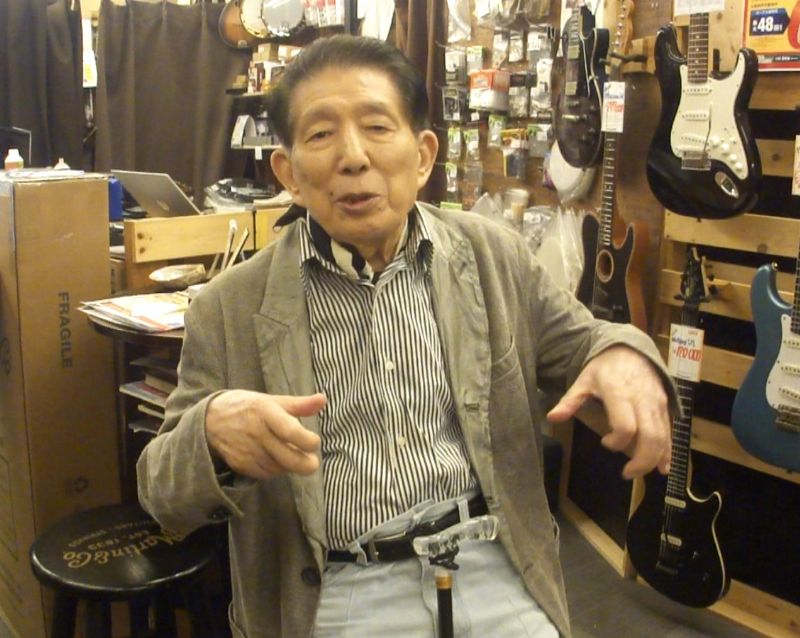
I recalled that I had recorded a video when speaking with Mr. Akira Tsumura, so I checked it yesterday. In the footage, he discusses how his preferences regarding banjo tone have evolved, noting that the best sound is achieved by using fingerpicks to pluck the strings in an upward motion. I have attached an image capturing that moment. Visible in the background behind him are two banjos; these are the Gibson UB4 and UB5 banjo-ukuleles—featuring the distinctive "diamond-hole" flange—that are documented in *The Tsumura Collection Book*. Upon re-reading the preface to his book, I am reminded of his view that banjos are instruments where the individual parts are largely crafted separately, and the final assembly and adjustment can result in a tenfold difference in overall condition. This differs significantly from other instruments where parts are glued together and only components like tuning pegs and strings are replaceable. He also describes the banjo as an instrument that effectively "died out"; while banjos were once used in the most prestigious musical settings, they lost those opportunities, meaning modern instruments struggle to match the quality of vintage ones. In my view, while the banjo is one of the few instruments with mechanisms that allow for tonal adjustment, frequent playing after those adjustments is paramount. I feel that only through such playing can the inherent stresses at the instrument's joints be relieved or balanced, resulting in a relaxed, pleasing tone. In my town, manufacturers like Yamaha and Kawai produce pianos, and they include a "break-in" playing phase at the end of production to simulate the effects of aging before shipment. Perhaps if we pour that same kind of loving, frequent attention into a banjo as it matures, it will respond in kind.

quote:
Originally posted by Toshi TsuchidaI recalled that I had recorded a video when speaking with Mr. Akira Tsumura, so I checked it yesterday. In the footage, he discusses how his preferences regarding banjo tone have evolved, noting that the best sound is achieved by using fingerpicks to pluck the strings in an upward motion. I have attached an image capturing that moment. Visible in the background behind him are two banjos; these are the Gibson UB4 and UB5 banjo-ukuleles—featuring the distinctive "diamond-hole" flange—that are documented in *The Tsumura Collection Book*. Upon re-reading the preface to his book, I am reminded of his view that banjos are instruments where the individual parts are largely crafted separately, and the final assembly and adjustment can result in a tenfold difference in overall condition. This differs significantly from other instruments where parts are glued together and only components like tuning pegs and strings are replaceable. He also describes the banjo as an instrument that effectively "died out"; while banjos were once used in the most prestigious musical settings, they lost those opportunities, meaning modern instruments struggle to match the quality of vintage ones. In my view, while the banjo is one of the few instruments with mechanisms that allow for tonal adjustment, frequent playing after those adjustments is paramount. I feel that only through such playing can the inherent stresses at the instrument's joints be relieved or balanced, resulting in a relaxed, pleasing tone. In my town, manufacturers like Yamaha and Kawai produce pianos, and they include a "break-in" playing phase at the end of production to simulate the effects of aging before shipment. Perhaps if we pour that same kind of loving, frequent attention into a banjo as it matures, it will respond in kind.
Thankyou for sharing Toshi. In terms of pouring into banjos the loving attention, surely we do that each time we play one.

quote:
Originally posted by Toshi Tsuchida...Perhaps if we pour that same kind of loving, frequent attention into a banjo as it matures, it will respond in kind.
I love this sentiment Toshi. It's funny how players develop these strange two-way relationships with an inanimate object. I guess banjos aren't so far removed from living entities -- they can be temperamental, they have unique personalities that change over time... and like most relationships -- the love and effort you put in directly informs what you get out of it.
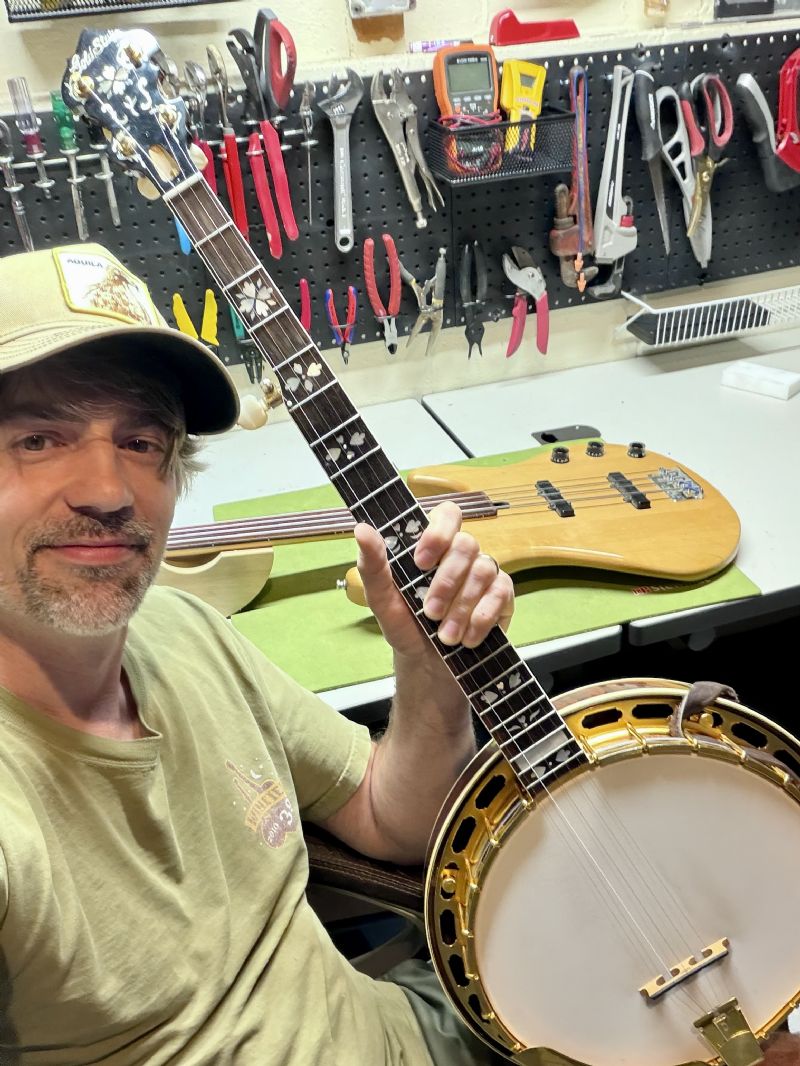
It's funny seeing your post now as I literally JUST finished a complete teardown of my 1981 Gold Star JD (wanted to try going back to a more heavily frosted head) -- and I'll always associate you with these instruments. It will indeed need a bit of extra love in the coming weeks to get everything settled back in, and I'm looking forward to putting that time in!
Tim,
Thanks for the post. While organizing materials related to my past banjo work today, I came across a comprehensive set of documents regarding the development of the '81 JD Crowe model that you also possess. These include the initial development request letter from Mr. Richard Keldsen of Saga (dated March 1979), meeting minutes from discussions between him and JD Crowe, JD Crowe’s specific instructions, notes confirming specification differences based on the GF-100 during a San Francisco trip with Mr. Keldsen, the resulting JD Crowe model final specifications, and minutes from the meeting that scheduled the production of the first 20 prototypes in November 1980. Since these are business documents, I am still debating whether it is appropriate to post them publicly, though I do feel they should be shared before I pass away.
Over the past few days, I have been working on a jig for banjo tone ring that allows for subtle horizontal adjustments of the ring's position relative to the rim. The concept is simple, based on the armrest nut. I used them to intentionally offset the tone ring's position. This adjustment affects the transfer of vibrational energy from the neck to the tone ring, and I experienced the most significant positive change I have ever achieved through pot adjustments. I plan to verify the results by replicating the test on other banjos. Later, I intend to post a graphic-rich guide on the setup forum—covering the full adjustment process, including the neck connection—with a particular focus on the Vintage Gold Star Flathead banjo, an instrument that offers significant room for fine-tuning.
quote:
Originally posted by TimFosterquote:
Originally posted by Toshi Tsuchida...Perhaps if we pour that same kind of loving, frequent attention into a banjo as it matures, it will respond in kind.
I love this sentiment Toshi. It's funny how players develop these strange two-way relationships with an inanimate object. I guess banjos aren't so far removed from living entities -- they can be temperamental, they have unique personalities that change over time... and like most relationships -- the love and effort you put in directly informs what you get out of it.
It's funny seeing your post now as I literally JUST finished a complete teardown of my 1981 Gold Star JD (wanted to try going back to a more heavily frosted head) -- and I'll always associate you with these instruments. It will indeed need a bit of extra love in the coming weeks to get everything settled back in, and I'm looking forward to putting that time in!
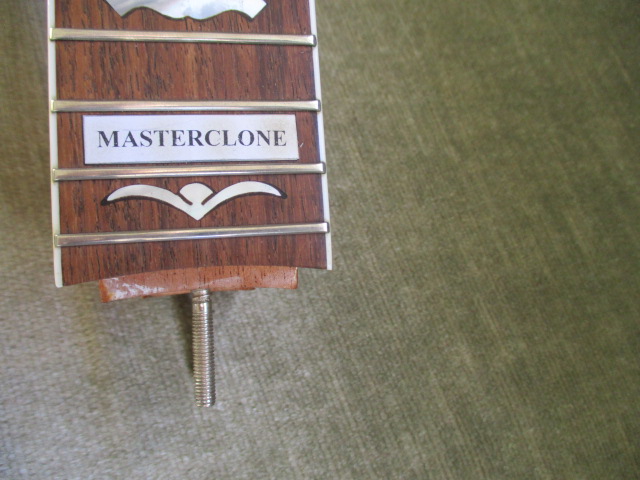
When I got my 2005 GS GF 85 a few years ago, I didn't like the blank pearl block in the neck. I cheekily made the 'Masterclone' label using my Dymo labeler. It now addorns that fret.
Haha — that came out pretty good, I like it banjonz !
And always appreciate any Gold Star lure you’re able to share, Toshi — if and when you feel comfortable doing so.
;-)
Terms of Use | Privacy Policy | Privacy Consent (EU/GDPR Only)
Copyright 2026 Banjo Hangout. All Rights Reserved.