Page: 1 2
Hi all,
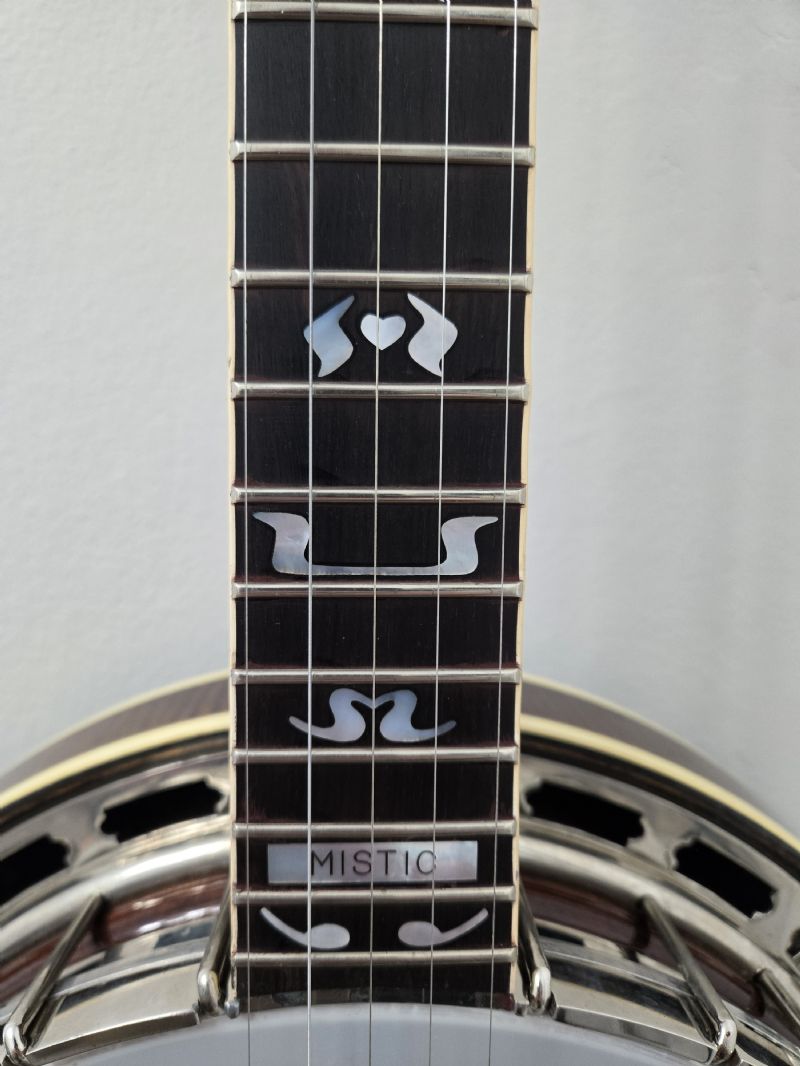
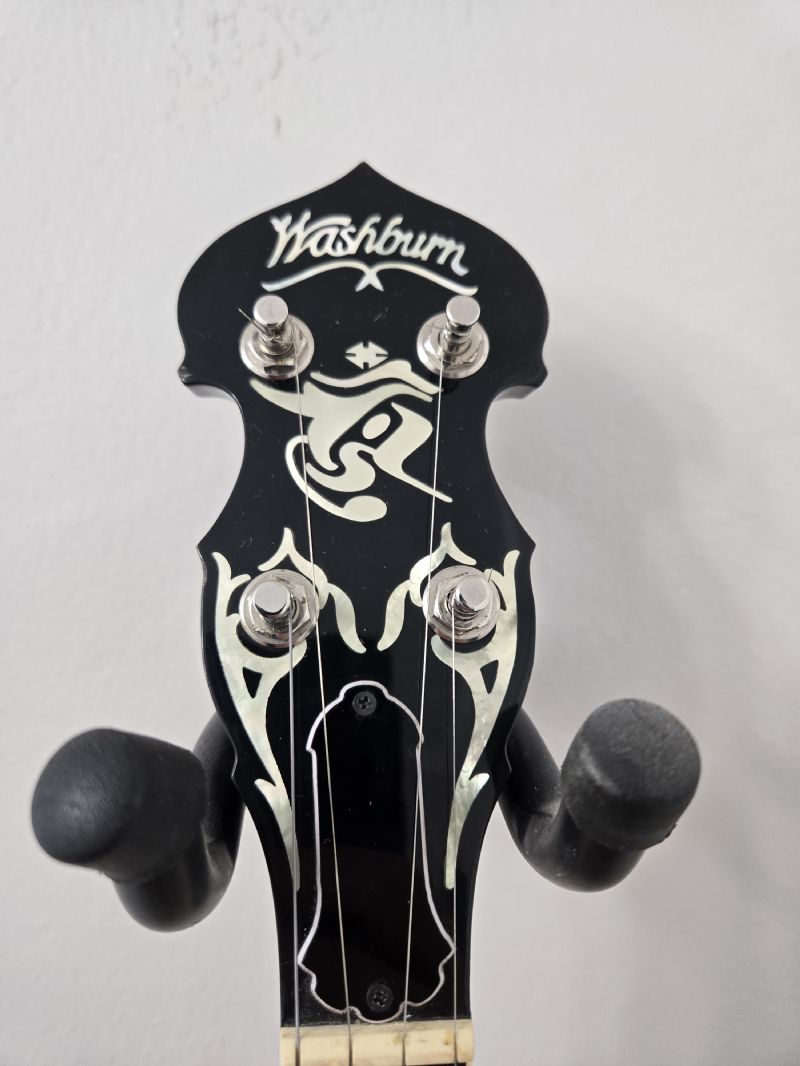
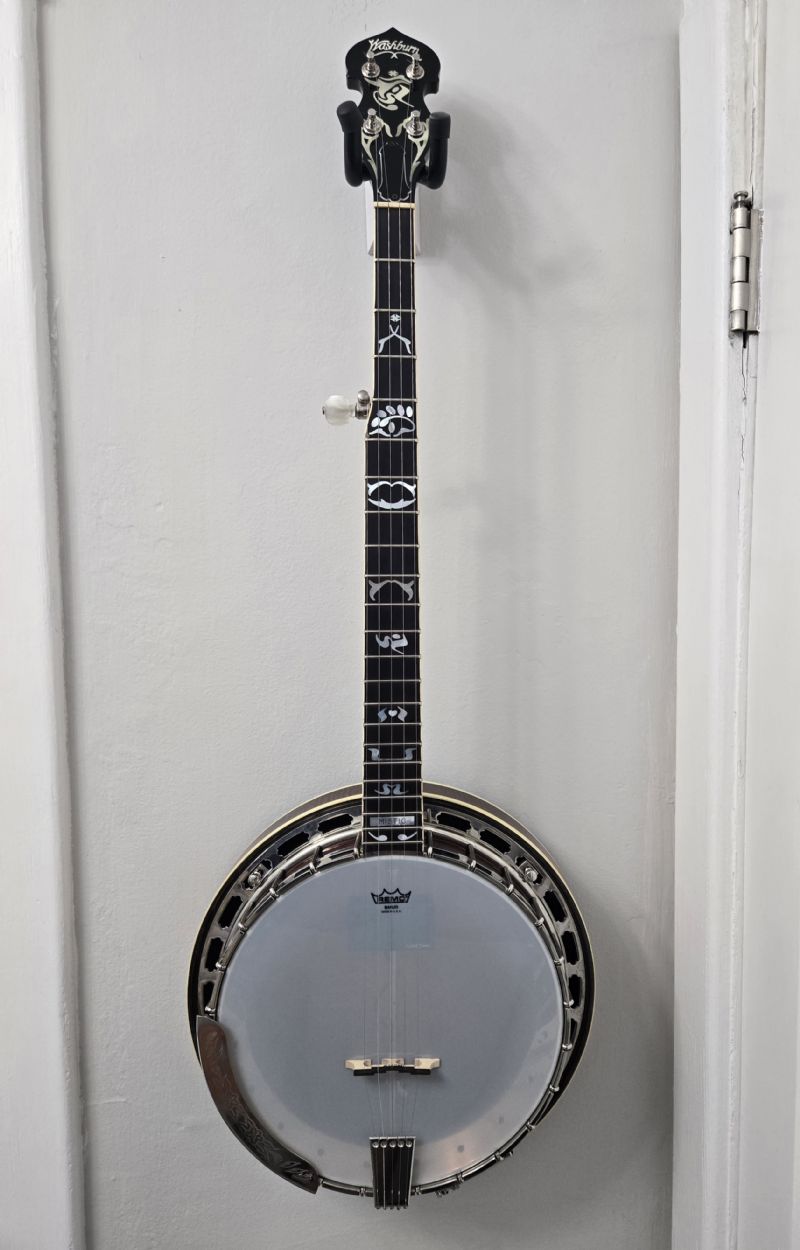
I picked up this beauty on FB marketplace but the owner didn't know much about it. It's a Washburn with a brass tone ring suspended by brass rods, so it seems like a B-23, but the neck inlay says "Mistic", which is an odd misspelling of what "should" say "Mystic DL". The neck and headstock inlays are also unique looking.
I'd love any help from you experts on identifying what this actually is. Is this somehow a copy of a B-23 that was itself a copy of a Mastertone?
I cleaned it up and got it ready to play. It sounds bright and wonderful, so I'll be keeping it regardless of what it is. I'd just love to know more about her.
Thanks for your expertise!
Edited by - Mkgruber on 06/21/2026 07:20:54

Welcome to the Hangout, Mike.
Washburn was once an American-built brand, and the brand name was subsequently picked up by a distributor who sourced instruments in Asia. Yours appears to be a Korean-built instrument, possibly made by Samick.
That company produced instruments for a number of different brands, with little difference between instruments other than the bling, which could be specified by the distributor. As such, structurally identical instruments would be sold under different marques. This is a practice that continues today, with instruments built in China.
Yours appears to be a two-piece flange instrument, and it aligns well with a description by the late Paul Hawthorne, who studied and cataloged Asian built banjos. Click this link and scroll down to the Washburn section.
It is unlikely to be a copy - nobody copying banjos would bother to reproduce a lower-value import instrument. They'd rather fool someone by copying Gibson.
Some of those Korean-built instruments were decently made and can play very nicely. Enjoy your new banjo!
Edited by - eagleisland on 06/21/2026 09:02:21

quote:
Originally posted by MkgruberI'd love any help from you experts on identifying what this actually is. Is this somehow a copy of a B-23 that was itself a copy of a Mastertone?
I'd add only two points to Skip's excellent answer:
- No actual Mastertone ever looked like this. Only the construction concept is the same.
- As far as this not quite looking the way you expect. I'm sure the product literature on this banjo said: Specifications subject to change without notice. That is: They expected to appoint them a certain way, but things happen, minds change.
And to emphasize what Skip said: No one copies Asian banjos. Well, one Asian company was briefly copying Recording King banjos 15 or so years ago, but that's ancient history and whole other mess.
Thank you, Skip and Ken!
I suppose I shouldn't be surprised that an english word (Mistic) could be misspelled coming out of a Korean factory, but it struck me as strange.
Is it worth trying to identify a model number on a Samick/Washburn like this, or does it really matter?
quote:
Originally posted by MkgruberThank you, Skip and Ken!
I suppose I shouldn't be surprised that an english word (Mistic) could be misspelled coming out of a Korean factory, but it struck me as strange.
Is it worth trying to identify a model number on a Samick/Washburn like this, or does it really matter?
No, it really doesn't matter. These aren't collectible, and as I noted above there are likely hundreds, probably thousands, of banjos that are structurally exactly like this one out there under different brand names and different dress. A serial number really wouldn't do anything for you beyond satisfying your own curiosity.
As to the name "Mistic" - I wouldn't read anything into that attributable to the factory. The distributor of Washburn instruments - and that's all they are, a distributor - contracts with overseas factories and specifies what they want. The factory builds per order. It's possible that an error was made in Korea and the distributor decided "oh well, close enough," but it's more likely that your banjo was built with that specification. Why "Mistic?" Marketers come up with all kinds of zany names that don't really mean anything but sound interesting. Exhibit A: the automotive industry.
But if it helps, the history of the brand is somewhat interesting.
I would say though that the inlays are not typical of Samick rebadges. It seems it's a Washburn B23 from the early 1980s. Could this be a made in Japan model? That tailpiece looks more Japan than Korea although it might be a latter day replacement.
The other thing is that the bridge is installed the wrong way round.
Edited by - GrahamHawker on 06/22/2026 11:37:49
Good eye, Graham! Thanks for the catch. I just keep learning from the hangout.
quote:
Originally posted by GrahamHawkerI would say though that the inlays are not typical of Samick rebadges. It seems it's a Washburn B23 from the early 1980s. Could this be a made in Japan model? That tailpiece looks more Japan than Korea although it might be a latter day replacement.
The other thing is that the bridge is installed the wrong way round.
I have a Washburn catalogue dated 1981 but it doesn't contain the model B-23 you mention. I have looked it up online and to my eye, it bears no resemblence to the B-23. The peghead is Washburn-ish but out of proportion. All the inlays are totaly non-Washburn. Could it have been a prototype that didn't make it into production?
quote:
Originally posted by banjonzquote:
Originally posted by GrahamHawkerI would say though that the inlays are not typical of Samick rebadges. It seems it's a Washburn B23 from the early 1980s. Could this be a made in Japan model? That tailpiece looks more Japan than Korea although it might be a latter day replacement.
The other thing is that the bridge is installed the wrong way round.I have a Washburn catalogue dated 1981 but it doesn't contain the model B-23 you mention. I have looked it up online and to my eye, it bears no resemblence to the B-23. The peghead is Washburn-ish but out of proportion. All the inlays are totaly non-Washburn. Could it have been a prototype that didn't make it into production?
Perhaps an early version before it was decided to just go for the standard inlays and peghead. Protype might be the right description.
One thing that is interesting is that this banjo has the brass rods and springs in the rim and this came up very recently on another Japanese made banjo - I think made by Iida.
Washburn B-23 "MYSTIC DL" that sold on the Hangout.
Doesn't look like the one in this discussion, but has the same rod pieces under the tone ring.
I'd guess the one here is some limited production anomaly. Possibly a prototype as Wayne guesses. Or a short-run design change before the model went out of production. Who knows?
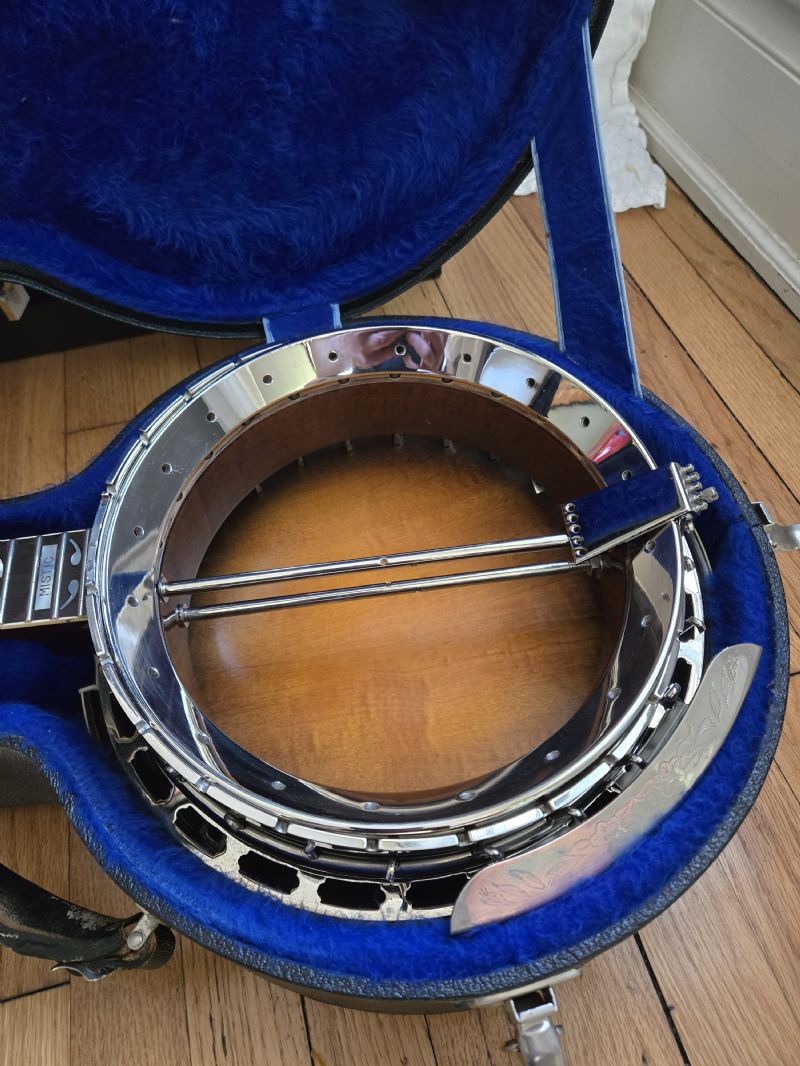
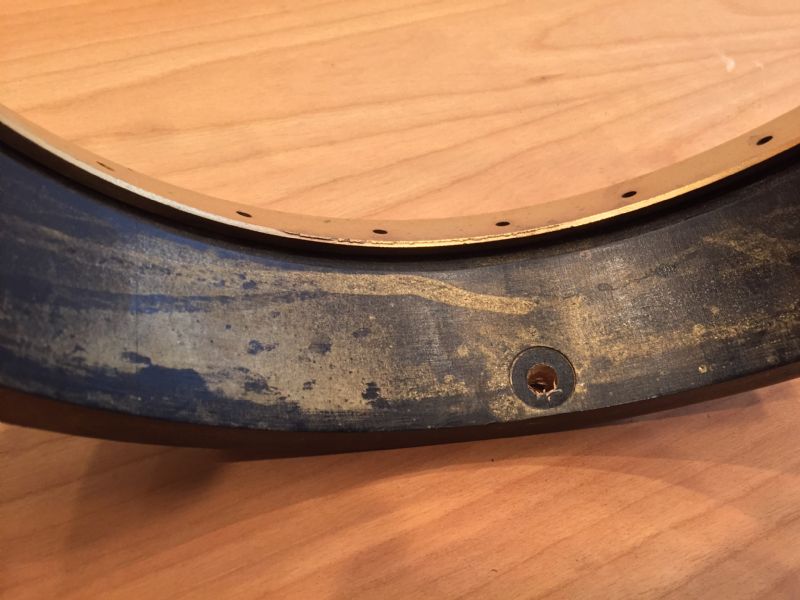
Thank you all for sharing your knowledge. Agreed that it doesn't match the B-23 visually, but I wasn't aware of another model that had the rods around the tone ring, so that's why I referenced it. I should have taken a better picture of the pot before reassembling but here one that you can see the brass rods under the tone ring if you zoom in. I had hypothesized it may have been some sort of prototype (which would make the misspelling of Mistic make sense) but good to read you all thought that might be a possibility, too. I know its not something that's sought after, but I do find it interesting and unique.
I have 3 Washburn open back banjo's from 1890 - 1900 with 'MYSTIC' engraved on a silver plate on the dowel stick and one with a silver area near where the neck joins the pot also engraved MYSTIC
All original
Both fantastic little banjos
I can send photo's
quote:
Originally posted by MkgruberThank you all for sharing your knowledge. Agreed that it doesn't match the B-23 visually, but I wasn't aware of another model that had the rods around the tone ring, so that's why I referenced it. I should have taken a better picture of the pot before reassembling but here one that you can see the brass rods under the tone ring if you zoom in. I had hypothesized it may have been some sort of prototype (which would make the misspelling of Mistic make sense) but good to read you all thought that might be a possibility, too. I know its not something that's sought after, but I do find it interesting and unique.
Unless I'm missing something... it appears that the rods you cite are the two rods running under the tailpiece to the butt of the neck.
These are called coordinator rods. Bluegrass banjos built on the Mastertone design - or variants of same - have them. They're basically what holds the neck to the pot.
quote:
Originally posted by eagleisland
Unless I'm missing something... it appears that the rods you cite are the two rods running under the tailpiece to the butt of the neck.These are called coordinator rods. Bluegrass banjos built on the Mastertone design - or variants of same - have them. They're basically what holds the neck to the pot.
There are brass rods inserted into the top of the rim with springs underneath. You can see them in the picture of this B23.
quote:
Originally posted by eagleisland
Unless I'm missing something... it appears that the rods you cite are the two rods running under the tailpiece to the butt of the neck.
Click through from the photo Mike shared, and you get a larger version that clearly shows something embedded in the top of the rim. Same as in the B-23 photos linked by Graham and me.
Edited by - Old Hickory on 06/23/2026 11:13:03
quote:
Originally posted by Old Hickoryquote:
Originally posted by eagleisland
Unless I'm missing something... it appears that the rods you cite are the two rods running under the tailpiece to the butt of the neck.Click through from the photo Mike shared, and you get a larger version that clearly shows something embedded in the top of the rim. Same as in the B-23 photos linked by Graham and me.
Okay, NOW I see it! Thanks, guys!
Yes, the small rods embedded in the rim. Sorry for the terrible picture, but disassembled it looks just like the B-23 picture Ken and Graham linked to.
Since no other manufacturer seems to have adopted this design I can't imagine it has much of a sound benefit, but it does make it unique. And even heavier.
Edited by - Mkgruber on 06/23/2026 12:34:42
quote:
Originally posted by MkgruberSince no other manufacturer seems to have adopted this design I can't imagine it has much of a sound benefit, but it does make it unique. And even heavier.
In your photo, is the tone ring seated as low as it goes? That is: Does the inner/lower foot of the rim sit on those pieces of brass rod?
If so, what's happening here is a version of Bill Palmer's "Tone Bell" system, in which the top inside corner of the rim is cut away so the inside foot of the tone ring doesn't sit on the rim. This supposedly opens up the sound. If you read the whole story at the linked page, you'll see that Bill didn't actually invent the concept of a tone ring sitting clear of the rim.
I'd guess the designers of the B-23 were trying to bump the sound in two ways: opening the space at the foot of the rim and adding the effect of brass -- especially if the tone ring was pot metal, which some imports were. Several folks here have described owning early Kasuga (Japanese)-made banjos (typically Alvarez branded) that had a brass rod on top of the beveled top surface of the multi-ply rim. The bevel went up inside the ring, which sat clear of the rim (a design feature borrowed from 60s thin-rimmed Gibsons on which the ring overhung the rim). Photo here shows the typical Kasuga ring-to-rim fit. This was a Ventura or Dorado without the brass rod. I've only seen photos of the rod setup on a Kasuga rim.
Until this discussion, I had never seen anything like yours.
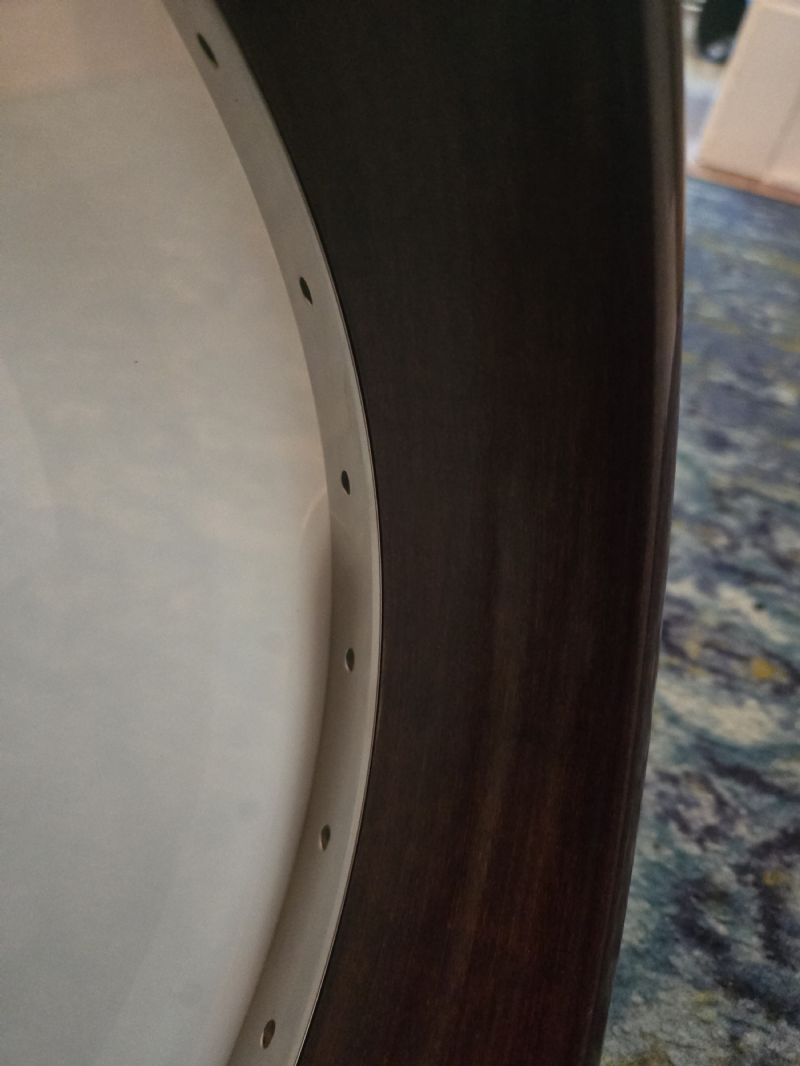
I added a photo from inside the pot with the tone ring fully seated. There isn't any gap between the ring and the rim, so I honestly don't understand how the brass rods embedded in the rim benefit the sound.
quote:
Originally posted by MkgruberThere isn't any gap between the ring and the rim, so I honestly don't understand how the brass rods embedded in the rim benefit the sound.
The seller in the Hangout ad I linked to above said the rods were spring-loaded. That says this was an Asian import version of Gibson's pre-war ball bearing concept. That likewise had holes drilled into the top surface of the rim. I believe there was a washes in the bottoms of each hole, a spring on top of the washer, another washer on top of the spring, and a ball bearing on top of that. The tone ring was an early version of an archtop, so it had a flat bottom that sat on all of this.
To my limited understanding, the idea was the springs pushed the washers up against the tone ring. What effect that was supposed to have on the sound, I don't know.
If there are springs under the brass rods in your banjo, then the same thing is happening, but with fewer pieces. Someone thought the brass rods pushing up against the foot of the tone ring contributes to sound. The abandonment of this design -- first by Gibson almost 100 years ago and then by the Washburn importers in the 1980s -- probably tells us all we need to know.
My guess is they're adding nothing to your banjo but weight.
Of course, I could be wrong.
quote:
Originally posted by Old Hickoryquote:
Originally posted by MkgruberThere isn't any gap between the ring and the rim, so I honestly don't understand how the brass rods embedded in the rim benefit the sound.
The seller in the Hangout ad I linked to above said the rods were spring-loaded. That says this was an Asian import version of Gibson's pre-war ball bearing concept. That likewise had holes drilled into the top surface of the rim. I believe there was a washes in the bottoms of each hole, a spring on top of the washer, another washer on top of the spring, and a ball bearing on top of that. The tone ring was an early version of an archtop, so it had a flat bottom that sat on all of this.
To my limited understanding, the idea was the springs pushed the washers up against the tone ring. What effect that was supposed to have on the sound, I don't know.
If there are springs under the brass rods in your banjo, then the same thing is happening, but with fewer pieces. Someone thought the brass rods pushing up against the foot of the tone ring contributes to sound. The abandonment of this design -- first by Gibson almost 100 years ago and then by the Washburn importers in the 1980s -- probably tells us all we need to know.
My guess is they're adding nothing to your banjo but weight.
Of course, I could be wrong.
I could be wrong but the idea of the ball bearing system was to keep tension on the head between fluctuating weather conditions. The heads then were hide heads and therefore subject to sagging and tightening due to temperature and moisture in the atmosphre.
quote:
Originally posted by banjonzI could be wrong but the idea of the ball bearing system was to keep tension on the head between fluctuating weather conditions. The heads then were hide heads and therefore subject to sagging and tightening due to temperature and moisture in the atmosphre.
Learn something new every day.
If that's what the ball-bearing system was for, then that just raises more questions as to why an Asian maker experimented with spring-loaded metal in the age of plastic heads that need no additional help to maintain tension.
quote:
Originally posted by banjonzquote:
Originally posted by Old Hickoryquote:
Originally posted by MkgruberThere isn't any gap between the ring and the rim, so I honestly don't understand how the brass rods embedded in the rim benefit the sound.
The seller in the Hangout ad I linked to above said the rods were spring-loaded. That says this was an Asian import version of Gibson's pre-war ball bearing concept. That likewise had holes drilled into the top surface of the rim. I believe there was a washes in the bottoms of each hole, a spring on top of the washer, another washer on top of the spring, and a ball bearing on top of that. The tone ring was an early version of an archtop, so it had a flat bottom that sat on all of this.
To my limited understanding, the idea was the springs pushed the washers up against the tone ring. What effect that was supposed to have on the sound, I don't know.
If there are springs under the brass rods in your banjo, then the same thing is happening, but with fewer pieces. Someone thought the brass rods pushing up against the foot of the tone ring contributes to sound. The abandonment of this design -- first by Gibson almost 100 years ago and then by the Washburn importers in the 1980s -- probably tells us all we need to know.
My guess is they're adding nothing to your banjo but weight.
Of course, I could be wrong.
I could be wrong but the idea of the ball bearing system was to keep tension on the head between fluctuating weather conditions. The heads then were hide heads and therefore subject to sagging and tightening due to temperature and moisture in the atmosphre.
Yes, you're wrong here… and it does not function that way. The springs are much too stiff to be able to compensate for these large fluctuations. As Loyd Loar stated in his article, the intention was to let the tonering vibrate freely.
quote:
Originally posted by Emielquote:
Originally posted by banjonzquote:
Originally posted by Old Hickoryquote:
Originally posted by MkgruberThere isn't any gap between the ring and the rim, so I honestly don't understand how the brass rods embedded in the rim benefit the sound.
The seller in the Hangout ad I linked to above said the rods were spring-loaded. That says this was an Asian import version of Gibson's pre-war ball bearing concept. That likewise had holes drilled into the top surface of the rim. I believe there was a washes in the bottoms of each hole, a spring on top of the washer, another washer on top of the spring, and a ball bearing on top of that. The tone ring was an early version of an archtop, so it had a flat bottom that sat on all of this.
To my limited understanding, the idea was the springs pushed the washers up against the tone ring. What effect that was supposed to have on the sound, I don't know.
If there are springs under the brass rods in your banjo, then the same thing is happening, but with fewer pieces. Someone thought the brass rods pushing up against the foot of the tone ring contributes to sound. The abandonment of this design -- first by Gibson almost 100 years ago and then by the Washburn importers in the 1980s -- probably tells us all we need to know.
My guess is they're adding nothing to your banjo but weight.
Of course, I could be wrong.
I could be wrong but the idea of the ball bearing system was to keep tension on the head between fluctuating weather conditions. The heads then were hide heads and therefore subject to sagging and tightening due to temperature and moisture in the atmosphre.
Yes, you're wrong here… and it does not function that way. The springs are much too stiff to be able to compensate for these large fluctuations. As Loyd Loar stated in his article, the intention was to let the tonering vibrate freely.
Ahh good. I have learned something today. Thankyou.
quote:
Originally posted by banjonzquote:
Originally posted by Emielquote:
Originally posted by banjonzquote:
Originally posted by Old Hickoryquote:
Originally posted by MkgruberThere isn't any gap between the ring and the rim, so I honestly don't understand how the brass rods embedded in the rim benefit the sound.
The seller in the Hangout ad I linked to above said the rods were spring-loaded. That says this was an Asian import version of Gibson's pre-war ball bearing concept. That likewise had holes drilled into the top surface of the rim. I believe there was a washes in the bottoms of each hole, a spring on top of the washer, another washer on top of the spring, and a ball bearing on top of that. The tone ring was an early version of an archtop, so it had a flat bottom that sat on all of this.
To my limited understanding, the idea was the springs pushed the washers up against the tone ring. What effect that was supposed to have on the sound, I don't know.
If there are springs under the brass rods in your banjo, then the same thing is happening, but with fewer pieces. Someone thought the brass rods pushing up against the foot of the tone ring contributes to sound. The abandonment of this design -- first by Gibson almost 100 years ago and then by the Washburn importers in the 1980s -- probably tells us all we need to know.
My guess is they're adding nothing to your banjo but weight.
Of course, I could be wrong.
I could be wrong but the idea of the ball bearing system was to keep tension on the head between fluctuating weather conditions. The heads then were hide heads and therefore subject to sagging and tightening due to temperature and moisture in the atmosphre.
Yes, you're wrong here… and it does not function that way. The springs are much too stiff to be able to compensate for these large fluctuations. As Loyd Loar stated in his article, the intention was to let the tonering vibrate freely.
Ahh good. I have learned something today. Thankyou.
You're welcome. We, me too, never stop learning… There were many discussions in the past on the BHO about the BB-ring. Lots of info should be there…
quote:
Originally posted by Emielquote:
Originally posted by banjonzquote:
Originally posted by Emielquote:
Originally posted by banjonzquote:
Originally posted by Old Hickoryquote:
Originally posted by MkgruberThere isn't any gap between the ring and the rim, so I honestly don't understand how the brass rods embedded in the rim benefit the sound.
The seller in the Hangout ad I linked to above said the rods were spring-loaded. That says this was an Asian import version of Gibson's pre-war ball bearing concept. That likewise had holes drilled into the top surface of the rim. I believe there was a washes in the bottoms of each hole, a spring on top of the washer, another washer on top of the spring, and a ball bearing on top of that. The tone ring was an early version of an archtop, so it had a flat bottom that sat on all of this.
To my limited understanding, the idea was the springs pushed the washers up against the tone ring. What effect that was supposed to have on the sound, I don't know.
If there are springs under the brass rods in your banjo, then the same thing is happening, but with fewer pieces. Someone thought the brass rods pushing up against the foot of the tone ring contributes to sound. The abandonment of this design -- first by Gibson almost 100 years ago and then by the Washburn importers in the 1980s -- probably tells us all we need to know.
My guess is they're adding nothing to your banjo but weight.
Of course, I could be wrong.
I could be wrong but the idea of the ball bearing system was to keep tension on the head between fluctuating weather conditions. The heads then were hide heads and therefore subject to sagging and tightening due to temperature and moisture in the atmosphre.
Yes, you're wrong here… and it does not function that way. The springs are much too stiff to be able to compensate for these large fluctuations. As Loyd Loar stated in his article, the intention was to let the tonering vibrate freely.
Ahh good. I have learned something today. Thankyou.
You're welcome. We, me too, never stop learning… There were many discussions in the past on the BHO about the BB-ring. Lots of info should be there…
I have only seen and played ONE BB banjo here. It was listed on Ebay with a different neck and the original neck was listed separately. The local buyer won both auctions and it was shipped to New Zealand. I was able to play it and the tone was incredibly sweet, not like a brash and loud bluegrass banjo. The owner since passed so I don't know where it is now.
Page: 1 2
Terms of Use | Privacy Policy | Privacy Consent (EU/GDPR Only)
Copyright 2026 Banjo Hangout. All Rights Reserved.