


I picked up this jo last weekend. Am in the process of stripping it down for cleaning and inspection. When I pulled the tone ring off, I found a brass rod sitting inside the ring. Any ideas why it is there and what purpose it serves?
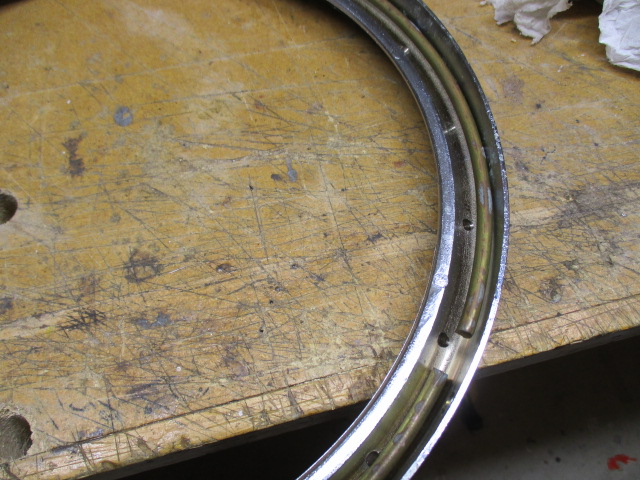
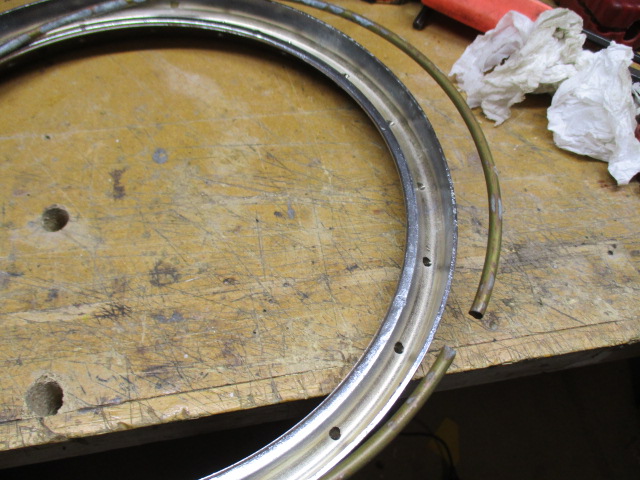

Was it a hoop banjo before? It looks like a brass hoop that maybe got left on and the tone ring placed on top of it ?? I’m interested to find out .

quote:
Originally posted by banjonzI picked up this jo last weekend. Am in the process of stripping it down for cleaning and inspection. When I pulled the tone ring off, I found a brass rod sitting inside the ring. Any ideas why it is there and what purpose it serves?
One other observation is that when the tone ring is fitted to the rim and the brass ring is sitting between the TR and the rim when shaken, there is no movement of the brass ring so it is touching both TR and rim. Could it be to add mass to the TR?
Could the rim have been cut for a short skirt ring and the hoop was added under a long skirt ring so it would fit without cutting it?
The original Dobson patent has a rod between the wooden rim and metal tone ring, even though many these days don't include it. Whether or not this banjo was built to emulate the Dobson patent is a different story.
quote:
Originally posted by woodchipsCould the rim have been cut for a short skirt ring and the hoop was added under a long skirt ring so it would fit without cutting it?
I know nothing about Gibsons and the reasons that would require this. However, this is a Japanese 'masterclone' only. Why would anyone want to modify it?
I've heard of some Kasuga-made Alvarez banjos from the 70s having this setup. Some versions of the bowtie.
I assume it was to help the sound since the tone rings were pot metal.
If this banjo wasn't built this way, I'd assume a previous owner did it for the same reason.
On those 70s Kasuga's the top of the rim was beveled and went up into the underside of the ring. But I don't know if that became a bearing surface or f all of them left room for the addition of a rod style hoop.
I have seen this before with a 70s asian import. i agree with the assessment that this was made because they had doubt in the tonal quality of the potmetal tone ring. So the brass hoop was added and the tone with probably more of a marketing thing. That said the end product usually sounded pretty good.
I have a Tokai tr750 with that arrangement. It actually sounds really good especially frets 0 to 12. Above that it sounds ordinary. It is an intentional design called a tone bell system. It leaves a small gap between the inside of the rim and the tone ring. In other words the inside lip of the tone ring is free to vibrate.
I had a Japanese 70’s banjo in the early 80’s that had that. I don’t remember the brand, maybe Alvarez. Decent enough instrument.
Seemed like a useless thing to do and the only rational I could come up with was that it added weight, because back then, the heavier the banjo, the better the quality, right? Based on that absolutely non-refutable truth of the early 80’s, I left the ring in.
Not sure if it is the same, but Bacon and Day put a hoop inside the tone ring of their later Silverbell banjos. Only photo I could find
quote:
Originally posted by Old HickoryI've heard of some Kasuga-made Alvarez banjos from the 70s having this setup. Some versions of the bowtie.
I assume it was to help the sound since the tone rings were pot metal.
If this banjo wasn't built this way, I'd assume a previous owner did it for the same reason.
On those 70s Kasuga's the top of the rim was beveled and went up into the underside of the ring. But I don't know if that became a bearing surface or f all of them left room for the addition of a rod style hoop.
This is definitely bevelled on the inside. Whether it was or was not, there is still room for a rod there.
quote:
Originally posted by banjonz
This is definitely bevelled on the inside. Whether it was or was not, there is still room for a rod there.
Also, the fit of the tone ring was very loose. I have an old Kasuga rim and tone ring in my parts collection. The tone ring skirt does sit on the outside ledge, so I don't know if the underside of the ring also sits on the top of the bevel or if there's no contact there at all. The inside lower edge of the tone ring does not sit on the rim, because the bevel starts lower than that point. The tone ring hanging in space appears to be a design element Kasuga copied from the later bowtie Mastertones.
quote:
Originally posted by Old Hickoryquote:
Originally posted by banjonz
This is definitely bevelled on the inside. Whether it was or was not, there is still room for a rod there.Also, the fit of the tone ring was very loose. I have an old Kasuga rim and tone ring in my parts collection. The tone ring skirt does sit on the outside ledge, so I don't know if the underside of the ring also sits on the top of the bevel or if there's no contact there at all. The inside lower edge of the tone ring does not sit on the rim, because the bevel starts lower than that point. The tone ring hanging in space appears to be a design element Kasuga copied from the later bowtie Mastertones.
Interesting. I had a good look at it while apart. Any idea why this design by Kasuga? In the 70's, I had a Gibson Bowtie Mastertone (Fiddle peghead). I cannot recall the shape of the upper rim
Seriously, this model is one of the most important banjos when considering the banjo world of later years.
At the time, the only banjos on the market in Japan were copies of the Gibson RB-250, meaning they had a two-piece flange. So when Tokai Gakki(musical instruments) released a model with a one-piece flange, I bought it immediately. I think it was 1974. Upon disassembling it, I was greatly disappointed to find that, as shown in this posting, it had a solid brass ring between the tone ring and the rim, with the tone ring straddling a thin rim. The tone ring, brass ring, and rim all have linear contact in the vertical direction, with no contact in the horizontal direction. I felt there was no point in owning such a banjo, and that it had to be a banjo with the same structure as the Prewar Gibson Mastertone, which I decided I had to do myself, so I joined Tokai Gakki. If this banjo hadn't existed, like many other Japanese banjo people at the time, I would have ended up buying a Prewar Gibson Mastertone a few years later and been satisfied with that. In other words, if this banjo hadn't existed, the later Gold Star GF-100, GF-85, and '81 JD Crow models wouldn't have existed either.
Next year marks the 50th anniversary of the development of the Gold Star GF-100 banjo, so I thought it would be a good idea to compile related information before my memory fades. I started creating graphics last week, and I've just finished the draft of the first page. I'm worried about whether the English expressions and vocabulary are correct. I would appreciate it if you could check it. Also, if you would like any additional information, I will add it. Pages 2 onwards will be graphics showing the specific structure and how to modify it to obtain prewar sounds.
Incidentally, the tone ring shown in the provided photo is made of brass die-cast and was later adopted for the GF-85.
quote:
Originally posted by Toshi TsuchidaSeriously, this model is one of the most important banjos when considering the banjo world of later years.
At the time, the only banjos on the market in Japan were copies of the Gibson RB-250, meaning they had a two-piece flange. So when Tokai Gakki(musical instruments) released a model with a one-piece flange, I bought it immediately. I think it was 1974. Upon disassembling it, I was greatly disappointed to find that, as shown in this posting, it had a solid brass ring between the tone ring and the rim, with the tone ring straddling a thin rim. The tone ring, brass ring, and rim all have linear contact in the vertical direction, with no contact in the horizontal direction. I felt there was no point in owning such a banjo, and that it had to be a banjo with the same structure as the Prewar Gibson Mastertone, which I decided I had to do myself, so I joined Tokai Gakki. If this banjo hadn't existed, like many other Japanese banjo people at the time, I would have ended up buying a Prewar Gibson Mastertone a few years later and been satisfied with that. In other words, if this banjo hadn't existed, the later Gold Star GF-100, GF-85, and '81 JD Crow models wouldn't have existed either.
Next year marks the 50th anniversary of the development of the Gold Star GF-100 banjo, so I thought it would be a good idea to compile related information before my memory fades. I started creating graphics last week, and I've just finished the draft of the first page. I'm worried about whether the English expressions and vocabulary are correct. I would appreciate it if you could check it. Also, if you would like any additional information, I will add it. Pages 2 onwards will be graphics showing the specific structure and how to modify it to obtain prewar sounds.
Incidentally, the tone ring shown in the provided photo is made of brass die-cast and was later adopted for the GF-85.
Thankyou for that input Toshi. Most informative.
Terms of Use | Privacy Policy | Privacy Consent (EU/GDPR Only)
Copyright 2026 Banjo Hangout. All Rights Reserved.


