


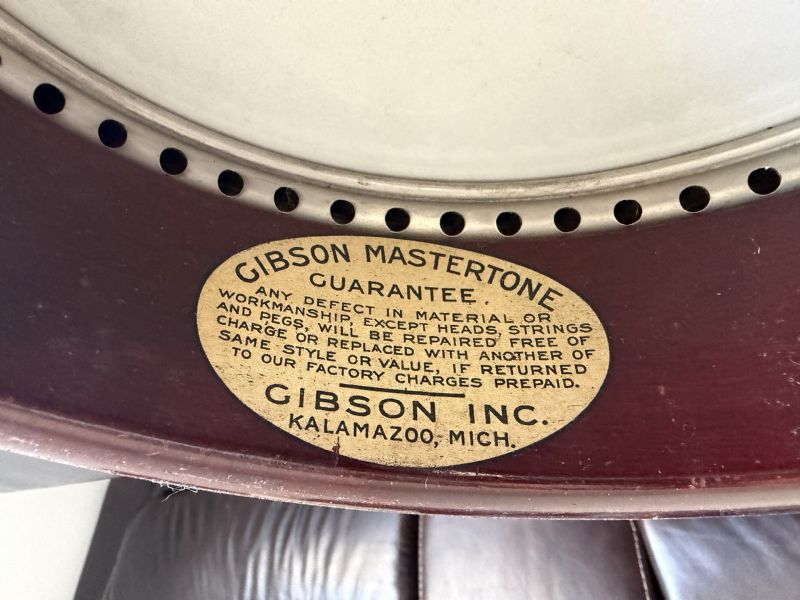
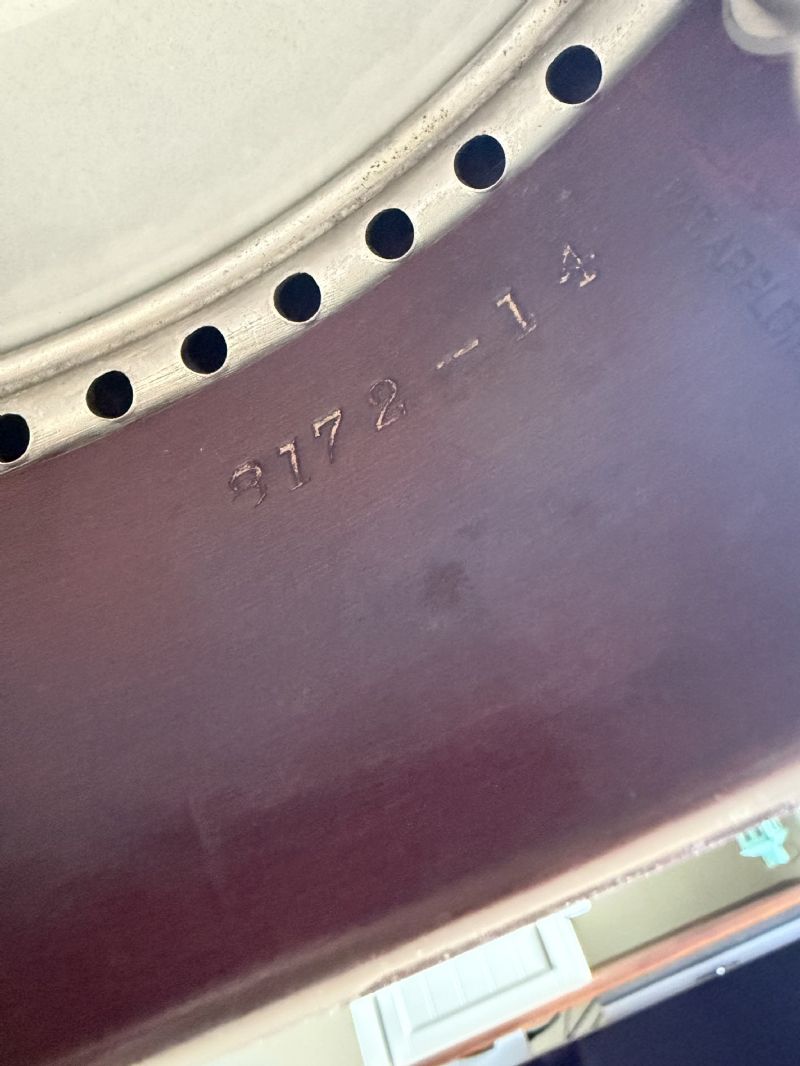
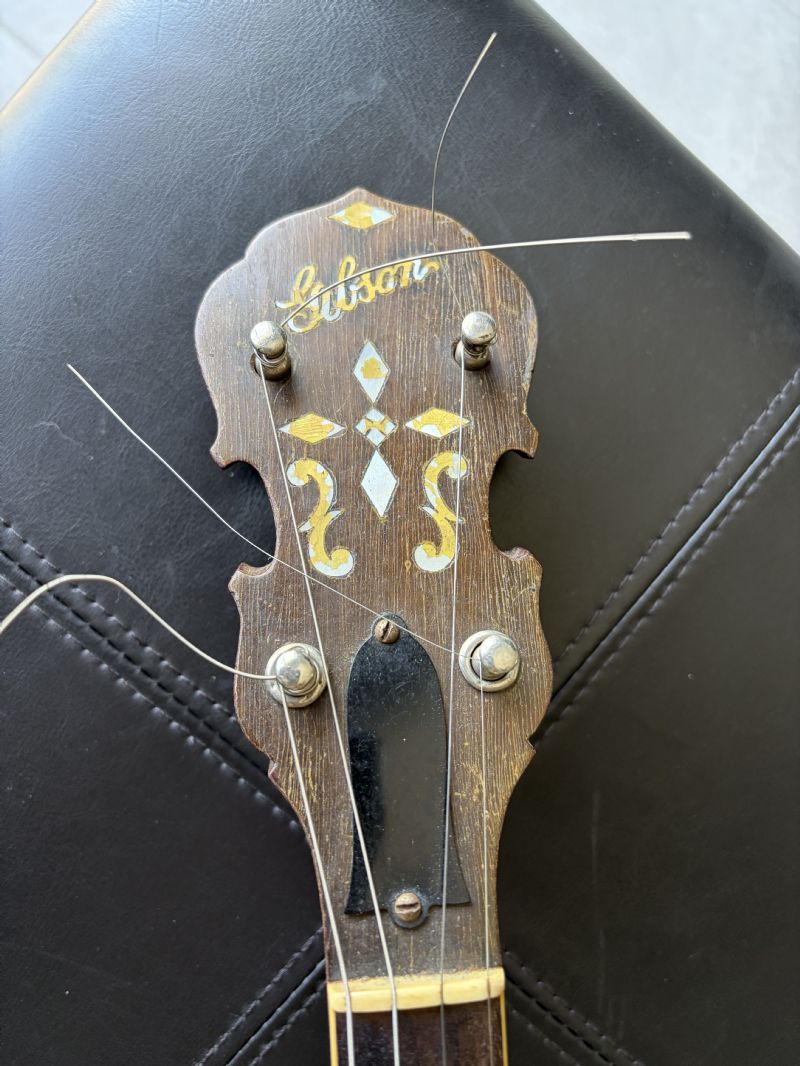
Hi, finally trying to figure out how old my dad’s Gibson banjo is and what it could be worth. Its serial number is 8172-14. I’m guessing it’s from 1925 but I haven’t seen that exact number. There’s diamond inlay on the neck and it also says Mastertone. Tuning pegs, bridge and tailpiece are Grover, not sure if they’re original but look to be of good quality. Thanks in advance for any info.

You are missing the critical photo. The one that shows us if it is a 4 string tenor, or an original 5 string model. The differences in value between the two is quite large.
If your is a tenor, which from the serial number I am guessing it is, typical sale values from private individuals range from 1900 to 2750 for a TB3 1926 Gibson Mastertone banjo.
If in the oddball chance it winds up being a much rarer 5 string model , in today’s market which is a little soft, if all original and in good condition, case ect, you can figure on 11-15k +\_.

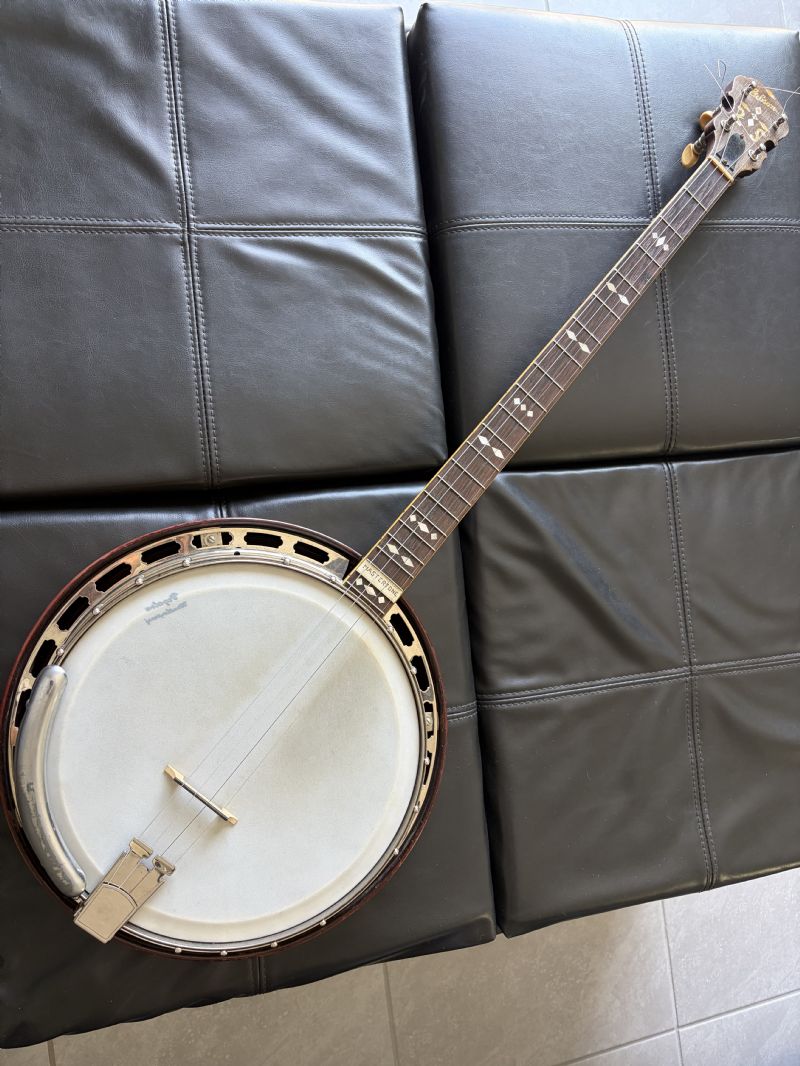
Yes it’s a 4 string tenor banjo, my bad. Thanks for the feedback.
quote:
Originally posted by BanjoantYes it’s a 4 string tenor banjo, my bad. Thanks for the feedback.
I'm counting 22 frets making this a Plectrum. These have value lecf alone but are very desirable for 5 string conversions.
Do you have the original case?
Yes, i do but it’s definitely showing its age.
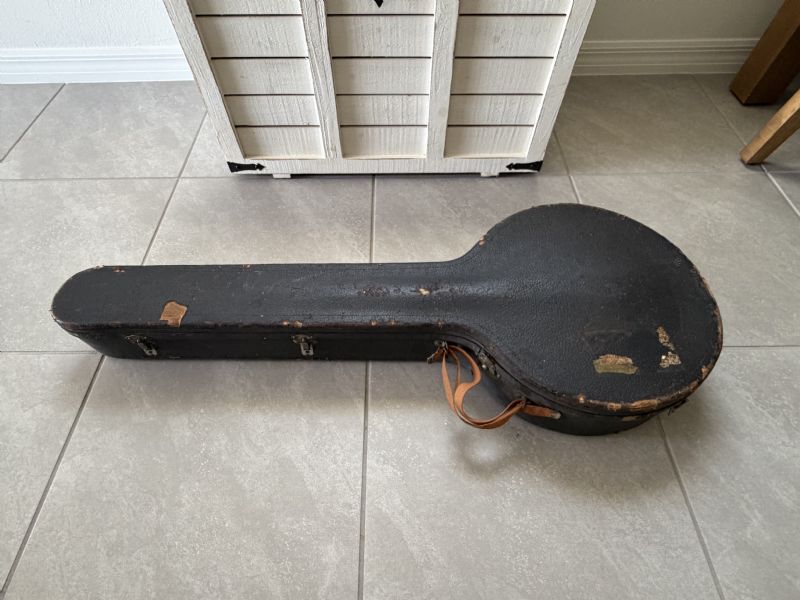
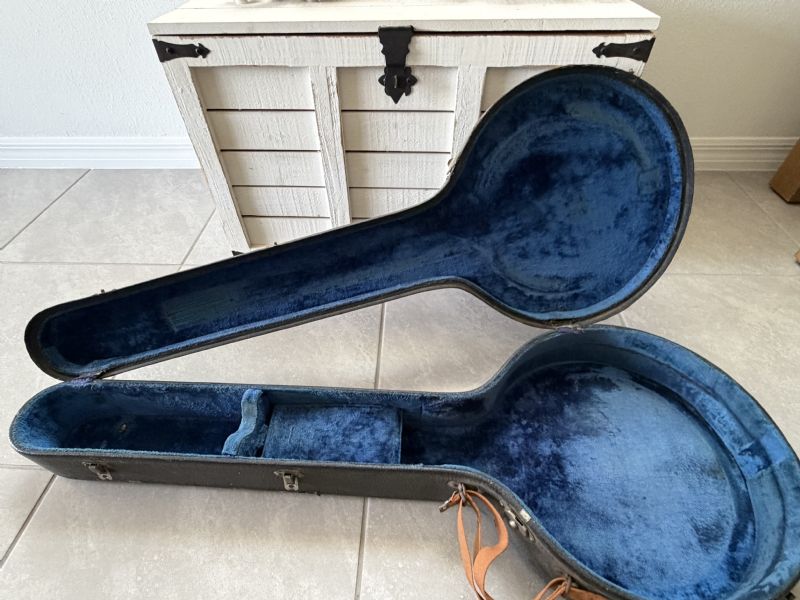
Actually, that case does add some value, and given the age, it’s in pretty good shape.
quote:
Actually, that case does add some value, and given the age, it’s in pretty good shape.
Yep! Plectrums and 5-strings use the same case. I don't use the original case that came with my Vegaphone conversion but that will always stay with the banjo.
Value? The big $$$$$ are reserved for the later versions with an original cast arch top or flattop tone ring, not what you have.
There is a 1926 PB-3 with a conversion neck on the market asking $3,750. Will they get it? Maybe...
For an early, unconverted, ball bearing tone ring and original case, asking prices seem to be in the $2,500 range with actual selling prices closer to $2,000. If I was still playing in Broadway show pit orchestras, I'd be shooting you an offer.
Edited by - mikehalloran on 05/15/2026 15:18:37
Any suggestions on tuning? Standard, Irish Tenor, Plectrum? Also string gauge? I would love to hear what this actually sounds like tuned and ready to pick.
quote:
Originally posted by BanjoantAny suggestions on tuning? Standard, Irish Tenor, Plectrum? Also string gauge? I would love to hear what this actually sounds like tuned and ready to pick.
If you're a guitar player, tune it Chicago Standard for starters — same as the top four strings of a guitar. I like a light gauge set with an .011" on the top and a wound G.
Awesome, thanks for the recommendation.
If your a guitar player, and this was your Fathers instrument. Keep it and learn to play it. Always good to have an instrument you can double on, and as you get older, always nice to have something with a little family history to it.
Yeah that’s what I plan to do. My dad passed away when I was young so I never really got to know him well. This banjo has always been tucked away and followed me wherever I moved. Getting to play and understand the instrument may give me a better insight into what he was like and to share one of his passions.
A picture taken from the side would help considerably. If the tone ring has a lot of little holes around it, that would be a 1925 model, although they usually have Mastertone inlaid on the peghead.
If the tone ring has no holes, as I suspect this one doesn't, it should be from 1926.
Either way, it is a fine banjo and a treasured piece of family history.
Is this the tone ring down inside?
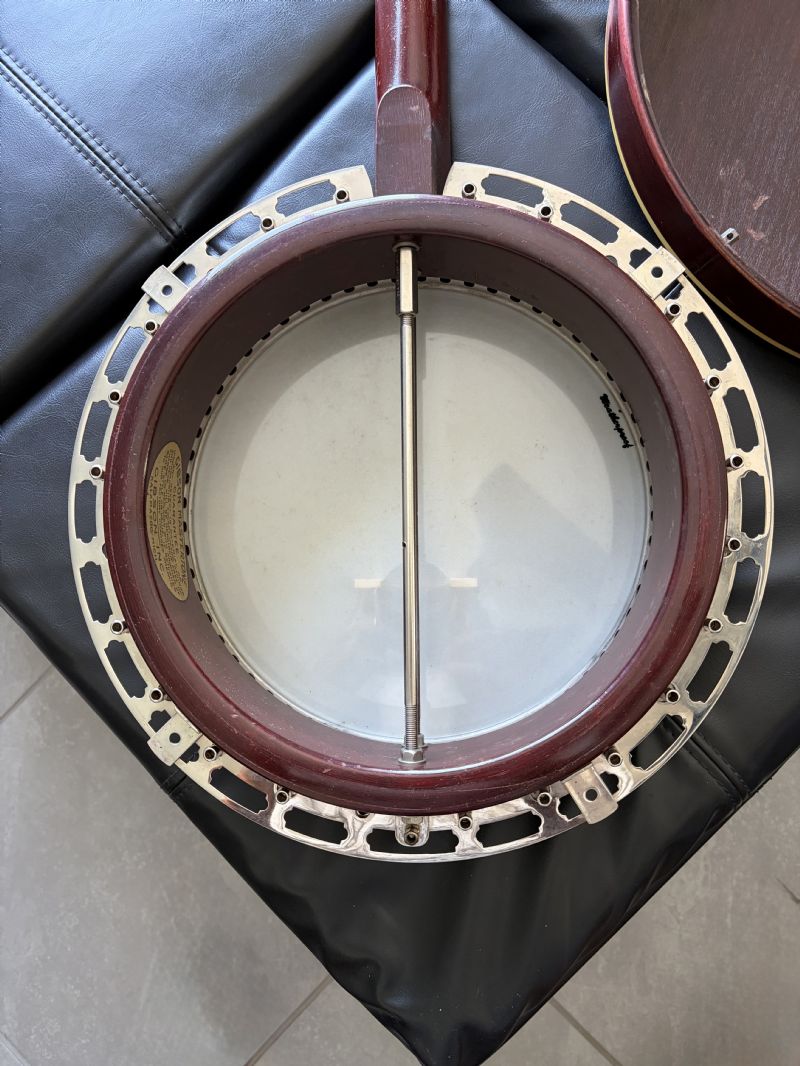
That's the tone ring, a typical ball bearing design. What I was referring to is a side shot of the pot that shows the skirt of the ring. Like this.
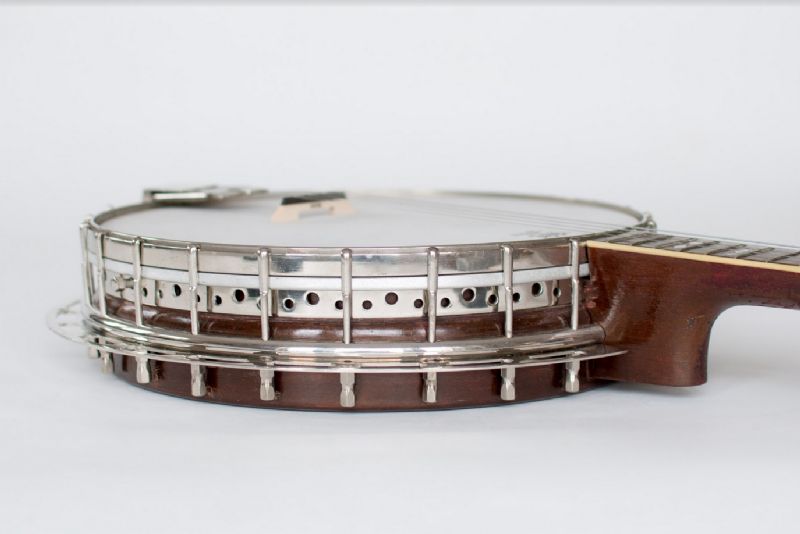
There are no holes on the skirt of the ring. I see what you mean now.
The Style 3 Mastertone was made in the highest numbers of all Gibson Mastertone models in the pre-war years. I made a rough estimate once from extant records and I thought the number were many thousands -- approaching 10,000.
Your photo indeed shows the well known "ball bearing" tone ring. There are vertical holes drilled in the wood rim, beneath the tone ring. These holes are filled with washers, very stout coil springs, and topped with a ball bearing just the diameter of the hole drilled in the wood. The tone ring rests on top of the tips of the ball bearings, suspended in air maybe 1/10th" above the wood rim. This was the early thinking on how to generate volume, sustain, tone, etc. The ball bearing tone ring has maybe 100 separate pieces in it, which means it was costly to assemble, and to keep parts. By late 1926 the whole shooting match was replaced by a heavy one-piece casting in brass/bronze, which was simple as could be to assemble!
Ball bearings have a unique tone and volume. Often described as "sweet", they're not as loud and SNAPPY! as the one piece heavy cast bronze tone rings that followed, were used right up til Gibson abandoned the banjo business around 2009. I have a 1926 gold plated Gibson tenor Granada Mastertone, with a 5 string conversion neck made for it, and I really love it. But I also have acquired a number of other Gibsons with the heavy cast one piece tone rings which truly are much more suited to the demands of bluegrass playing.
You'll be startled by folks contacting you with offers on that case! Pre-war cases in decent shape that can hold a 5 string Mastertone are in high demand!
Were you to decide to play bluegrass music on this banjo, you can get a beautifully made MATCHING 5 string neck for $1000+. And that would apply to anyone who bought this banjo to play bluegrass.
Thank you for the really interesting detailed info. I’m finding it truly fascinating learning about this instrument. I’m going to try and tackle 4 strings to start. I’ve played acoustic guitar and a bit of uke in the past so I think I can make some sense of it. Just ordered new strings, but even with old ones I can tell this banjo sounds sweet.
Terms of Use | Privacy Policy | Privacy Consent (EU/GDPR Only)
Copyright 2026 Banjo Hangout. All Rights Reserved.


