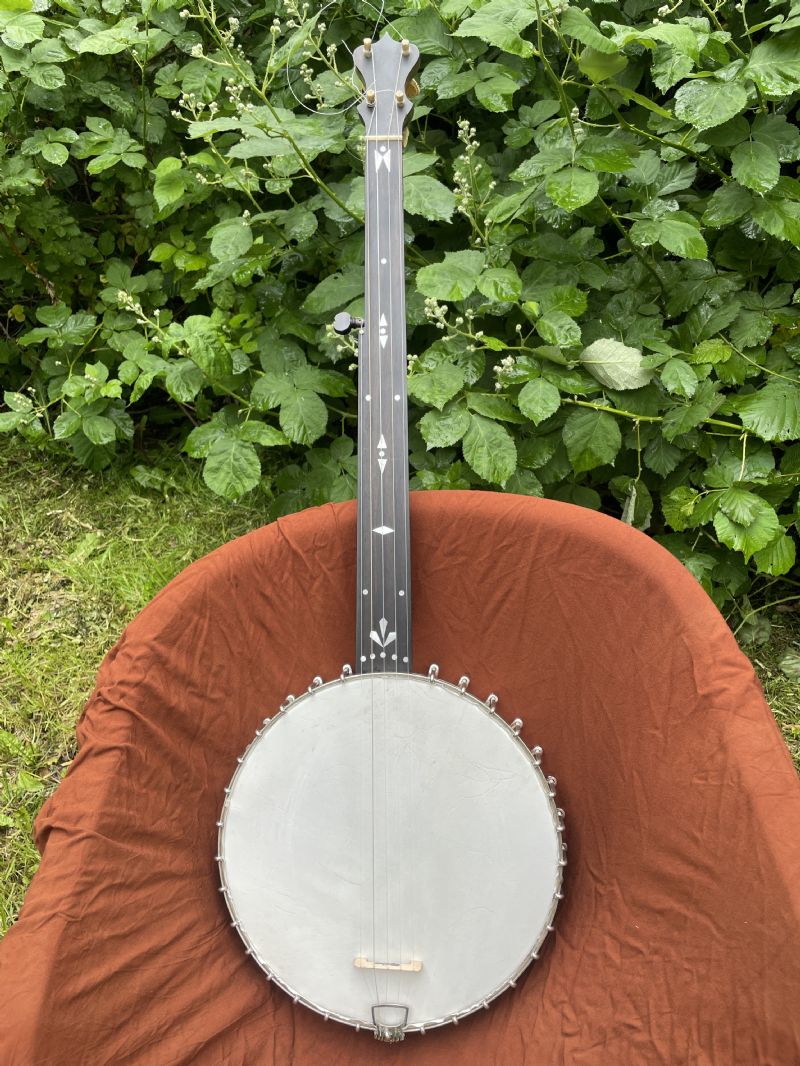
I need help identifying it. I’ve done some research, but there seems to be no certainty as to whether it was made by “Lyon & Healy” or “Geo. P. Matthew,” or by someone unknown?
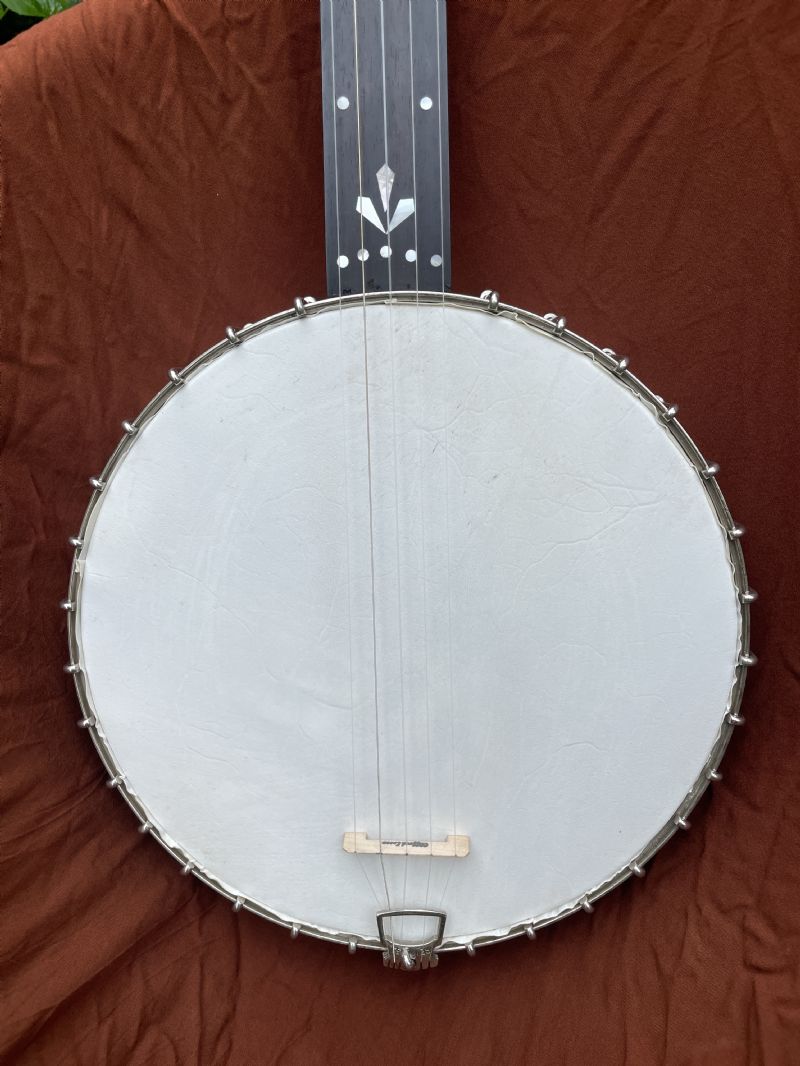
The bridge is positioned so close to the tailpiece because that is where the octave aligns with the twelfth fret.
Because of this, it has a very—I’d call it—dry sound,and it’s also quite quiet, but when I set the bridge to 1/3, it’s loud but also rattles a lot.
Since this is my first fretless, I’m glad to have the markings, but after a while I can play with my eyes closed—it’s already a lot of fun.
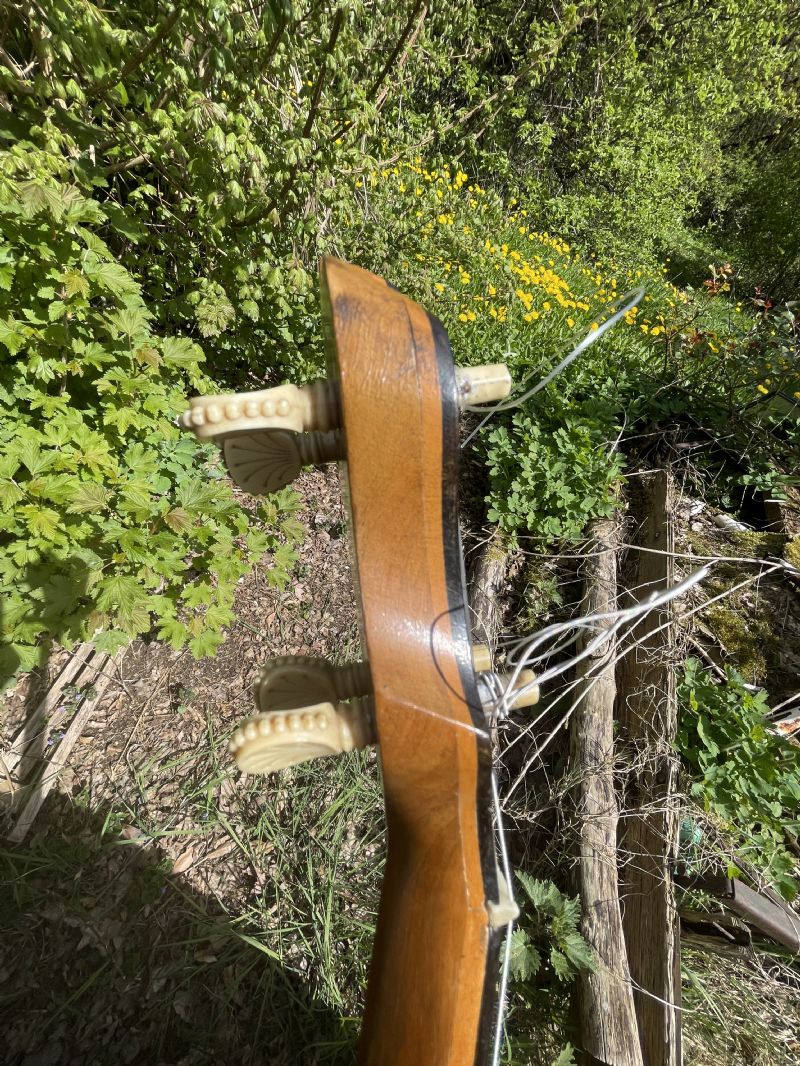
The friction tuners look like they’re made of plastic?Unfortunately, they’re not quite round either, so they don’t turn smoothly;I treated them with tuning peg soap and chalk, and now they at least hold their tuning.
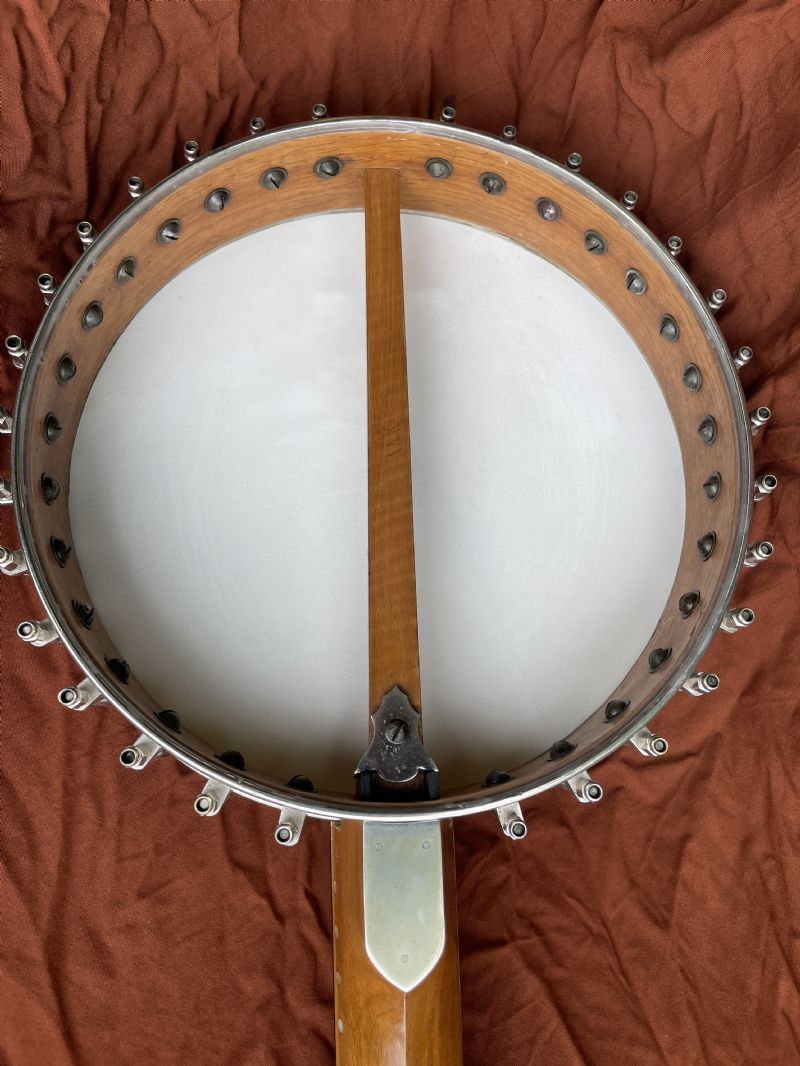
There's also some slight delamination on the rim.
Should I repair it with white glue?
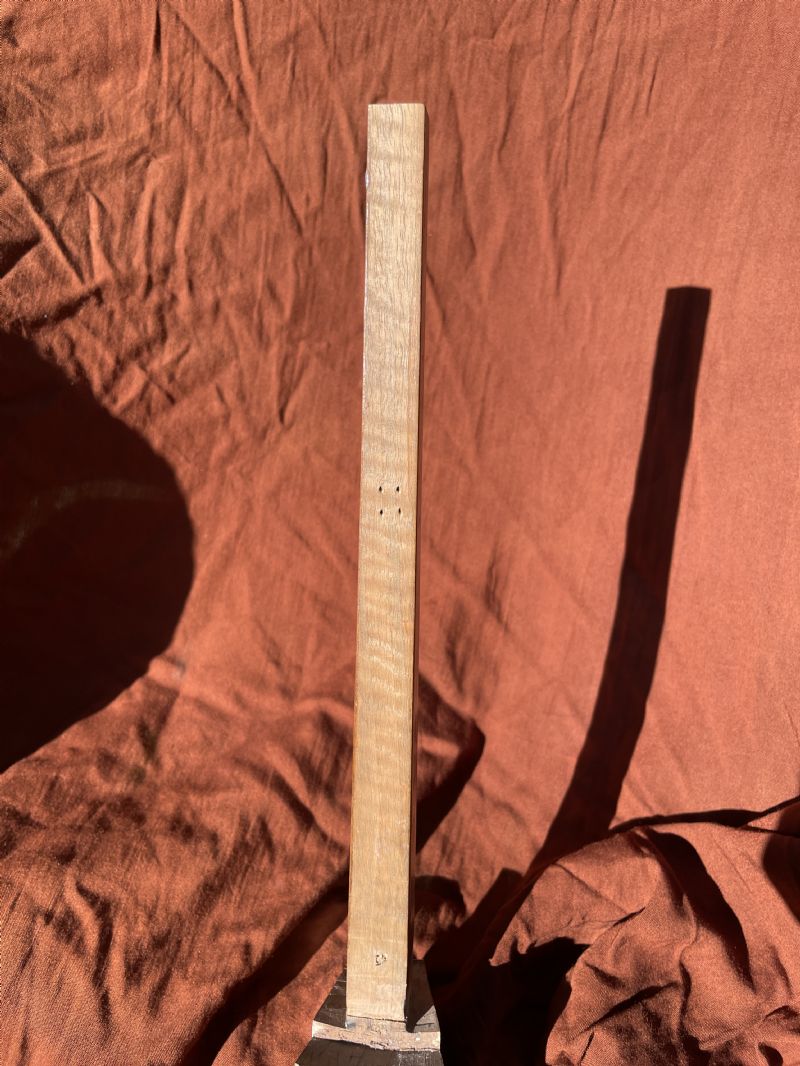
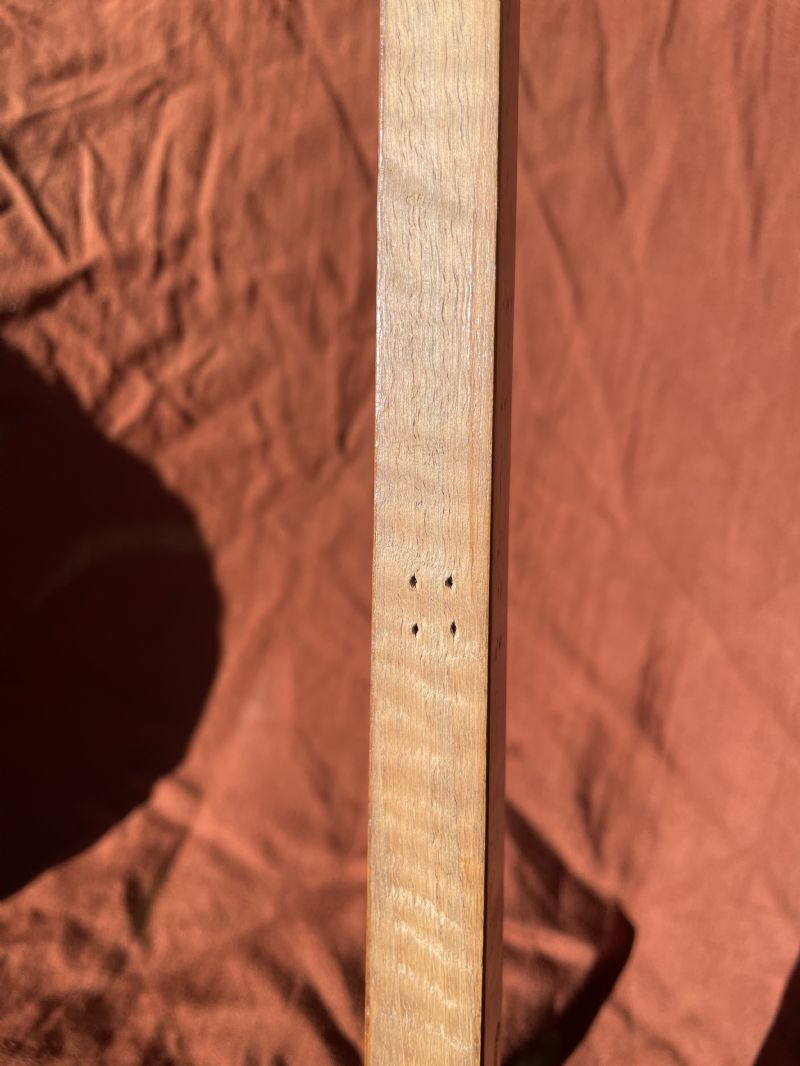
I'm waiting for a new Remo 11 2/16" frosted drumhead, and then I'll take some photos of the Taipiese and the back of the dowel, since it feels like there's something engraved there; unfortunately, I don't have a small mirror.
I’m thinking about replacing the friction tuners with ebony ones, but I’m holding off for now to see if we can’t get along after all—sometimes even a small piece of packing paper can make a difference.
I also plan to stretch a natural calfskin over it later.
I almost forgot—the distance to the twelfth fret is 35 cm, does that mean it has a 27.5-inch scale length?
I’d appreciate any information you have about this banjo,
such as its age, maker, value, and what else I can do to improve it.
Greetings to all banjo lovers
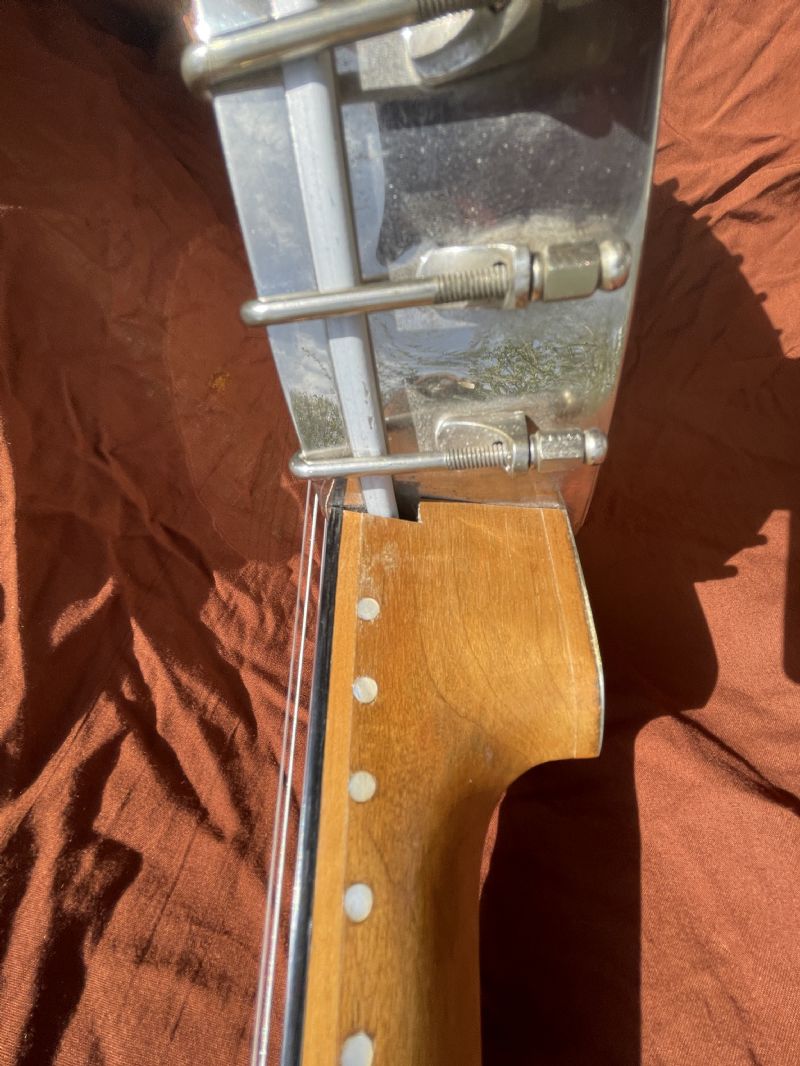
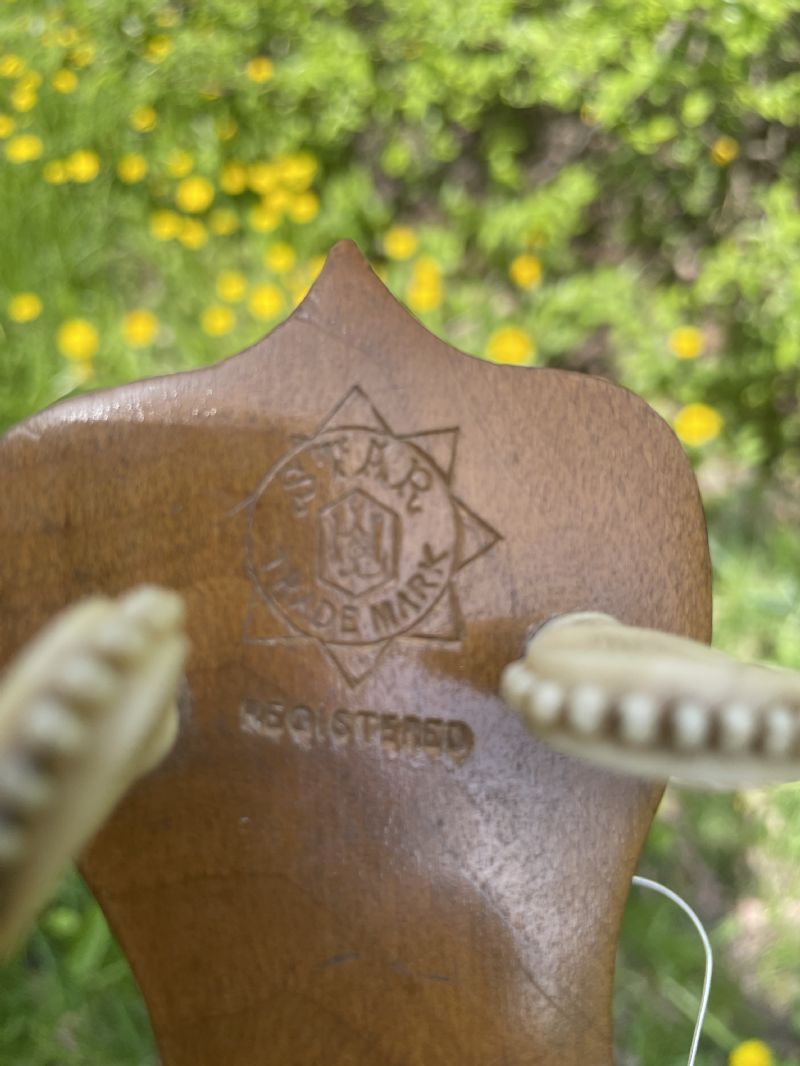
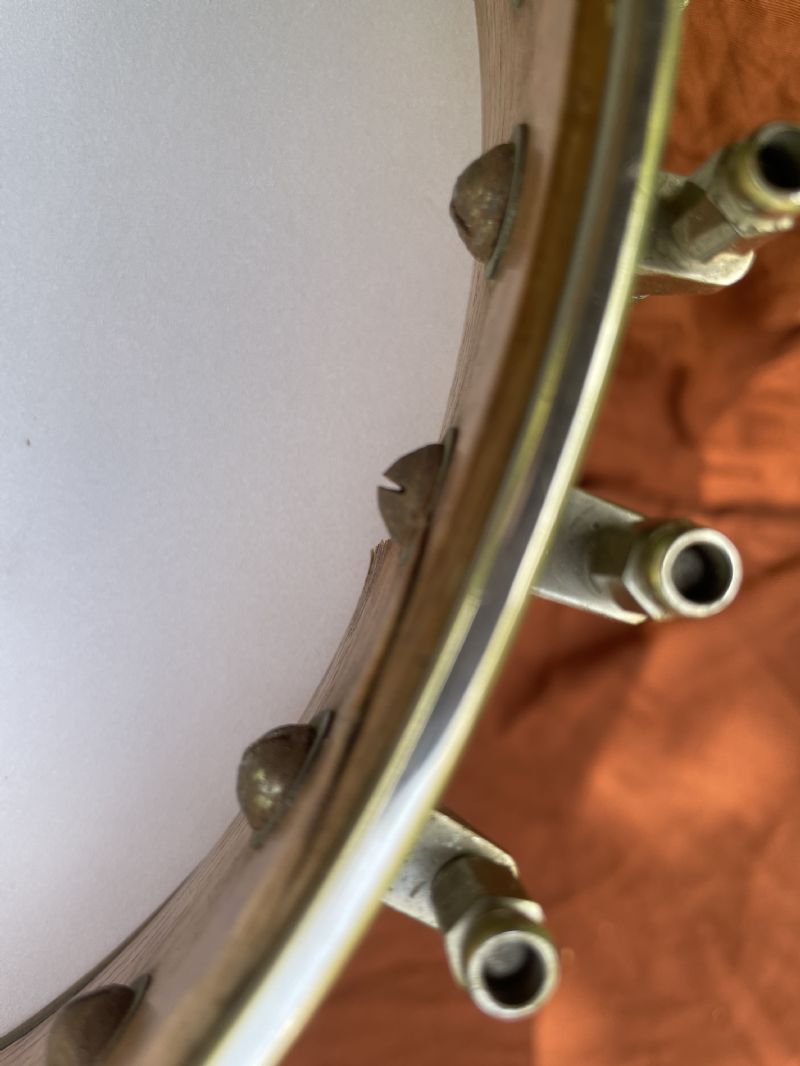
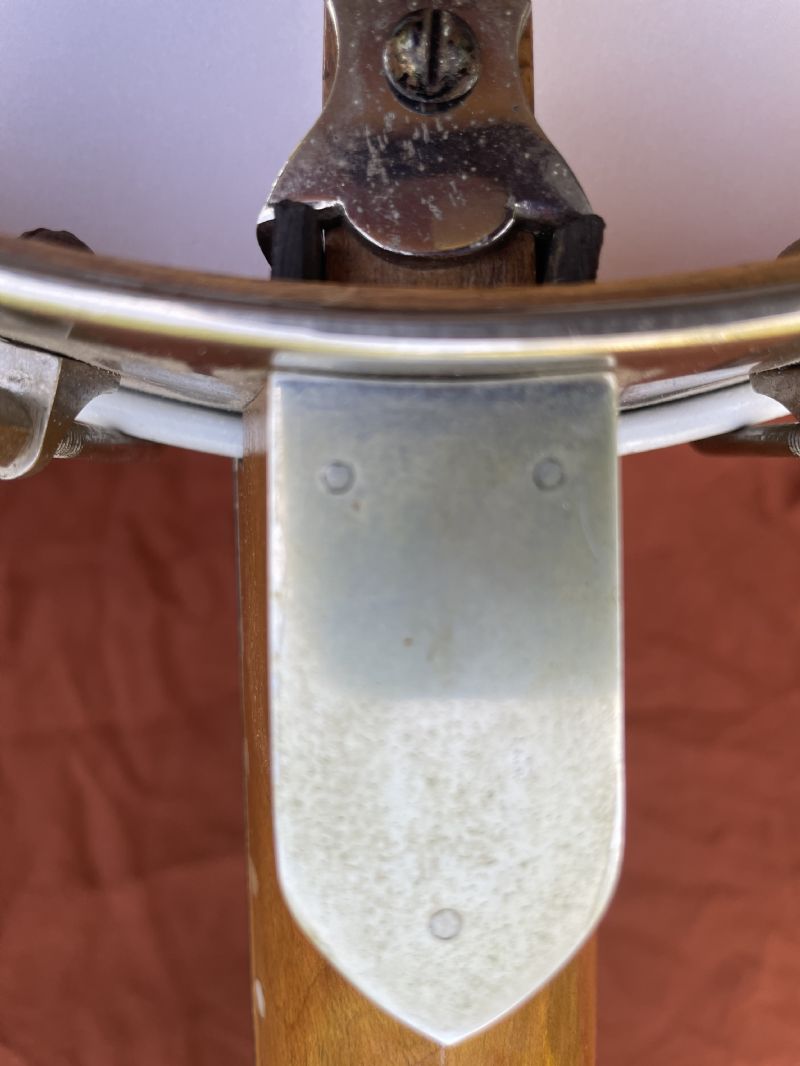
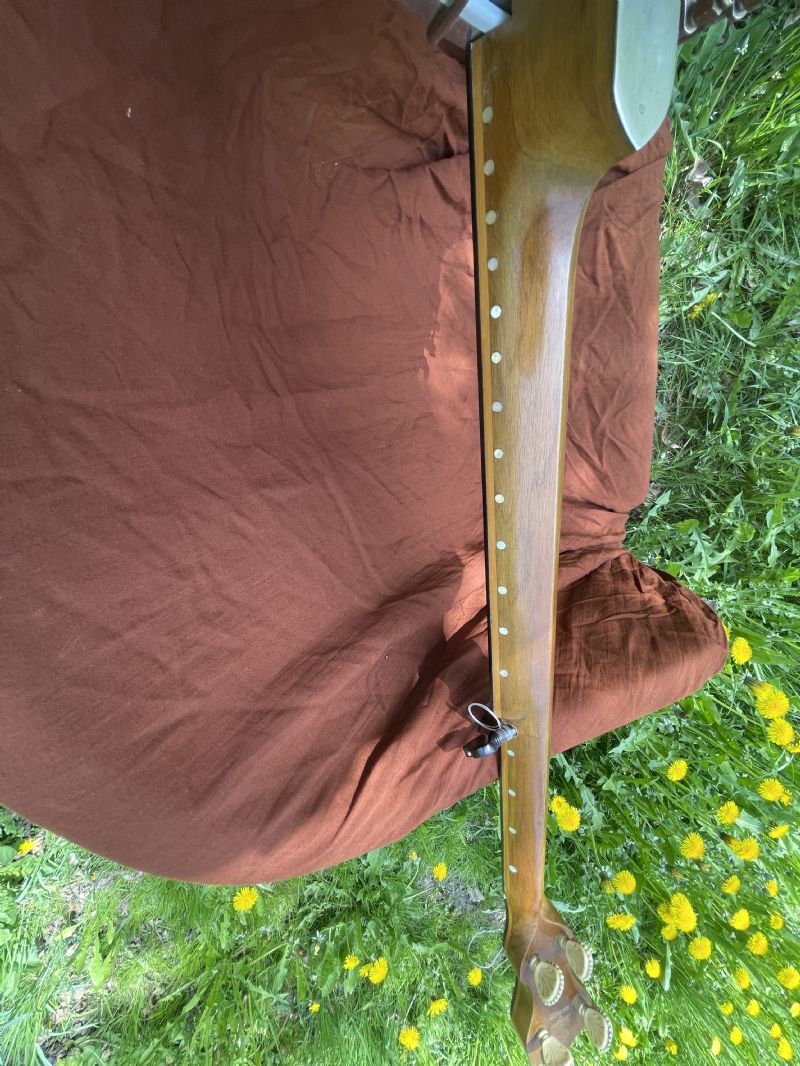
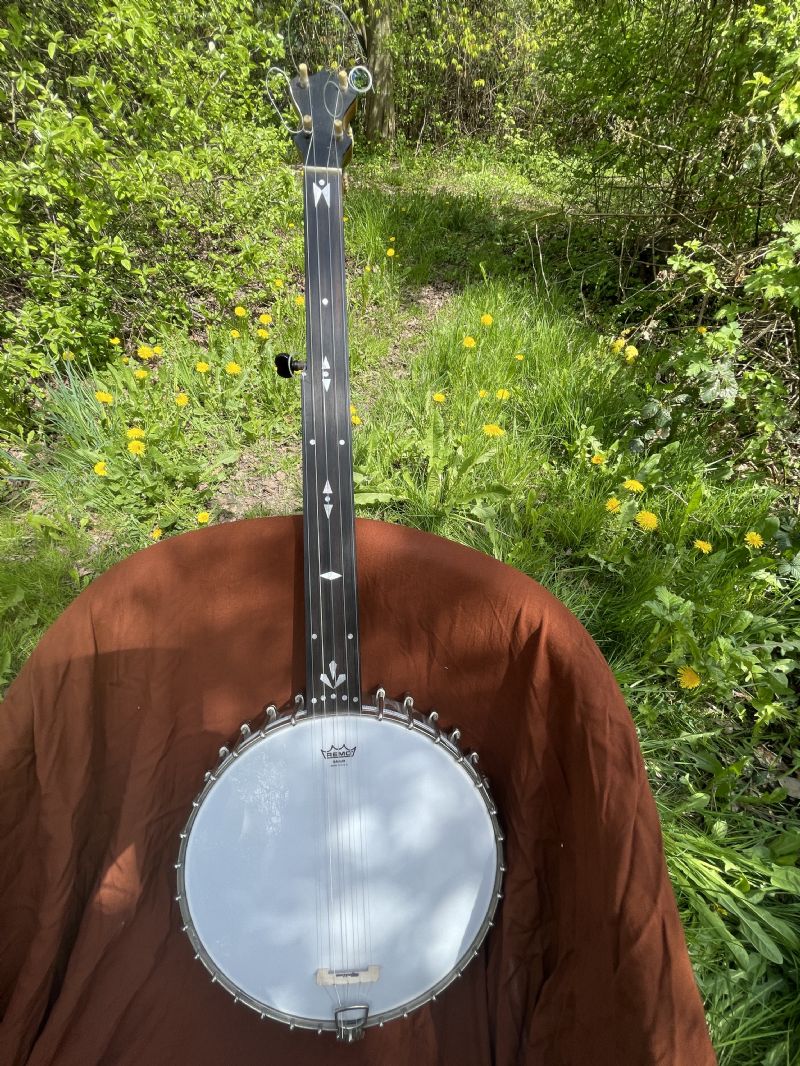

I would think that it is British made because of the side marker dots indicating where the frets might be. I have never seen that on US made banjos, however I could be wrong. It's just I have never seen it. Also the lettering (as far as I can make out) is 150 Strand? which is in London. Just me 2c worth.

quote:
Originally posted by banjonzI would think that it is British made because of the side marker dots indicating where the frets might be. I have never seen that on US made banjos, however I could be wrong. It's just I have never seen it. Also the lettering (as far as I can make out) is 150 Strand? which is in London. Just me 2c worth.
It is British made because it generally looks British made.
However, "side marker dots" were called often "professional frets" and were very common on US made banjos from about the 1870s to when raised frets became prevalent in the mid 1880s.
quote:
Originally posted by Joel Hooksquote:
Originally posted by banjonzI would think that it is British made because of the side marker dots indicating where the frets might be. I have never seen that on US made banjos, however I could be wrong. It's just I have never seen it. Also the lettering (as far as I can make out) is 150 Strand? which is in London. Just me 2c worth.
It is British made because it generally looks British made.
However, "side marker dots" were called often "professional frets" and were very common on US made banjos from about the 1870s to when raised frets became prevalent in the mid 1880s.
Thanks for that Joel. That was something I did not know. However, the street address kind of gave it away, at least to miy mind!
quote:
Originally posted by TuedelbandI need help identifying it. I’ve done some research, but there seems to be no certainty as to whether it was made by “Lyon & Healy” or “Geo. P. Matthew,” or by someone unknown?
The bridge is positioned so close to the tailpiece because that is where the octave aligns with the twelfth fret.
Because of this, it has a very—I’d call it—dry sound,and it’s also quite quiet, but when I set the bridge to 1/3, it’s loud but also rattles a lot.
Since this is my first fretless, I’m glad to have the markings, but after a while I can play with my eyes closed—it’s already a lot of fun.
The friction tuners look like they’re made of plastic?Unfortunately, they’re not quite round either, so they don’t turn smoothly;I treated them with tuning peg soap and chalk, and now they at least hold their tuning.
There's also some slight delamination on the rim.
Should I repair it with white glue?
I'm waiting for a new Remo 11 2/16" frosted drumhead, and then I'll take some photos of the Taipiese and the back of the dowel, since it feels like there's something engraved there; unfortunately, I don't have a small mirror.
I’m thinking about replacing the friction tuners with ebony ones, but I’m holding off for now to see if we can’t get along after all—sometimes even a small piece of packing paper can make a difference.
I also plan to stretch a natural calfskin over it later.
I almost forgot—the distance to the twelfth fret is 35 cm, does that mean it has a 27.5-inch scale length?
I’d appreciate any information you have about this banjo,
such as its age, maker, value, and what else I can do to improve it.
Greetings to all banjo lovers
Made by G P Matthew Birmingham UK. I've had several pass through my hands. The letters on the headstock "Registered",
Edited by - Stephen John Prior on 04/27/2026 16:13:20
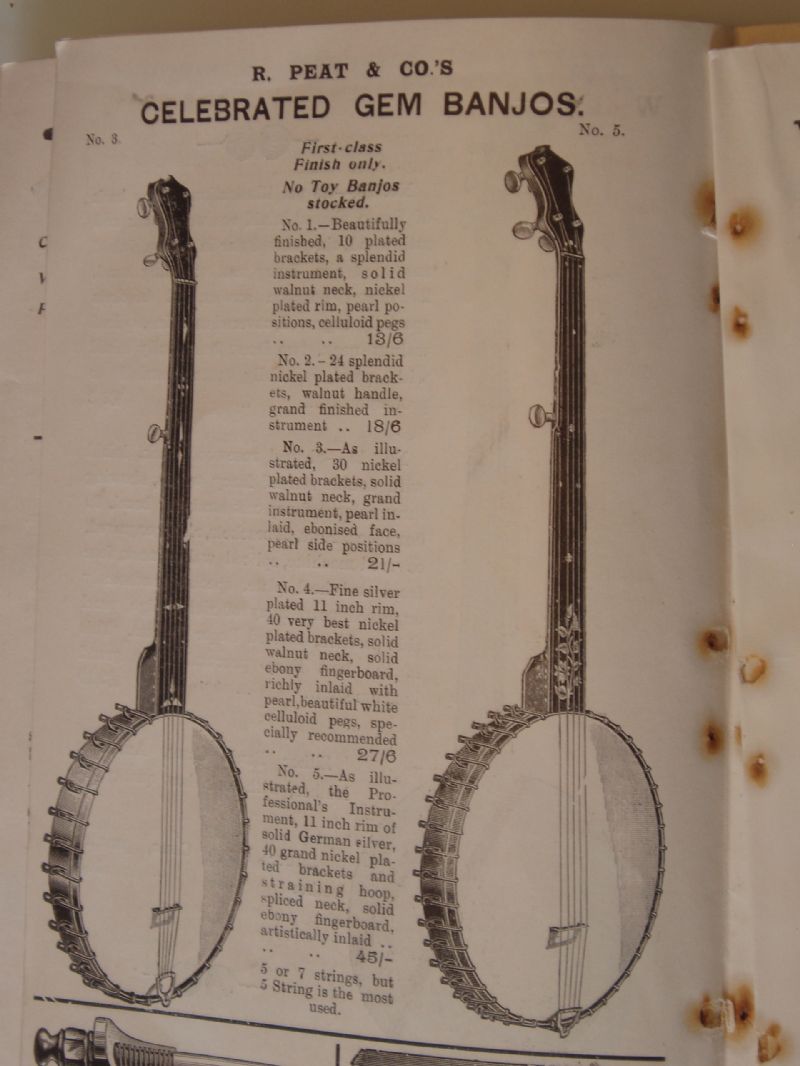
G P Matthew was a prolific maker here in the UK. He made a large number of banjos for retail by others. Early 1890's would be my guess at the date. It should have a serial number on the underside of the dowel please share that with the Matthew group here on the hangout. Your banjo is very similar to his "Gem no,3." as attached photo. Estimate of value here in the UK would be £200 - £300 as is. A drop of white wood glue and clamp should sort the lamination. The celluloid beaded edge tuners are nice and hard to find these days, so they have some value. Quick fix would be as you say to replace with ebony. It's great to see this banjo being played and enjoyed, nice work.
Thank you so much for shedding some light on this.
Thanks to you, I now know that George Paradice Matthew built it around the turn of the century.
The tuners are made of celluloid; a little white glue is the solution for delamination, and there is a Matthew group here on the forum.
That’s great.
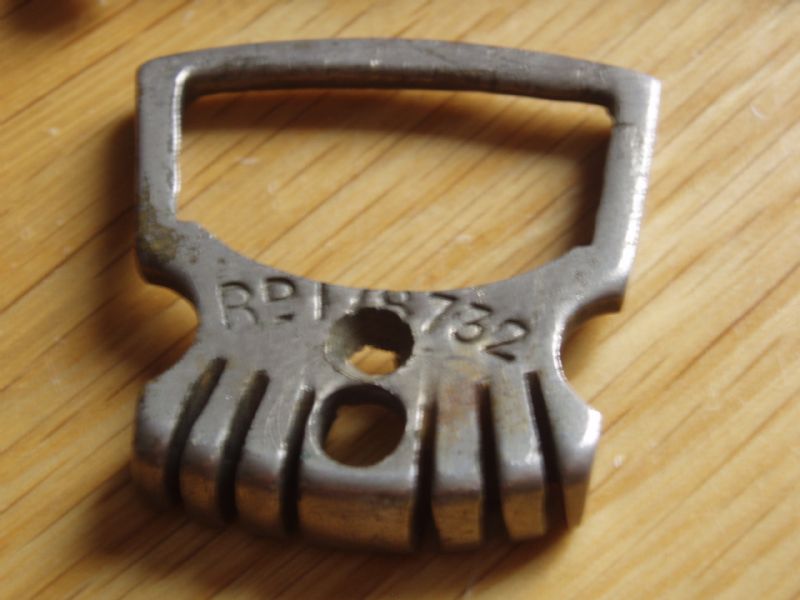
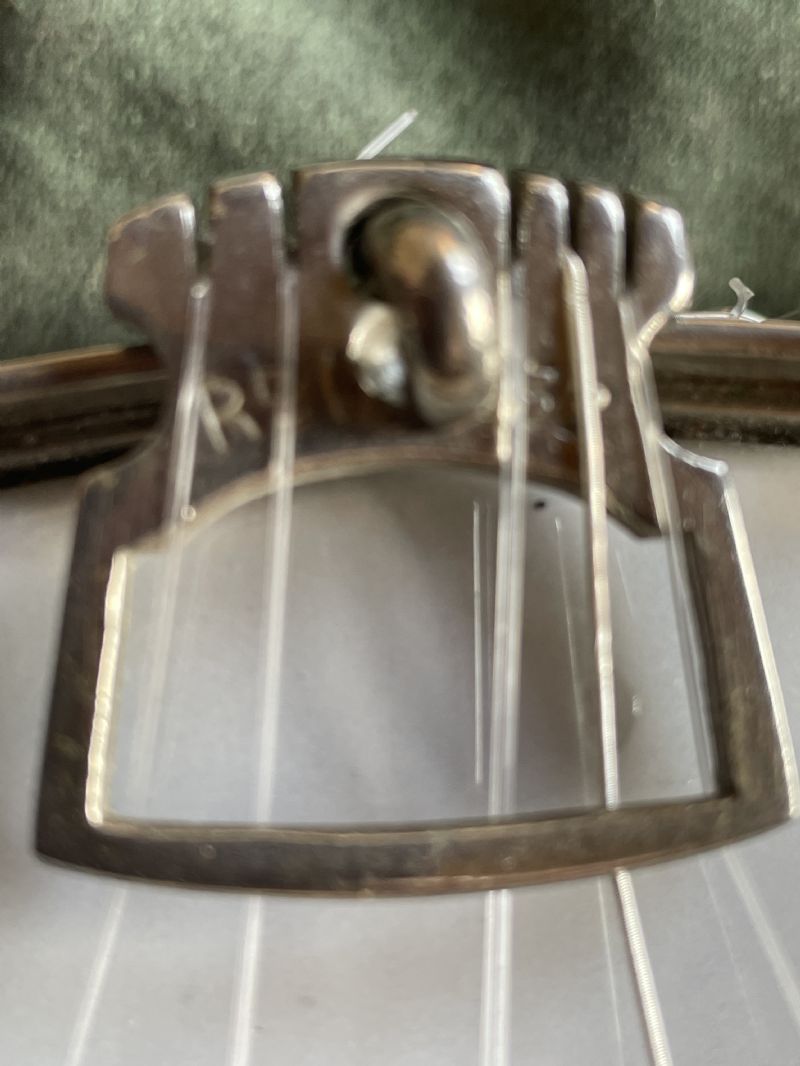
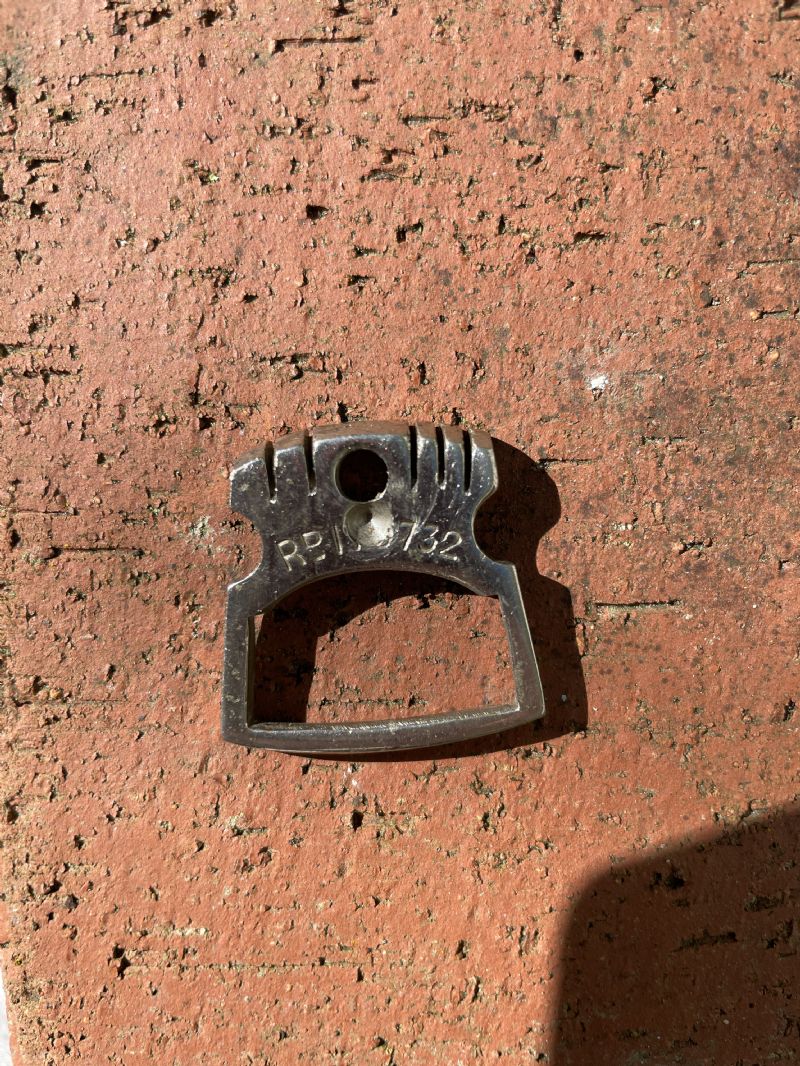
I’m still wondering if there is any information about the tailpiece; the slots for the strings are so narrow that the third string from the Labella 17 set is already very tight.
I think it was built for gut strings?
Do you think it’s an original?
Was there a time when the bridge was placed so close to the tailpiece,
and what kind of music was played on it?
@banjonz
Where do you see “150 Strand”? I only see “Star Trade Mark Registered,”
but my eyes aren’t what they used to be.
As soon as I get the new skin head, I’ll send more pictures of the back of the dowel stick and the tailpiece.
quote:
Originally posted by TuedelbandThank you so much for shedding some light on this.
Thanks to you, I now know that George Paradice Matthew built it around the turn of the century.
The tuners are made of celluloid; a little white glue is the solution for delamination, and there is a Matthew group here on the forum.That’s great.
I’m still wondering if there is any information about the tailpiece; the slots for the strings are so narrow that the third string from the Labella 17 set is already very tight.
I think it was built for gut strings?
Do you think it’s an original?Was there a time when the bridge was placed so close to the tailpiece,
and what kind of music was played on it?@banjonz
Where do you see “150 Strand”? I only see “Star Trade Mark Registered,”
but my eyes aren’t what they used to be.As soon as I get the new skin head, I’ll send more pictures of the back of the dowel stick and the tailpiece.
I believe the tailpiece is original as I've had a couple with the same tailpiece. I believe that gut strings of the period were a light gauge. The banjo would have been used for what is termed now "Classic" style. How far is the bridge from the tailpiece ?
Your eyesight is fine.
quote:
Originally posted by Tuedelband
I’m still wondering if there is any information about the tailpiece; the slots for the strings are so narrow that the third string from the Labella 17 set is already very tight.
I think it was built for gut strings?
Do you think it’s an original?Was there a time when the bridge was placed so close to the tailpiece,
and what kind of music was played on it?
Yes, the tailpiece is likely original. At some point in the 1990s, a few "old time" banjo players decided that they wanted nylon strings but did not want to learn how to play using the sensitive nature of them.
Their solution was to use extremely heavy/thick nylon in attempt to simulate the tension of wire strings. This bled into the "industry" via the polyester strings offered by Aquila as "nylgut". Eventually pretty much all packaged sets of nylon or polyester (nylgut) strings became very thick. Some sets are nearly twice as thick as what was originally used.
The strings originally used on your banjo were likely somewhere around .017, .019, .023, .024 wound, .017 or .018, .022, .028, .024, though I have measured strings that were .016 etc. Gut and Silk, the 4th was wound with silver plated copper.
In the 1890s, as a compromise due to climatic conditions (humidity), some English banjoists used and promoted the use of a wire first string for regular banjo. This trend seems to have emerged after Alfred Cammeyer arrived with his zither banjo. This trend did not really catch on until WW1 caused string shortages. But for the most part, regular banjo players stuck to all gut sets (and wound 4ths).
The "No 17" designation meant .017 first and fifth. At some point Labella decided they needed to make them .019. To confuse matters, they kept calling them "No 17" when "No 19" would have been logical.
Regarding the bridge placement. Yes, that was popular in the mid 1880s. Strange to us, the desired tone was bright, sharp, clear and loud. These banjos were made for playing "banjo style" (aka stroke style or thimble style) and fingerstyle popular music that we now call "classic banjo". There is an endless supply of this music that has been scanned and uploaded on the internet. Literately thousands and thousands of pieces of music, all public domain and free to get and play.
Also hundreds of instruction books. And they work just fine to teach how to play the banjo. One only needs to start on page one, read the instructions, do the exercises, and practice.
Thanks,
I measured 32 mm between the tailpiece and the bridge, and 750 mm
between the nut and the bridge.
To avoid making a mistake, I’d rather not convert the measurements—sorry.
I’ve tuned it down three semitones for now; it feels better to me that way.
The question of the right scale length still remains, though?
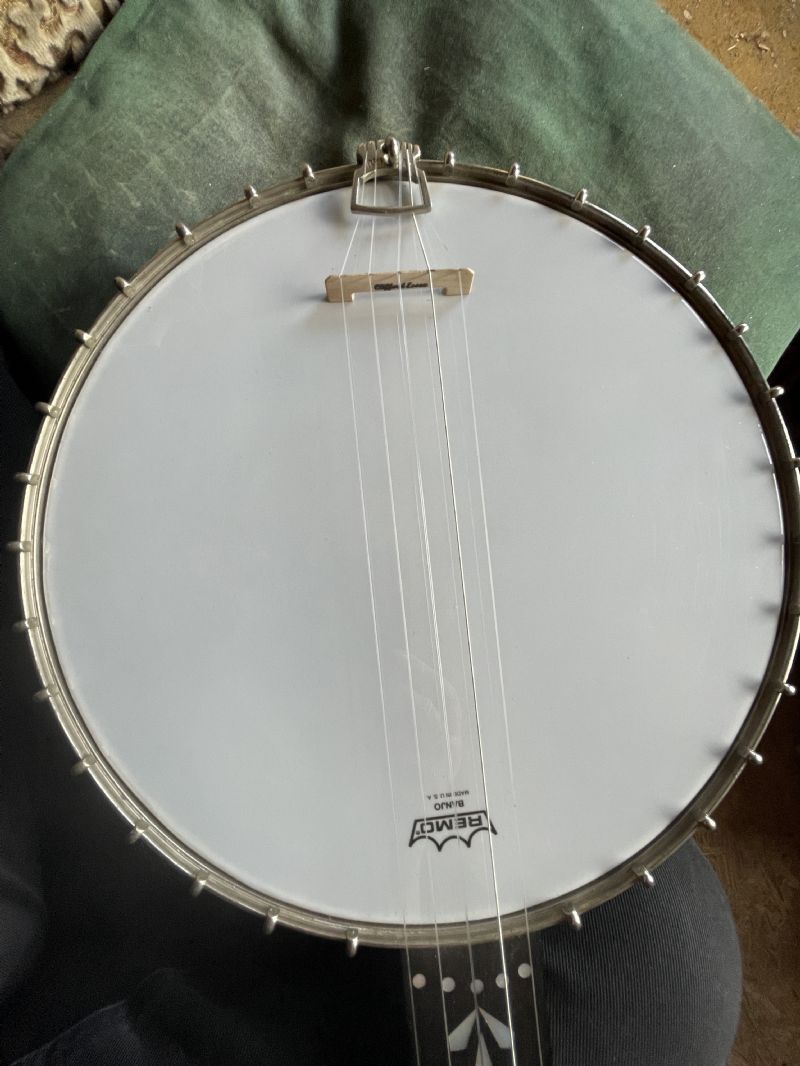
I’ve experimented with different distances; right now, I like it best close to the bridge, though I don’t like the sound of the smooth Remo heads either.
It also sounds best to me when played with two or more fingers.
Translated with DeepL.com (free version)
Oh, that overlapped.
@Joel Hooks, I love your detailed explanations.
I installed the genuine Labella 17s you recommended, and they also adorn my other nylon-string banjos.
Unfortunately, I don’t speak English, so the books you suggested aren’t that easy for me to understand, but I’m working on it.
quote:
Originally posted by TuedelbandThank you so much for shedding some light on this.
Thanks to you, I now know that George Paradice Matthew built it around the turn of the century.
The tuners are made of celluloid; a little white glue is the solution for delamination, and there is a Matthew group here on the forum.That’s great.
I’m still wondering if there is any information about the tailpiece; the slots for the strings are so narrow that the third string from the Labella 17 set is already very tight.
I think it was built for gut strings?
Do you think it’s an original?Was there a time when the bridge was placed so close to the tailpiece,
and what kind of music was played on it?@banjonz
Where do you see “150 Strand”? I only see “Star Trade Mark Registered,”
but my eyes aren’t what they used to be.As soon as I get the new skin head, I’ll send more pictures of the back of the dowel stick and the tailpiece.
I downloaded the image and enlarged it. What I first thought was '150 Strand' was actually 'Registered'. My bad!
Edited by - banjonz on 04/29/2026 15:03:46
Now it’s completely taken apart, and all the screws and hooks are floating in oil.
Because of the wide rim of the Remo head, everything was very tight; I’m still waiting for a natural skin.
This will be my first attempt at mounting a natural skin—wish me luck.
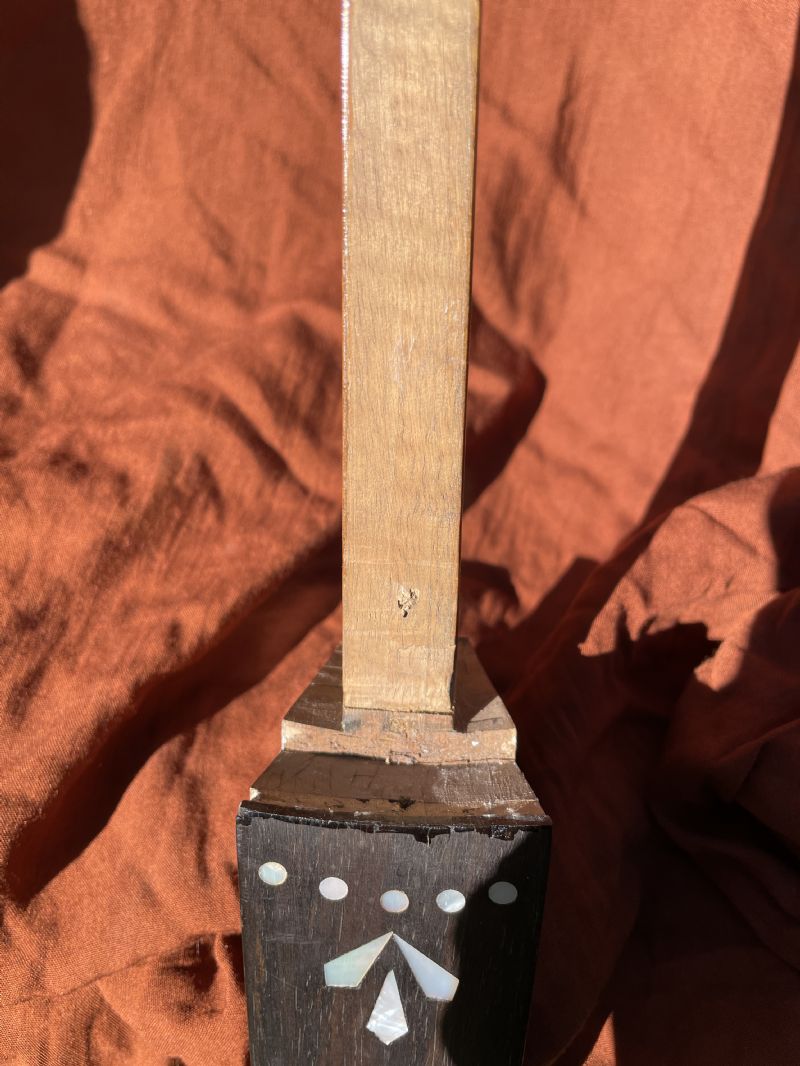
Unfortunately, I didn’t find a serial number, just the initials of a presumed previous owner.
I’ll check in when it’s done, or if I need help.
Thank you so much for your help so far—this forum is a real blessing!
@banjonz
Oh, I know that all too well. I also see letters in the picture of the neck joint, but they’re probably just cracks or tool marks in the wood.
I’ve now mounted a new skin, following these instructions
“https://archive.org/details/how-to-fit-a-vellum-to-your-banjo-clifford-essex”
, though at the very end I treated the skin with Renaissance wax.
The tension is between 80 and 90 on the Drumdial and fluctuates very little.
The work wasn't as hard as I expected, but I could have used an extra pair of hands.
Here's a tip: if you're feeling overwhelmed, take a deep breath and wait a moment—there's no rush.
The celluloid tuning pegs still need to be replaced; since they’re no longer round,
tuning is a nightmare.
Unfortunately, the sound doesn't quite do it for me. I've tried different bridge positions, but I always end up close to the tailpiece, and when playing with two or three fingers—
clawhammer works, of course, but as soon as you move a little further from the bridge toward the neck, it feels very mushy, similar to playing over a Scoope, and I don't like Scoopes.
Right now, the sound when played close to the bridge reminds me more of a shamisen than
a banjo, but I’m not giving up hope that we’ll still become friends.
Unfortunately, now I’m also craving another fretless banjo—oh, oh.
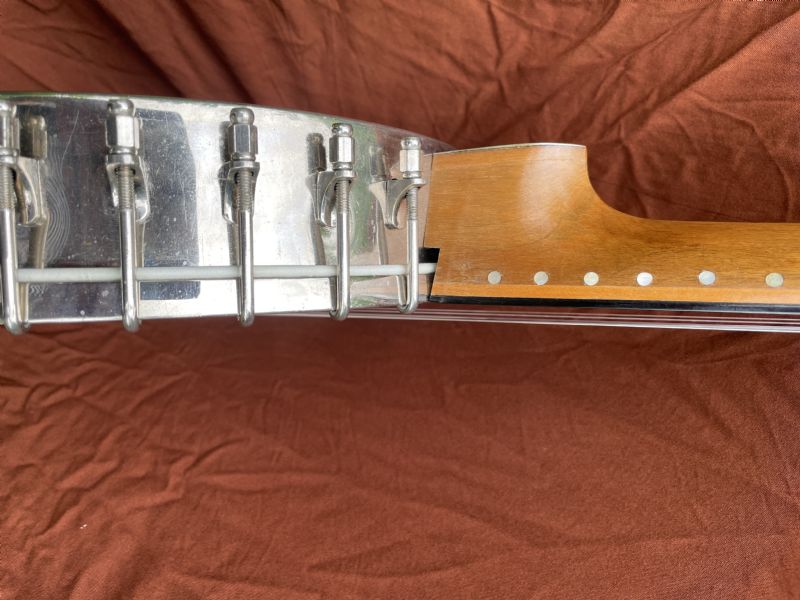
I've never tried re-shaping a celluloid peg, and don't know if the usual tool would do the job without chipping or shattering the peg. A homemade shaper that uses abrasive (sandpaper) instead of a blade would work, though, as long as the peg isn't too far from round.
I think the hole usually changes shape more than the peg does, though. Check the pegs with a micrometer. Re-tapering the holes with a reamer may solve most of the problem, though you'll probably need to line them with some kind of bushing first, so they don't wind up too big for the pegs.
Fitting a new set of ebony or boxwood violin pegs would be easier!
The exceptionally long scale and position of the bridge seem to have been in fashion at the time that banjo was made. I have a (fretted) JB Schall of about the same vintage that has a scale of ~760mm (~30"!), and similar bridge placement. I haven't ever tried to set it up for modern pitch, but I don't think it would be easy to do without breaking strings! That bridge position does make for a tone that is more nasal and less sparkly than we usually think of as ideal for a banjo. I've always called it a brassy or trumpet-like character, and your comparison with the shamisen seems a very good way of describing the same thing.
Generally, you should pluck/strike gut or synthetic strings much closer to the bridge than you do with wire strings, especially if they are of the period-correct very light gauges.
Thank you, I appreciate your comment.
Since some of the tuning pegs are not only bent (banana-shaped) but also pushed all the way in, I think I’ll have my luthier install new ebony tuning pegs.
On the other hand, I have a banjo where I lined the socket with packing paper, which allowed me to install a thinner tuning peg—it’s worked wonderfully for years. I’ll discuss this with my luthier, who, fortunately, has a soft spot for poor musicians.
I tuned it to gCGBD but four semitones lower, and tried my hand at “Pompey Ran Away” (plucked very close to the bridge)—the banjo seemed to fill out nicely here, but for me, this seemingly simple piece is very difficult. :)
Terms of Use | Privacy Policy | Privacy Consent (EU/GDPR Only)
Copyright 2026 Banjo Hangout. All Rights Reserved.