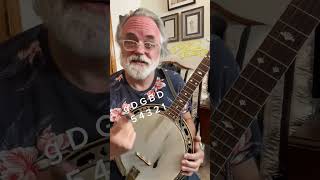
Created these for folks that want to "get on with it."
If you know anyone looking to learn banjo, these might just be the ticket!
Hope you enjoy!
Edited by - Bill Rogers on 12/19/2022 00:29:37

Thank you Jim, you are an inspiration!

Wonderful. Thanks Jim.
Hi Jim,
As a beginner I am getting decent speed but cant improv worth crap. I can play songs but I see videos of people like yourself demonstrating banjos and just playing off the cuff. Is there a video for improving like improv solos?
quote:
Originally posted by NotABanjoYoda
Is there a video for improving like improv solos?
I don't have anything like that. I talk about that sort of thing a lot in my live streams, but it comes down to this: if you want to be better at improvising you've got to start improvising. I can't show you how to improvise a solo, because in doing so I've shown you a solo and you're just doing what I'm doing.
Take the things I teach in my series here and start trying to apply them to other songs you can already sing or hum. Will it be awesome? Nope... but the more you do it, the better it'll get.
quote:
Originally posted by Jim Pankeyquote:
Originally posted by NotABanjoYoda
Is there a video for improving like improv solos?I don't have anything like that. I talk about that sort of thing a lot in my live streams, but it comes down to this: if you want to be better at improvising you've got to start improvising. I can't show you how to improvise a solo, because in doing so I've shown you a solo and you're just doing what I'm doing.
Take the things I teach in my series here and start trying to apply them to other songs you can already sing or hum. Will it be awesome? Nope... but the more you do it, the better it'll get.
I get what your saying. Let me bemore specific. Im a good guitar player and have no problems on guitar improving and playing whatever one can hum.
I can also do that guitar style licks on a banjo, So i could play plectrum.. But when i try to surround the melodies in my head with banjo rolls, the melodies sound slow and I havent found the secret sauce to change rolls up. Is there a good set of rolls that lends itself to surrounding your melody notes. I know sometimes its fine to solo like a guitar player would, but Im trying to not do that for now.
But Ill keep working at it so it will eventually not suck.
On the other hand, learning the banjo has greatly improved my chet atkins style!
quote:
Originally posted by NotABanjoYodaI havent found the secret sauce to change rolls up. Is there a good set of rolls that lends itself to surrounding your melody notes.
There's really no secret or set of rolls that you'll use. You just have to start trying different things.
That said you can get a lot done with cripple creek slides/rolls and foggy mountain breakdown rolls/hammers.
quote:
Originally posted by Jim Pankeyquote:
Originally posted by NotABanjoYodaI havent found the secret sauce to change rolls up. Is there a good set of rolls that lends itself to surrounding your melody notes.
There's really no secret or set of rolls that you'll use. You just have to start trying different things.
That said you can get a lot done with cripple creek slides/rolls and foggy mountain breakdown rolls/hammers.
Thanks Jim,
Im learning your version of Foggy Mountain now. I just today found My Grandfathers clock. I have looked at 6 different versions. I know you also have a video on it but havent made it there yet. This melody tabbed in scruggs style in multiple ways is the answer, for me. It is a melody of notes wrapped in different ways which allow for different speeds.
I think to my ear banjo requires different rolls. I was taught the melody roll, the double melody roll and whatever 52152121 or 53153131 is called to play melodies. They work but sound not right if one is used for most of the song.
Again, thanks. I only keep replying because I think this is a major hurdle to get over for us long term guitar players. New banjo players kinda just accept and learn new songs, as a long term guitarist, I wanna get to the end quicker....so to speak. But it did take me years to become a good guitar improv soloist.
Jim, I’ve been going through your Beginning Bluegrass videos from around 5 years ago. You have helped me so much! I can’t wait to watch these other videos.
Do you give private lessons? (I’m near Asheville.)
Jim's videos are a great help to all that want to learn, and he seems to be a great guy to boot.
Thanks for all you do Jim.
I'm just starting out and found these in a search! Will be giving this some attention and hopefully learning my first tune.
I just hope Jim is a YouTube millionaire!
I’ve learned a ton from him. Mostly how to learn.
Always a pleasure watching your vids Jim - [even though i am no longer a beginner] - I LOVED the 'Hanging Tree how to' posted a while back - pure inspiration and no, i cant play it as well as you despite trying really hard.....
hello all
new member here and hopefully a Banjo player one day ! saw Jims youtube videos and they inspired me enough to buy a 5 string . only started Friday so very early days .
but thanks Jim Pankey another week or two and i should be on lesson two lol
My banjo teacher finds your videos such a hoot. We love how you look sideways into the camera. Thank you for making banjo accessible to beginners. :)
Lets be realistic and honest. Like any musical instrument, it takes years and years and a lot of practice to become good at it. I've been playing the banjo for over 10 years, and I am still not as good as I want to be. Most professional musicians started playing in their teens. My take, if you didnt start at an early age, you'll never reach the level of playing that you would like.
quote:
Originally posted by NotABanjoYodaI think to my ear banjo requires different rolls. I was taught the melody roll, the double melody roll and whatever 52152121 or 53153131 is called to play melodies. They work but sound not right if one is used for most of the song.
Melody roll? Double melody roll? These strike me as misnomers and signposts to frustration.
No one or two rolls render melody all the time. Some come close, I suppose. Players who do it best render melody with every known roll pattern* and also context-specific patterns we might not think of when thinking about rolls.**
More importantly: The roll does not not come before the melody.*** The melody comes first. This defines the space in between melody notes available for us to play harmonizing notes from the current chord, passing notes from the current scale/key but outside the chord, or half-note-away leading tones.
Since it's tricky to play all the melody notes in a banjoistic way (within fluid roll patterns), we typically jettison the notes that aren't necessary to express a recognizable melody. And sometimes we might move/displace a melody note one place forward or back ("one place" being an eighth or sixteenth note, depending whether you think of the music as 4/4 or 2/4 and that's about my depth of understanding of that). Yes, the purpose of that is to more easily fit this core melody into rolls, or rather roll patterns, and the occasional non-roll or no-name picking sequence.
Interruption here to say that two-count hammers, slides, and pull-offs are common tricks for avoiding picking problems when you simply must have two consecutive notes on one string with no intervening rest or space.
And you don't have to play every available eighth (or sixteenth) note. Space is good. The occasional Thumb - Pinch - Thumb - Pinch onthe counts of 1-2-3-4 with nothing on the "and"s is a good thing. Or even four quarter notes without the pinches.
The connection of this to improvisation is that you can't improvise until you have the banjo vocabulary to improvise with. That includes being able to play lots of different rolls and the ability to break them up and recombine them in different ways to make the music you want to make at any particular moment.
Rendering melody in improvisation is a fairly advanced skill. It requires the relative pitch that tells you on the fly where the melody notes are within the chords and on the fingerboard. That's why many solos you'll hear at jams don't have a lot of melody but maybe hint at melody while being essentially scat singing on the banjo. Nothing wrong with that. It's music.
- - - - - - - - - - - - - - - - - - - - - - -
* 52152121 or 53153131 are not rolls. They are full measure roll patterns. And, technically, these are string sequences that imply the fingering roll patterns. "Rolls" are the basic units in finger movements, not strings: T-I-M forward, M-I-T backward, T-I-T-M square, M-I-M-T Osborne or Dillard. Even the "forward-backward" or "reverse" is more of a "roll pattern" than a roll, since it's a repeating pattern starting on "one" of every measure.
But, yes, I often call these rolls because it's easy to think and communicate about them that way.
Truly advanced playing comes when one can break away from measure-based patterns. I've been exposed to this concept twice at Bela Fleck banjo camps. It's not yet part of my playing. I don't have my lesson notes or tabs handy to describe the concept. Maybe later.
** Ricky Mier has an excellent FREE YouTube video on his concept of "Modes of Rhythm" in which he sees banjo picking not as the various 3-, 4-, 6- and 8-note patterns but a finite number of 4-finger combinations of the 6 possible 2-finger movements: T-I, T-M, I-M, I-T, M-T, M-I, plus three 4-note "modes" of directional rolls. I'm not sure this is a better way to think about picking patterns. But it does seem to identify every way we might pick. [Pay no attention to the character he plays in his videos]
*** OK, when improvising at performance speed at a jam on a song we haven't heard before or have never worked up a version of, then yes the experienced among us probably let our picking hands take over and dictate a roll pattern. Or maybe we make a simultaneous decision of what pattern to use at any moment based on which string(s) we want to play the melody notes. The only way I can describe it is that experience and my ear usually steer me to something that works. There is no shortcut. There are no cheats. There may be some patterns known to work -- such as forward roll or Foggy Mountain Breakdown Roll (pattern) for playing the melody up and down the second string. But there's no substitute for years (or at least many hours) of practical experience to be able to do it. Expcept for being an innately talented prodigy. They do exist.
Also experienced players learn to substitute licks for melody. And, melody is not always necessary. If you get the fourth or fifth solo on a song at a jam and a banjo has already gone before you, unless you have some remarkable way of playing the melody applying highly advanced technique maybe melody isn't so important at that point. Scat singing, remember?
Terms of Use | Privacy Policy | Privacy Consent (EU/GDPR Only)
Copyright 2026 Banjo Hangout. All Rights Reserved.