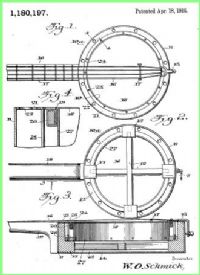
Anybody here know anything regarding the acoustic velocity of different banjo component materials and whether or how matching velocities and integrals of velocities impacts the sound? I've been thinking about it a lot lately since I began to think I'd like to make a 6AL-4V titanium tone ring. Beryllium copper would be interesting also because of it's high velocity but probably even more expensive for material.
7 Comments |
 | rachel.love says:
2/19/2011 9:24:41 PM
i don't know anything about it per se but you can always look up material properties and presumably, matching certain properties might give you a similar sound. your titanium alloy idea would probably sound SWEET. i've always wanted to make a carbon fiber tone ring and wonder how the heck that would sound.
maybe someone can contribute some more technical advice.
|
 | answerguru says:
2/19/2011 9:57:24 PM
Have you checked out Titan Banjos? ( titanbanjos.com ) Of course, they're not cheap, but they do have quite a few sound / video samples on their site for reference. If you seriously consider beryllium copper, please be careful as it's *highly* toxic if you breath in any machining dust.
|
 | David Cunningham says:
2/19/2011 10:13:12 PM
I had a look at the Titans a couple months back when I began to consider this. When I thought about making a ring from 6AL-4V I was at work and I got my titanium (6AL-4V) prybar out, hung it from the bent end on my finger and whacked it with a steel bar. It rang very nicely with sweet overtones and strong sustain. At around 6100 m/s it is a good bit faster than brass. I would be curious to compare that to a good aluminum bronze which is not in my tables for acoustic velocity. I actually occasionally have to machine BECU making airplane parts. We keep the work and cutters wet with coolant. I still wear a paper mask when I'm doing BECU or any other hazardous material. I make a part that is pure lead (about 90 lbs) as well. It's some sort of ballast weight. Handled with gloves of course. I'd also like to shave a few pounds off of my OB-250. I won't be messing with the Tenn 20 in my other one though. There are a few folks around here that have made their own titanium rings, one using the outside ring of a turbine or jet fan from a scrap engine.
|
 | phwill says:
2/21/2011 8:28:28 AM
Just thought I'd throw this in. You can determine sound velocity if you have access to an ultrasonic thickness meter or UT flaw detector and a piece of material with known thickness. You calibrate the meter to the known thickness on the material in question and the meter will calculate the velocity for you. That's a pretty common way to determine the velocity of a material in the nondestructive testing world.
This meithod is for determination of longitudinal waves. Shear and surface waves will be different from longitudinal waves in any given material.
Good luck.
|
| David Cunningham says:
2/21/2011 8:33:12 AM
We have the meter in the qc lab at work but I can't use it. What about a mic and pc based fft? Applicable?
DC
|
| phwill says:
2/21/2011 9:21:31 AM
I'm not sure a mic will work since they're geared for sonic waves and we're addressing the ultrasonic spectrum when we're dealing with material sound velocities. What the mic could help you do is determine the resonant frequency of a part after all of the machining and finishing is done, if you don't have an accelerometer available.
You might take a look at the ASNT Handbook on Ultrasonic Testing if you haven't already. They have a fair number of materials listed in there, there may be one/some that are close to what you're interested in.
|
| David Cunningham says:
2/21/2011 10:14:25 AM
Definitely. Thanks for contributing to my knowledge base on this one. I am also examining the option of making a birch block rim with a locust cap to be used on this experiment.
|
Post a Comment
|
You must be logged in and a member of this group to post a comment.
|