DVD-quality lessons (including tabs/sheet music) available for immediate viewing on any device.
Take your playing to the next level with the help of a local or online banjo teacher.
Weekly newsletter includes free lessons, favorite member content, banjo news and more.
Premier Sponsors


|
Please note this is an archived topic, so it is locked and unable to be replied to. You may, however, start a new topic and refer to this topic with a link: http://www.banjohangout.org/archive/408356
ToniV - Posted - 04/27/2026: 12:27:55
Hi, I'm new here and would like some advice please. I'm considering putting a compensated bridge on my banjo. I've read good things regarding intonation but I came across one of the Deering guys on YouTube saying that they really impact the sound and are a bad thing. I'd be very keen to get your thoughts on this.
Many thanks,
Anthony.
steve davis - Posted - 04/27/2026: 12:48:17
I think they can make the sound better.
The old heavy Grovers didn't sound as good as they could have had they been lighter in weight.
It was a common misconception that the compensated bridge impeded the sound of a banjo,but it is only because of their weight.
I've made compensated bridges as light as 1 gram and there's was nothing holding back its shrill and piercing tone.
I make a good sounding compensated bridge by keeping the weight between 2.2 and 2.3 grams for a great tone with plenty of punch and sparkle.
Stanley tone either side of 2 grams and Scruggs tones at 2.25 grams.
Alex Z - Posted - 04/27/2026: 15:43:28
Can you post a link to the YouTube Deering video?
Deering has been making compensated bridges for at least a dozen years. I'd like to hear the explanation on the video.
pinenut - Posted - 04/27/2026: 15:51:48
quote:
Originally posted by ToniVHi, I'm new here and would like some advice please. I'm considering putting a compensated bridge on my banjo. I've read good things regarding intonation but I came across one of the Deering guys on YouTube saying that they really impact the sound and are a bad thing. I'd be very keen to get your thoughts on this.
Many thanks,
Anthony.
Hi Anthony,
If you notice that with steel strings some of the notes don't sound right or rub you a little wrong; don't waste fifteen years figuring out that compensated bridges sweeten the tone. (Concerning nylon/nylgut strings, use a two-leg straight bridge. And remember, gDGBD sounds more together with the second B string tuned a few cents flat.)
Do it now, get a compensated bridge like Moon, Sampson or a Steve Davis.
Cheers
Edited by - pinenut on 04/27/2026 16:06:17
Old Hickory - Posted - 04/27/2026: 17:33:54
I've heard banjos sound better with a compensated bridge.
I've heard banjos sound no different with a compensated bridge.
I've never heard a banjo sound worse with a compensated bridge.
Your experience may be different.
Owen - Posted - 04/27/2026: 17:51:49
My experience has been that this type of mute
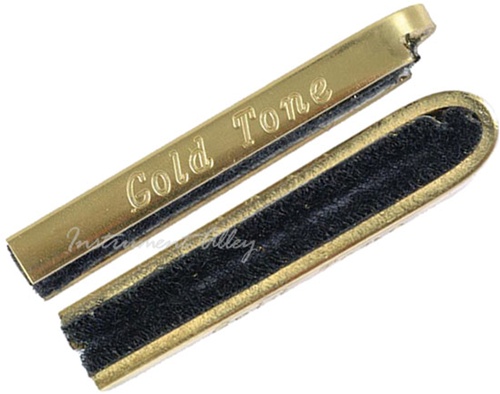
doesn't fit compensated bridges as well as it does straight ones. [But it does make my banjo sound "different."] 
Will Frady - Posted - 04/27/2026: 18:36:32
Depends on the banjo, some need a compensated bridge for intonation. Others maybe not ? I rather like a compensated bridge… over all . Best of luck
LouieChee - Posted - 04/27/2026: 19:58:54
Due to differences in stiffness, heavier gauge strings will pull sharper up the neck. I've never played a banjo that was immune to this physical phenomenon.
The question is, does it bother you? I'm sensitive to out-of-tune notes, so I like compensated bridges. I can't see why they wouldn't sound as good as a straight bridge, but others may have more ideas.
EEB - Posted - 04/28/2026: 01:19:28
Have you checked and adjusted your current bridge angle using harmonics at the 12th fret?
That would be a first step.
banjopaolo - Posted - 04/28/2026: 03:25:26
I have always used straight bridges (Scorpion bridge) and never had intonation problems… of course you must be very careful placing the bridge on the head in the right position…
Different is for Tenor banjo that has heavier strings and different tuning, in that case I keep the bridge (always straight bridge) not parallel to the frets so that the bass strings are a bit longer than the high strings (like is usual on acoustic guitars)
Bart Veerman - Posted - 04/28/2026: 07:48:54
You didn't tell us what kind of banjo you have and whether or not you have intonation problems. The function of a compensated bridge is to fix intonation problems - no more, no less. What a bridge will make a banjo sound like depends on the material and weight that the bridge is made of regardless of whether it's compensated or not
When the bridge is located at the proper spot then you can tell whether you do, or do not need one. Keep in mind that most banjos simply do not need a compensated bridge.
Here's how to get your bridge at the proper spot and whether you do, or do not need a compensated one. Don't worry, it's easy to do and it takes less time than putting on a set of new strings. Besides, it's really required knowledge for any and all dedicated banjoeys:
banjobridge.com/index.html">web.archive.org/web/20170808175559/banjobridge.com/index.html
RK-FenderPartsBanjo07 - Posted - 04/28/2026: 10:28:13
I get a straight bridge then I use a needle file to compensate it if it needs it. This method means my bridges are always compensated perfectly to my banjos.
ToniV - Posted - 04/29/2026: 03:10:23
Ok, if you go to YouTube and search How To Setup A Banjo with Greg Deering at around 3 minutes he will say about compensated bridges not being a good thing.
Alex Z - Posted - 04/29/2026: 10:59:04
Thanks. It's around the 5:00 - 6:00 mark.
For a company that has been making and selling compensated bridges for at least 13 years, Mr. Greg is out of his mind with the assertion -- not an explanation -- that "a compensated bridge cuts down on the tone immensely." Could be that he is talking about the Deering compensated bridge, which appears pretty chunky, like the old Grover and Shubb "stairstep" compensated bridges? That I would believe and have experienced.
Then he starts denigrating players that use a compensated bridge as not being able to play at the same level as "top pros," so therefore they would not care about tone.
Since there are many other types of bridges that provide differential compensation for the different strings, I wish he had explained why he thinks any type of differentially compensated bridge would "cut down on the tone immensely" just due to the fact that it is compensated. Is it the design of compensation or simply the large added mass of the stairstep compensated bridge?
steve davis - Posted - 05/20/2026: 16:10:57
My compensated bridge works with all banjos that use a straight nut.
It rearranges where the frets contact the strings.
My design makes all the 12th fret notes match the open or 12 fret harmonics.
This can't happen with a straight bridge.It sweetens the balance of the strings to each other and also makes it unnecessary to retune after capoing.
There is no reason for poor tone if the weight of the bridge isn't too light or too heavy.
I've carved compensated bridges as light as 1 gram.
Way too light for good tone.
A good sounding bluegrass bridge weighs between 2 and 2.5 grams in general.
I think a correctly compensated bridge sounds better than a straight bridge.I didn't design my bridge to fix a banjo with intonation problems.I designed it to have properties that a straight bridge can't realize.
Anyone can have a good sounding banjo with a straight bridge,but a compensated bridge provides a new way for notes to interact with each other.
Edited by - steve davis on 05/20/2026 16:15:38
Helix - Posted - 05/25/2026: 09:28:00
My dog can hear the difference , use a tuner
There is a math compromise
I spec them from Maple
I like older Bart Veerman and Kat eye and such. straights work better if everything else is in shape. A tighter head works better
One builder used an 11 “ rim on his lathe to set the proper curve! He used the OD
Once at a jam, the host said he knew a guy who could tell why they didn’t work
I replied , Then why do they?”
Remember Deering uses the nut,
Edited by - Helix on 05/25/2026 09:35:00
lazyarcher - Posted - 05/26/2026: 06:54:05
The Tim Davis banjo I recently acquired requires absolutely NO compensation. The neck is dead accurate. I use a John Coffey bridge right now, and the tone is amazing. A compensated bridge would be unnecessary.
Bart Veerman - Posted - 05/26/2026: 07:14:13
quote:
Originally posted by lazyarcherThe Tim Davis banjo I recently acquired requires absolutely NO compensation. The neck is dead accurate. I use a John Coffey bridge right now, and the tone is amazing. A compensated bridge would be unnecessary.
Yup, most decent banjos do not not not need compensated bridges.
Alex Z - Posted - 05/26/2026: 13:38:29
A more precise way to state the accuracy of differential string length compensation might be:
"A straight bridge -- assuming it can be positioned at a place other than exactly twice the distance from the nut to the 12th fret -- can on some banjos provide accurate intonation within the error band of my electronic tuner, within my perception of different pitches, and within my tolerance for out-of-tune notes in a tempered scale on a banjo that I play with the way I play it."
In other words, a straight bridge can be "good enough for me."
steve davis - Posted - 05/27/2026: 16:38:41
There is nothing wrong with my '29 tb-2 conversion neck made by Jimmy Cox,but it is improved in its intonation by my compensated bridge.
Jimmy did the ring-thing and set up and it was a dream come true.
It plays great with a straight bridge,but comparing the fretted notes to the harmonics at the 12th fret shows differences as will any banjo in the world with a straight bridge.
I wondered what would happen if I made a bridge that adjusts the strings to show 0 on the harmonics and 0 on all the 12th fret fretted notes.
I like the difference.
Edited by - steve davis on 05/27/2026 16:40:48
steve davis - Posted - 05/29/2026: 19:10:14
I made my first compensated bridge in 1977 from a piece of maple firewood while living up country in an old farmhouse with a geodesic dome-topped "silo" addition.
Many evenings were whiled away playing music,making state-of-the-art paper airplanes (long flight times) and thinking deep thoughts.
lazyarcher - Posted - 05/30/2026: 07:32:32
quote:
Originally posted by Bart Veermanquote:
Originally posted by lazyarcherThe Tim Davis banjo I recently acquired requires absolutely NO compensation. The neck is dead accurate. I use a John Coffey bridge right now, and the tone is amazing. A compensated bridge would be unnecessary.
Yup, most decent banjos do not not not need compensated bridges.
Ive played/owned banjos that benefited from a comp bridge, some needed a comp bridge, others absolutely did not require one.
A friends high end boutique banjo from a well respected builder absolutely needs one. My 89 Granada does not, as is my recently acquired Davis. Both match harmonics perfectly with a properly positioned straight bridge, the Granada with a slight 3rd string relief on the bridge..maybe 1/16 cut out?
My reasoning for not using a lot of comp bridges over the years is the lack of choices with comp bridges..although there are more now. I might go through 10 bridges on a banjo before I find one that the banjo responds best to. There are just more and better choices with straight bridges.
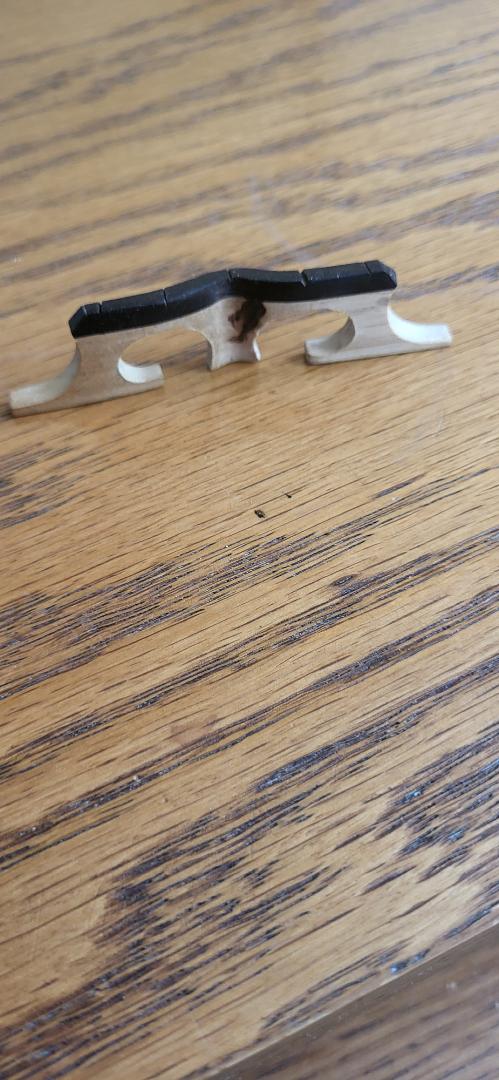
I do make comp bridges..heres a picture of a Beaver King comp..so I can use them if I want, but not generally needed.
chuckv97 - Posted - 05/30/2026: 08:02:58
Since I’ve gone to a tighter head on my banjos they intonate fine with a straight bridge,, as strings get older I angle the bridge a bit. Bart Veerman bridges work best for me.
steen - Posted - 06/01/2026: 15:06:32
1) The lower the action, the less need for compensation (but we can´t have it so low that the strings touch the frets :).
2) It is true that a stiffer string reacts more to being fretted (stretched and bent), but it is also true, that a looser string reacts more to fretting than a tighter one, so if you choose a set with a lighter third string (relative to the others) in order to get rid of a the intonation problem, there is no guaranty that you will succeed.
3) Theoretically every banjo ought to have a more or less compensated bridge, but in real life it does not always seem to be necessary (I don´t use them for cosmetic reasons and feel fine).
4) While many people I are happy with compensated. bridges because of better intonation, I have never ever in my long life heard about anyone complaining that the intonation had grown worse by changing a straight bridge to a compensated one. so------------. Steen
Edited by - steen on 06/01/2026 15:10:01
The Old Timer - Posted - 06/01/2026: 17:35:50
Just chiming in, for the record. I like straight bridges. I have tried the curved "Moon" bridge, didn't like it. I've tried the early grossly staggered (with square corners) bridge and didn't like it. I have one or two Snuffy Smiths with the tiny little cutout in the front of the ebony cap under just the 3rd string. At least this one is still in use and not back in the junk drawer.
Currently I do what each banjo needs in term of slanting the bridge to get the best average intonation.
All my banjos now are Gibsons, either factory 5 strings or Nichols or Sullivan conversion necks. Some intonate better than others.
As I've said before, I once asked Alan Munde how he could play all the complex up the neck stuff with such perfect intonation. His answer! "Well, it IS a Stelling..."
My own experience is that only my Vegas have had near-perfect intonation. A Scruggs, an Osborne, and the 1912 No. 7 that I still own. Vega simply used different fret spacing than Gibson. It was better. And no, I don't know how fret spacing can affect 12th fret intonation.
Edited by - The Old Timer on 06/01/2026 17:38:03
steen - Posted - 06/01/2026: 22:53:35
Frets are not always where they are supposed to be. I once made a "fretcheck" on my at that time 6 instruments (I can tell you how, if wanted). The best was a neck on a homemade banjo, that had a fretbord I had bought from StewMac, and the worst was a copy of the Beatles bass made in Taiwan, And the second worse was an old Gibson guitar that I still have and love. But I had never noticed anything before checking it out, and you do not hear minor irregularities. :). Steen
steve davis - Posted - 06/02/2026: 10:09:23
I never thought about curing intonation problems with a bridge.
I hung out with some electric guitar players and we had discussions on why they had adjustable string-length saddles and they talked about "sweetening" the notes chords to their tastes.
I wanted that for my banjo but soon figured out that a heavy mechanism like they had would destroy the tone and power of an acoustic banjo that is greatly affected by a few extra grams of weight in the bridge.
I talked to guitar luthiers about my decision to "zero" the bridge at the 12th fret and reap the benefits up and down the neck using the 12th fret as a "center" and they agreed that the 12th fret shape would improve the intonation up or down from that point.I've found that to be true upon close inspection with my Peterson Strobe tuner.
People enjoy playing guitars with adjustable saddles and they enjoy acoustic guitars with straight saddles.(Though there is a bit of "comp" in a Martin saddle.
The "W" patterns seen in electric guitar saddles are very similar to my compensated bridge pattern.
There are advantages and choices there.
steve davis - Posted - 06/02/2026: 10:18:08
Since the popularity of CNC and programmable cuts one can pretty much say that nuts and frets all agree with each other on banjos and guitars.
Homemade instruments might need a second look,I suppose,but there's no reason for that in these well documented times.
The truth is easy to find.
steen - Posted - 06/02/2026: 11:33:11
I completely agree. An intonation based on similarity with 12. fret chime and fretting on all strings is the best we can have. Some people think this can be found also in straight bridges, but I tink - only very close, and that may be good enough for some. Some people choose a straight bridge knowing that the intonation could be a little better ( - me) because it FEELS good enough (not knowing that it could feel still better :)).
I think that one day I will save my soul and buy one of yoour bridges Steeve, because all you write make perfectly sense to me. Also interesting to hear a little about the guitar path to your bridges. Steen
Dean T - Posted - 06/02/2026: 15:30:13
I went through a phase about 15 years ago, where I thought I needed compensated bridges, because so many folks here said we did. I tried some commercially available, and even made several of my own. I learned that for my playing ability, and my banjos, it didn’t make enough difference to worry about. By physics, open positions fret a little sharp by the nut. Action and relief varies things along the neck. And my fretting pressure differs between solidly grabbing chords, quick vs slow slides, crisp pull offs, different hammer ons. Etc. Even different fingers vary, and reaching for notes with a pinky can be different than landing the same note with ring or index. So even if I had a perfect banjo with a perfect bridge, my own playing varies enough to screw it all up. So my theory is that the longer we play what we have, the more we learn it’s nuances, and the more our own ear, and playing imperfections, offset our machines imperfections, and we make good music. I haven’t used a compensated bridge in many years.
Terms of Use | Privacy Policy | Privacy Consent (EU/GDPR Only)
Copyright 2026 Banjo Hangout. All Rights Reserved.