DVD-quality lessons (including tabs/sheet music) available for immediate viewing on any device.
Take your playing to the next level with the help of a local or online banjo teacher.
Weekly newsletter includes free lessons, favorite member content, banjo news and more.
Premier Sponsors


|
Please note this is an archived topic, so it is locked and unable to be replied to. You may, however, start a new topic and refer to this topic with a link: http://www.banjohangout.org/archive/408100
TexasTess - Posted - 04/09/2026: 06:32:57
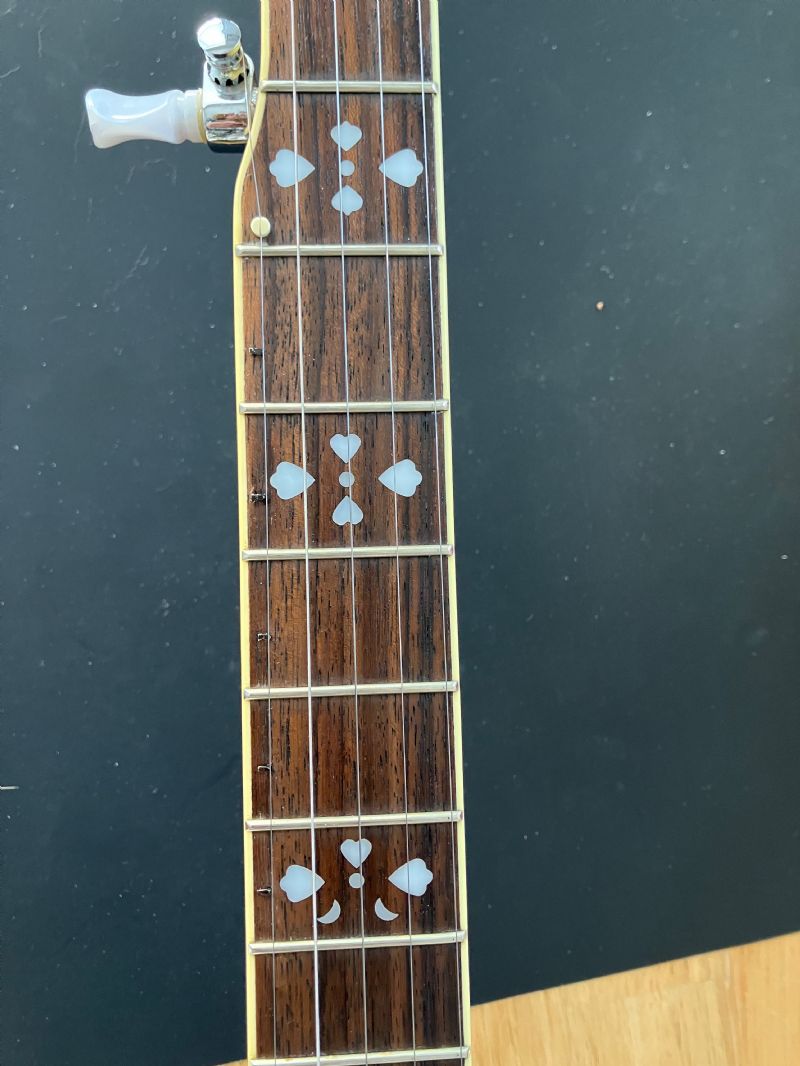
I just had spikes installed by the luthier recommended by my teacher. All of the videos I watched online about installing spikes had the opening facing the ground, but these were installed with the opening up. Don't know if that makes a difference? However my main issue is when I use the spikes the 5th string isn't in tune. If I use a capo and the old pen cap method on the 5th string it is in tune. My teacher is a guitar player who does banjo on the side (no other teachers in my area). He got a bit pissy when I mentioned the 5th string like I was insulting his luthier pal. He said 'just retune the string' but if I was just going to retune it each time why did I bother getting spikes? The whole point of using a luthier was because I didn't want to mess with the neck myself but now I'm not sure if the luthier is really a guitar guy and doesn't have experience with banjo. I guess my real question is, am I expecting too much? I don't want to make waves with my teacher but I'm thinking I'm going to have to go to someone else and get a second opinion, and then I'm not sure how much they can do without destroying the neck of the banjo. Thanks for any help.
Edited by - Texasbanjo on 04/10/2026 04:03:33
Sunrise Lee - Posted - 04/09/2026: 06:46:35
I think it is pretty common to have to tune a little after spiking the string. One of my banjos has larger frets so the "pull" on the string after spiking brings it way more out of tune than my other banjos. To answer the why would you bother getting spikes, to not over stress the string as by tuning the 5th sting up to whatever key you are playing in, or to keep the strings in the appropriate place should you fret the 5th string in a song.
Just all part of the banjo tuning fun.
Owen - Posted - 04/09/2026: 06:56:46
.... don't overthink this. The spikes look okay [to me], and in any event, moving them or removing them shouldn't destroy the neck.
If all else fails you can just join: "Half the time tuning and the rest of the time playing out of tune." 
Edited by - Owen on 04/09/2026 06:59:57
RB-1 - Posted - 04/09/2026: 07:03:01
Guitar guys advicing about banjo can be a gamble.
Most common today would be having the openings facing down, not up.
But when done right it should work just as good.
Remember, when applied, a spike is always 'pulling' on the string and therefore introducing a little 'pitch up', so yes I'll always do a bit of fine tuning.
I am also seeing a spike at fret 6. This is uncommon as there are hardly situations where the keys of G# or C# are required. But it is not wrong per se.
What is common though (but correct at your bannjo) is leaving out the spike at fret 8 and retuning for Bb. This will disturb the relatuon between notes on the 1st and 5th string, where the same frets should give you the same pitch.
Maybe these people are never fretting the 5th string, but once leaving the rank beginner level that won't be an excuse any longer.
In your case that won't be a problem.
Things to check are:
Once spiked and tuned the string should have a clear, unmuted sound, similar to that of the 'unspiked' string
And second, when fretting the 5th string with your thumb at any position the sound should be clear too.
trapdoor2 - Posted - 04/09/2026: 07:04:22
Spike direction is simply preference.
Re-tuning is normal. You've tuned the string unspiked, it should be a little sharper when under the spike...and its tuning will need to be tweaked. When moving from one spike to another, you might not need to tweak the tuning...maybe.
Using a capo, you should be tweaking the whole banjo's tuning anyway. I never trust any of mine to keep perfectly in tune anytime I capo. You see tuners on professional players' banjos in videos and onstage...constant checking/tweaking of tuning is part of playing any instrument.
Culloden - Posted - 04/09/2026: 07:22:38
I have installed spikes facing both directions. I always install them facing the center of the fingerboard now but there was a time when it was easier for me to put them in the other way. Whichever way they are installed, you are going to have to tweak the tuning. That's part of banjo physics.
When I install spikes, I only put two in the neck; one at the seventh fret, and one at the ninth. If i play in Bb, I spike at the ninth fret and tune down. On the rare occasions I capo on the fifth fret, I spike a the ninth fret and tune up.
Edited by - Culloden on 04/09/2026 07:26:46
slammer - Posted - 04/09/2026: 08:21:29
Retuning is normal when using spikes or capo. Just the way it is. When it starts getting difficult to tune my banjos and they don't stay tuned for more than a song or two, it’s usually an indication for new strings.
Slammer!!!
Alex Z - Posted - 04/09/2026: 08:23:31
Notice that your 5th string is further from the edge of the fingerboard than the 1st string. (Result is that the space between the 1st string and 4th string is smaller than the other spaces.)
Also, the shaft of the spike is not directly below the string (as is done on most all banjos I've seen) but rather offset toward the edge of the fingerboard. Maybe the concept here was that the player could fret the string straight down without having the string touch the spike. Other banjo luthiers solve this situation by putting the shaft directly under the string and then filing down the top of the spike so that it is lower than fret height.
Given the position of the 5th string far from the fingerboard and the design of putting the shaft next to the string rather than under the string, then if the luthier had pointed the opening toward the 4th string the shaft would be much closer to the 4th string and the end of the spike even closer.
The reason the 5th string is going sharp is (a) under the spike the string is being pulled down more than if it were fretted -- and this happens on most all banjos and (b) the string is being pulled sideways as well, toward the the edge of the fingerboard. That is, the string is being stretched two ways, not just one, and the result is a change in pitch more than with a different design of spike placement.
What to do about it now? I don't know. Depends how much it bothers you.
Myself, I prefer spikes in frets 7-10, no skipped frets and tuning up or down. I use the 5th string a lot and want to retain the pitch relationship with the other strings.
Edited by - Alex Z on 04/09/2026 08:24:14
BobbyE - Posted - 04/09/2026: 08:44:10
Retuning 5th string when spiked is not uncommon at all. With a spike correctly installed, the string is pulled down with a lot of force over the fret resulting in the string going a bit sharp. Same as incorrect fretting with the finger tip can cause tuning issues. Use this as ear tuning for getting your banjo in tune without a tuner even if you normally use one.
Bobby
Dean T - Posted - 04/09/2026: 08:48:16
When you use the spikes, retuning becomes second nature. You get so used to how much to turn the 5th string knob after spiking, that you do it without thinking. A quick comparison with the fretted 1st string and play on. At gigs, I’m ready before our singer can announce the next song.
I’m only a year into using spikes, after playing over 20 years without them. I would NEVER go back. I had one banjo done professionally, and did my other two myself. I fret the 5th string and it lot, so have my spikes all facing the floor. I didn’t want to get my thumb impaled by them.
mrbook - Posted - 04/09/2026: 09:28:21
I have three banjos with the spikes facing down (two I did myself) and one that came with the spikes facing up. The installation with the spikes facing up looks a bit neater for some reason, but I'm not sure I like it as much. I don't dislike it enough to change it, however. Pulling the string down under the spike increases the tension, so you have to retune a bit, but only a little.
chuckv97 - Posted - 04/09/2026: 10:05:51
I usually have to retune slightly when spiked. Also, if you have a pip like yours ,, many banjos do,, spiking definitely puts the pitch out a bit.
Old Hickory - Posted - 04/09/2026: 10:09:28
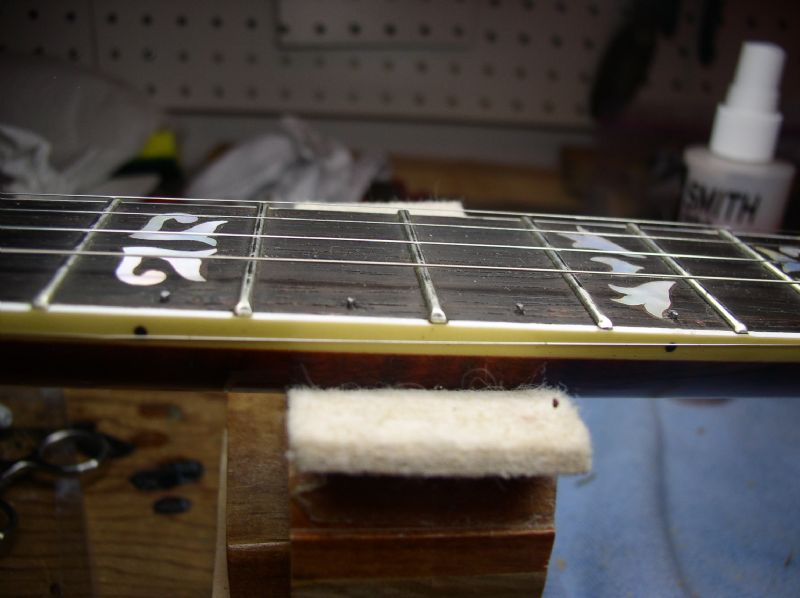
Nothing to add except to share this two-part how-to video from Richie Dotson on installing spikes. Reinforces everything Alex says about the shaft being directly under the string. Spikes on my oldest banjo when it was built in 1973 were installed staggered on either side of the string and away from it, as shown in a drawing circulating in that era. It was in APpendix 2 of Pete Wernick's "Bluegrass Banjo" and included with spikes I bought from First Quality later on when I wanted to spike another neck.
The linked video here was created around the time I needed to add and relocate spikes on my banjo and wanted to learn if there was a better way than what I had done decades ago. There was! I've now done four necks following Richie's instructions and getting ready to do a fourth.
Old Hickory - Posted - 04/09/2026: 10:11:46
Spikes in my 1973 banjo after seeing the Richie Dotson video: 8th fret added, 7th, 9th and 10th relocated. Holes filled with Minx Blend-Fil or brown crayon.
Edited by - Old Hickory on 04/09/2026 10:12:18
Bart Veerman - Posted - 04/09/2026: 12:29:26
quote:
Originally posted by Dean TWhen you use the spikes, retuning becomes second nature
Not a biggie, no point making it one. It's just one of them weird properties that belong in the 5 string world.
Banjos are about having fun, go have some already 
Old Hickory - Posted - 04/09/2026: 15:39:15
quote:
Originally posted by Old HickoryI've now done four necks following Richie's instructions and getting ready to do a fourth.
Holes filled with Minx Blend-Fil or brown crayon.
Put brain in geear before typing!
I've done four necks following Richie's instructions and getting ready to do a fifth. Maybe I'll do a fifth after doing the fifth.
Also: Holes filled with Minwax Blend-Fil . . . not "Minx.
Edited by - Old Hickory on 04/09/2026 15:40:47
deestexas - Posted - 04/09/2026: 15:55:50
In my experience, another important factor is the height of the slot on fifth string pip. If the height of the fifth string is as high as the other four strings at the fifth fret, spiking it will increase the pitch significantly more than a fifth string which rests on the fifth fret. I do far less re-tuning when the fifth string is stretched less.
Owen - Posted - 04/09/2026: 16:24:57
"Maybe I'll do a fifth after doing the fifth."
Sounds awright to me...
.
John Yerxa - Posted - 04/09/2026: 21:23:01
A lot of agreement here, and Alex Z has a good point about the string being pulled sideways as well as down. I can only add that one of the reasons this is so is that the pip is located pretty far toward the center of the fretboard. I can't tell for sure if the fifth string is resting on the fret, I assume so. Having someone relocate the pip laterally - doable, but probably not DIY - might alleviate the problem a little, by aligning the string more closely with the spikes.
TexasTess - Posted - 04/10/2026: 04:27:45
Thanks All, I appreciate the feedback. I wasn’t sure what to expect and my teacher isn’t helpful in this area as his banjo isn’t spiked (and actually he says he had never heard of this until I brought it up). I will just work on my retuning then.
TexasTess - Posted - 04/10/2026: 04:30:06
quote:
Originally posted by Bart Veermanquote:
Originally posted by Dean TWhen you use the spikes, retuning becomes second nature
Not a biggie, no point making it one. It's just one of them weird properties that belong in the 5 string world.
Banjos are about having fun, go have some already
Good Advice!
RB-1 - Posted - 04/10/2026: 07:11:39
quote:
Originally posted by TexasTessactually he says he had never heard of this until I brought it up
That is outright painful.
Similar like a banjo teacher telling you he's not aware of finger picks and considering flat picks the only types around...
I bet he has never heard of the Banjo Hangout.
TexasTess - Posted - 04/10/2026: 07:26:09
quote:
Originally posted by RB-1quote:
Originally posted by TexasTessactually he says he had never heard of this until I brought it up
That is outright painful.
Similar like a banjo teacher telling you he's not aware of finger picks and considering flat picks the only types around...
I bet he has never heard of the Banjo Hangout.
My teacher is a guitar teacher - he has already asked me 3 times if I wouldn't rather learn guitar. But since he is the only one in the area willing to teach I have to take what I can get. Usually its me going on youtube and making a Bluegrass suggestion and then we work on that song. Its a bit frustrating that he can't direct me but again, its better than my trying to figure out things on my own.
Texasbanjo - Posted - 04/10/2026: 08:13:19
I'll go a little off the subject and say this: there are a lot of online teachers that can get you started on how bluegrass banjo should be played. You might be better off going to one of them than counting on a guitar picker to show you the correct way to play banjo. I'm sure people on here would be happy to give you names of good teachers. Just start another thread on online teachers.
Okay. Back to the subject. I agree with other above: it's fairly normal to have to tweek the 5th string a little when you capo. My Stelling is pretty good about staying in tune on the 5th when capoed, but sometimes I still have to retune just a tad.
banjonz - Posted - 04/10/2026: 16:57:11
I am the only one in my region here that does spikes. I ALWAYS have the head facing down and the shaft just a wee bit higher than the plane of the string. This enables the head to be positioned UNDER the string. When pushing the string under the spike, the string stays in the same position relative to the fret board. The ones this luthier has installed is always going to sound sharp because it is pulling the string beyond its capoed note.
jt80 - Posted - 04/10/2026: 18:17:50
Does the fact that the scale length on that string doesn’t match the scale length of the fretboard contribute here?
Seems like the sliding shubb 5th capo I have doesn’t do much better and I always have to retune, too.
banjoec - Posted - 04/11/2026: 04:47:59
A build to order banjo I purchased from Deering arrived with spike openings facing up.
Ks_5-picker - Posted - 04/11/2026: 07:23:49
My Huber banjo has the spikes facing down. It requires less tuning than any banjo I’ve ever had on the first four,I played two hours last night without having to adjust it once. The fifth always needs a tweak when it’s changed however.
I believe your bridge needs to move left very slightly. That will help the tuning somewhat.
steve davis - Posted - 04/12/2026: 05:34:23
The pip in the pic is behind the 5th fret maybe 1/8".
This affects the intonation of the 5th string when fretted or spiked.
By letting the 5th string rest directly on the 5th fret by deepening the pip notch the spiked or fretted 5th string will require very little if any retuning.
A correctly intonated bridge further improves 5th string intonation.
I love spiking a string and not having to retune.
Cox necks have the pip installed haifway into the 5th fret.
Edited by - steve davis on 04/12/2026 05:36:55
TexasTess - Posted - 04/12/2026: 07:46:00
quote:
Originally posted by Ks_5-pickerMy Huber banjo has the spikes facing down. It requires less tuning than any banjo I’ve ever had on the first four,I played two hours last night without having to adjust it once. The fifth always needs a tweak when it’s changed however.
I believe your bridge needs to move left very slightly. That will help the tuning somewhat.
Thank you very much - that is helpful advice about the bridge! Ill give it a try.
Edited by - TexasTess on 04/12/2026 07:47:56
The Old Timer - Posted - 04/12/2026: 09:13:16
Earl Scruggs mentions this issue in his 1960s instruction book.
He also had to tweak the 5th string when capoing with nails. He did this SO MUCH (with a friction 5th peg no less) that he had the muscle memory to tweak the 5th strings without sounding it!
However, speaking about this issue in his book, he said he permanently solved the problem by removing the 5th string "pip" (nut) and putting a nail in its place so that the 5th string rested directly on top of the 5th fret. The nail simply prevented the 5th string from sliding off the edge of the fingerboard. This eliminated the height that the capo nail had to pull the string down from. Same concept as a "zero fret" on an electric guitar.
I started out with Vega Pittman sliding capoes but never liked the added bulk hanging on the side of the neck. Switched to capo nails almost 50 years ago and never looked back. Although they are a bit "fussy" to live with.
steve davis - Posted - 04/15/2026: 08:13:46
It also helps to have the spike(s) located directly under the 5th string rather than inside or outside of the string's line.
This requires precise height and dressing of the spike's top.Location just slightly forward of the halfway point between the frets.
Edited by - steve davis on 04/15/2026 08:14:47
steve davis - Posted - 04/16/2026: 09:09:35
Spike needs to be set at .012 under the head and top sanded smooth.
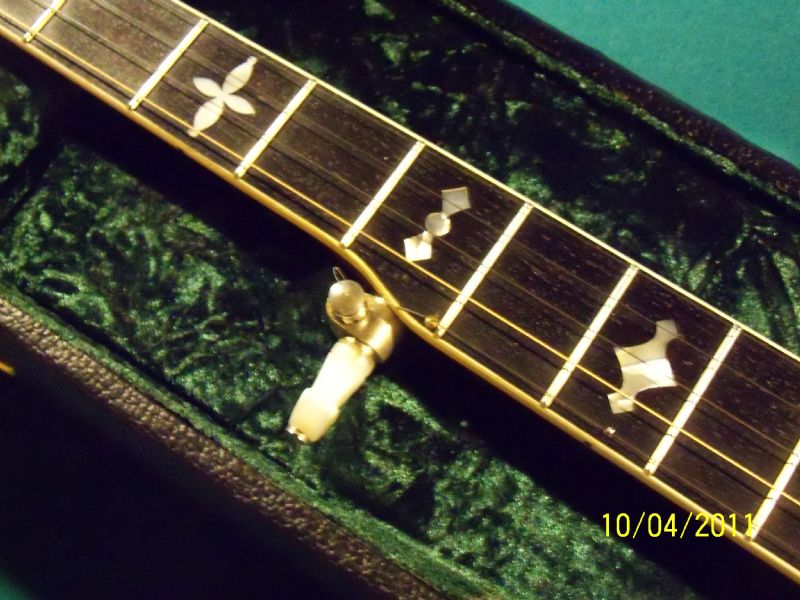
Pictured is a '79 GF 85 Gold Star whose pip is very well placed against the 5th fret,but I went further by replacing the pip with a brass pin that lets the string rest firmly on top of the 5th fret.
Edited by - steve davis on 04/16/2026 09:14:38
BG Banjo - Posted - 04/16/2026: 11:21:24
quote:
Originally posted by jt80Does the fact that the scale length on that string doesn’t match the scale length of the fretboard contribute here?
Seems like the sliding shubb 5th capo I have doesn’t do much better and I always have to retune, too.
I have an old no name banjo that a friend gave me and the 5th string pip is a little brass screw. The string runs through the slot in the head and you can raise or lower it by simply screwing it in or out to where you want it.
Jim V - Posted - 04/17/2026: 09:43:42
The depth of the spike can slightly change the tone. If it is slightly shaped, raise the spike or visa versa.
RDP - Posted - 04/18/2026: 10:43:17
Banjo players are tuning a lot. Lots of jokes and poking fun because on it. It’s the nature of the beast.
steve davis - Posted - 04/19/2026: 08:11:04
With my compensated bridge and 5th string on the 5th fret I play for days without retuning.
Nice to be in tune all the time.
Terms of Use | Privacy Policy | Privacy Consent (EU/GDPR Only)
Copyright 2026 Banjo Hangout. All Rights Reserved.