
DVD-quality lessons (including tabs/sheet music) available for immediate viewing on any device.
Take your playing to the next level with the help of a local or online banjo teacher.
Weekly newsletter includes free lessons, favorite member content, banjo news and more.
Premier Sponsors


|
Please note this is an archived topic, so it is locked and unable to be replied to. You may, however, start a new topic and refer to this topic with a link: http://www.banjohangout.org/archive/408091
Pierrot76 - Posted - 04/08/2026: 09:31:14
Hi everybody , how to place a Rover banjo bridge compasented . I have read that you have to place the Rover banjo bridge compensated with the Rover brand towards the tailpiece . Is it correct? Thanks you
Cordialy
steen - Posted - 04/08/2026: 10:16:46
Any compensated bridge (also Grover) must have the notch for the third string closest to the tailpiece. Steen
jenorma1 - Posted - 04/08/2026: 10:21:33
compensated bridges are made (at the very least) to lengthen the vibrating length of the 3rd string in comparison to a standard bridge. If there is a notch in one side of the bridge, place it so that that this notch is facing the neck rather than the tailpiece (thereby slightly increasing the vibrating length of the 3rd string)
Bart Veerman - Posted - 04/08/2026: 10:27:15
The name on the bridge needs to face peghead, not the tail piece.
Old Hickory - Posted - 04/08/2026: 10:39:19
quote:
Originally posted by steenAny compensated bridge (also Grover) must have the notch for the third string closest to the tailpiece. Steen
Since the purpose of a third-string notch is to lengthen the third string, I'd suggest a more clear description would be: The opening of the third string notch must face the neck.
GrahamHawker - Posted - 04/08/2026: 10:58:13
quote:
Originally posted by Bart VeermanThe name on the bridge needs to face peghead, not the tail piece.
Not for Grover compensated bridges, which I guess is the case here.
pinenut - Posted - 04/08/2026: 11:16:19
note: a couple of layers of iron-on maple edge binding (~.005") on the bottom of the center leg and trimmed flush with scissors improves function and tone on less rigid bridges (stairsteps in particular).
Edited by - pinenut on 04/08/2026 11:24:26
Pierrot76 - Posted - 04/08/2026: 14:53:51
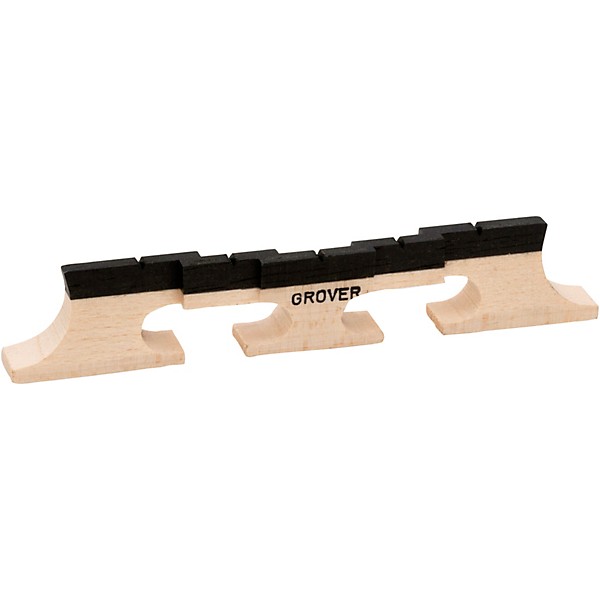
Hi! Thank you for your answers and you are divided. The bridge I bought is a Grover Tune-Craft as in the photo of Pignon. So if I have to lengthen the rope to have a good intonation, I must turn the bridge with the Grover brand towards the tailpiece since the notch of the 3rd string is in front in the photo. It’s good ?
Cordially
Owen - Posted - 04/08/2026: 15:38:06
quote:
Originally posted by GrahamHawkerquote:
Originally posted by Bart VeermanThe name on the bridge needs to face peghead, not the tail piece.
Not for Grover compensated bridges, which I guess is the case here.
I've read on BHO that the makers' mark [for "conventional" bridges] goes toward the tailpiece, AND that it goes toward the neck/peghead. Lately the latter seems to be holding sway.
[If it's good enough for BHO, it's good enough for me.  ]
]
Bart Veerman - Posted - 04/08/2026: 19:24:52
quote:
Originally posted by GrahamHawkerquote:
Originally posted by Bart VeermanThe name on the bridge needs to face peghead, not the tail piece.
Not for Grover compensated bridges, which I guess is the case here.
who knew... thanks!
HSmith - Posted - 04/09/2026: 01:40:58
Hi
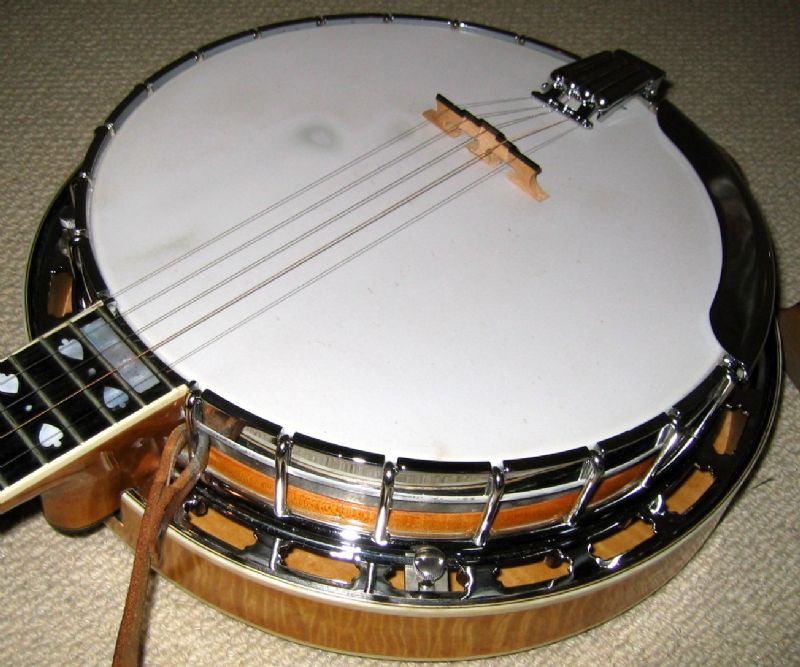
I had one of these bridges on my old Masterclone for many years. Here's a photo to show correct orientation. FWIW, the bridge worked very well ensuring good intonation (I played a lot of melodic stuff in the higher registers) but it was a little heavy and I don't think it produced the best tone. Here in the UK in the 70s, there was very little choice of banjo bridges, and at the time it was the best I could get. Better choices are available today.
HSmith - Posted - 04/09/2026: 08:07:57
Re my earlier post. I should perhaps add that my bridge was made and distributed by Rick Shubb rather than Grover, but the design seems identical and orientation on the head should be as in my photo attachment.
mikehalloran - Posted - 04/15/2026: 18:17:24
quote:
Originally posted by HSmithRe my earlier post. I should perhaps add that my bridge was made and distributed by Rick Shubb rather than Grover, but the design seems identical and orientation on the head should be as in my photo attachment.
Actually, though the Shubb and Grover stairstep bridges look the same (other than placement of the logo), they were not.
Elderly used to carry an ebony mute for these. There were two part numbers and they were not interchangeable. Somewhere in a banjo case, I still have one of those mutes but I couldn't tell you which bridge it fits. When I went back to wound 3rd strings, I went back to straight bridges on all my banjos.
Old Hickory - Posted - 04/16/2026: 14:41:28
quote:
Originally posted by HSmithRe my earlier post. I should perhaps add that my bridge was made and distributed by Rick Shubb rather than Grover, but the design seems identical and orientation on the head should be as in my photo attachment.
My recollection is Rick Shubb invented the stair-stepped compensated bridge. Maybe in teh late '70s or sometime in the '80s. I bought at least one original Shubb that had his name on it.
Some time later, he announced (maybe through Banjo Newsletter) he getting out of the bridge business and offering his design to the public for anyone to make bridges without needing a license from him or to compensate him in any way. Guess that pun is intended!
If the Grover version is any different, I'm guessing it's because they didn't copy Shubb's original design exactly.
quote:
Originally posted by Pierrot76Hi! Thank you for your answers and you are divided. . . . So if I have to lengthen the rope to have a good intonation, I must turn the bridge with the Grover brand towards the tailpiece since the notch of the 3rd string is in front in the photo. It’s good ?
The explanation for why we were divided has two parts:
1: Compensation lengthens the the third string. So the correct orientation of the bridge is always the one that accomplishes that function. Always. We are not divided on that. The name or logo on the bridge performs no function, so while it usually faces the neck it may not always do so, and does not have to.
2: Those of use who said the name faces the neck most likely did not know the Grover (or Rover?) bridge had the name on the backside. We can't know every bridge. And looking at the bridge, it's easy to see why the name is on the back side: There is no flat surface on the front side long enough for the name.
Terms of Use | Privacy Policy | Privacy Consent (EU/GDPR Only)
Copyright 2026 Banjo Hangout. All Rights Reserved.


