DVD-quality lessons (including tabs/sheet music) available for immediate viewing on any device.
Take your playing to the next level with the help of a local or online banjo teacher.
Weekly newsletter includes free lessons, favorite member content, banjo news and more.
Premier Sponsors


|
Please note this is an archived topic, so it is locked and unable to be replied to. You may, however, start a new topic and refer to this topic with a link: http://www.banjohangout.org/archive/407914
timsch - Posted - 03/26/2026: 16:04:37
I got a set of classical guitar strings (normal tension per manufacturer) to use on my basic Goodtime with a Renaissance head. Gauges are 0.028, 0.033, 0.040 & 0.032 (wound), 0.028.
Reading here today, recommendations are frequently to use smaller gauge. I got the recommendation to use classical from perusing this forum.
What can I expect from these heavier gauge strings?
Edited by - timsch on 03/26/2026 16:07:19
Bill Rogers - Posted - 03/26/2026: 17:32:54
. I use high-tension nylon strings on my two nylon-strung banjos. I find they replicate the feel (resistance when struck) of steel strings. Plenty of volume; not ringy. I play clawhammer and that works for me. If I played finger style, I would use different strings. Experiment until you find what works for you to play what you want.
trapdoor2 - Posted - 03/26/2026: 17:47:13
Everybody is different. I am like Bill, I prefer the resistance of heavy nylon when doing the clawhammer thing. For Classic fingerstyle, a little lighter...but nowhere near historical standard (which are like spider silk).
Run what you like.
KCJones - Posted - 03/26/2026: 18:55:31
Aside from the gage, nylon strings require more setup adjustment to sound good. You might want to look into 3/4" bridge, one that is as lightweight as possible and bare maple rather than ebony-capped.
timsch - Posted - 03/26/2026: 20:06:23
quote:
Originally posted by KCJonesAside from the gage, nylon strings require more setup adjustment to sound good. You might want to look into 3/4" bridge, one that is as lightweight as possible and bare maple rather than ebony-capped.
I made a 5/8" bridge from bare maple and at 1st fitup tonight, it does look like it'll be too low. I needed a 1/2" on my vegaphone with steel strings and was thinking that an extra 1/8" would be enough on this one. I should have thought more about it.
I'd read that 0.2 grams was about as light as would be recommended, but maybe that's for steel strings. How light is too light for nylon? I could certainly make it lighter than 0.2 grams.
davidppp - Posted - 03/26/2026: 20:29:44
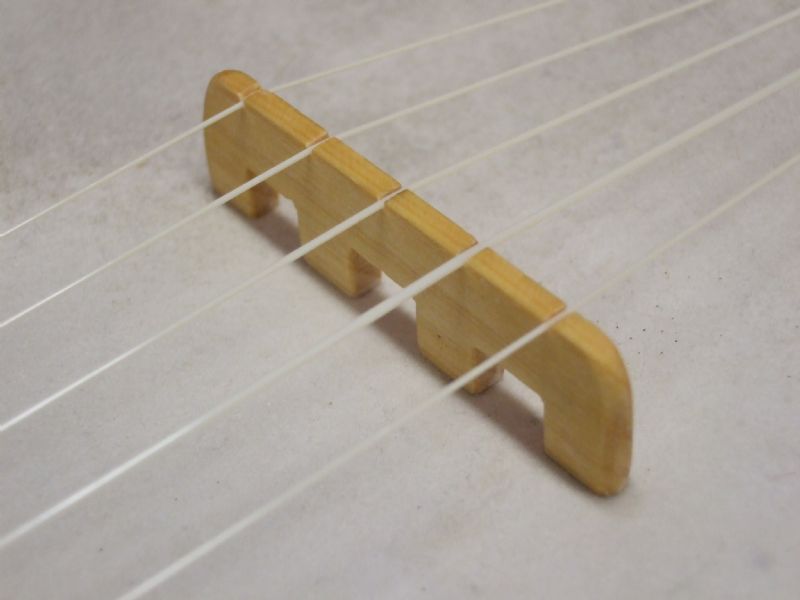
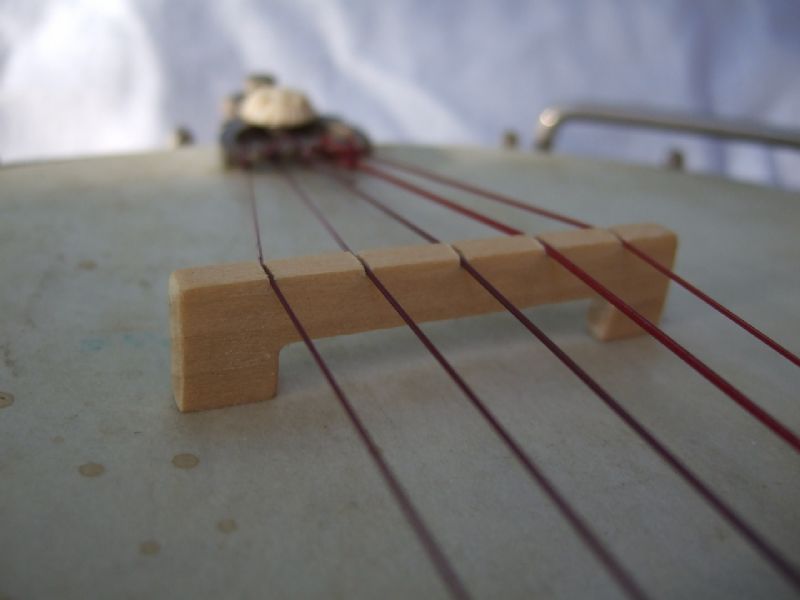
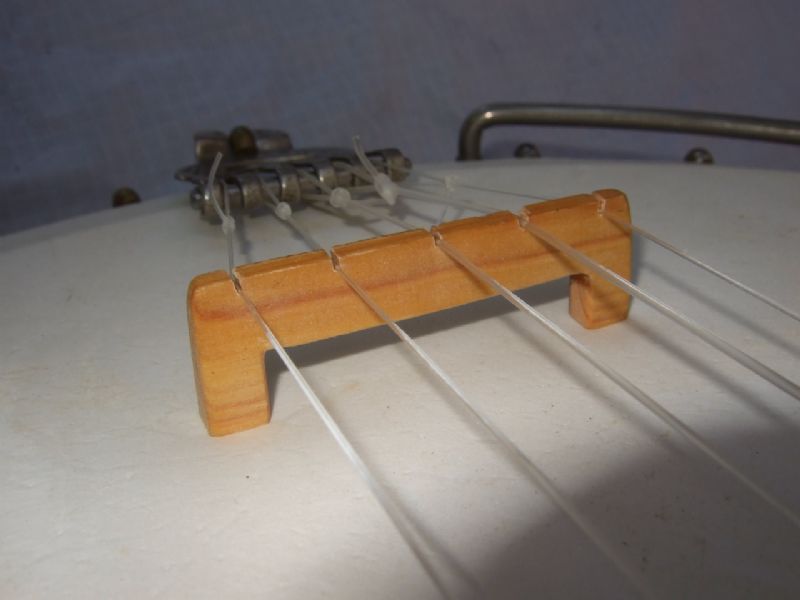
The 0.2 was actually 2.0 grams. You can certainly go down to 1.0 g. I figure it shouldn't be thinner than 1/8". By the time you make it the desired height and sturdy enough to support the strings, you probably can't get particularly lighter than 1 g. On the light-heavy axis, lighter gives you more punch, louder initial sound, and shorter sustain.
The virtue of making your own is that you can easily experiment, especially since there's no need for a hardwood cap. I think that any kind of wood is worth a try.
Pictured are a few of my homemade ones in the traditional style. Joel Hooks pointed out that the outer slots were angled inward.
Joel Hooks - Posted - 03/27/2026: 05:43:35
I cannot speak to using heavy guitar strings to simulate wire tensions (why not just use wire?).
But period bridges were often less than 1mm thick at the top. Arbitrary weight limits are meaningless.
I expect that heavy guitar strings would destroy a classic period sized bridge.
Spudwheat - Posted - 04/11/2026: 16:40:48
quote:
Originally posted by trapdoor2Everybody is different. I am like Bill, I prefer the resistance of heavy nylon when doing the clawhammer thing. For Classic fingerstyle, a little lighter...but nowhere near historical standard (which are like spider silk).
Run what you like.
I prefer Deering Vintage Lights for clawhammer. :-)
timsch - Posted - 04/12/2026: 09:09:27
quote:
.......I prefer Deering Vintage Lights for clawhammer. :-)
I'll give those a try. I am curious about using fishing line, but will need to find some fishermen to get some lengths from since I don't see buying several long rolls of line.
The ones I posted about had two of them break within a couple of days, so they were at the limits of their tension. They weren't the highest quality, so that didn't help. I wasn't terribly pleased with the sound anyway.
I restrung it with the steel strings that were on it before and it still doesn't have the plunky sound I'm looking for even with the change from frosted top Remo to the Renaissance head.
Edit: I posted this with the assumption that the Deering Vintage lights were nylon since that was what this thread was about. Looks like that's not the case from what I see. Let me know if otherwise.
Edited by - timsch on 04/12/2026 09:13:09
Spudwheat - Posted - 04/12/2026: 09:24:57
Deering Vintage Lights are steel. If you'd pardon me, I might've missed the part about your desire of the plunky sound. I don't think those lights will give you that. I have heard that you can use fishing line, as well. But knowing the properties of monofilament line, it tends to break easily if it is nicked at all. This would mostly apply to the 5th string capo if it is a RR spike. Good luck finding just the right nylon strings... Then, you can plunk away ;-)
davidppp - Posted - 04/12/2026: 10:23:48
Fishing line works fine -- or, rather, works. However, it comes by the 100's of yards, and it might take some experimenting to find the right gauge for the application. Also, it sounds rather dull compared to musical nylon strings, which have been "rectified," i.e., ground to a uniform diameter. (Aren't gut strings subject to non-uniformities? That must be part of the attraction and why you pay more for "better" ones.) My favorite mountain banjo builder put fishing line on the instruments he sold.
As to breakage, I've never noticed a problem with fishing line or commercial (music) nylon. Aquilas are another thing altogether. Joel Hooks characterized them as polyester. In any case, those do suffer from breakage of all sorts.
timsch - Posted - 04/12/2026: 10:57:16
quote:
Originally posted by SpudwheatDeering Vintage Lights are steel. If you'd pardon me, I might've missed the part about your desire of the plunky sound. I don't think those lights will give you that. I have heard that you can use fishing line, as well. But knowing the properties of monofilament line, it tends to break easily if it is nicked at all. This would mostly apply to the 5th string capo if it is a RR spike. Good luck finding just the right nylon strings... Then, you can plunk away ;-)
Admittedly, I never mentioned plunky, but that sound is my goal when trying nylon in the 1st place. I never had a problem with the steel, and admit that my Goodtime with the standard light strings is incredibly easy to play and doesn't sound particularly bad to my ears. That being said, I played for a contra dance last night and got pretty tired of hearing my bright 5th string on the bum-diddys....
Listening to so many old time (style) recordings lately, I notice that for clawhammer, the plunk is king. Not many bright OT style recordings I'm hearing. Not just trying to follow the crowd or conform - I really do like that sound.
Joel Hooks - Posted - 04/12/2026: 11:18:20
The problem with most fishing line (esp the price point which people who are trying to avoid paying for music strings) is that they are made for catching fish.
Fishing does not require equal diameter or density.
Fishing strings will drive you crazy if you care about intonation.
timsch - Posted - 04/12/2026: 13:11:32
quote:
Originally posted by Joel HooksThe problem with most fishing line (esp the price point which people who are trying to avoid paying for music strings) is that they are made for catching fish.
Fishing does not require equal diameter or density.
Fishing strings will drive you crazy if you care about intonation.
And I do. I don't care much about up the neck, if that's where the problems lie. I don't need any more hassles though, so if that'll be one, I'll put it out of mind now.
I'm having enough frustration getting the sounds I want out of the banjos I have to add to it.
Edited by - timsch on 04/12/2026 13:11:56
Spudwheat - Posted - 04/12/2026: 15:33:31
quote:
Originally posted by timschquote:
Originally posted by SpudwheatDeering Vintage Lights are steel. If you'd pardon me, I might've missed the part about your desire of the plunky sound. I don't think those lights will give you that. I have heard that you can use fishing line, as well. But knowing the properties of monofilament line, it tends to break easily if it is nicked at all. This would mostly apply to the 5th string capo if it is a RR spike. Good luck finding just the right nylon strings... Then, you can plunk away ;-)
Admittedly, I never mentioned plunky, but that sound is my goal when trying nylon in the 1st place. I never had a problem with the steel, and admit that my Goodtime with the standard light strings is incredibly easy to play and doesn't sound particularly bad to my ears. That being said, I played for a contra dance last night and got pretty tired of hearing my bright 5th string on the bum-diddys....
Listening to so many old time (style) recordings lately, I notice that for clawhammer, the plunk is king. Not many bright OT style recordings I'm hearing. Not just trying to follow the crowd or conform - I really do like that sound.
Even if you followed the crowd, I don't think it would be a crime. 
Terms of Use | Privacy Policy | Privacy Consent (EU/GDPR Only)
Copyright 2026 Banjo Hangout. All Rights Reserved.