
DVD-quality lessons (including tabs/sheet music) available for immediate viewing on any device.
Take your playing to the next level with the help of a local or online banjo teacher.
Weekly newsletter includes free lessons, favorite member content, banjo news and more.
Premier Sponsors


|
Please note this is an archived topic, so it is locked and unable to be replied to. You may, however, start a new topic and refer to this topic with a link: http://www.banjohangout.org/archive/407564/2
Page: 1 2
Dale Diehl - Posted - 03/07/2026: 08:12:32
Strings, AARGH! My very first experience tuning my new banjo on Christmas day, one string broke. I was obviously tuning to wrong note or wrong octave, but with no extras I was dejected and disgusted. That seemed like such a big deal at the time but perspective is every thing. And like everything else, our perspective changes with time. It was the beginning of a long journey.
BG Banjo - Posted - 03/07/2026: 09:07:25
quote:
Originally posted by Dean Tquote:
Originally posted by RB-1quote:
Originally posted by OwenI didn't examine all the responses closely. I change strings quite infrequently, but I think changing them one string at a time helps me... and it could even help me to get it in the correct octave??
Apart from some major maintenance on the banjo, who wouldn't change strings one at a time?
I do. At least every other string change, I take them all off. I always have my heads marked for bridge location so no problem there. I like to clean all the marks off the head, and all the fret gunk. And do an inspection of all the hardware and adjustments. As a career aircraft mechanic who has strung a million miles of safety wire, I enjoy changing banjo and guitar strings.
Me too. It might be an airplane mechanic thing. I don't think changing out the strings is that big of a deal, singly or taking them all off. That that said, like Dean, I've strung a lot of wire and cables.
Edited by - BG Banjo on 03/07/2026 09:08:12
GChicco - Posted - 03/07/2026: 13:21:44
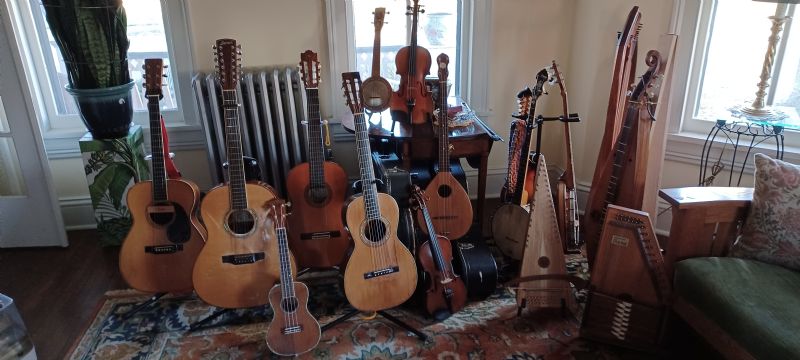
My thoughts (for what they are worth) on changing strings. I have lots of stringed instruments and don't change the strings as often as I should, Generally it is the guitars and banjos that get new strings periodically, depending on how how they are played. I have an autoharp that has had the same string for over fifty years, and it still sounds fine. Of course, a new set of autoharp strings is $125 and changing 26 strings would take a good chunk out of the day.
For my guitars I like trying different weights and brands, I currently use Martin Retros light gauge. When I do change the strings, I write the date on one of the string sleeves and put it in the guitar case. Same thing with my banjo, so I always know what brand they are, how old they are and if they were worth replacing.
I do use a guitar string winder, and have a smaller one for my mandolin. It's not arthritis but my hand gets sore from all the turning. Also my banjo has Rickard tuners with a 10:1 ratio and it saves some time.
I use banjo strings on my dulcimer, because four of the six strings are the same weight, a a five string pack gets me almost there.
My harp strings are custom made and I only change them only when they break, which is more often than I like.
For my 19th century instruments I use Nylgut strings. They sound the best of the various types I've tried.
Some of the "exotic" instruments, where sets are not available, I have buy wire and fashion my own loop,
I cut strings after they are wound, I was told a long time ago that you needed a a minimum of three turns around the post to provide the requisite friction, and it seems to work.
More than you've asked for but it may help someone.
GS - Posted - 03/08/2026: 01:47:20
quote:
Originally posted by GChiccoMy thoughts (for what they are worth) on changing strings. I have lots of stringed instruments and don't change the strings as often as I should, Generally it is the guitars and banjos that get new strings periodically, depending on how how they are played. I have an autoharp that has had the same string for over fifty years, and it still sounds fine. Of course, a new set of autoharp strings is $125 and changing 26 strings would take a good chunk out of the day.
For my guitars I like trying different weights and brands, I currently use Martin Retros light gauge. When I do change the strings, I write the date on one of the string sleeves and put it in the guitar case. Same thing with my banjo, so I always know what brand they are, how old they are and if they were worth replacing.
I do use a guitar string winder, and have a smaller one for my mandolin. It's not arthritis but my hand gets sore from all the turning. Also my banjo has Rickard tuners with a 10:1 ratio and it saves some time.
I use banjo strings on my dulcimer, because four of the six strings are the same weight, a a five string pack gets me almost there.
My harp strings are custom made and I only change them only when they break, which is more often than I like.
For my 19th century instruments I use Nylgut strings. They sound the best of the various types I've tried.
Some of the "exotic" instruments, where sets are not available, I have buy wire and fashion my own loop,
I cut strings after they are wound, I was told a long time ago that you needed a a minimum of three turns around the post to provide the requisite friction, and it seems to work.
More than you've asked for but it may help someone.
An interesting read, sir. You've amassed what seems to be a fine collection of instruments. Have a fine Sunday
GS
BanjoRuth - Posted - 03/08/2026: 07:40:55
Reed Martin almost never changed strings, proving, if proof were needed, that it’s the player that makes the biggest difference. Still, for me, it helps to change them from time to time.
My longest string change took about all day. I put on a nylgut set and tied my own knots for the quite old tailpiece. Then, I struggled with the rest of the process. Afterwards, I took it to Jim Craig at Hogeye, Evanston, for evaluation. He said it was very good for a first effort. I cherish his compliment.
Julio B - Posted - 03/08/2026: 12:54:21
You should review the pages from my old college room-mate, Frank, as you are probably doing it incorrectly: frets.com/FretsPages/Musician/...str3.html
J.Albert - Posted - 03/08/2026: 13:07:12
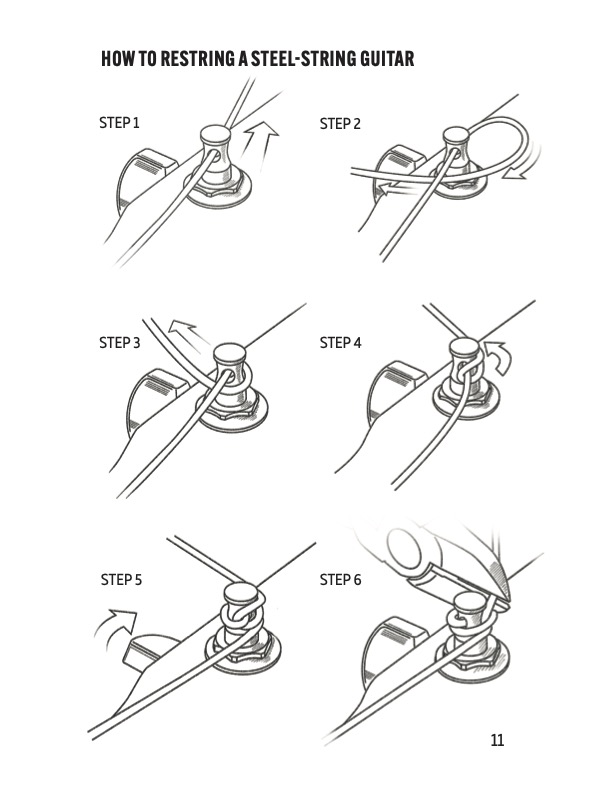
Here's a link to the C.F. Martin publication "Care & Feeding Guide".
martinguitar.com/on/demandware...guide.pdf
I've taken the liberty of extracting the relevant page showing how to change strings:
RB3 - Posted - 03/08/2026: 13:42:09
If you leave enough slack in the string when you attach it to the post of the tuner, you’ll end up with 3 to 4 wraps of the string around the post after the string is tightened. Those 3 to 4 wraps create enough friction force between the string and the post so that the string won’t come loose from the post after it's tightened to the appropriate pitch. This is similar to the way a capstan on a sailboat works. There’s no need for a knot or some other clinching feature.
Mountain Dew - Posted - 03/08/2026: 14:47:17
Here is a link to a video tutorial by Jim Pankey on changing strings -- youtube.com/watch?v=tZpnShHCz5U .It took the mystery and time out of string changes for me.
GS - Posted - 03/09/2026: 02:14:01
I'm pleased I popped back to read the most recent posts. Thank you all.
Spudwheat - Posted - 03/19/2026: 03:30:44
...about those kinks... After reading all of the current responses, I didn't see this addressed. Depending on where the kink is on the post, or near the post, etc... be mindful, when tuning that kink can cause a string to break. (ask me how I know...) It becomes a weak spot and the tension applied when tuning really pulls on it.
Additionally, I find it easier if all of the tuning pegs tighten the strings in an orderly fashion. On mine, I always tighten the string by turning it to the outside. This means counter-clockwise rotation on strings 5, 4, 3; and clockwise rotation on strings 1 & 2. (Or the way I think of it, always turn away from the head to tighten.) By having some order, it will increase your chances of not turning the string in the opposite direction that you want to tune it.
Lastly, I change strings from the inside out, one at a time: 3, 2, 4, 1, 5.
In time, it does get easier. Don't do it when you haven't got the time or patience. If there is a benevolent tech at a nearby music store, ask him to show you. I would suggest you buy the strings there and consider a tip. Good luck!
steve davis - Posted - 03/19/2026: 08:42:30
I've always changed my strings on guitar,mandolin or banjo the same with no issues of breakage.
String twice around the post and the end stuck through the post hole.
Very quick to accomplish on stage,too.
gcpicken - Posted - 03/19/2026: 18:38:39
First, let me confess that I have not read every post in this thread. That said, I would love to know how many wraps each string should get to avoid slippage, and how to get there. I started threading the string through the hole, pulling it tight, and then taking it between my thumb and forefinger, and pulling it back down to, say, the second fret, with the unwound strings, and a different distance with the wound string. That seems to work for me, but I have failed to make a note of it, so it's guesswork every time.
Dean T - Posted - 03/19/2026: 19:10:38
I do two wraps below the hole, one wrap above the hole, stick the string through the hole, tune to pitch, then do whatever you want with the excess string. I've never had a string slip, and as Steve mentioned, very easy to change, especially if in a hurry.
Edited by - Dean T on 03/19/2026 19:15:27
steve davis - Posted - 03/25/2026: 05:32:05
The final step in any restringing is to seat the new string.
Seating the string is accomplished by lifting the new string at the point where the neck meets the rim.
Finger underneath the string and raise the string 1 inch away from the neck.
This makes the string note flat.
Retune the flattened string and raise it at the neck joint again.
Retune the flattened note and raise the string again.
Repeat this process until the string no longer goes flat when raised.
This raising of the strings seats the windings on the post and the tailpiece loops or knots.
wileypickett - Posted - 03/25/2026: 21:40:30
The most aggravating thing for me is having the loop end of the string pop off while I'm trying to secure the other end.
I mainly use No-Knot tailpieces on my banjos. To hold the loop end of the string in place, I put an alligator clip on the little ball the loop encircles while I thread the other end through the tuner post.
I've been doing this for several years now -- really cuts down on the time it takes to change strings, for me anyway.
Edited by - wileypickett on 03/25/2026 21:41:41
Page: 1 2
Terms of Use | Privacy Policy | Privacy Consent (EU/GDPR Only)
Copyright 2026 Banjo Hangout. All Rights Reserved.


