DVD-quality lessons (including tabs/sheet music) available for immediate viewing on any device.
Take your playing to the next level with the help of a local or online banjo teacher.
Weekly newsletter includes free lessons, favorite member content, banjo news and more.
Premier Sponsors


|
Please note this is an archived topic, so it is locked and unable to be replied to. You may, however, start a new topic and refer to this topic with a link: http://www.banjohangout.org/archive/407374
Bill Rogers - Posted - 02/17/2026: 11:20:25
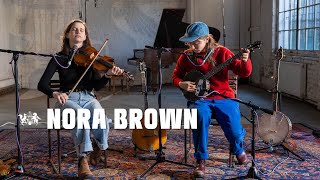
The YouTube writeup says it’s a bouzouki, so I’ll go with that.
Dowel - Posted - 02/18/2026: 10:22:28
Is an Bouzouki a fairly common instrument within old-time traditions (given its Celtic connections)
Or is this a bit of a novelty by Nora?
Bill Rogers - Posted - 02/18/2026: 11:46:38
As far as I know, bouzoukis are traditional Greek instruments. Their adoption to Irish music is relatively recent (in terms of music history). Nora Brown’s use of a bouzouki to play. American traditional tunes is most unusual. It has never beeb part of traditional American music.
R.D. Lunceford - Posted - 02/20/2026: 17:35:05
quote:
Originally posted by Dowelwonderful!
is this an Irish Bouzouki?
Broadly speaking, yes.
Irish Bouzouki, Octave Mandolin, and Cittern are all pretty much the same these days, and the designation is usually decided by the individual maker, and determined by the scale length, with the "bouzouki" typcally having the longer length and lighter gauge strings.
The actual bouzouki is a Greek instrument with either 3 or 4 courses (string pairs a la a mandolin) and has a bowl back like a "tater bug" mandolin. Irish musician Andy Irvine often is credited with introducing the Greek bouzouki into Irish music in the 1960's. A hybrid instrument with a teardrop shaped soundbox with flat back and sides became very popular. The soundbox being similar to the Portuguese guitar, or Renaissance cittern. This "Irish Bouzouki/Cittern is more popular and is seen in 4 and 5 course versions tuned GDAE or GDAD, ADAD, etc.
Extensively used in Irish/Celtic music, Donal Lunny of Planxty is known for his pioneering Irish Bouzouki playing, and Alec Finn for his use of the original Greek trichordo (3 course) Bouzouki. At this point there are literally hundreds of professional players.
Though it could certainly handle the Old-Time repertoire, the bouzouki has not been accepted in OT to any degree.
Alec Finn, Greek bouzouki: Frankie Gavin & Alec Finn 1988 Cursaí RTE1 Note that though this is a 3 course instrument it is fitted with 4 course tuners- a common practice.
Gerald Trimble, 5-course Cittern: The Three Men of Brittany/The Wild Man of Steel
4-course Irish Bouzouki: Irish Bouzouki - MacArthur Road
Aaron Jones, 5-course Cittern: Aaron Jones & Claire Mann - William Taylor
Edited by - R.D. Lunceford on 02/20/2026 17:40:16
Dowel - Posted - 03/08/2026: 10:45:11
What would you say is the closest banjo tuning? Id love to play this tune
banjobard - Posted - 03/14/2026: 11:33:28
The Greek bouzouki was first brought to Ireland by Johnny Moynihan, who also invented the GDAD timing before that to be able to express some ideas on the mandolin. He was in the band Sweeney’s men with Andy Irvine, who also got one. Donal Lunny got the first Irish bouzouki with a flat back made, and together with Andy Irvine in planxty brought the instrument to a wider audience. Their pairing of melodic, counter-melodic , and rhythmic interplay between bouzoukis (or various other double course instruments like mandolin and Guitarra Portuguese) was electrifying. Alec Finn was unaware of this, and ended up having a bouzouki brought to him by a friend returning from Greece (Alec had asked him to bring back a Lauto, more similar to the guitar that Alec already was playing, but what he got was a 3-course Greek bouzouki). His accompaniment to Frankie Gavin’s fiddling as a duo and in De Dannan is similarly perfect.
I have recently been playing with using the Irish bouzouki in old time music, and I quite like it. I have done so in a duo setting and also taken it to jams, and the response has been positive.
I find that there are a lot of parallels between bouzouki playing and banjo - it uses an open or semi-open tuning (GDAD is most popular, ADAd, GDGD are also used along with others), and frequently capos to different spots on the neck to play in different keys in order to maintain the sound of the open strings being in the key. It quite frequently uses a “bum-ditty” or “bumps-ditty” sort of rhythm and uses hammer ons, slides, and pull-offs, and and combines playing the melody or a harmony note with strums on the drone strings. Alec Finn in particular pioneered this approach, which sounds a lot like clawhammer banjo, though he never made the connection, he was coming to the instrument from the realm of playing blues guitar. Also instead of playing the same basic melody line as the fiddle, interspersed with drone notes as is typically done by clawhammer banjo players, he usually picked harmony notes that were a part of the chord but not the main melody note, and interspersed those with drones. I find this is a good choice to more easily stay out of the fiddler’s way.
When tuned GDGD (or raised to AEAE), it’s the same as a cross tuned fiddle. A lot of old time leans heavily on the drone aspect and uses open strings played repeatedly around the melody notes, and you can do the same on the bouzouki. The GDAD tuning (or traditional Greek 3-course tuning of DAD) has the intervals of a 5th and a 4th, so it is like the low strings of a banjo in double C (the CGC strings), and I have successfully transferred bouzouki arrangements into double C banjo. You can also tune gDGAD which can get you similar sounds and you can also learn a lot from DADGAD guitar in that tuning (listen to the Wooden Nickels album with Laura Fedderson and Owen Marshall to hear how nice this style of guitar playing can go with old time). Since the top 3 strings of GDAD are the same as standard dulcimer tuning of DAD you can also play it like it’s a dulcimer, sliding up and down the first string for the melody and strumming the second and third as drones.
And also listen to Alan Murray and Andrew Finn Magill on get up in the cool
getupinthecool.fireside.fm/352
Also listen to the band Mozaik which has Andy, Donal, Bruse Molsky, and an Eastern European woodwind player.
I think that the primary reason it hasn’t been accepted in old time has more to do with the fact that it’s a very new instrument and style of play, so it’s not on any of the source recordings or part of the culture, rather than any kind of sonic incompatibility. Now of course there are certain times and styles of play it would be more suited to than others. It rings a long time and isn’t quite as punchy as a banjo (the Greek ones are a little more cutting than the Irish ones). It kinda falls in between the guitar and banjo as a sound, and requires some ways of thinking adapted from each. Use it for accompanying old time songs perhaps, or break it out in a D jam or cross tunes jam or modal A tunes jam, or generally anything droney and trancey and I think it will do well. If people are playing ragtime and C tunes, you’d be better off with a mandolin or playing in drop C banjo tuning.
If you want to go deeper into this feel free to drop me a line. I play a lot of Irish music and a lot of old time, and I play both banjo and bouzouki, and have a lot of thoughts about how to make either one fit into either context.
Terms of Use | Privacy Policy | Privacy Consent (EU/GDPR Only)
Copyright 2026 Banjo Hangout. All Rights Reserved.