DVD-quality lessons (including tabs/sheet music) available for immediate viewing on any device.
Take your playing to the next level with the help of a local or online banjo teacher.
Weekly newsletter includes free lessons, favorite member content, banjo news and more.
Premier Sponsors


|
Please note this is an archived topic, so it is locked and unable to be replied to. You may, however, start a new topic and refer to this topic with a link: http://www.banjohangout.org/archive/407349/3
writerrad - Posted - 02/25/2026: 08:01:42
I think there are several uses of tradition. Banjo Hangout has traditions. Internet discussion boards where we argue about the NY Giants have traditions. Innovation itself has its own traditions.
However, the issue here the existence of "folk tradition" as opposed to the idea of artistic and commercial innovation, or traditions of musicianship passed along show business or bluegrass banjoists.. There are all sorts of variations on this idea of folk tradition from useful scientific to down right racist and silly.
Having been involved in playing old time music since the 1960s, I can say old time music revivalism has a set of traditions and attitudes that seem to grow and change that have little to do with what people who were folk traditional banjoists played. People that I knew at the heart of the revival in the 60s and 70s were always thinking of whether this, that or the other thing was "traditional" in a way that musicians like Joe Thompson or Rufus Kasey never would.
In the world of the banjo people speak of "traditional banjo" as if some forms of banjo playing are the product chiefly of folk tradition when clearly they are not. There is gross misunderstanding of the dramatic changes in how many people ever played the banjo before commercial, show business, and even art-oriented banjo playing became dominant forces in banjo playing and decisively shaped everything else banjo.
However, there was a constant thread of people since I have encountered old time music revivalism who saw themselves as sticking to what they believed was the folk traditional way of playing the banjo to preserve some original pure thing. There were musicians I knew some of whom became quite well known nationally, who would NOT play a song or tune that was commercially written or created. or did not originate among what they considered traditional folk artists. Most I think of in that wise are now passed away or have educated themselves, insofar our current knowledge is that so many of the songs and tunes they felt were purely traditional were actually written by commercial oriented entertainers or song merchants in major cities for money and one or two actually derived from European classical compositions!
Anyway, generally in discussing the old time music there has been an exaggeration of what comes out of pure "folk tradition" and a minimization of what has been contributed by innovations that come from commercially oriented musicians, fine arts musicians, or popular musicians. I am used to the idea that if someone says "tradition", they mean 'folk tradition.'
Banjo playing itself has hardly much folk tradition to it. Banjos did not exist before the 1600s and then relatively few of them existed among Black people in the Caribbean and by about 1720 or 30 in North America. The decisive moment for their spread both among Black people and especially beyond Black people came across the late 1830s and 1840s, when largely commercial entertainers and designers of instruments for them went beyond the gourd banjo to create designs of the banjo that were not traditionally limited by the spiritual beliefs of the early gourd banjo makers, to create the frame or hoop headed banjo which could both be made more easily by non-luthiers, and more easily manufactured, and would and could be constantly developed and redeveloped by anyone with a good idea or for that matter bad idea.
Talking about how "traditional" banjo playing is creates a kind of fiction about the antiquity of the banjo. It also is gross denial that the banjo's large scale spread and development came not as an object of folk culture or folklife, but as a commercially generated commodity. There is no sign of any resistance by folk or "traditional" players to any of the innovations commercially oriented or artisan banjo makers introduced starting in the ate 1830s. Just the opposite, with actual players associated with the older tradition-oriented approaches being the mos receptive to innovations coming from commercial, professional, or artisan banjo designers created for the needs of non-traditional players and entertainers.
Earlier in this thread I spoke of a presentation I did on the banjos played by the Black banjoists in the Digital Library of Appalachia for the Banjo Gathering. I found that without exception, these banjoists' original banjos were RBs Gibsons or Deerings if they could afford them, Japanese invasion low budget rbs if they could not, I found that if they were pictured playing a Fairbanks, or Vega open back as many were, it was uniformly a banjo owned by a white college based often college teaching, old time music revivalists, who thought it more appropriate for them to play a Boston banjo. I know this because I have played banjos you will see people like Dink Roberts or Odell Thompson playing if you see them with open backs. thinking rather fondly of an 1890s Fairbanks Special Electric that Cece Conway still owns that Odell Thompson is often pictured with.
On the other hand, when the Black traditional banjoists had choice in the matter as when Deering offered to provide Odell Thompson with a banjo, he got a new Deering RB model and also a owned a Gibson RB. These are not traditional instruments.
There is a constant conflict between how banjo playing is an activity of the modern every changing ever progressing world in which exchange and development is constant, and a romanticist idea that old time music or banjo playing is an express trip back to a past bounded by ancient folk tradition. Banjo playing is a development of the modern dynamic world of constant change and development, not primarily a relic of ancient tradition.
Paradoxically, the closer one gets to people whose origin in the banjo is in actual folk tradition--a vanished group now--the greater acceptance there is to modern innovation. It is a shame no one ever recorded Odell Thompson playing acoustic guitar which was his main instrument in the family band or playing electric guitar which he played in both R & B and even Rock and Roll bands in the late 40s and 50s.
Edited by - writerrad on 02/25/2026 08:07:03
Joel Hooks - Posted - 02/25/2026: 08:03:58
quote:
Originally posted by Lew HA quarter century ago at Suwannee Banjo Camp, I got to see Mike Seeger play "Doing my time," a bluegrass song, on a gourd banjo clawhammer (or down stroke) style but emulating bluegrass banjo sounds. It was a jarring, but wonderful and humorous experience for me, full of cognitive dissonance. All because there is a tradition of some sort of playing that song is appropriate only on resonator banjos.
Herein lies another point-- the "gourd banjo" that Mike Seeger was playing is fiction. It was created in the early 1980s (that is no typo) by Scott Didlake and Clarke Buehling. Later, and in tandem, Pete Ross developed a similar version of the gourd banjo, and eventually studied with Scott Didlake.
There are no known original examples of gourd body 5 string banjos of this pattern. There is one single example that has been determined to have been assembled by the seller who sold it to a museum, the neck originating on a round wood rim.
These 5 string gourd banjos continue to be presented as a reflection of early banjos by musicians in the public eye, including a MacArthur Fellowship Genius Grant recipient. The time period that these are "authentic" to is the 1980s.
EEB - Posted - 02/25/2026: 08:06:27
One of the only features or aspects of vernacular music that seems to resist its denial as traditional is actually a characteristic: the ephemeral.
An experience produced and enjoyed for and in the moment.
Today we are as far removed from an ephemeral culture as we have ever been. Maybe that's why we place such value on what we attempt to define as 'traditional'?
Edited by - EEB on 02/25/2026 08:09:46
RB3 - Posted - 02/25/2026: 08:30:43
It seems to me that "traditional" simply means that the same thing has been done for a long period of time.
When Earl Scruggs hit the stage of the Opry in the Forties, he would have been considered "non-traditional". Today, 75 years later, it's reasonable to describe Charlie Cushman as playing traditional Scruggs-style banjo.
banjoboyd - Posted - 02/25/2026: 08:42:54
EEB: Consensus - 'social agreement' - even if tacit, is pretty much how culture is defined. But not everything that carries cultural identity is 'traditional'.
Right. Cultural activities we take for granted, that are not felt to have any deeper significance, that are not contested, that are not tied to membership in a particular community, that require no specialized knowledge or conscious effort to maintain, are generally not identified as traditions. The "traditionality" of a given activity can shift over time or between different settings.
But even if we could reach a consensus on the meaning of tradition, we would still be hamstrung by the terms "folk" (which has been applied to everything from isolated rural communities to songwriters in 1960s Greenwich Village) and "old time" (which is an umbrella term for multiple traditions, some more "folk" than others).
Realbluegrassfan - Posted - 02/25/2026: 09:34:01
quote:
Originally posted by SophiaDquote:
Originally posted by banjoboydMany old-time banjo players and makers today are aiming for a sound that did not really exist in the past, or at least was not that common or desirable. There has occurred a timbral shift, alongside perhaps more obvious changes in technique and musical interpretation. It's a sound I would describe as "hollow-plunky,"I think I read something that indicated that some of the first recordings of clawhammer style banjoists have that plunky sound, and that there is a current trend to recapture that as an authentic feature of old time music. I wonder if that's a factor.
Might a comparison be today's RB banjo makers trying to emulate Earls' banjo to capture the sound Earl made?
Bill Rogers - Posted - 02/25/2026: 11:42:23
If you emulate the recorded sound of banjos in the 1920s and before, you really don't know if that's what the banjo sounded like because early recordings techniques missed so much of the sound--especially the subtleties. I tend to set up my banjos for a sound I prefer--not necessarily based on what might have been 100 years before.
writerrad - Posted - 02/25/2026: 13:54:50
Converse and other19th century banjoists of his type make a fundamental contribution. The use of the term "stroke style" to me seems to cover musicians who follow the exact delineations that Converse and others in his train followed. I find it more precise to confine the use of "the stroke style" to adherents of down picking like those Converse spoke to and with the destinations and limitations that his and his peers influence radiated to.
Up picking and down picking, seem practically useful. The stroke style seems to denote one kind of down picking or down stroking. I would find it hard to say Rufus Kasey played in the stroke style. I have to admit as you may have seen me mention elsewhere. Kasey, a Black Virginia banjoist told Kip Lornell around 1980 that he had used banjo thimbles to some point in the 1950s when he loaned his to a friend who moved away and was surprised he could no longer buy them in stores. If I am among ABF members or classical banjoists or people familiar with that segment of banjo history and the banjo world. I do find it useful. However, if I am writing about the banjo in general it seems limiting.
There is no line of blood about it. I remember the discussions Shlomo, Greg, Bob, and I had working with the portion of Roots and Branches I quote earlier here and the up and down picking seemed the compromise .
Edited by - writerrad on 02/25/2026 13:58:52
Lew H - Posted - 02/25/2026: 14:13:35
I see that Tony writerrad doesn't accept the folklorist definition of what he is talking about, so I'll change paths. We all need to think about what kinds of cultural traditions are there. Culture has two parts that are useful to distinguish, ideas and material things. Gourd banjos, open back banjos and resonator banjos ( we could add tenor and plectrum banjos, banjo uses, etc) are parts of the country's current material culture. There are subcultures* today that each claim one or two of these banjos. Within these subcultures, there are ideas about how one appropriately plays on each of these banjos, when and where it is appropriate to play, and what music is appropriate. Sociologists call these ideas NORMS. Norms can come in clusters, so if one attends Cliff Top, there are areas (I am told) where only "traditional" tunes and only open back or gourd banjos are appropriate. Foggy Mountain Breakdown is not appropriate, nor neo-trad. There are kinds of norms. Some are long lived, going back generations (These might be associated with important values . Some, like clothing styles change every few years. Then there are fads that are very short lived. Any group of people might hold some of each these types of norms.
The material banjo has changed over the centuries, and the ideas about it have changed As Tony points out, slaves saw it as a ritual instrument, a part of the sacred. I know of nobody who thinks that today in the USA. It is a secular instrument. There were different subcultures in between the sacred and secular: minstrelsy, the classic or guitar style for the middle classes that Stewart promoted, the college banjo orchestras, etc.
Another example. In today's oldtime/openback subculture it is a fashion to have raw brass fittings--J-hooks, tuning pegs, tail pieces, etc. on openbacks. I don't know just how or when this got started, but it wasn't that way a few years ago. In the bluegrass subcullture nickel or gold plated fittings are still preferred.
Differential preferences for tone and how these might have got started have been described already. But I get the impression that there are some openback/oldtime pickers who are well trained in clawhammer are developing a new softer style of picking that is more emotive than the usual rapid fire claw. Is this a fad, a developing fashion? Will it take root and become "traditional?"
Would it help the discussion here if we distinguish between long standing norms, fashions and fads? -- shared ideas and material goods? Can we distinguish between the subcultures that are within the banjo world?
* A subculture is a set of norms and values shared by a network of people who have been exposed to and learned that set along. They may not personally accept each detail of the norms and values, but they know, or at least believe, that other members do accept them.
Edited by - Lew H on 02/25/2026 14:29:25
Lew H - Posted - 02/25/2026: 14:20:45
Joel Hooks By the way, I didn't say that Mike Seeger f,ound a gourd banjo from the 1700s. It was a fretted instrument with planetary tuning pegs. Quite a wonderful banjo too! It was a real banjo, contrary to what you say. I saw it in person. I heard it. I saw Seeger clawing a bluegrass song on it.
Edited by - Lew H on 02/25/2026 14:38:00
writerrad - Posted - 02/25/2026: 14:28:49
Terminology exists to explain things. If terminology gets confused, or is used in one context one way, and other contexts otherwise, it does not help to bend to the confusion, but to seek clarification. When scholars discuss the banjo and tradition, they speak of folk traditions. The idea of folk tradition is a rightly contested view, but for scholars it is not confused with people who call themselves folksingers and such that emerged out of Romanticis and Peoples' Front debentures of music. The idea of folk tradition itself is specific and well defined even if people who are not part of any folk tradition or folk culture call themselves folk singer
It is true there are a variety of other kinds of traditions, but we mean folk tradition. My friend Lew's delineation of what is folk tradition and music which he deals as an academic on the one hand, and as an adept musician on the other, although most of his music (we have belonged to a weekly zoom picking session together for several years)is not folk music from a folk tradition.
It does not help anyone to eliminate the idea of folk tradition or merge it with other things that call it that because it is not. The problem is misuse of the term makes it harder to accurately discuss reality and to learn what those who have studied folk culture and folk music and how it evolves, and how it is different from other music gets thrown into the toilet.
There is also an awful lot simple refusal to recognize music that is NOT folk music and not coming from a folk tradition is NOT folk music and does not come from a folk tradition. That is why we find it to be useful.
Bluegrass is not folk music. It is a show business music that was created by professional musicians at the top of their genre of musical performance, on the Grand Ole Opry shows and radio broadcasts from 1945 to 47. By and large it largely proceeded not in the playing of folk songs or airs, but in the playing of copyrighted already written, or published for the first time popular songs, or copyrighted arrangements. Much of the discourse about "tradition" and Bluegrass only began in the late 1950s when some in the Bluegrass milieu felt Bluegrass could attract fans of the Folk Music boom. If you examine the repertoire of Flatt and Scruggs or Bill Monroe in the 1940s, the repertoire contains relatively few songs that are folk songsm and is largely composed of copy righted and alreadty published songs. B
Bluegrass entertainers increased the number and amount of songs with links to tradition in the late 1950s and and early 1960s when they sought to attract people who came out of the "Folk Music" boom of that era. Musicians like Doc Watson and the Stanley Brothers and many others sought old time and traditional recordings from people like Ralph Rinzler, Mike Seeger, and John Cohen and added songs from such sources to their repertoire.
However, get any record the Stanleys or Monroe made around 1950 or even 52, compare it with a recording they would have made in 1962 or 63, and note the prevalence of professionally composed songs and published songs, in the pre folk scare recordings and the greater number of popular songs, including non folk popular songs from England and the United States from the late 19th century and early 20th century.
Tractor1 - Posted - 02/25/2026: 14:34:48
still I say the open back's voice fitting the old-time ( a stringband genre} is why it is seen more--as in "sounds better" the bottom line
With picks on a masterclone and playing ongoing arpeggios-- the music does not--- fit easily --clawhammer on a resonator is still a more differing timbre than the other instruments
a good part of genre's and their rhetorical traditions are marketing hype uttered with great music--we fall for some good nostalgia also --nothing sinful about selling things --but we just ain't that deep into a worldwide movement --more like jam to jam-- or a good festival
my opinion I ask no agreement
Edited by - Tractor1 on 02/25/2026 14:47:32
writerrad - Posted - 02/25/2026: 14:41:05
One year at the banjo gathering we had a focus on the Creeds. It was funny insofar as at the same meet, there was a focus on the Boucher banjo and Bob Winans and Greg Adams presented a multi lecture presentation on Boucher and the banjo in Baltimore. We met in a big room tht contained about 30 or 40 Bouchers and an equal number of Creeds.
What i got out of the discussion of the Creeds from people who had interacted with Creed is that Creed was an innovator rather than a traditionalist. What I got out of the discussion of Creed by those who knew him and studied it was that he was trying to incorporate many of the measures in making a loud bright banjo with strength that had come into the banjo world in the Gibson and other resonator banjos that were created in the early 20th century, originally based on designs to meet the needs of tenor and plectrum banjos in part for band playing,
The Creeds were not a traditional throwback to anything in the banjo's past, but a late 20th century designers aim update what banjos did to sensibilities created by post WWII music and by other banjo designs.
writerrad - Posted - 02/25/2026: 14:43:22
quote:
Originally posted by Lew HI see that Tony writerrad doesn't accept the folklorist definition of what he is talking about, so I'll change paths. We all need to think about what kinds of cultural traditions are there. Culture has two parts that are useful to distinguish, ideas and material things. Gourd banjos, open back banjos and resonator banjos ( we could add tenor and plectrum banjos, banjo uses, etc) are parts of the country's current material culture. There are subcultures* today that each claim one or two of these banjos. Within these subcultures, there are ideas about how one appropriately plays on each of these banjos, when and where it is appropriate to play, and what music is appropriate. Sociologists call these ideas NORMS. Norms can come in clusters, so if one attends Cliff Top, there are areas (I am told) where only "traditional" tunes and only open back or gourd banjos are appropriate. Foggy Mountain Breakdown is not appropriate, nor neo-trad. There are kinds of norms. Some are long lived, going back generations (These might be associated with important values . Some, like clothing styles change every few years. Then there are fads that are very short lived. Any group of people might hold some of each these types of norms.
The material banjo has changed over the centuries, and the ideas about it have changed As Tony points out, slaves saw it as a ritual instrument, a part of the sacred. I know of nobody who thinks that today in the USA. It is a secular instrument. There were different subcultures in between the sacred and secular: minstrelsy, the classic or guitar style for the middle classes that Stewart promoted, the college banjo orchestras, etc.Another example. In today's oldtime/openback subculture it is a fashion to have raw brass fittings--J-hooks, tuning pegs, tail pieces, etc. on openbacks. I don't know just how or when this got started, but it wasn't that way a few years ago. In the bluegrass subcullture nickel or gold plated fittings are still preferred.
Differential preferences for tone and how these might have got started have been described already. But I get the impression that there are some openback/oldtime pickers who are well trained in clawhammer are developing a new softer style of picking that is more emotive than the usual rapid fire claw. Is this a fad, a developing fashion? Will it take root and become "traditional?"
Would it help the discussion here if we distinguish between long standing norms, fashions and fads? -- shared ideas and material goods? Can we distinguish between the subcultures that are within the banjo world?
* A subculture is a set of norms and values shared by a network of people who have been exposed to and learned that set along. They may not personally accept each detail of the norms and values, but they know, or at least believe, that other members do accept them.
writerrad - Posted - 02/25/2026: 15:23:53
quote:
Originally posted by KCJonesquote:
Originally posted by SophiaDquote:
Originally posted by writerradBy folk banjoists, I mean people who have learning banjo as part of an actual community folk tradition in which the music made was part of the living life of the community, not a decision by people who enjoy and wish to revive or celebrate the music who did not learn it in their communities.There is a difference between people who make an intellectual decision to play old time music and people who are part of organic communities in which the music evolved.Thank you for such a thoughtful explanation. There's a lot to think about there!
Thoughtful, yes. Truthful, perhaps not so much.It's frankly offensive to suggest that because someone is young, or 'not from around here', that they are not part of the tradition. It's also insulting to the players that are from those areas, to suggest that they put no thought into their playing or that they also didn't make a concious decision to continue the tradition.
The fact is, the vast majority of people from all areas do not play traditional music. This is a statistical fact. Anyone that does play traditional music, has made a conscious decision to participate and celebrate the tradition.
There is a fixation among both players and scholars that the "tradition" only happened during a specific period, in a fixed place, and everything after that is simply a recreation or revival of that time and place. It's a false paradigm. It's a fundamental misunderstanding of the nature of time and culture. The tradition is alive and well, it is organic and growing to this day. Music made this year is just as much as a tradition as music made in 1930. A banjo player that plays the old songs in Utah is just as much part of the tradition as one from South Carolina. When the music was made back then, it was new. Someone playing The Cuckoo or Cold Frosty Morning in 2026 is just as much part of the tradition as someone that played it in 1926. It's not emulation, and it's not 'inauthentic' just because they're not from a specific demographic.
Again, the overall point here is that 'tradition' is an ever changing and organic cultural phenomenon. It is not fixed, in any way. All traditions were, at one point, new styles. They change over time. Tradition does not mean "old". By it's very nature, despite many attempts to do so by educated individuals trying to sell books and lectures, tradition can not be canned and labeled and sold on a shelf.
All that is to say, back to the subject. If you take the 1920 to the 1970, that is 50 years. 1970 to 2026, is 56 years. This means that open backs have been the 'default' banjo design for clawhammer for a longer period than resonator banjos were the standard. Time marches on.
writerrad - Posted - 02/25/2026: 15:28:55
" It is a closed mind that thinks you can only be part of the American musical tradition if you check specific boxes (as defined by self-proclamed authorities on the subject). It's 2026, 1926 was 100 years ago. There have been traditional fiddle competitions throughout the country for over 75 years. "
No one here is speacking of "American musical tradition." Folk music and folk tradition are specific things that are defined in definite ways over now a couple centuries of discussion about what they are a specified as such things.
Folk tradition is one thing. The product of continued innovation and invention of often borrowing from the craft of making other instrument, largely driven by what the commercial market and professional market for the instruments is another things.
Most banjos made today are not open back banjo but have some kind of external resonator. This is a material fact.
Tractor1 - Posted - 02/25/2026: 18:06:28
crosspollination---and it's big downhill run on the world wide web --fueled by ---, available access to any whim--tradition itself is in for speedbumps --when the billboards tout new ways to ruin the world ,with banjos --
good taste is part of the establishment of a tradition among peers--they did not agree to the tempered scale all at once--but finally shook their heads yes together---that is going to be more a case of how many likes it gets --for a while--
Edited by - Tractor1 on 02/25/2026 18:08:27
Helix - Posted - 02/25/2026: 18:15:37
< a 5 bender. Aw, Charlie Poole played open back proto-bluegrass until he broke it over a Sheriff's head and got permanent powder burn on his cheek and a chipped tooth from the bullet going by, then he sold enough moonshine to get his Gibson. I think the picture is a promo, whatever from 1492.
I strongly suggest a Gold Tone AC-1 because they researched the original Bakelite by Harmony and then changed the composite formula to get a lighter, stronger, and more durable banjo to offer, smart enough to go 4-string, short neck and 25 fret. I had a person stop by with one and got to play it. I like to be able to Lean on it and it did just fine. It won't vintage, but it still deserves a place on the plane.
Edited by - Helix on 02/25/2026 18:35:32
Helix - Posted - 02/25/2026: 18:42:13
I know this gets asked a lot, but I’m just curious what the reasoning is. Correction, AC-5
It's the sound of it that brings the fox in the fog, it's more loving and personal
Edited by - Helix on 02/25/2026 18:45:37
writerrad - Posted - 02/25/2026: 19:43:37
I should add that i give no special value to something because it is a folk tradition. Earl Scruggs confessed even after years of trying, he never could play down picking, frailing, down stroking, the stroke style adequately. He is still to me one of the greatest positive influences in my life. He grew up in an area that was a hotbed of the guitar style of Banjo with neighbors he told he heard from his early childhood who made records that more or less quote the Frank B. Converse, that my hero Joel Hooks tells us to honor. And people I know who spent time with Earl at his house said he could play that music note for note until he was in his last days.
It is no coincidence Joel points us to Converse on that, because the ABF tradition does not shy away from recognizing the massive positive influence on the banjo that non-folk banjo has had since the late 1830s, and of world-famous banjo entertainers Black and white.
History is not advocacy, but trying to understand reality.
You cannot explain the way the banjo has risen and fallen and different developments in the banjo if you think that after it passed out of Black exclusive hands in the 1830s, that the banjo has simply a folk tradition, or to try to say any kind of banjo playing you or anyone should like is the product of a pure folk tradition.
For one thing, designs of the banjo that performing music makers like Sweeney, artisan shop luthiers like Boucher, down to the Dobsons, and on to SS Stewart and my CT homeboy Fred Bacon (really David Day did the work and both Day and Fred were born in Massachusetts) and many others down to those who made the Gibson's, created the banjo as it is played, and that folk or traditional players have uniformly followed the modifications in the instrument that were produced by urban commercial banjo designers designing banjos for professional entertainers and popular parlor musicians.
Even if you want to study just African American banjo playing, the history of the banjo is not the unfolding of a tradition in which "folk" playing has led the great variety of changes, but the responses and contributions to tremendous change and development of the instrument and adoption of all the latest design and advances produced by commercial and artisan construction of the banjo.
Odell when asked already owning a Gibson RB had Deering give him an RB. Gus Cannon played a Wasburn "Professional" a professional level 5 string, and then for a decade or more a Van Eps Recording banjo with an internal Resonator, and finally acquired a Gretsch pseudo Bacon Broadkaster with an enormous resonator.
This returns us to the original subject of this board: There is absolutely no truth to the idea that either historically or in actual practice, frailing or down picking, or down stroking, or stroke style banjoists play open backs, and not resonators. This is an idea based on fashions and misinformation among old time music revivalists, that was not share among banjo players traditional and otherwise before some point in the 1960s or perhaps 1970s. When internal resonators were available, banjoists used them and When the external resonator started to be popularized by Paramount and other makers including Gibson in the early 20th century, old time banjoists who were frailers ued them.
Dave Macon used resonator banjos from the time they were available when he was a teen aged banjo performer until just before WWII when they became too heavy for him to deal with due to severe Arthritis he could no longer hold resonator Gibsons and had Gibson made him special Gibson banjos without a resonator with a dowel stick. '
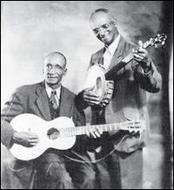
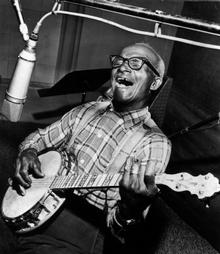
I attach photos to illustrate this last of Gus Cannon playing his Van Eps Recording banjo with an internal resonator and Gus Cannon in the Stax studio in 1963 with his resonator Grestch Bacon Broadcaster, myself playing Doc Boggs' Gibson RB, and myself playing one of the open back Gibson made for Dave Macon.
Should anyone be confused and feel they can become a "traditional" banjoist by discarding their Resonator Banjo, particularly if it is a Gibson Master tone or a close clone thereof, I am quite willing to take it off their hands as I only own 7 banjos and both are bottom of the line banjos one from the current Recording King and a Chinese Wasburn, banjos I have because they resemble the budget RBs the Black traditional banjoists I study play.
writerrad - Posted - 02/25/2026: 19:50:49
Mike was quite fond of that banjo which someone in Los Angeles had made for him. He was among a party of folks that Scott Odell and other took one of my favorite banjoists, the great Rufus Kasey in his home of SW Va back in the 80s or early 1990s. Mike brought that monster gourd banjo with him and asked Rufus if he wished to play it., Kasey who played an inexpensive Japanese invasion RB declined. On the other hand he was excited to play Scott's Creed.
KCJones - Posted - 02/26/2026: 06:40:47
quote:
Originally posted by writerrad
Most banjos made today are not open back banjo but have some kind of external resonator. This is a material fact.
Interesting claim. I wonder if there's any data or evidence to back it up? Aside from getting numbers from manufacturers I don't see how anyone would be able to know this.
Edited by - KCJones on 02/26/2026 06:42:04
writerrad - Posted - 02/26/2026: 07:39:32
I spend some time talking to people who buy and sell banjos over the last two decades. I have been part of the Banjo Gathering which used to be the Banjo Collectors Gathering for 20 years. There such things are discussed not by any typist who goes ont he board but by people who own music stores and make banjos. Stan Werbin of Elderly Instruments was sitting in the room I am typing in talking to me about such things with me Monday.
Bluegrass is the biggest generator of banjo sales, not old time or folk. People who just play old time music don't understand how much bigger the world of Bluegrass is and how deep it is. You can also add in most forms of banjo playing outside of old time and bluegrass like trad jazz etc use banjos with resonators.
Just look at BHO. Even if we old time music enthusiasts tend to type more words per banjo than anyone else [More than anyone should in my case],the dominant discussion here is about Bluegrass playing, as it should be.
Thanks
Edited by - writerrad on 02/26/2026 07:41:46
Joel Hooks - Posted - 02/26/2026: 08:31:16
quote:
Originally posted by Lew HJoel Hooks By the way, I didn't say that Mike Seeger f,ound a gourd banjo from the 1700s. It was a fretted instrument with planetary tuning pegs. Quite a wonderful banjo too! It was a real banjo, contrary to what you say. I saw it in person. I heard it. I saw Seeger clawing a bluegrass song on it.
Understood, my reply was for general audience as I feel this truth is left out.
These 5 string "gourd banjos" are currently being presented (including by some Emmy winning musicians) as representing "authentic early banjos".
These claims by are misleading and many people buy/make these thinking what they are getting represents something earlier than the 1980s.
This is a problem with "old time"-- not cataloging or documenting credit, rather using a catchall vague "traditional". When the history of these 5 string gourd banjos are discussed, Scott Didlake and Clarke Buehling should be given credit for the existence of them.
EEB - Posted - 02/26/2026: 15:48:40
quote:
Originally posted by banjoboyd
But even if we could reach a consensus on the meaning of tradition, we would still be hamstrung by the terms "folk" (which has been applied to everything from isolated rural communities to songwriters in 1960s Greenwich Village) and "old time" (which is an umbrella term for multiple traditions, some more "folk" than others).
The aspect that tends to be laid bare by research is the highly selective nature of what is defined or constructed as 'traditional'. The casualty of that process is the rich diversity that existed which owed nothing to the modern insistence on genre conventions. The narratives associated with that diversity are suppressed to reinforce a partial or idealised image largely constructed by modern sensibility. 'Old Time' as a genre and the modern elevation of 'clawhammer' to the status of 'tradition' is an interesting example of this process of selectivity, constructed narrative and omission.
Edited by - EEB on 02/26/2026 16:01:37
Bill Rogers - Posted - 02/26/2026: 17:04:54
The meaning of “traditional” changed significantly and permanently with the advent of 1) records and 2) radio.
writerrad - Posted - 02/26/2026: 19:09:31
Originally posted by Bill RogersThe meaning of “traditional” changed significantly and permanently with the advent of 1) records and 2) radio.
As classically considers it ends.. When real folk, or even artisan musician tradition exists, then you have a variety of drift such as from generation to generation, or from region to region. When people are trying to be "traditional" outside of that and they have the previous accepted traditional variant exactly recorded either by recording or sufficient sheet music or other notation then they are doing something different than "traditional" players.
The real problem for the banjo is that despite folklore models about "tradition" being imposed on banjo playing, Banjo playing's development has never been traditional, at least from what we know about the banjo since say around 1700 and certainly once frame headed banjo emerged in jhe late 1840s or 50s.
It has also to be realized that the early gourd banjos created by spiritual/religious groups among the enslaved in the Caribbean and North America were soon rejected even before European Americans or people outside the faiths accepted them because their designs, especially the angling of the necks followed beliefs about the shape and nature of the cosmos that what a physics dictate make a loud or clear sounding instrument or one easier to play. Especially insofar as their makers faced persecution on all fronts the early banjos not sounding so loud was not muh of a problem, and people with these beliefs continued to make such banjos at least into the 1860s when they may have just died out.
janolov - Posted - 02/26/2026: 23:33:47
Sometimes I wonder if the contemporary "Old-Time" music really is traditional?
EEB - Posted - 02/27/2026: 01:35:48
quote:
Originally posted by janolovSometimes I wonder if the contemporary "Old-Time" music really is traditional?
It's certainly giving exposure and continuity to elements of a historical repertoire. But it's a simplified, hybrid structure as you would expect in a society so different from the complex societal contexts it is referencing.
Does it matter? Not really. The core motivation remains the same: enjoyment, creative expression and social connection.
Documented historical sources are available for study by those interested in factual detail and the complex diversity of past social landscapes. There's no natural 'requirement' to conduct one to enjoy the other.
Edited by - EEB on 02/27/2026 01:40:12
Don Borchelt - Posted - 02/27/2026: 03:32:55
quote:
Originally posted by EEBquote:
Originally posted by janolovSometimes I wonder if the contemporary "Old-Time" music really is traditional?
...Does it matter? Not really. The core motivation remains the same: enjoyment, creative expression and social connection...
That's it, in a nutshell, as we used to say.
As someone, and I forget who, used to say on here, it's your d**n banjo, play it any way you want.
cjwit - Posted - 02/27/2026: 04:08:11
At the risk of derailing the thread a bit, I always bristle a bit when I hear that this stuff doesn't really matter. It really does matter and in powerful, but subtle ways. Many of the arguments Tony is making here and elsewhere are about power over narratives of identity. There are folks in positions with that power: granting agencies, record labels, contest judges, festival organizers, workshop teachers, and yes, scholars, folklorists, etc. What they think tradition is matters because it can put boundaries around how you want to play the banjo. This is the part that can be scary, and that history tells us matters.
I think of language use in Orwell's 1984. If you remove words, you're also removing thoughts. It's also why I personally find it helpful to think about tradition as a plural (there are lots of interwoven traditions) that are not static (ideas about them change over time). If you leave one out, people might not even think of them as a possibility.
Joel's comments about classic era banjo are a good example. If you leave that out, then banjo is for hillbillies. Tony's comments about sophistication in bluegrass in another thread also matter: leave that out, and you're just talking about rubes and Deliverance or Spongebob Squarepants. The Black banjo renaissance is a thing specifically because ideas about tradition left Black banjo players out of the history. I absolutely play my banjo differently because of what I learned from the folks leading the way in that movement. I wouldn't have a gourd banjo or a fretless, nor would I have ever built one.
Does everyone have to study history and these circulations of ideas? No, absolutely not. But they do define the experiences we have, how we come to the instrument, and what we do with it. This bit about resonators and open backs also defines, in many (but not all) ways, how we spend our money. That matters, too, especially to folks like banjo builders.
PS: This has been a really fascinating and fun conversation. Thanks to everyone for letting it continue, probably long after it should have died out. It's too hard to find a way to hang for too long with a bunch of banjo players who aren't folks you already know too well.
Edited by - cjwit on 02/27/2026 04:11:04
EEB - Posted - 02/27/2026: 05:30:49
quote:
Originally posted by cjwit
Does everyone have to study history and these circulations of ideas? No, absolutely not. But they do define the experiences we have, how we come to the instrument, and what we do with it.
I wish we could all truthfully say that were the case. Current incomplete narratives, selectivity and unconscious neglect - the characteristic aspects that contribute to the largely unconscious process of dominant narrative - make this in practice at best a partial and unreliable knowledge base from which to form a full and balanced understanding.
This appropriation is glimpsed in the relatively recent commercial unilateral projection of the banjo as 'America's Instrument'. Not untrue; but incomplete, selective and unconsciously misleadingly neglectful.
Edited by - EEB on 02/27/2026 05:33:20
Lew H - Posted - 02/27/2026: 10:36:22
EEB Your posts intrigue me a bit, but I don't understand what you are saying. I know meanings of every word in your posts, but I don't know what you actually mean to say. For example, you say regarding the newly popular oldtime:
"It's certainly giving exposure and continuity to elements of a historical repertoire. But it's a simplified, hybrid structure as you would expect in a society so different from the complex societal contexts it is referencing."
This sounds to me like the abstract to lengthy essay that might be interesting. Please give me a couple of concrete examples of what you are abstractly talking about.
Edited by - Lew H on 02/27/2026 10:37:16
writerrad - Posted - 02/27/2026: 13:24:41
quote:You are neglecting the massive influence along the same lines of printed music in standard notation which used to be very widely circulated as it was the only way to share music. The amount of musical illiteracy we all suffer from---I am a recovering musical illiterate who could read music when he was 10 20 and barely at 30==can blind one to the very high level of musical literacy of anyone who wanted to play music basically before recorded music became widespread and available to plebeians. Joel Hooks who graces our conversations has uploaded to Archives dot com--the heroic work of a saint of the banjo--hundreds of banjo tutors, banjo instructors, pieces of sheet music for the banjo created beginning in the 19th century.
I once had a long conversation about this with Joel Shimburg who attested through his life long interest in education, that North of the Ohio people were taught to read music. Across the South below, all kinds of other methods like the shape notes were encouraged. Pleasant Carter was able to make some kind of living traveling the Mountain areas of Va, NC, Kentucky holding summer singing schools in churches.
We should not project our own standard notation illiteracy upon people who lived before the great explosion of recored electrcal and then electronically reproduced music on people who lived before radio, records, etc made music easier to get at.
Originally posted by Bill RogersThe meaning of “traditional” changed significantly and permanently with the advent of 1) records and 2) radio.
Mark Douglas - Posted - 02/27/2026: 22:18:00
quote:
Originally posted by EEBquote:
Originally posted by cjwitDoes everyone have to study history and these circulations of ideas? No, absolutely not. But they do define the experiences we have, how we come to the instrument, and what we do with it.
I wish we could all truthfully say that were the case. Current incomplete narratives, selectivity and unconscious neglect - the characteristic aspects that contribute to the largely unconscious process of dominant narrative - make this in practice at best a partial and unreliable knowledge base from which to form a full and balanced understanding.
This appropriation is glimpsed in the relatively recent commercial unilateral projection of the banjo as 'America's Instrument'. Not untrue; but incomplete, selective and unconsciously misleadingly neglectful.
EEB:
Your writing is the epitome of needless complexity and obfuscation!
However, one fact is most assuredly indisputable.....
The banjo is America's instrument!
And no amount of academic gobbledygook can ever take that away!
EEB - Posted - 02/28/2026: 02:22:16
quote:
Originally posted by Lew H
This sounds to me like the abstract to lengthy essay that might be interesting. Please give me a couple of concrete examples of what you are abstractly talking about.
This is a fascinating discussion and I have no wish to divert the focus so I'll try and reply as neutrally as I can. What jumped off the page when I read the OP was that the iniitial question regarding the association of banjo type to what is predominantly a modern genre, inadvertantly lands squarely on one awkward 'gap' between what is current convention - our neat modern interpretation of 'tradition' - and the historical record that has no function toward 'neatness' or modern 'folk' agenda.
What 19th century sources reveal is the diversity of a world that pre-dates the neat classification of genre that is largely a product of commerce. To some extent also the early development of our genre-classified culture.
In the 19th century contexts that are the focus of our research, 'concrete' is commonly banjo in association with song, both popular and that composed for the banjo, pianoforte, cornet, harp, piccolo, flute etc. and in a huge diversity of social settings. None of which inform or feature in our modern interpretation of 'tradition'. Hence the use of terms 'simplified' and selective'.
Modern players of traditional repertoire are not 're-enactors'. Similarly historians and researchers, bound by a fundamental awareness of confirmation bias, are not agents of selectivity.
Again, does it matter? Not the enjoyment of modern open-back back banjo players who love to play a wonderfullly rich legacy that is traditional fiddle repertoire. Not to historians who will continue to examine the detail, diversity and actuality of past activity.
EEB - Posted - 02/28/2026: 03:53:06
quote:
Originally posted by Mark Douglasquote:
Originally posted by EEBquote:
Originally posted by cjwitDoes everyone have to study history and these circulations of ideas? No, absolutely not. But they do define the experiences we have, how we come to the instrument, and what we do with it.
I wish we could all truthfully say that were the case. Current incomplete narratives, selectivity and unconscious neglect - the characteristic aspects that contribute to the largely unconscious process of dominant narrative - make this in practice at best a partial and unreliable knowledge base from which to form a full and balanced understanding.
This appropriation is glimpsed in the relatively recent commercial unilateral projection of the banjo as 'America's Instrument'. Not untrue; but incomplete, selective and unconsciously misleadingly neglectful.
EEB:Your writing is the epitome of needless complexity and obfuscation!
However, one fact is most assuredly indisputable.....
The banjo is America's instrument!
And no amount of academic gobbledygook can ever take that away!
I'm sorry you find my posts 'needlessly complex'. I don't post to offend or argue. One consequence of dominant narratives is that those of the dominant group generally do not like to acknowledge narratives that appear to challenge the dominant narrative. The nature of dominant narrative is that it is consumed as objective fact.
Maybe you'd respond better to circumstance presented in a way that you yourself are at liberty to consider?
We're probably all in broad agreement (courtesy of academic research) that what we refer to as the banjo originates within the African diaspora? White contact, uptake and adaptation of this instrument occurred in a relatively narrow, early 19th century time frame in the Caribbean and eastern U.S. For sake of argument if we take the near simultaneous introduction of this banjo adaptation and its cadences to Britain by Rice, Sweeney et al in the 1830's and early 1840's we have, in cultural terms, a 'genie out of the bottle' moment.
Britain then was the seat of the worlds largest empire and economy. A dynamic, innovative society. Immediately - in c.1842 - the stage banjo was copied on request of British musicians and crucially, adapted by British makers. White usage and development of this instrument actually had simultaneous and independent 'life' on both sides of the Atlantic from its earliest possession by people of European descent and Europeans. Popular influence? Yes. Cross fertilisation? Yes. But here's the elephant in the room...
...independent cultural assimilation and adaptation. Yes.
The banjo was hugely popular in Britain. Cross-fertilisation worked both ways. Cultural and compositional influence travelled to the U.S. both physically and intellectually.
Today knowledge of this duality is minimal and selective at best outside of research communities. We see the 'safeness' of Morley reflected back at us, but not the influence of early migrant British musicians arriving in the U.S. Nor the preference in Britain for the adaptation to 6 and 7- strings.
Edited by - EEB on 02/28/2026 04:13:09
Mark Douglas - Posted - 02/28/2026: 04:49:16
EEB:
Your argument and line of reasoning would fit quite well in an academic and scholarly environment. Unfortunately, your writing here is considered very pedantic and perhaps even philosophical. As such your ideas on this forum (for the most part) by and large fall upon deaf ears.
Obviously, you have an extraordinary command of the English language. Perhaps you also have some awareness of American cliches and some commonplace remarks?
Among those are….
“Know your audience!”
Perhaps you have some interesting points to convey….
Even so, most folks here will not see your post as meaningful. Rather, it will be viewed as an exercise in futility!
Edited by - Mark Douglas on 02/28/2026 04:55:10
EEB - Posted - 02/28/2026: 05:07:26
quote:
Originally posted by Mark Douglas
As such your ideas on this forum (for the most part) by and large fall upon deaf ears
a) they're not ideas.
b) I've acknowledged the dynamic of dominant narrative. I have literally no way to circumvent that except to be truthful and polite.
Lew H - Posted - 02/28/2026: 07:05:09
I might suppose that EEB is using the perspectives of critical theory or of post modernism to respond to the the OP’s seemingly simple “why” question and the ensuing discussion. Or perhaps not. He mentions the popularity of banjos in Britain and the cross-fertilization and that is useful. Otherwise, the discussion has focused on the US historically and today. We could look at other nations to follow up on EEB’s ideas. I think, based on my Australian friend’s music and activities, that there is less separation between bluegrass and oldtime there but much influence from this country. I have to wonder, does this openback-resonator distinction vary much across nations. But I think the OP meant to talk about the US.
We have diverged from the original question: “Why is clawhammer (still) traditionally played on an open-back banjo?” We have got bogged down or diverted in questions about what is tradition, whether openback-clawing was the original tradition, what is a tradition, what is folk, etc. But notice the bracketed “still” in the question, indicating the OP's doubt that this is a long term practice. Maybe the word, “traditionally,” perhaps unintended in the way we took it, threw us off. Maybe it only meant "commonly." What if the question were: “In the US today, why is clawhammer played on openback banjos while bluegrass is played on Mastertone style resonator banjos?”
With this question, we might have covered the earlier resonator banjo clawers, and ask what made for some cultural stickiness linking claw and openback in recent times. I think we have recognized that the claw-openback link is a recently originated fashion—not a long term tradition in the US.
There are some interesting empirical questions once we make that recognition. Which people began making this distinction and when? Were people and groups, like Pete Seeger, the Almanac Singers, or the Kingston Trio, the NLCR, role models Which companies (banjo manufacturers, recording companies, publishers) picked up on this distinction and spread it more broadly into the culture? How did the transition from pseudo-folk groups to, let’s say, Round Peak, come about in banjo culture? Was this partly a reaction to Scrugg’s use of the Gibson Mastertone in the development of bluegrass?
Unfortunately, we have worked ourselves into a batch of conceptual matters more than dealing with the question by talking about evidence of the shift. I have found this hugely frustrating. To no (or little) avail, I offered some concepts from folklore studies and sociology that I thought were useful. Now I suggest we, and others who are curious about this divergence of fashionin bluegrass and oldtime, try to be empirical historians.
banjoboyd - Posted - 02/28/2026: 07:50:49
quote:
Originally posted by janolovSometimes I wonder if the contemporary "Old-Time" music really is traditional?
This is the reason these discussions are always so circular.
Is contemporary old-time music a musical tradition? Yes, unequivocally so. The only arguments to the contrary are rooted in cultural essentialism.
Okay. Is there such a thing as a un-traditional tradition? How about a traditional non-tradition? Linguistically speaking, no. The two terms, nominal and adjectival, refer back to the same thing. Yet we continue to see implied distinctions between the two.
For example, learning from and referring back to source recordings is a long-established part of the practice of contemporary old-time music, and therefore part of a musical tradition. If we are looking at it more objectively, then learning from source recordings can only be a traditional activity, and the people who do it can only be traditional musicians. To suggest otherwise is to privilege certain modes of musical learning/performing/interacting as "more" traditional than others, which of course ties back to folkloric notions of authenticity, purity, and so on.
Lew H - Posted - 02/28/2026: 09:40:37
@banjoboyd No privilege. If you look back at what Tony and I have said, we emphasized differences in how traditions are transmitted. "Folk" refers to learning songs in face-to-face situations within communities, usually geographic communities. This is not better than music learned from recordings or print. It is just transmitted differently. Recorded music sometimes becomes passed person to person and a folk version exists for those people, even if the versions are identical. One person can be a part of a folk tradition and also sing commercial songs. So sure there is a new tradition, since music has been recorded of people learning songs from these sources.
If there is a privilege asserted by others, it is likely that the centuries old tunes and songs still being sung or played, such as those in Sir Francis Child's anthology of British and Scottish ballads, have appealed to people in many generations and thus are of much wider appeal. There may be an antiquarian bias in this privilege that was apparent in the early folklorists. Of course culture changes so what appeals also changes.
banjoboyd - Posted - 02/28/2026: 11:24:51
Lew, I am certainly not suggesting there is no practical distinction to be made between folk* and other modes of transmission. What I take issue with is the label "traditional" (whether we put it in quotation marks or not) being applied as a synonym for the former, which implies it is not relevant to the latter. The anthropological "oral-aural"** label is, in my opinion, more accurate and more useful for describing transmission. And perhaps (I am certainly not the first to suggest this) we need a separate category for "disembodied" oral transmission, where the primary medium is recorded audio/video from a third party.
Preoccupation with tradition and traditionality is all over old-time music. Always has been. The whole notion of source recordings attests to this. Source for what? For the qualitatively/aesthetically "best" version of a tune? No, it's for the authentic, definitive version of a tune, assumed to be geographically/historically bounded. What makes it so? The people on record are understood to be bearers — perhaps the final bearers — of a folk tradition, and their music the product of folk transmission. That is 100% privileging a particular mode of transmission. You also see it when players feel the need to preface a performance by explaining where they got a tune from, whether it was transmitted directly or via source recording.
*1. We may be in agreement on what the term means, but that doesn't make it any less abused in the wider world; 2. The purported isolation and purity of "folk" communities — by which they function as reservoirs of the "real" culture of a people/place/nation — has been exaggerated for as long as folkloric studies have existed (I am thinking in a European context as well).
**It has become fashionable to contest "oral" when applied to music, as music is about sound/listening, not speaking per se. This is largely pedantic; "oral" exists in opposition to "literate/literary," transmission by writing.
Lew H - Posted - 02/28/2026: 12:19:08
banjoboyd I think I agree with you. I was just saying that Tony and I do not intend to say that folksong is necessarily better or worse. I still wish we could focus on how the processes in which the openback banjo became the standard for oldtime music, while the Mastertone became the standard for bluegrass. I think the latter is better known.
EEB - Posted - 03/01/2026: 00:57:37
quote:
Originally posted by Lew H
I still wish we could focus on how the processes in which the openback banjo became the standard for oldtime music, while the Mastertone became the standard for bluegrass. I think the latter is better known.
If the processes of choice are what you are looking to examine. Then it is closer study of the social aspect of the activity that will yield that understanding.
Empirical study that you refer to, vital for obtaining data and context, will likely highlight time lines for specific preferences and behaviours and the extent to which those preferences and behaviours conform or diverge according to sertting. But the mechanism or 'process' is an aspect of social behaviour not musical pragmatism. The helpful and productive approach would likely be to view these preferences and behaviours through the lens of social identity and genre.
The 'talking around the subject', mentioned by several posters here, is a product of being ideally placed to access data and context but not having found the relevant theoretical basis to analyse that resource. I hope this is helpful.
Edited by - EEB on 03/01/2026 01:13:18
Lew H - Posted - 03/01/2026: 06:26:42
EEB Not helpful at all. That's not really a response to what I said. Goodbye.
Mark Douglas - Posted - 03/01/2026: 07:47:39
quote:
Originally posted by Lew HEEB Not helpful at all. That's not really a response to what I said. Goodbye.
Hey Lew:
After you engaged with EEB....you then say "Goodbye." Not really a fair response! He did make a sincere effort to answer you. Simply because we don't fully understand a response doesn't mean we need to disengage!
C'mon Lew, we can do better than that.
EEB has demonstrated a willingness to share his knowledge and politely respond to anyone. I think we need to respect that!
Don Borchelt - Posted - 03/01/2026: 13:33:14
This may be the very first forum topic that needs to be locked by the moderators for medical reasons.
Mark Douglas - Posted - 03/01/2026: 15:49:37
^^^^ I like people with a sense of humor!
Edited by - Mark Douglas on 03/01/2026 15:50:08
Mark Douglas - Posted - 03/01/2026: 16:24:33
quote:
Originally posted by Don BorcheltThis may be the very first forum topic that needs to be locked by the moderators for medical reasons.
When I see a post like this I am reminded why we should all be thankful that individuals like you do NOT make those decision on this forum (and even more thankful that folks with that kind of arrogance don't make those decisions in society at large!).
Edited by - Mark Douglas on 03/01/2026 16:26:33
Terms of Use | Privacy Policy | Privacy Consent (EU/GDPR Only)
Copyright 2026 Banjo Hangout. All Rights Reserved.