DVD-quality lessons (including tabs/sheet music) available for immediate viewing on any device.
Take your playing to the next level with the help of a local or online banjo teacher.
Weekly newsletter includes free lessons, favorite member content, banjo news and more.
Premier Sponsors


|
Please note this is an archived topic, so it is locked and unable to be replied to. You may, however, start a new topic and refer to this topic with a link: http://www.banjohangout.org/archive/406663
CanadianCal - Posted - 12/31/2025: 07:43:54
Hello,
I play in a band that plays a variety of music but no bluegrass.
Normally, knowing the chords I just roll a simple roll over the chords.
Can someone explain in very simple terms how I go about adding slides, hammer on, pull offs slides etc?
I want it to sound like I’m actually playing the banjo not just rolling it that makes sense?
I just can’t figure out how to incorporate some of the techniques that make a banjo sound like a banjo into non bluegrass songs.
Thank you for your time.
Texasbanjo - Posted - 12/31/2025: 08:09:36
Are you talking about backup or doing breaks on non-bluegrass songs?
For backup, you can always slide into a root note and finish off with a roll or partial roll. You can add a 2-3 hammer where it fits in the chord structure. You can always do a hot lick at the end of a musical phase.
For brakes, work on finding just the melody to some of the songs the band plays. When you get the melody down, then see where you can add the slide to a root note or a hammer on or pull off to a melody note and a hot lick at the end of a musical phrase.
I'm sure others will have more and maybe better ideas, but this will get you started.
Owen - Posted - 12/31/2025: 08:31:07
Though I don't play in a band, I have [or more accurately "had"] questions just like Cals.
Edit: I changed my response, so hopefully not too many will respond to the former.
I don't know about you Cal, but for me, in-person, one-on-one, show me rather than tell me or have me read about it is the productive way to go.
Edited by - Owen on 12/31/2025 08:40:28
Old Hickory - Posted - 12/31/2025: 08:40:09
If the song is at a tempo where you can roll at a banjoistic speed, then just add slides and hammers where you would play them if you were rolling on a bluegrass song.
Really. That's all there is to it.
For example: If you can do a forward-backward roll on strings 3-2-1-5-1-2-3-1 on an open strings G chord, then you can start with a 2-3 slide on the first hit of the 3rd string and either a 3-2 pull-off or slide or 2-0 pull-off on the second hit of 3rd string.
Or: If you can do a one-measure forward-roll pattern on strings 2-1-5-2-1-5-2-1 (or 2-1-5-3-1-5-3-1) you can do a 2-3 hammer or slide on the opening hit on 2nd string. In the second version (where I suggest picking the 3rd string in the middle of the forward roll) on the second hit of 3rd string (next-to-last note) substitute a 3-2 slide: the kind where you execute the slide in the space/time of one note.
Or: Play one of the most basic G tag licks wherever a G chord comes up. Strings 3-1-5-3-1-3-4-1 3 As above, on the 3rd string hit that follows open 5th string, do a 3-2 slide or pull-off. 4th string can be open or have a 2-0 pull-off.
This is not rocket science. It's "rolling backup." We've talked this topic to death. All you do is play the exact same stuff you play in roll+hammer+slide+pull-off exercises or songs and use those things as your backup on the appropriate chord.
You need to become aware of the modular nature of three-finger banjo: Every measure of G, C, D and any other chord you've learned in bluegrass songs is banjo vocabulary you can use on those same chords in other songs.
If those measures of G, C, D and etc. you play in various songs sound too much like melody, simplify them to be melody neutral so you're just creating a bed of G, C, D or other chord "noise." That's a term I think was coined by Bill Knopf in his excellent but long out-of-print Hot Licks book. If you write to him through his web site, he might sell you a PDF. People here have said they bought copies from him that way.
Tony Trischka's excellent Hot Licks book is still in print and is available everywhere you can find music books online. He might also sell it on his own site.
Both of these books are full of measures and longer phrases you can work into both your soloing and back-up.
- - - - - - - -
If the non-bluegrass songs your band is playing are at a tempo where the banjo has to be either too slow or too fast (double timed) to play banjo sounding rolls, then those might be songs where rolling and licks don't work and you have to be inventive.
This is something you're going to have to develop from your own ear and talent or with the help of a live instructor who can offer suggestions for the specific songs you want to play.
Good luck.
RB3 - Posted - 12/31/2025: 09:25:20
The usual purpose of adding embellishments like slides, hammer-ons, and pull-offs is to accent certain notes. Usually, those certain notes are the melody notes. That's not a rule, but it is the way a lot of folks do it. If you're play solos that faithfully represent the melody, put add some of the embellishment to those melody notes.
If you're only using the banjo for backup, I would suggest that you look at some of the tablatures of the playing of Earl Scruggs. Figure out which of the notes on the fingerboard have those embellishments associated with them. Then, when you play those notes as part of your backup arrangements, add the appropriate embellishment.
Old Hickory - Posted - 12/31/2025: 09:51:41
Here's a great lesson from Jim Pankey on rolling backup.
Skip ahead to to 4:15 where the actual teaching starts.
O.D. - Posted - 12/31/2025: 10:48:50
Just to add to what has been posted Id suggest paying close attention to rhythm or pulse of the music so that you fall into the rhythmic groove
chuckv97 - Posted - 12/31/2025: 10:51:54
Alan Munde and Beth Mead put out a book a while ago with arrangements of mostly 1920’s to 1950’s pop/jazz tunes called “The Great American Banjo Songbook”. I’ve recorded some for YouTube, as have others. Have a listen,, it might give you some ideas for thinking outside the bluegrass box.
youtube.com/playlist?list=PLBZ...3LdVdzYdR
Nopix - Posted - 12/31/2025: 11:04:11
9 banjer songs. Not ness. bluegrass
(2 of 9 are bluegrass)
I'm not ness. proud of these, but i feel it's better than trying to talk about it.
You won't hear too much 5th string. If that's not really "playing" banjer, sorry.
There's things I do unconsciously between chord changes. But it depends on if I have room for the tag or lick. Maybe I need to pay more attention to what and how I play, but that hasn't made me additional money.
Someone above said it's simple. And it is. Just don't overthink it. Roll/play in time/rhythm, and be on the correct chord. Especially in a band.
Edited by - Nopix on 12/31/2025 11:06:15
Owen - Posted - 12/31/2025: 12:25:01
quote:
Originally posted by Old HickoryHere's a great lesson from Jim Pankey on rolling backup.
Skip ahead to to 4:15 where the actual teaching starts.
Are ^^ techniques [or others that are mentioned in this thread] the banjo equivalent to, or serve the same purpose as, bass runs when playing a guitar?
Greg Denton - Posted - 12/31/2025: 13:14:51
I always say that bluegrass is what you do to a song and any song is bluegrass if you do bluegrass to it. But if you don't want to do bluegrass to it, then you need to seek alternatives.
I also play three-finger style banjo in a non-bluegrass band.
I've found Eli Gilbert's rolling back-up tutorials on youtube to be invaluable as an approach that can navigate me through chord progressions where I want to avoid the 5th string but keep a consistent rolling flow with walks between chords, slides and other slurs to add some grease, and occassionally licks.
youtube.com/watch?v=up4tDmYRKu...eaTFpxsUS
I also find exploring rhythmic variations with chop chords beyond typical bluegrass rhythms can work nicely.
And I've found various mixes of "single-string" and "melodic style" allow me to grab riffs and key melodic passages.
Pat Cloud's book "Key to Five-String Banjo: Home Improvisation Workshop" has been very useful to me in helping to understand the entire banjo neck and how to deploy these techniques in a variety of contexts. (though I found that the book and accompanying audio have many errors and idiosyncratic notation - I have a CD version, maybe some of the errors have been corrected in online audio versions?)
melbay.com/Products/96926BCDEB...anjo.aspx
Alan Munde's book "Arranging Tunes for Solo Banjo" is also useful for some chord-melody approaches. I use chord-melody to add color and flair to passages of melody rather than as an approach for a whole song.
amazon.com/Arranging-Tunes-Sol...786692375
Some of the Deering Live interviews and tutorials that they started doing during the Covid Lockdowns have been useful in giving me lots of ideas. Check out tutorials by Allison Brown, Trey Wellington, Jens Kruger and others who reach beyond bluegrass in their playing and repertoire. Jens Kruger's "Masterclass" videos there are great!
youtube.com/channel/UCO-4dr1VN...aGYS3e4BA
Really, the banjo can play anything. But if you want to play it bluegrass-style (if that means anything other than 3-finger style), then you may have to convince the rest of your band to bluegrass-it-up a bit with the songs you're playing?
Jack Baker - Posted - 12/31/2025: 14:07:06
Chuck,
That was an awesome post....Bluegrass or not, is a state of mind I think...with regards to the other post....Jack p.s. where do I find this incredible book? pps. to my way of thinking--when you got a banjo, fiddle and guitar, you're usually playing bluegrass, no matter the tune...
bOriginally posted by chuckv97Alan Munde and Beth Mead put out a book a while ago with arrangements of mostly 1920’s to 1950’s pop/jazz tunes called “The Great American Banjo Songbook”. I’ve recorded some for YouTube, as have others. Have a listen,, it might give you some ideas for thinking outside the bluegrass box.
youtube.com/playlist?list=PLBZ...3LdVdzYdR
Edited by - Jack Baker on 12/31/2025 14:21:11
steve davis - Posted - 12/31/2025: 14:27:45
I joined a band in the 70s that played maybe 50% bluegrass.
I found songs like Landslide and many others to not be so accepting of a Scruggs roll (for me) and went to work on developing a melodic style which opened up any style of music on the banjo.
Ten years later I became an added banjo to a piano bar guy.He played maybe a dozen bluegrass/banjo tunes and the rest of the time he played stuff like "Secret Love" and "Blueberry Hill" and the melodic way of thinking really helped me navigate his stuff.
In case you hadn't noticed I'm recommending learning the basics of melodic along with your bluegrass/Scruggs playing.
Melodics open a lot of doors.
And then there is the option of playing chord harmonies that fit.
Edited by - steve davis on 12/31/2025 14:31:21
chuckv97 - Posted - 12/31/2025: 15:27:20
quote:
Originally posted by Jack BakerChuck,That was an awesome post....Bluegrass or not, is a state of mind I think...with regards to the other post....Jack p.s. where do I find this incredible book? pps. to my way of thinking--when you got a banjo, fiddle and guitar, you're usually playing bluegrass, no matter the tune...
bOriginally posted by chuckv97Alan Munde and Beth Mead put out a book a while ago with arrangements of mostly 1920’s to 1950’s pop/jazz tunes called “The Great American Banjo Songbook”. I’ve recorded some for YouTube, as have others. Have a listen,, it might give you some ideas for thinking outside the bluegrass box.
youtube.com/playlist?list=PLBZ...3LdVdzYdR
A great book, Jack. It's available from Hal Leonard Publ. , called "The Great American Banjo Songbook".
Old Hickory - Posted - 12/31/2025: 16:22:37
quote:
Originally posted by CanadianCal
I play in a band that plays a variety of music but no bluegrass.
. . . I just can’t figure out how to incorporate some of the techniques that make a banjo sound like a banjo into non bluegrass songs.
Could you name some of the songs? And original artists in case they're not well known or obvious.
Jerry Hatrick - Posted - 01/02/2026: 01:53:27
I think I found that playing very basic rolls, fills and slides was the most you could get away with when playing with a rock line up. The others were so wedded to steady 4/4 rock rhythms, that there was no room for any syncopation, typical of bluegrass banjo, and solos based on the verse melody were rather frowned upon. I guess it’s a matter of upbringing - pop and rock is very much chord led music (and learning), whereas folk, bluegrass and old timey is much more melodic in approach.
BG Banjo - Posted - 01/17/2026: 07:53:24
I don't know if this will be any help or not. I play in a jam band and we play some of the bluegrass standards. We also play some Old Crow, Bob Dylan, Neil Young, some blues and even some originals. I play anything and everything. I too mostly roll or vamp on the chords, but I slide into them, sometimes hit some melody notes if they are handy, slide into them. Some chords lend themselves to bouncing between the major and the seventh, which I like to do. I run chords up the neck to get a little different flavor. I just play around with everything, see what I can fit in and see what happens.
But I think that I didn't learn to do all that, I just felt it. And some of it came out of mistakes where it just sounded good, so I kept doing it. I call it playing by feel. I just try to get into a groove, get a feel for the song, and then start doing something, see what happens. And because I can't replicate that environment at home by myself in my basement, I do a lot of OJT with it. Sure, I hit some klinkers, but that's where the slide comes in handy, or just pretend no one heard it and keep on playing, learn not to do that again. But a lot more good comes out of it than not. I think that if I have any strength as a banjo player it is that I'm not afraid to try something.
Edited by - BG Banjo on 01/17/2026 07:56:20
FenderFred - Posted - 01/17/2026: 08:50:47
quote:
Originally posted by CanadianCalHello,
I play in a band that plays a variety of music but no bluegrass.
Normally, knowing the chords I just roll a simple roll over the chords.
Can someone explain in very simple terms how I go about adding slides, hammer on, pull offs slides etc?
I want it to sound like I’m actually playing the banjo not just rolling it that makes sense?
I just can’t figure out how to incorporate some of the techniques that make a banjo sound like a banjo into non bluegrass songs.
Thank you for your time.
Check this out
HSmith - Posted - 01/18/2026: 00:04:45
Hi
Over the years many bands have recorded 'bluegrass' arrangements of songs from other musical genres. I guess the most popular would be pop songs from the 1950s and 1960s. Bands like Cliff Waldron, the Country Gentlemen, Bluegrass Alliance, Spectrum and Seldom Scene have been spectacularly successful in making songs like 'Fox On The Run', 'Sea Of Heartbreak', 'Red Rubber Ball', 'Hello Mary Lou' and countless others sound as if they were written for bluegrass treatment, and indeed have now been absorbed into the bluegrass world. The Charles River Valley Boys recorded an entire album of Beatles songs (but with mixed success in my opinion). More recently, Mile Twelve have recorded a wonderful version of Elton John's 'Rocket Man'.
I'd suggest you listen to some of these arrangements to understand what can be achieved and gain some ideas for your own use.
From Greylock to Bean Blossom - Posted - 01/18/2026: 15:47:20
Banjo Ben Clark just came out with a lesson on that this month. I have not listened to it yet, but he has played with people from bluegrass to Taylor Swift I believe.
ken
eagleisland - Posted - 01/18/2026: 16:47:52
Bluegrassers are rare here on Cape Cod. Skilled Irish musicians are plentiful, so I play a lot of that. The musics are first cousins, anyway.
In such settings, I tend to think of the banjo not as a melodic instrument, but as a percussion instrument. This requires good control of the right hand, and an emphasis on one- and five-notes, but it sounds good.
CanadianCal - Posted - 01/22/2026: 12:37:03
Thank you so much this is exactly the kind of thing I was looking for!!!
Originally posted by FenderFredquote:
Originally posted by CanadianCalHello,
I play in a band that plays a variety of music but no bluegrass.
Normally, knowing the chords I just roll a simple roll over the chords.
Can someone explain in very simple terms how I go about adding slides, hammer on, pull offs slides etc?
I want it to sound like I’m actually playing the banjo not just rolling it that makes sense?
I just can’t figure out how to incorporate some of the techniques that make a banjo sound like a banjo into non bluegrass songs.
Thank you for your time.Check this out
RB-1 - Posted - 01/22/2026: 13:28:20
quote:
Originally posted by Jerry HatrickI think I found that playing very basic rolls, fills and slides was the most you could get away with when playing with a rock line up. The others were so wedded to steady 4/4 rock rhythms, that there was no room for any syncopation, typical of bluegrass banjo, and solos based on the verse melody were rather frowned upon. I guess it’s a matter of upbringing - pop and rock is very much chord led music (and learning), whereas folk, bluegrass and old timey is much more melodic in approach.
Yet...
Speaking of rock, many of you might have heard this attempt of being funny.
Long ago, for a 'riff contest' on a (mainly electric) guitarforum I piled up all the instruments I had at hand into this track...
banjohangout.org/myhang...;archived=
So this is another possibility of playing banjo to something non Bluegrass....
If you'd like I can show you the tab I wrote of the banjo 'back up' (eventually stealing the dobro's thunder... ).
).
Mickhammer - Posted - 01/22/2026: 13:55:44
I'm trying to wrap my head around the basic question behind this discussion: if I understand this correctly, you're in a band that's not playing the music you want to play or are capable of playing or somehow isn't suited to the instrument you want to play?
Why?
You don't mention the style the band plays in, only a "variety", but that covers quite a lot of territory. Are you looking for a way to play on every song? Are you willing to sit out for the ones where banjo simply doesn't work? Maybe grab another instrument for those songs?
Have you tried other styles of banjo playing -- clawhammer, two-finger, Irish, Dixieland, etc.?
All that said, there are a number of songs from the sixties -- the Who, the Kinks -- that manage to incorporate banjo while remaining rock(ish). Check some of those out, see how they manage it. Have a listen to "Endless Tunnel" by the Serpent Power, great banjo-driven non-bluegrass song.
Or do what I did -- I found a partner and formed my own band (duo) that's centered around our instruments and playing styles.
Edited by - Mickhammer on 01/22/2026 13:58:08
Old Hickory - Posted - 01/22/2026: 14:27:02
quote:
Originally posted by FenderFredCheck this out
Great lesson! I never saw Ben post a whole half-hour free lesson. Just teaser segments from his paid lessons. This is a lot of valuable material to give away.
Anyway, I thought the differences in the five different "grooves" for playing along with were extremely subtle. But maybe that was the point. I really liked how he was demonstrating how to put banjo to these sounds without making it bluegrassy.
Rich Weill - Posted - 01/22/2026: 19:08:36
quote:
Originally posted by Greg DentonI always say that bluegrass is what you do to a song and any song is bluegrass if you do bluegrass to it.
...
Really, the banjo can play anything.
Exactly. It's not the song category: pop, folk, blues, ragtime, jazz, etc. It's the way you choose to play it. My banjo mentor, the late great Roger Sprung, didn't consider bluegrass a genre or a style, but an instrumentation. Put the right instruments together, anything could be bluegrass.
bellisamum - Posted - 01/23/2026: 02:51:46
quote:
Originally posted by From Greylock to Bean BlossomBanjo Ben Clark just came out with a lesson on that this month. I have not listened to it yet, but he has played with people from bluegrass to Taylor Swift I believe.
ken
I am in the same position and was thrilled to see this come out from Banjo Ben. I'm midway through it and highly recommend. For Gold Pick members the tabs for 5 'grooves' that could be applied to any number of non-bluegrass pieces are provided and recordings of each. Could be just what you're looking for.
steve davis - Posted - 01/23/2026: 06:12:54
Put yourself in non-bluegrass settings and try out different ideas to see what fits.
FenderFred - Posted - 01/31/2026: 11:26:05
quote:
Originally posted by CanadianCalThank you so much this is exactly the kind of thing I was looking for!!!
Originally posted by FenderFredquote:
Originally posted by CanadianCalHello,
I play in a band that plays a variety of music but no bluegrass.
Normally, knowing the chords I just roll a simple roll over the chords.
Can someone explain in very simple terms how I go about adding slides, hammer on, pull offs slides etc?
I want it to sound like I’m actually playing the banjo not just rolling it that makes sense?
I just can’t figure out how to incorporate some of the techniques that make a banjo sound like a banjo into non bluegrass songs.
Thank you for your time.Check this out
Glad to be of help CanadianCal
FenderFred - Posted - 01/31/2026: 11:38:45
quote:
Originally posted by Old Hickoryquote:
Originally posted by FenderFredCheck this outGreat lesson! I never saw Ben post a whole half-hour free lesson. Just teaser segments from his paid lessons. This is a lot of valuable material to give away.
Anyway, I thought the differences in the five different "grooves" for playing along with were extremely subtle. But maybe that was the point. I really liked how he was demonstrating how to put banjo to these sounds without making it bluegrassy.
Hi Ken there are a few FULL FREE lessons on his website although it's been a while since he posted anything like this. Also anyone caring to sign up for a FREE SilverPick membership can unlock up to THREE FULL Lessons FREE without obligation. Which is ideal for anyone starting out and unsure how to get into Bluegrass whether it be Banjo, Guitar or Mandolin.
steve davis - Posted - 01/31/2026: 16:12:00
A good tab will show you lots about slides,hammers/pull-offs,intros,endings,Scruggs or melodic choices and answer other questions or open up things you have never thought of.
RB-1 - Posted - 01/31/2026: 23:57:49
quote:
Originally posted by steve davisA good tab will show you lots about slides,hammers/pull-offs,intros,endings,Scruggs or melodic choices and answer other questions or open up things you have never thought of.
I couldn't agree more, that's a valuable way how insight in how something is played and feeding one's own ideas can start.
Therefore I'm really surprized that, until now, nobody asked for the tab to the demo piece I posted
 Anyone?
steve davis - Posted - 02/01/2026: 09:42:49
There seems to be a sizeable opinion that tab is something to be avoided at all costs.That it makes you play something in only one way.
That is totally wrong.Tablature opens doors of expression and discovery.
Old Hickory - Posted - 02/01/2026: 13:26:40
quote:
Originally posted by steve davisThere seems to be a sizeable opinion that tab is something to be avoided at all costs.That it makes you play something in only one way. That is totally wrong.Tablature opens doors of expression and discovery.
Nearly all the criticism about tab is not actually about tab, but about how people use tab.
Tab, of course, is not responsible for how people use it.
If I say any more, it will be hijacking this thread.
steve davis - Posted - 02/01/2026: 13:59:03
I don't see how it can be misused.Information is just information.
chuckv97 - Posted - 02/01/2026: 14:03:19
Methinks Ken is referring to over-dependence on TAB to the point where a banjo student doesn’t acquire ear recognition of notes & licks, and can’t seem to want to go through the effort of memorizing tunes & breaks.
steve davis - Posted - 02/01/2026: 14:14:40
quote:
Originally posted by Jerry HatrickI think I found that playing very basic rolls, fills and slides was the most you could get away with when playing with a rock line up. The others were so wedded to steady 4/4 rock rhythms, that there was no room for any syncopation, typical of bluegrass banjo, and solos based on the verse melody were rather frowned upon. I guess it’s a matter of upbringing - pop and rock is very much chord led music (and learning), whereas folk, bluegrass and old timey is much more melodic in approach.
To me it's always been about who I'm playing with and what fits their music rather than only playing bluegrass contexts.
I am so grateful that I started out playing flatpicked chords to country and western music for the choices that gave me.
Old Hickory - Posted - 02/01/2026: 14:16:29
quote:
Originally posted by steve davisI don't see how it can be misused.Information is just information.
Steve, you yourself described one of the criticisms of tab that is not about tab but how the player uses it: Tab supposedly makes people play a song only one way.
Of course it does not do that. Tab doesn't make anyone do anything.
As Chuck correctly guesses, my point (in which I was actually agreeing with you) is that it's not the tab's fault if players who learn songs from tab never develop an ear and begin to memorize or internalize the various pieces of songs they can use in other songs and change the way they play the songs. Tab can show someone how to play a song. It's the player's job to listen to, actually hear, and learn from what they're playing.
But, again, saying more would be a hijack.
steve davis - Posted - 02/01/2026: 14:24:27
I feel the best way to learn to play outside of the bg roll is to simply put yourself in situations where it doesn't fit.
steve davis - Posted - 02/04/2026: 08:59:45
In my opinion the best way to add banjo to anything is simply by trying stuff out and see if works.
Experiment with what sticks and what doesn't.
Learn by applying ideas.
Failure is at least as important as success
Edited by - steve davis on 02/04/2026 09:01:10
stevedenver - Posted - 03/03/2026: 10:37:03
What Steve said...
adding hammers/pulls offs...id start with rolls, and simply try these, like a folk/bluegrass guitarist, hammer strum, hammer strum...then try these same with an alternating roll, etc.
In my mind, adding banjo is about arranging.
Id listen listen listen. Getting a song in my head helps me find, then expand on melody variations. I have to really know the song first. Chord changes, rhythm, melody. Thats the stuff to know cold, then monkey with, imho. Sometimes theres nothing to monkey with that fits, sometimes there is.
What can you add that improves the song? Not merely, playing along, but adds to the overall mood.
whats the mood, driving, light, ballad, blues, etc.
Where does the banjo belong? If at all…..
Does the entire song need banjo, or a part/ can you layer in with a harmony/different register from other instruments? Can you add some passing chords to the progression?do they help or clutter things?
Then, with the track, play along, see what you can create, what seems to fit. Imho, theres nothing like noodling , A LOT,to arrive at a new way of thinking about a song. I might play a song 10 or more times, each time with changes in fret positions, chord voicing, rhythm variations, even going from major to minor, etc.
Then, think about ‘blank’ space, quiet, single notes, chopping, etc. less may be more. Certainly variation can be, rolls, chops, single string, vamping on a repeating pattern, etc.
If you can, record yourself. It is the single most revealing tool.
Its a lot to think about.
For example, Thinking of The Who’s Squeezebox, the banjo only comes in at the end of the song, in an uptempo roll, really adding to the energy and climax of the tune.
Banjo can be wonderfully nuanced, quiet, sweet, more bassy, or bright and cutting.
When im playing non-bluegrass/americana music, i generally will not use banjo in every song. Often too, only in a portion of a song, depending on the song and mood to be created.
playing way up the neck can , in small groups/doses really sound different, like the register of a mandolin/violin.
on occasion, ive even used a slide. Sounds very different than a normal banjo .
I often will try to use jazz extention chords, 6, 9, sus, etc leaving out the root, sometimes the 5, which imho definitely helps to make the banjo accompaniment more interesting.
dont forget different tunings too. Sometimes these present great options.
Edited by - stevedenver on 03/03/2026 10:56:50
RB3 - Posted - 03/03/2026: 11:29:05
I also found Banjo Ben's video to be interesting, but I think it would have been helpful if he had provided a definition of "groove".
With respect to tablature, I find its vilification by some people to be nonsense. Tablature is just a graphic model of the music, and in that regard, it functions the same as standard musical notation. It's a tool that has great utility if used properly.
RB-1 - Posted - 03/03/2026: 12:13:22
quote:
Originally posted by stevedenverIn my mind, adding banjo is about arranging.
Id listen listen listen. Getting a song in my head helps me find, then expand on melody variations. I have to really know the song first. Chord changes, rhythm, melody. Thats the stuff to know cold, then monkey with, imho. Sometimes theres nothing to monkey with that fits, sometimes there is.
What can you add that improves the song? Not merely, playing along, but adds to the overall mood.whats the mood, driving, light, ballad, blues, etc.
Where does the banjo belong? If at all…..
Does the entire song need banjo, or a part/ can you layer in with a harmony/different register from other instruments?
Then, with the track, play along, see what you can create, what seems to fit. Imho, theres nothing like noodling , A LOT,to arrive at a new way of thinking about a song. I might play a song 10 or more times, each time with changes in fret positions, chord voicing, rhythm variations, even going from major to minor, etc.
If you can, record yourself. It is the single most revealing tool.
For example, Thinking of The Who’s Squeezebox, the banjo only comes in at the end of the song, in an uptempo roll, really adding to the energy and climax of the tune.
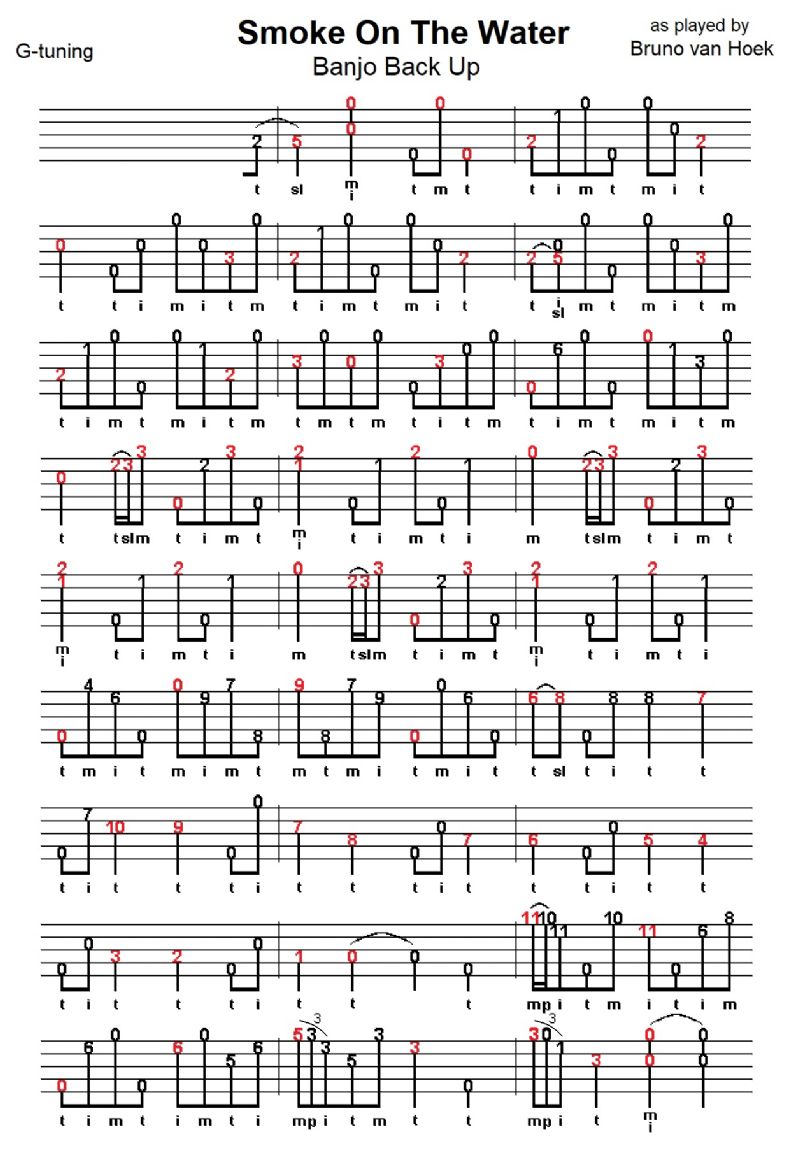
How about Deep Purple's 'Smoke On The Water'? Because (how Steve described it above) that's exactly what I did there.
I posted my version (sound file) in page 1 of this topic (Jan 22), but apparently nobody (of those looking for information) ever seemed to care, listen and react. Because it being so different, I expected many 'But that ain't Bluegrass' type of reactions or exactly the opposite, whatever, just not utter silence.
In a way, it's strange that, in a topic that asks for learning material, a genuine offer seems to be ignored or being overlooked at least..
Anyway, here's the tab to that banjo part:
Terms of Use | Privacy Policy | Privacy Consent (EU/GDPR Only)
Copyright 2026 Banjo Hangout. All Rights Reserved.