DVD-quality lessons (including tabs/sheet music) available for immediate viewing on any device.
Take your playing to the next level with the help of a local or online banjo teacher.
Weekly newsletter includes free lessons, favorite member content, banjo news and more.
Premier Sponsors


|
Please note this is an archived topic, so it is locked and unable to be replied to. You may, however, start a new topic and refer to this topic with a link: http://www.banjohangout.org/archive/405735
The Eclectic Banjo - Posted - 10/29/2025: 10:47:17
Good afternoon BHO community,
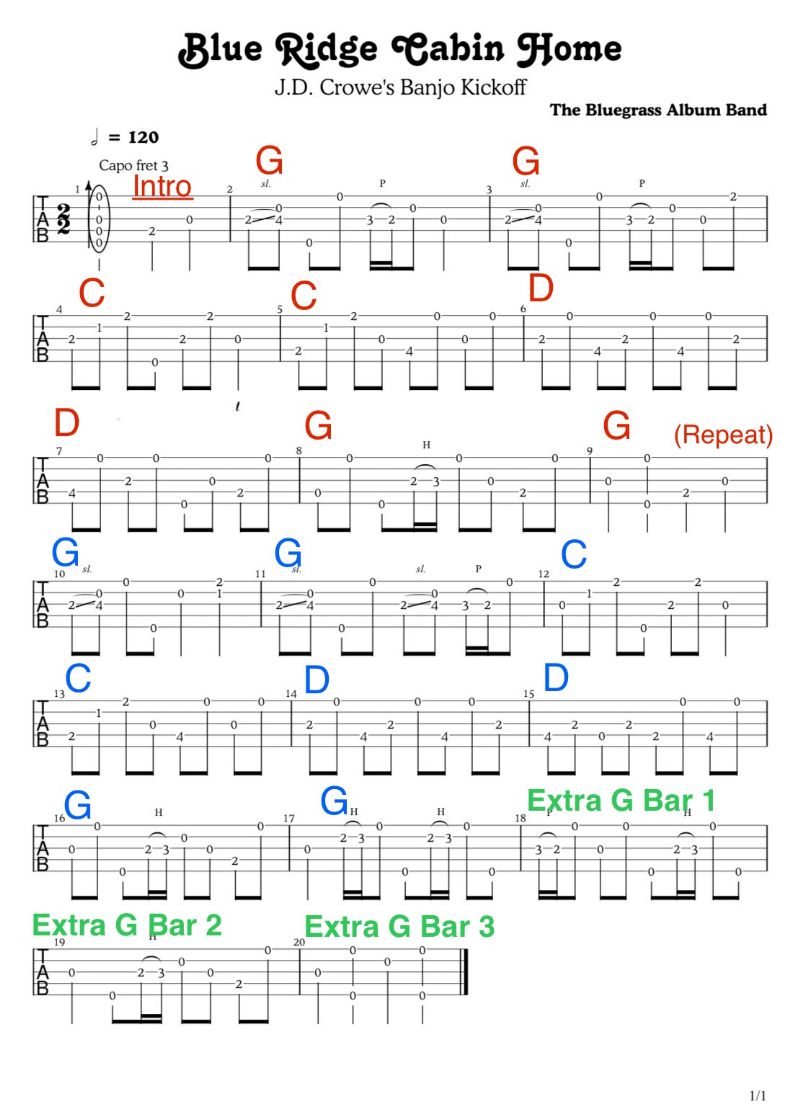
Every time I play Blue Ridge Cabin Home at a jam I mess it up somehow. Someone suggested I play along to my favorite version of the song to make sure I have the timing right. I really enjoy the Bluegrass Album Band’s version, and someone was gracious enough to transcribe and upload it (sorry I forgot who). After playing along with them and then comparing it to some tabs, I think my problems arise at the end with the 3 extra G measures (see attached). My backup sheet doesn’t show them but most of the BHO BRCH uploads include them.
So I guess my questions are:
1) Are these measures expected by jammers who know BRCH?
2) Are they additions on both a solo break and at the end of the chorus on a vocal part?
And a semi related question: someone mentioned a tag at the end of my play through recently, explaining that the last line of the song can be played again instead of trying to lift up my leg to signify an end to the song.
3) Would it be expected that the 3 extra G measures be played to finish the song as well?
Thank you!
RB3 - Posted - 10/29/2025: 11:26:13
The extra measures at the end of J.D.'s kickoff is the way he and Tony liked to do it. It was their preference. If the folks you play with think that's too many extra measures, then do it the way they want you to do it, or find someone else pick with who likes to do it the way J.D. and Tony did it. Also, you might want to listen the version of song by Flatt & Scruggs for comparison.
Edited by - RB3 on 10/29/2025 11:29:51
jdeluke137 - Posted - 10/29/2025: 11:36:52
Yep. In my opinion those measures are completely dependent on when the singer wants to come in. Sometimes in a jam you’ll start immediately after the last two G measures, sometimes it’s two, sometimes three. I like three, but sometimes it will even change mid-song. Sometimes Lester Flatt couldn’t remember the words to the next verse and Earl would play something until he was ready, sometimes several measures. To me part of the fun of bluegrass is figuring out stuff like this on the fly in a jam or band situation. The more you play with others the easier it gets.
chuckv97 - Posted - 10/29/2025: 11:43:28
This is a problem at our jams as well - some folks like to play a “breathing/tread-water” measure after vocal lines in the middle of a verse, others don’t. I had a heck of a time playing a simple 2 chord song and getting everyone in sync on the accompaniment. For experienced players they’ll catch the pause/extra measure,, for others it’s a train wreck.
Jack Baker - Posted - 10/29/2025: 12:02:26
Earl's arrangement as recorded on "Foggy Mountain Jamboree" is aboard in the Newest Tab Archive....Jack p.s. this extra measure thing is as Earl has done his endings in many of his songs so it's nothing new...
Edited by - Jack Baker on 10/29/2025 12:07:33
Old Hickory - Posted - 10/29/2025: 13:12:11
This is a prime example of people confusing or conflating the song with the record or arrangement.
Pauses or extra measures between instrumental intros and singing or between verses and choruses (or vice-versa) are aspects of arrangement (how someone chooses to play the song -- which is the melody and lyrics) captured in a particular recording or performance. They are not necessarily how the song goes.
However, as has been discussed on the Hangout several times over the years, certain recordings have become the standard way certain songs are played -- down to the specific intro or kickoff, repeated choruses, endings, emphasized beats -- that most likely were not in fact how the song was written.
Lots of words to say you're playing with people who expect to do it "the way JD did it" and there will be no convincing them the extra measures aren't a necessary part of the song.
- - - - - - - - - - -
"someone mentioned a tag at the end of my play through recently, explaining that the last line of the song can be played again instead of trying to lift up my leg to signify an end to the song."
- - - - - - - - - - -
What I do, when I'm singing, is raise one of my hands, extend my index finger, and circle it in the air. I believe this signals "tag" or "wrap it up" and whenever I do it -- even at jams I've never been to before -- players have understood it to mean repeat the last line. I usually get my hands back on the banjo in time for the ending lick, sometimes moving the neck to indicate it's really the end.
Texasbanjo - Posted - 10/29/2025: 14:05:52
To sum it up: there's no one size fits all in bluegrass songs. One person does it his/her way anothe a different way. You just have to listen and go along with what's being played. When your time comes to start the song, then you do it your way and everyone else should follow along.
The Eclectic Banjo - Posted - 10/29/2025: 14:28:45
quote:
Originally posted by TexasbanjoTo sum it up: there's no one size fits all in bluegrass songs. One person does it his/her way anothe a different way. You just have to listen and go along with what's being played. When your time comes to start the song, then you do it your way and everyone else should follow along.
Oh good glad to hear it... so it's somewhere else I'm screwing up :***(
Ill just continue playing along to these songs until I get the lyrics at the right places I think... and when the planets align everyone will play along with me!
Old Hickory - Posted - 10/29/2025: 19:07:16
What exactly is the situation, and what's happening?
Is someone else calling the song they're going to sing but you're playing the intro and not adding three measures of licks they're expecting before the singing starts? Is this happening every verse coming out of solos? Assuming you're playing backup, couldn't the rest of the jam just play over you if instead of playing three measures of G fill you're going to the C chord too soon?
Did you call the song, play the intro, and then sing without the three measures of fill licks? Well, as Sherry said: your call, your way. It's jam etiquette that they follow your lead.
Is it something else? I'd really like to know, because comparative jam dynamics is really interesting.
Of course you should learn the song the way this jam plays it. So you'll learn it and move on.
BruceS2 - Posted - 10/29/2025: 19:32:54
I see happen a lot in the jams I've played in. Often I'll play the extra G measures but watch the singer for when he starts up again...I'll see him start singing before I'm done with extra measures then I'll back off on volume and shift into the start of the song, so it works out in the end.
dfstd - Posted - 10/30/2025: 06:31:51
We sometimes get this in our bluegrass jams too. The safest bet in our group is to go directly to the next thing, no extra bars, unless it's the song leader singing the next verse, in which case we wait for the song leader to start singing and then join up with that.
The song can become a train wreck when an instrumental soloist waits an extra bar or two before starting his/her solo break. Nobody else knows what's going on. Did the soloist start late but is still on schedule, or did s/he add extra bars? Sometimes, it's hard to tell. When in doubt, we look to the song leader or bass player to reestablish where we are in the song.
Ira Gitlin - Posted - 10/30/2025: 07:12:03
As usual, Old Hickory nailed it.
I'd add that you go straight from verse to chorus without extra measures; ditto for going from chorus to break. BUT going from a break into the next verse, you can linger on that root chord as long as needed/desired until a) the soloist has finished his/her string of filler licks, or b) the singer is ready to sing the next verse.
As for the ending, IMNSHO the raised foot should ONLY be used to mean, "Finish up what we're doing right now, as promptly as possible." If you want to do something more, like a tag, you need to signal it differently--rotating a finger or an instrument headstock, calling out the tag verbally, or whatever.
That said, a dismaying number of jammers don't observe this valuable distinction. It's one of my jamming pet peeves, along with people not knowing (or caring) how to kick off a song, or people just singing whatever harmony notes come to mind, rather than singing proper tenor or baritone parts, or multiple people trying to sing the same vocal parts.
Now get off of my lawn! ;^)
RB-1 - Posted - 10/30/2025: 08:04:49
quote:
Originally posted by Ira GitlinAs usual, Old Hickory nailed it.
I'd add that you go straight from verse to chorus without extra measures; ditto for going from chorus to break. BUT going from a break into the next verse, you can linger on that root chord as long as needed/desired until a) the soloist has finished his/her string of filler licks, or b) the singer is ready to sing the next verse.
As for the ending, IMNSHO the raised foot should ONLY be used to mean, "Finish up what we're doing right now, as promptly as possible." If you want to do something more, like a tag, you need to signal it differently--rotating a finger or an instrument headstock, calling out the tag verbally, or whatever.
That said, a dismaying number of jammers don't observe this valuable distinction. It's one of my jamming pet peeves, along with people not knowing (or caring) how to kick off a song, or people just singing whatever harmony notes come to mind, rather than singing proper tenor or baritone parts, or multiple people trying to sing the same vocal parts.
Now get off of my lawn! ;^)
As usual, Ira nailed it... 
chuckv97 - Posted - 10/30/2025: 08:14:34
Actually I’ve given up being annoyed at chaos at jams - there are not enough experienced players at ours to glue things together and /or play loud enough to drag “slackers” kicking & screaming into proper rhythm and song structure. I’ve tried introducing new, yet simple enough songs- even to the point of emailing a YouTube video and chord progression to everyone a few days before- but alas, “Jimmy Brown the Newsboy” and others entered quickly into train wreck/in the ditch territory.
To repeat ,, Hey you kids, GET OFFA MY LAWN !!
Edited by - chuckv97 on 10/30/2025 08:15:24
Bob Buckingham - Posted - 10/30/2025: 08:35:48
I've always thought of those extra measures as the time when you play time keeper licks, after all you are kind of the drummer in that situation. Follow the singer.
Ira Gitlin - Posted - 10/31/2025: 06:46:39
quote:
Originally posted by mmuussiiccaallFiddlers usually call this “potatoes “
In my experience, "potatoes" is something quite different: a rhythmic pattern played to establish the tempo and key of a fiddle tune. It's almost never done for vocal songs, and only occurs at the very beginning of the tune, not after breaks in the middle of the tune.
Jack Baker - Posted - 10/31/2025: 07:34:44
Correcto Ira,
Bill Keith used that term often...Jack
Edited by - Jack Baker on 10/31/2025 07:35:30
The Eclectic Banjo - Posted - 11/01/2025: 05:32:11
quote:
Originally posted by chuckv97but alas, “Jimmy Brown the Newsboy” and others entered quickly into train wreck/in the ditch territory.
Bummer! I love Flatt & Scruggs version of that song, although I've always wondered how it would sound on the banjo.
The Eclectic Banjo - Posted - 11/01/2025: 05:49:15
quote:
Originally posted by Old HickoryWhat exactly is the situation, and what's happening?
Is someone else calling the song they're going to sing but you're playing the intro and not adding three measures of licks they're expecting before the singing starts? Is this happening every verse coming out of solos? Assuming you're playing backup, couldn't the rest of the jam just play over you if instead of playing three measures of G fill you're going to the C chord too soon?
Did you call the song, play the intro, and then sing without the three measures of fill licks? Well, as Sherry said: your call, your way. It's jam etiquette that they follow your lead.
Is it something else? I'd really like to know, because comparative jam dynamics is really interesting.
Of course you should learn the song the way this jam plays it. So you'll learn it and move on.
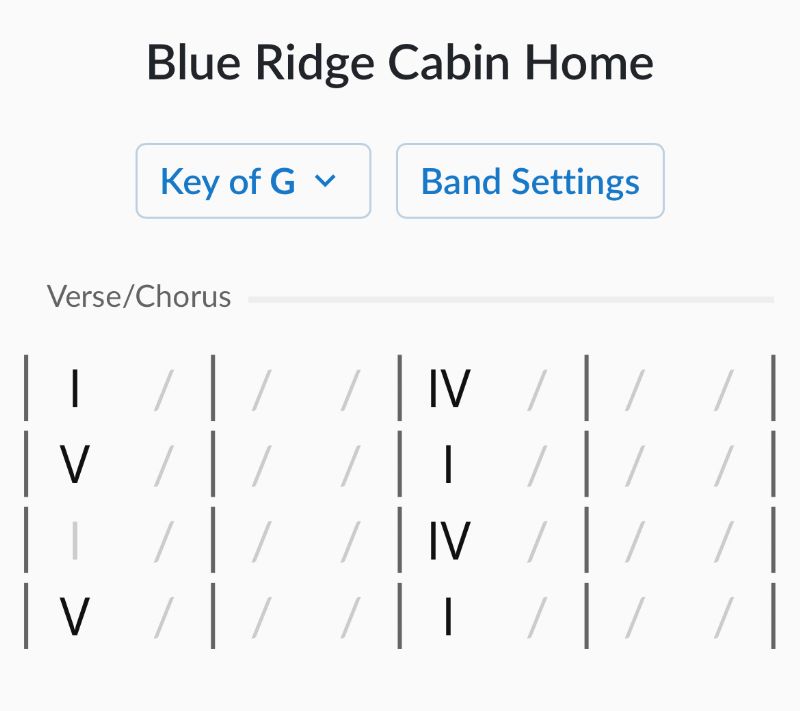
I usually start with the basic 1 measure kick off followed by my own break which I learned from one of the BHO tabs. I usually don't do the extra G measures at the end of the solo but am considering to start doing them. Then I play and sing a basic melody line of the song. Then I usually look around for someone to take a break while I go right into vamping the chords, but if no one picks up after vamping the verse, I'll go right into singing the next verse.
Question: Should I continue looping the verse vamping until someone takes a break or at least give it until the end of the chorus (2 full vamp rotations)?
I think I struggle with keeping a consistent tempo and singing the lyrics precisely on the beats that they should be on. Also no one seems to want to take a break whenever I look around the room (though I'm still learning the "HEY YOU THERE, TAKE A BREAK NOW!" dynamic, even when I describe how easy the chord progression is. I've played BRCH twice since writing this post, once at my local jam and once at a Raleigh area jam (the veteran players of the latter jam were super helpful and supportive):
1) Last time at my jam, a few of the old timers decided to take a coffee break when I called it :*( Maybe 1 person took a break who I've known to take a break to the song in the past, but I was shooting daggers and nodding at her to get her to take it.
2) At the Raleigh Jam the bass player started singing with me to keep me consistent with his beat. I think people were singing along with me before that point though, it's still hard for me to "hear the room" when I'm in the hot seat. But it went better. And they affirmed that I need to keep a consistent tempo and land the lyrics where they need to be.
I think going forward I'm just going to setup my trusty iPhone tripod stand and play the song on my music software app to help keep me in better time.
The Eclectic Banjo - Posted - 11/01/2025: 08:02:11
quote:
Originally posted by Ira Gitlinquote:
Originally posted by mmuussiiccaallFiddlers usually call this “potatoes “
In my experience, "potatoes" is something quite different: a rhythmic pattern played to establish the tempo and key of a fiddle tune. It's almost never done for vocal songs, and only occurs at the very beginning of the tune, not after breaks in the middle of the tune.
Is a kickoff a different thing then than these "potatoes"? Also can you use potatoes in a contextual sentence?
chuckv97 - Posted - 11/01/2025: 08:24:43
quote:
Originally posted by The Eclectic Banjoquote:
Originally posted by chuckv97but alas, “Jimmy Brown the Newsboy” and others entered quickly into train wreck/in the ditch territory.
Bummer! I love Flatt & Scruggs version of that song, although I've always wondered how it would sound on the banjo.
Hi Dan,, here's my version
share.icloud.com/photos/046Azu..._jAcG-CHw
youtu.be/MTA6VxfaXEo?si=B2fud3UoBPKwSo2Q
Edited by - chuckv97 on 11/01/2025 08:26:11
RB3 - Posted - 11/01/2025: 08:34:02
Below are links to three different videos that explain the use and purpose of taters for fiddle tunes.
One Potato, Two Potatoes, Three Potatoes . . .
Here's an example of banjo taters.
Edited by - RB3 on 11/01/2025 08:44:37
Ira Gitlin - Posted - 11/01/2025: 09:02:41
quote:
Originally posted by The Eclectic Banjoquote:
Originally posted by Ira Gitlinquote:
Originally posted by mmuussiiccaallFiddlers usually call this “potatoes “
In my experience, "potatoes" is something quite different: a rhythmic pattern played to establish the tempo and key of a fiddle tune. It's almost never done for vocal songs, and only occurs at the very beginning of the tune, not after breaks in the middle of the tune.
Is a kickoff a different thing then than these "potatoes"? Also can you use potatoes in a contextual sentence?
In my experience (several decades'worth), a "kickoff" is an instrumental solo that starts of a song. Most often its a verse played instrumentally, though occasionally it'll be some other part of the song . "Potatoes" are a separate add-on--NOT a part of the tune per se. Here it is in a sentence: "Let's start off 'Bill Cheatham' with eight potatoes."
Old Hickory - Posted - 11/01/2025: 09:12:47
Bill Keith plays "potatoes" to set the time for Cherokee Shuffle. From about 0:08 to 0:12
I suppose taters serve the same purpose as a kickoff: a musical intro of sorts. But as Ira said, taters is not necessarily or literally the same thing as a kickoff to a vocal song. I think vocal song kickoffs or intros are usually more musically specific. But this is not a rule. And if you want to intro a vocal song with potatoes, that's your call.
The Eclectic Banjo - Posted - 11/01/2025: 15:29:05
quote:
Originally posted by Ira Gitlinquote:
Originally posted by The Eclectic Banjoquote:
Originally posted by Ira Gitlinquote:
Originally posted by mmuussiiccaallFiddlers usually call this “potatoes “
In my experience, "potatoes" is something quite different: a rhythmic pattern played to establish the tempo and key of a fiddle tune. It's almost never done for vocal songs, and only occurs at the very beginning of the tune, not after breaks in the middle of the tune.
Is a kickoff a different thing then than these "potatoes"? Also can you use potatoes in a contextual sentence?
In my experience (several decades'worth), a "kickoff" is an instrumental solo that starts of a song. Most often its a verse played instrumentally, though occasionally it'll be some other part of the song . "Potatoes" are a separate add-on--NOT a part of the tune per se. Here it is in a sentence: "Let's start off 'Bill Cheatham' with eight potatoes."
So eight potatoes would be 8 measures of a non-verse "kickoff"?
Alex Z - Posted - 11/01/2025: 19:18:38
8 beats, not 8 measures.
One potato, two potato, three potato, four,
five potato, six potato, seven potato more.
Ira Gitlin - Posted - 11/02/2025: 06:02:11
quote:
Originally posted by Alex Z8 beats, not 8 measures.
One potato, two potato, three potato, four,
five potato, six potato, seven potato more.
Yeah.
Ira Gitlin - Posted - 11/02/2025: 06:28:51
quote:
Originally posted by Old HickoryAnd if you want to intro a vocal song with potatoes, that's your call.
I've heard that done, and to me it always seems wrong, like when a foreigner tries to use English slang but doesn't quite get it right.
YMMV.
The Eclectic Banjo - Posted - 11/13/2025: 12:59:56
A follow up question if I may continue my post... whatever measure the banjo player ends his multi extra measure break on, would the "pickup measure" vocals start at the last measure of that break? E.G. "There's a..." portion of the first verse "There's a well beaten path..." would begin during the soloists final bar?
This question will help me come in on time, as that might be part of my problem on being able to successfully lead this song that I love so much.
chuckv97 - Posted - 11/13/2025: 13:05:47
On your posted TAB in your initial post the words “There’s a” would fall on the last 2 beats of the last measure,, the open 2nd string followed by the pinch.
Alex Z - Posted - 11/13/2025: 16:23:55
Right, assuming a measure has 4 beats.
. . . Moun-tain | Home 2 3 Pick - up | note note note and-a | note note note and-a
The music on the original post is in 2/2, so each measure would have 2 beats -- two "boom-chicks". So the pick-up notes would start on the 2nd beat of the second G measure at the end of the chorus, labeled measure 17.
The soloist's final measure would be measure 16.
Edited by - Alex Z on 11/13/2025 16:25:16
chuckv97 - Posted - 11/13/2025: 16:35:58
I never even noticed the 2/2 time signature,, I’m so used to 4/4 , esp. the way the TAB is written.
banjoy - Posted - 11/14/2025: 08:38:43
This happens on plenty of tunes. For me, this often happens with Dylan's "You Ain't Going Nowhere" where sometimes there is an extra measure between verse-chorus and again chorus-verse. Sometimes it happens, sometimes not. The best advice found above IMHO is Follow The Singer.
Edit to add a MSG to Dan -- I received your private IM, but apparently you are not receiving mine or my reply to yours. Check your email spam folder.
Edited by - banjoy on 11/14/2025 08:41:07
Alex Z - Posted - 11/14/2025: 10:26:07
When the singer ends the chorus and so stops singing to make room for a instrumental break, have to understand the normal timing to get into the break.
Counting the beats can help, until the rhythm is internalized.
'' , , , Blue Ridge mountain | home "
"Home" is on the first beat of the measure. "Blue" and "mount" are on the last two beats of the previous measure.
The break will start on the first beat of a measure also, with the pick-up notes on the last beat of the previous measure.
So can count either:
" home" 2 | 1 pick-up |
or
" home" 2 3 pick-up |
Same pace, same beat pace, just a matter of whether 2 beats or 4 beats are put into a measure. And by "beat," that means the pulse of the music no matter what time signature is used. "Boom-chick" is one pulse beat. 4-note banjo roll is one pulse beat.
Don't want:
"home" pick-up | 1
although experienced players playing by ear (not by tab or music notation) will hear this and be able to follow along.
As Kahlil Gibran said about marriage, which applies to large jam sessions too: "Let there be space in your togetherness." 
mmuussiiccaall - Posted - 11/14/2025: 10:38:08
quote:
Originally posted by The Eclectic BanjoA follow up question if I may continue my post... whatever measure the banjo player ends his multi extra measure break on, would the "pickup measure" vocals start at the last measure of that break? E.G. "There's a..." portion of the first verse "There's a well beaten path..." would begin during the soloists final bar?
This question will help me come in on time, as that might be part of my problem on being able to successfully lead this song that I love so much.
In the 70s I was attending a drum workshop with a world famous drummer and one thing he said suck with me since then. "All you have to do is know where the one is the rest is just whatever you wanna do." I would advise you to put down the banjo and work on your rhythm by counting 12 etc. or 1234 etc. until you're locked in like a metronome. This will answer your questions for every song you ever do instead of just one in question .
Bad Bernie - Posted - 11/22/2025: 15:17:10
I think adding a measure or two at the end of a normal break that "plays the words", happens quite frequently in bluegrass. I always got the feeling that JD did it more often than most, often with a string of those hammer-pulls that were one of his trademarks. The break just goes on a bit longer than you'd expect. Someone once told me that the original purpose of the extra measure or two was to give a bit of additional time for the band to re-arrange themselves around a single mike, ready for the next instrumental break or vocal. Don't know if this is true or not, but I that's what I was told. With practice, you can hear it coming. A common indication that there's going to be an extra measure of doodling, is that the break doesn't resolve to the root note or melody note when you feel like it should. The resolution of the break - the hitting of that final melody note - gets delayed. The musical effect is to add a little bit of suspense at the end of the break. Not hitting that final note when it's expected sends out the message "wait a moment.... I'm not done yet!".
Edited by - Bad Bernie on 11/22/2025 15:25:10
Terms of Use | Privacy Policy | Privacy Consent (EU/GDPR Only)
Copyright 2026 Banjo Hangout. All Rights Reserved.