DVD-quality lessons (including tabs/sheet music) available for immediate viewing on any device.
Take your playing to the next level with the help of a local or online banjo teacher.
Weekly newsletter includes free lessons, favorite member content, banjo news and more.
Premier Sponsors


|
Please note this is an archived topic, so it is locked and unable to be replied to. You may, however, start a new topic and refer to this topic with a link: http://www.banjohangout.org/archive/405615
taylorbanjoguy - Posted - 10/21/2025: 21:56:06
Hey all, first post on here.
I’ve been learning the tenor since about April, CGDA tuning, and after learning a few basic chord shapes from YouTube tutorials (and fruitlessly hunting down Buddy Wachter’s Banjo Pathways) I found out about Charles McNeil’s Chord System book. So far, it’s just about all made perfect sense to me (I’m not very far, I’m only just learning the D Major family, but I’m enjoying it), but I've finally encountered something I found peculiar.
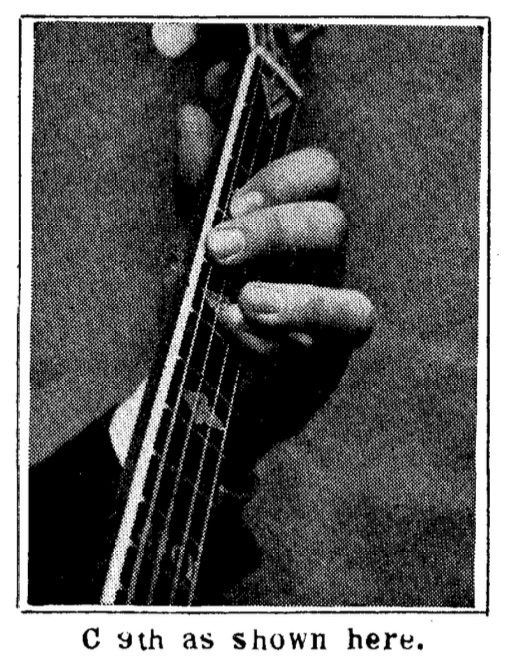
In the G Major section of the book, there’s an exercise that includes a D9 chord, for which McNeil provides the correct frets but not a suggested fingering. I interpreted the fingering as playing the top notes as a barre with my pinky and then the bottom two notes with my middle and ring finger, respectively:
Fingers: 4-4-2-3
Frets: 7-7-5-6
Notes: E-A-C-F#
(lmk if this is the right way to notate this)
I realized after practicing this fingering for a few days that he actually does provide a fingering at nearly the end of the book, which is different from what I’d assumed:
Fingering: 4-4-1-2
According to the diagram provided, this is executed by holding the pinky down with the ring finger for reinforcement. Is that right? Am I crazy for thinking that’s strange? Is that sort of fingering idiomatic to the instrument, and I just wasn’t aware yet? (Photo is of a C9, but it uses the same shape)
Because I’ll be honest, the way I was doing it did not feel great, which is why I searched for an alternative. But the ergonomics of throwing my ring finger over my pinky seem… wonky.
Please let me know. If this is correct, I’ll certainly do my best to reinforce it. If, however, it’s just an antiquated product of the 1920’s (which, to be fair, the instrument itself is), then let me know how the modern folks are fingering their 9th chords.
Thanks in advance!
Bonus question: McNeil also makes a point that you should never strike a new string with an upstroke – is this also an antiquated idea? Striking every new string with a downstroke seems like it could get… slippery.
Edited by - taylorbanjoguy on 10/22/2025 08:01:51
pasdimo - Posted - 10/22/2025: 08:59:28
The chord shape is correct but the fingering is weird, it’s much more convenient using (from higher to lower) fingers 4-3-1-2 for the frets 7-7-5-6. An alternative is fingers 4-2-3-1 on 7-4-5-2, or fingers 1-3-4-2 on frets 7-10-11-9
guitarbanjoman - Posted - 10/23/2025: 20:47:06
Regarding the “downstroke on the new string” question above…
This is a concept I had never heard of prior to studying gypsy jazz for a few years.
I learned that all the gypsy players, including Django, use this technique.
It gives you more power and volume and helps your phrasing too.
It takes a while to retrain your right hand, well anyway it took me about six months.
But I do recommend it
Will
Joe Phillips - Posted - 10/24/2025: 22:41:38
Interesting stuff in this thread. I never encountered the chord description by frets during 60 years of jazz guitar, possibly because I suppose that notating six strings likes that is not really a shortcut. But when I took up the ukulele about 15 years ago, I found it was commonly used, except it was given low to high (which seems more natural to me). So, I would write the D9 chord @taylorbanjoguy describes as 7756 as 6577. I start a new song by penciling in a chord abbreviation in this form as a starting point before I get into transcribing, tabbing, and chord-stamping. Is there a standard way to notate this in the tenor banjo world? I'm new to the instrument with a year and a half of self-teaching with the old method books, none of which use this notation anyway.
As to the picking question: a downstroke on every move to a new string is a good one for guitar. I think it makes a lot of sense on the guitar, especially Gypsy style because upstroke dynamics are different (usually quieter) than for downstrokes. Carrying over from jazz guitar, after practicing alternate picking, I evolved to picking in the direction of the new string when changing: upstroke to a lower string, downstroke to a higher string. The tenor banjo, to me is loud enough that the volume difference between upstrokes and downstrokes for me is not material, so I default to that directional method. However when playing an old method book exercise with picking direction notation, I try to follow it in hopes that the author had a good reason to notate the picking and fingering in a way unnatural (at first) to me. I would like to hear the thoughts of others on these two issues. Are most of you flexible on the pick direction? And what about the chord abbreviations by fret number? High to low, or low to high?
Edited by - Joe Phillips on 10/24/2025 22:43:07
Terms of Use | Privacy Policy | Privacy Consent (EU/GDPR Only)
Copyright 2026 Banjo Hangout. All Rights Reserved.